Ask ten engineers for the most durable plastic and you will get ten answers, because "durable" is not one property. A material that survives a hammer blow may wear away in a bearing application. A material that lasts twenty years outdoors may crack under a solvent. A material that resists high temperature may be brittle at room temperature.
So the honest answer is: there is no single most durable plastic — but there is a most durable plastic for each kind of abuse. This guide sets out the contenders, the data that separates them, and how to choose for impact, wear, fatigue, heat, chemicals and weather.
What "Durable" Actually Means
| Form of durability | What it measures | Typical test |
|---|---|---|
| Impact resistance | Energy absorbed before fracture | Notched Izod, Charpy |
| Wear resistance | Material lost under sliding contact | Wear factor, PV limits |
| Fatigue resistance | Cycles survived under repeated load | Fatigue testing at stress level |
| Heat resistance | Staying rigid and stable when hot | Heat deflection temperature (HDT) |
| Chemical resistance | Resistance to attack by fluids | Immersion and stress-crack testing |
| Weathering | Retention of properties outdoors | Accelerated UV and humidity exposure (ISO weathering) |
| Creep resistance | Deformation under sustained load | Creep modulus over time |
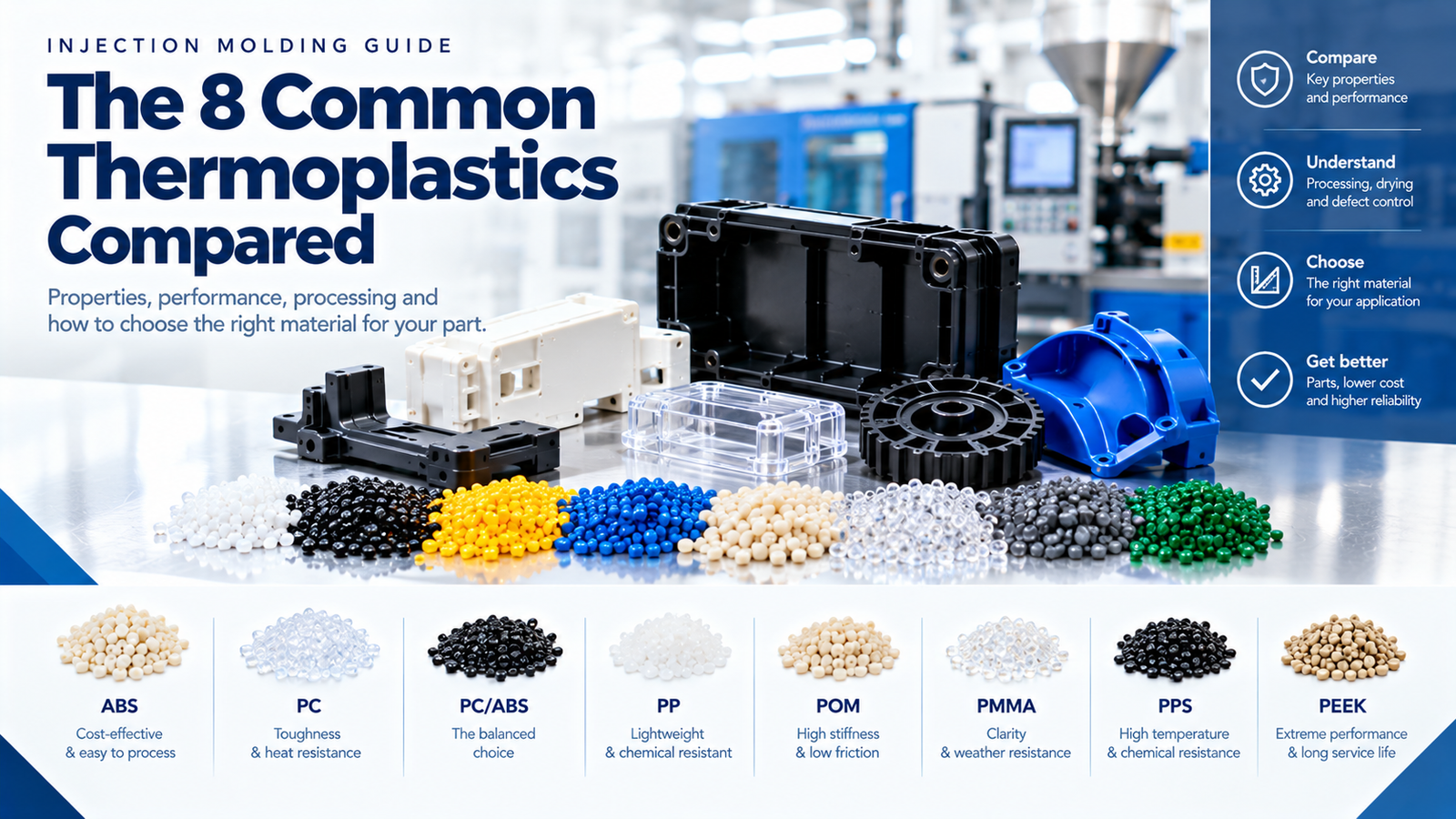
A material can be excellent on one row and poor on another. Polycarbonate is outstanding in impact and poor in chemical resistance. POM is outstanding in wear and mediocre in impact. PEEK is strong across almost every row, which is exactly why it costs what it does.
The Contenders at a Glance
| Material | Impact | Wear | Heat (HDT, approx.) | Chemicals | Cost |
|---|---|---|---|---|---|
| UHMW-PE | Very high | Excellent | Low | Good | Low |
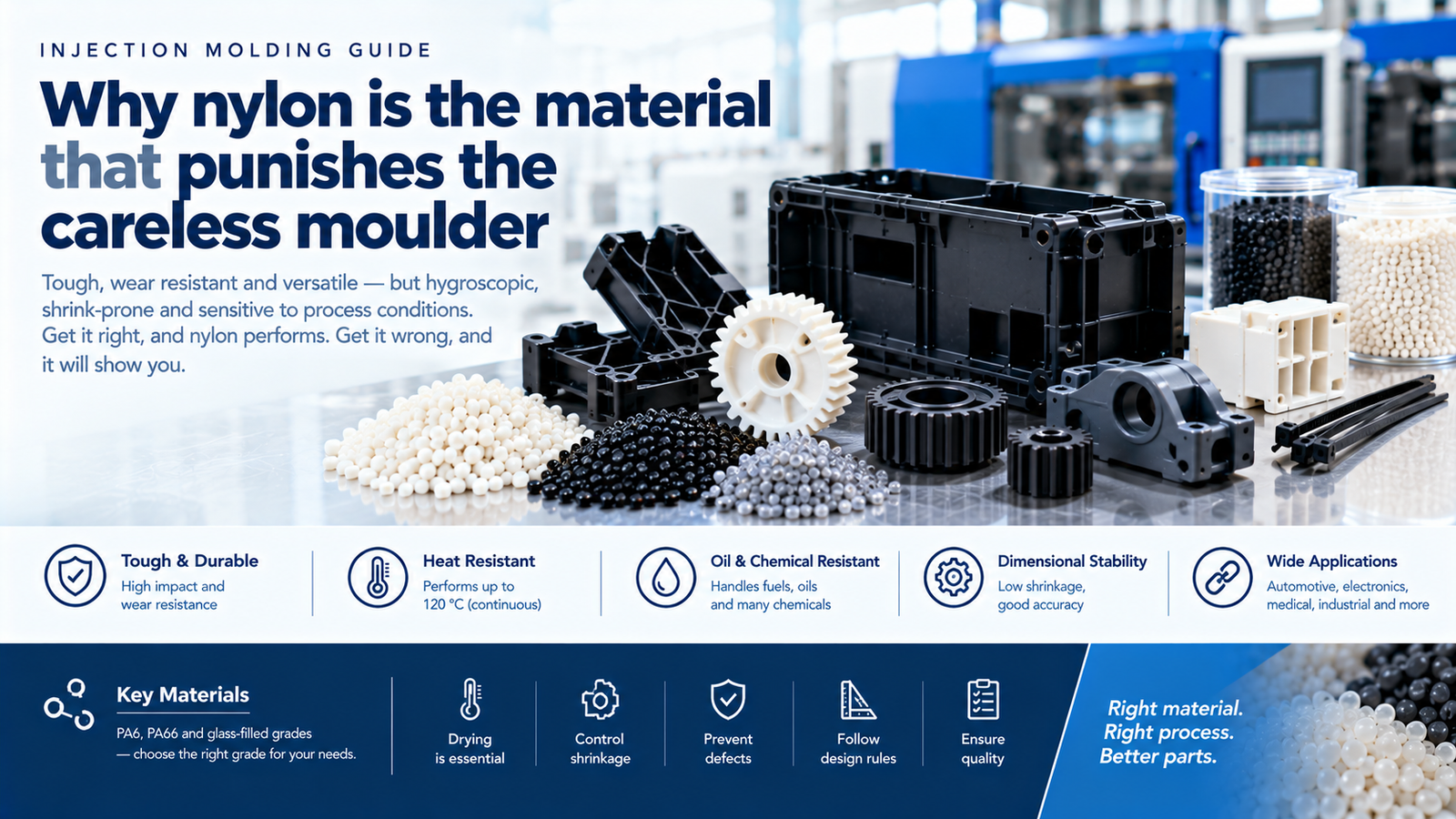
| PA66 (nylon) | High | Very good | Moderate | Moderate | Low |
| POM (acetal) | Moderate | Excellent | Moderate | Moderate | Low |
| PC | Very high | Moderate | Moderate to high | Poor | Moderate |
| ABS | High | Moderate | Low to moderate | Poor | Low |
| PBT | Moderate | Good | Moderate | Good | Moderate |
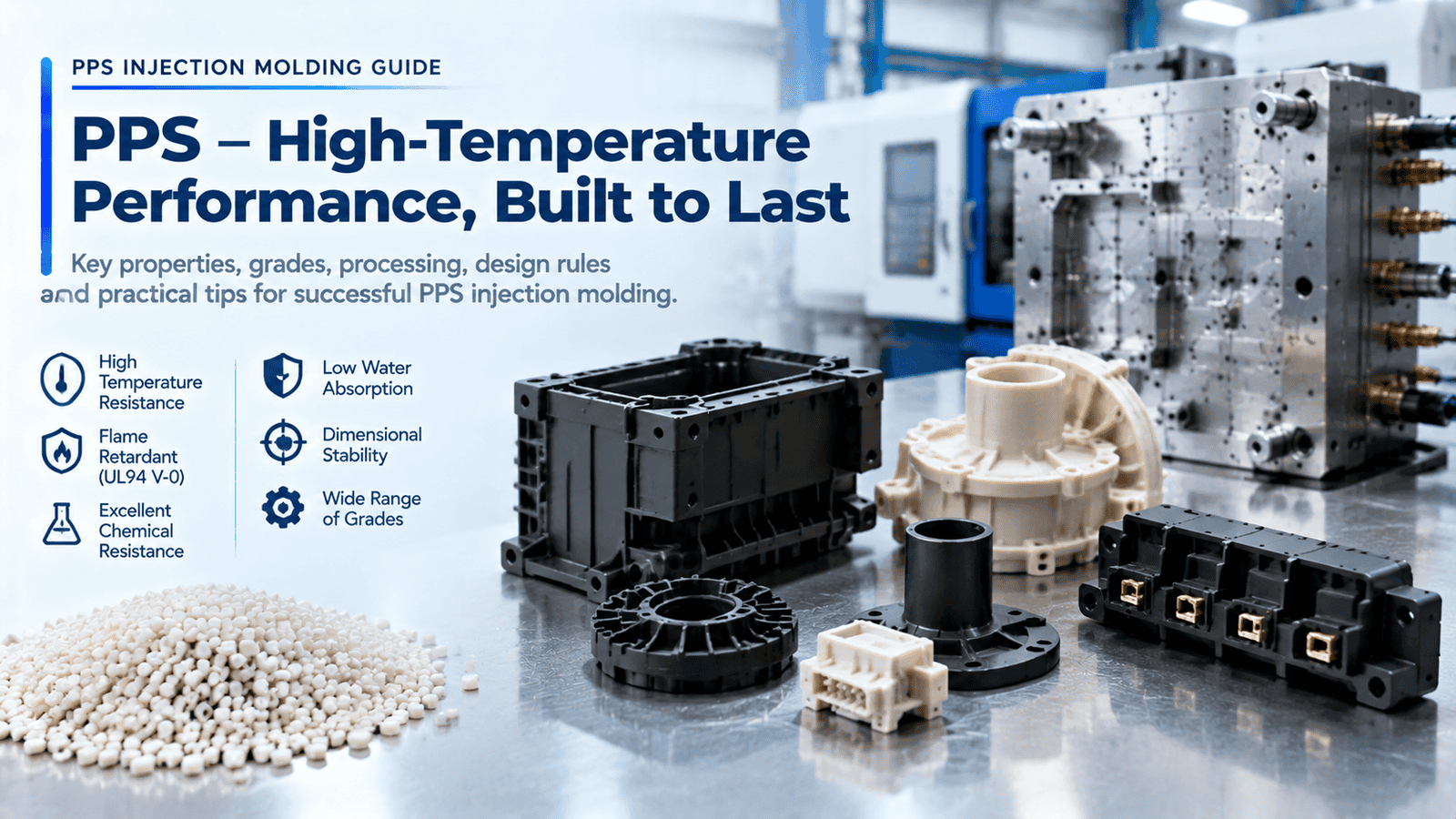
| PPS | Low to moderate | Good | High | Excellent | High |
| PEEK | High | Excellent | Very high | Excellent | Very high |
| PSU / PES | High | Moderate | High | Good | High |
| PTFE | Moderate | Excellent (low friction) | High | Excellent | High |
| TPU | Very high | Good | Low | Moderate | Moderate |
Values are indicative for unfilled grades; glass and carbon filled versions change the picture considerably, usually increasing stiffness, heat resistance and wear resistance while reducing impact strength. Grade-specific behaviour matters as much as the family — self-lubricating acetal is a good example, covered in our guide to self-lubricating Delrin.
Impact Resistance: The Toughest Plastics
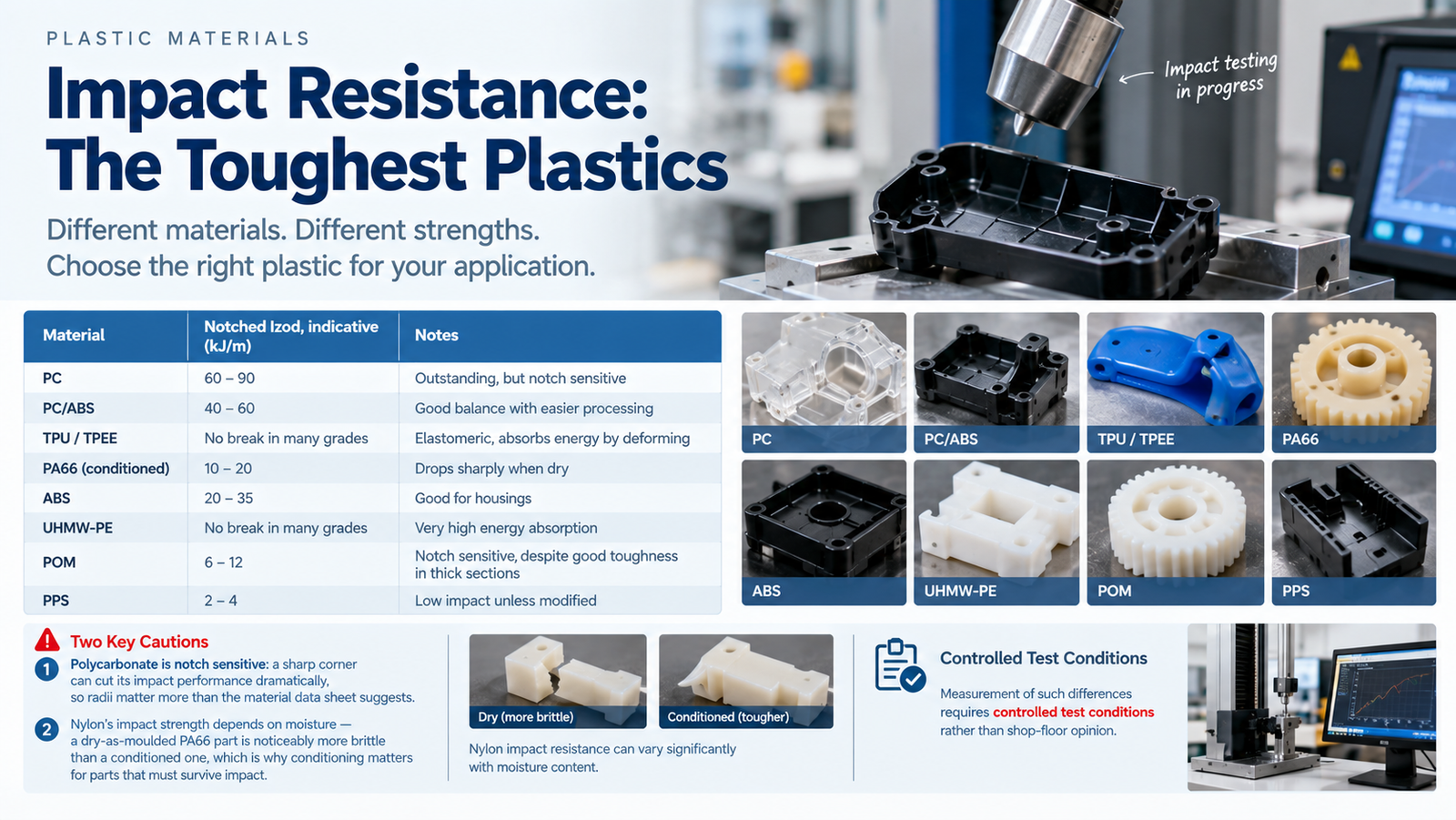
| Material | Notched Izod, indicative (kJ/m) | Notes |
|---|---|---|
| PC | 60 – 90 | Outstanding, but notch sensitive |
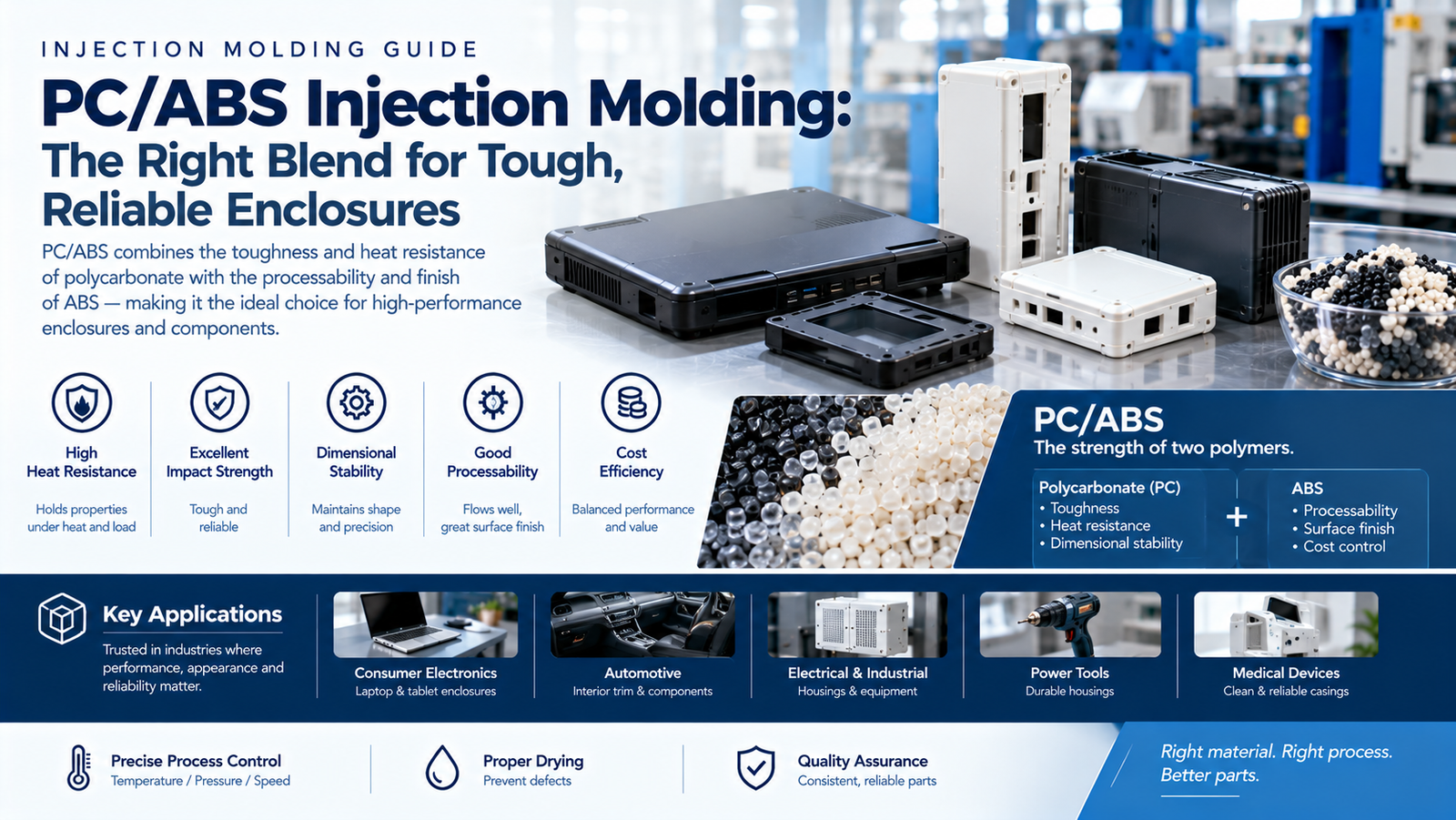
| PC/ABS | 40 – 60 | Good balance with easier processing |
| TPU / TPEE | No break in many grades | Elastomeric, absorbs energy by deforming |
| PA66 (conditioned) | 10 – 20 | Drops sharply when dry |
| ABS | 20 – 35 | Good for housings |
| UHMW-PE | No break in many grades | Very high energy absorption |
| POM | 6 – 12 | Notch sensitive despite good toughness in thick sections |
| PPS | 2 – 4 | Low impact unless modified |
Two cautions. First, polycarbonate is notch sensitive: a sharp corner can cut its impact performance dramatically, so radii matter more than the material data sheet suggests. Second, nylon's impact strength depends on moisture — a dry-as-moulded PA66 part is noticeably more brittle than a conditioned one, which is why conditioning matters for parts that must survive impact. Measurement of such differences requires controlled test conditions rather than shop-floor opinion.
Wear and Friction: Best for Moving Parts
| Material | Wear behaviour | Typical use |
|---|---|---|
| POM | Excellent, low friction, dimensionally stable | Gears, bushings, conveyor parts |
| UHMW-PE | Excellent abrasion resistance | Liners, guides, impact strips |
| PA66 | Very good, especially with molybdenum disulphide or oil additives | Gears, bearings, wear pads |
| PEEK | Excellent, retains wear performance hot | High-temperature bearings and seals |
| PTFE | Lowest friction, soft and prone to cold flow | Seals, sliding surfaces with low load |
| PPS | Good with fillers | Pump and valve components |
For unlubricated moving parts, POM and nylon are the workhorses; PEEK takes over where temperature or chemical exposure rules the others out. Additives such as molybdenum disulphide, PTFE or glass fibre are usually what turn a general-purpose grade into a wear grade. For a direct comparison of the two workhorses, see our guide to POM vs nylon for gears and moving parts.
Fatigue and Long-Term Load
Repeated loading is a different failure from impact, and it is measured differently.
- PA66-GF and PBT-GF resist creep and fatigue well and are common in structural automotive parts
- POM performs well in repeated cycling at moderate load, which is why it dominates small mechanism parts
- PEEK holds fatigue performance at high temperature where other materials have already lost stiffness
- Amorphous materials such as PC and ABS generally have lower fatigue resistance than semi-crystalline grades in cyclic loading
For parts under sustained load, creep data over time at the service temperature matters more than short-term strength figures. A material that is strong in a tensile test can still sag under a constant load for a year. Moisture content changes nylon's dimensions and fatigue behaviour too, as we cover in our guide to warpage in nylon (PA66) parts.
Heat and Chemical Resistance
| Material | Continuous use temperature, indicative | Chemical strengths |
|---|---|---|
| PEEK | 250 °C | Almost universal resistance |
| PPS | 200 – 220 °C | Solvents, acids, bases |
| PSU / PES | 150 – 180 °C | Hot water, sterilisation |
| PA66 | 80 – 120 °C | Oils, fuels (moderate) |
| PBT | 100 – 140 °C | Solvents, fuels |
| POM | 80 – 100 °C | Fuels, solvents (moderate) |
| PC | 100 – 120 °C | Poor against alkalis and many solvents |
| ABS | 60 – 80 °C | Poor against solvents |
| UHMW-PE | 60 – 80 °C | Good against most chemicals |
Chemical resistance must be assessed under stress, not only by immersion. Many failures described as "the plastic cracked on its own" are environmental stress cracking, where a chemical that is harmless to an unstressed part attacks a part that carries moulded-in or assembly stress. Polycarbonate is the classic example, and it is worth understanding before specifying it near solvents or cleaning agents.
Weathering and UV
| Material | Outdoor performance | Note |
|---|---|---|
| ASA | Very good | Designed as a weatherable ABS alternative |
| PMMA (acrylic) | Very good | Clarity and colour stability |
| PVDF | Excellent | Coatings and architectural parts |
| PC (UV stabilised) | Good | Requires UV stabilisation; yellows otherwise |
| PA66 | Moderate | Needs stabilisation for long outdoor life |
| ABS | Poor | Yellows and embrittles without protection |
| PP / PE | Moderate | Carbon black significantly improves life |
For outdoor parts, an unstabilised material should never be assumed to last. UV attack is a surface phenomenon, and it progresses into cracking over years rather than months, which makes it easy to overlook at the design stage.
So Which Plastic Is the Most Durable?
| If durability means | The answer is | Runner-up |
|---|---|---|
| Surviving impacts | UHMW-PE or polycarbonate | TPU for flexible impact |
| Resisting wear | POM or PEEK | UHMW-PE, PA66 with additives |
| Handling high temperature | PEEK | PPS |
| Resisting chemicals | PEEK or PTFE | PPS |
| Surviving outdoors for years | PVDF or ASA | UV-stabilised PC, PMMA |
| Long-term load without creep | PA66-GF or PEEK | PBT-GF |
| Best all-round durability | PEEK | PA66-GF for cost-effective structural parts |
| Best durability per unit cost | PA66 or POM | PBT |
That last row is the one that matters commercially. PEEK is the most durable engineering plastic in absolute terms, but a nylon or acetal part that lasts the life of the product at a fraction of the cost is the better engineering decision. Durability is not a maximum; it is a match to the service conditions. If you are weighing material cost against expected service life, our breakdown of injection mould costs puts the tooling side of that decision in context.
How to Choose in Practice
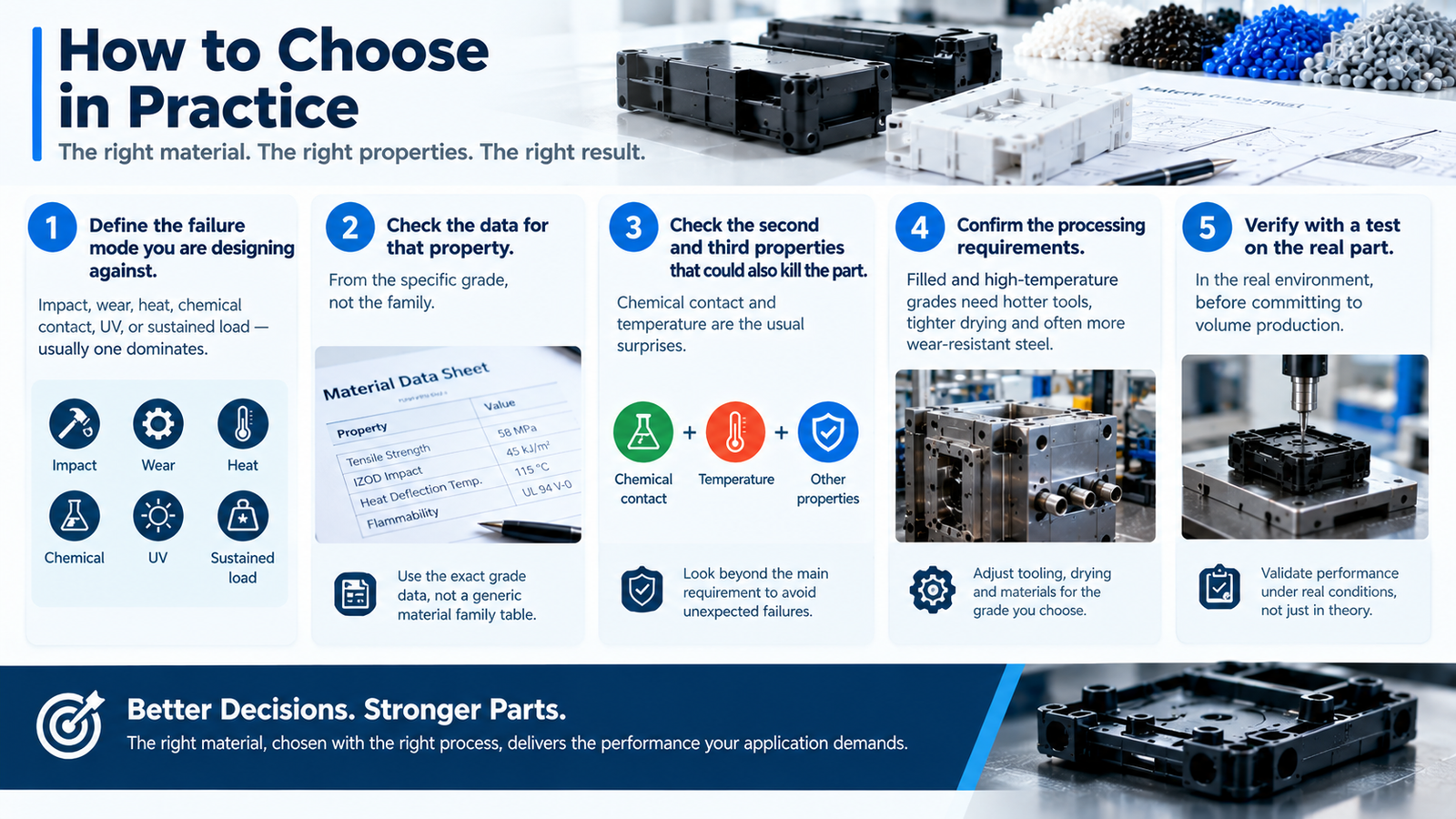
- Define the failure mode you are designing against. Impact, wear, heat, chemical contact, UV, or sustained load — usually one dominates.
- Check the data for that property, from the specific grade, not the family.
- Check the second and third properties that could also kill the part; chemical contact and temperature are the usual surprises.
- Confirm the processing requirements: filled and high-temperature grades need hotter tools, tighter drying and often more wear-resistant steel.
- Verify with a test on the real part, in the real environment, before committing to volume production.
Common Mistakes
| Mistake | Consequence |
|---|---|
| Choosing by "strength" alone | A stiff, brittle material fails on impact |
| Ignoring chemical contact under stress | Environmental stress cracking in service |
| Assuming UV performance without stabilisation | Surface degradation and cracking after years |
| Using unfilled data for a glass-filled grade | Wrong shrinkage, wrong tooling, wrong part |
| Overlooking moisture in nylon | Dry, brittle parts and dimensional movement |
| Optimising for material cost only | Premature failure and replacement cost far exceeding the saving |
Conclusion
The most durable plastic is PEEK if the question is asked in the abstract, but the useful answer is application-specific: POM or PA66 for wear and mechanisms, polycarbonate or UHMW-PE for impact, PPS or PEEK for heat and chemicals, ASA or PVDF for weathering, and glass-filled nylon where stiffness must be combined with long-term load resistance.
Choosing well means identifying the controlling failure mode, checking that property for the exact grade, and then checking the second and third risks that often decide the outcome — chemical attack under stress and service temperature being the two most commonly missed.
With in-house tooling and custom injection moulding across engineering materials, including glass-filled and high-temperature grades, we support material selection through to stable production. Send us your application details and service conditions to discuss the right grade for your part.
FAQ
What is the most durable plastic overall?
PEEK (polyether ether ketone) is generally considered the most durable engineering plastic, combining high impact strength, wear resistance, chemical resistance and continuous service temperatures around 250 °C. It is also by far the most expensive, which is why it is specified only where the service conditions demand it.
What is the strongest plastic material?
Strength depends on what is being resisted. For tensile strength, glass or carbon fibre reinforced grades of PA66, PBT or PEEK are highest. For impact strength, polycarbonate and UHMW-PE lead. For stiffness, filled grades win. "Strongest" should always be qualified by the loading type.
Which plastic is best for wear resistance?
POM (acetal) and PEEK offer the best combination of low friction and wear resistance, with UHMW-PE excellent for abrasion and sliding contact. Nylon with molybdenum disulphide or oil additives is a cost-effective wear grade for gears and bearings.
Which plastic lasts longest outdoors?
PVDF and ASA perform best outdoors, with UV-stabilised polycarbonate and PMMA also giving good long-term performance. Unstabilised ABS and polypropylene degrade relatively quickly in sunlight unless protected with stabilisers or carbon black.
Is polycarbonate the toughest plastic?
Polycarbonate has the highest notched impact resistance among the common transparent and opaque engineering plastics, but it is notch sensitive and has poor chemical resistance. A sharp corner or contact with a solvent can significantly reduce its real-world durability.
What is the best plastic for high temperature?
PEEK withstands continuous service around 250 °C, followed by PPS at around 200 – 220 °C and polysulphone grades around 150 – 180 °C. Standard materials such as ABS and PE are limited to well under 100 °C. The required temperature, load and chemical exposure together determine the choice.