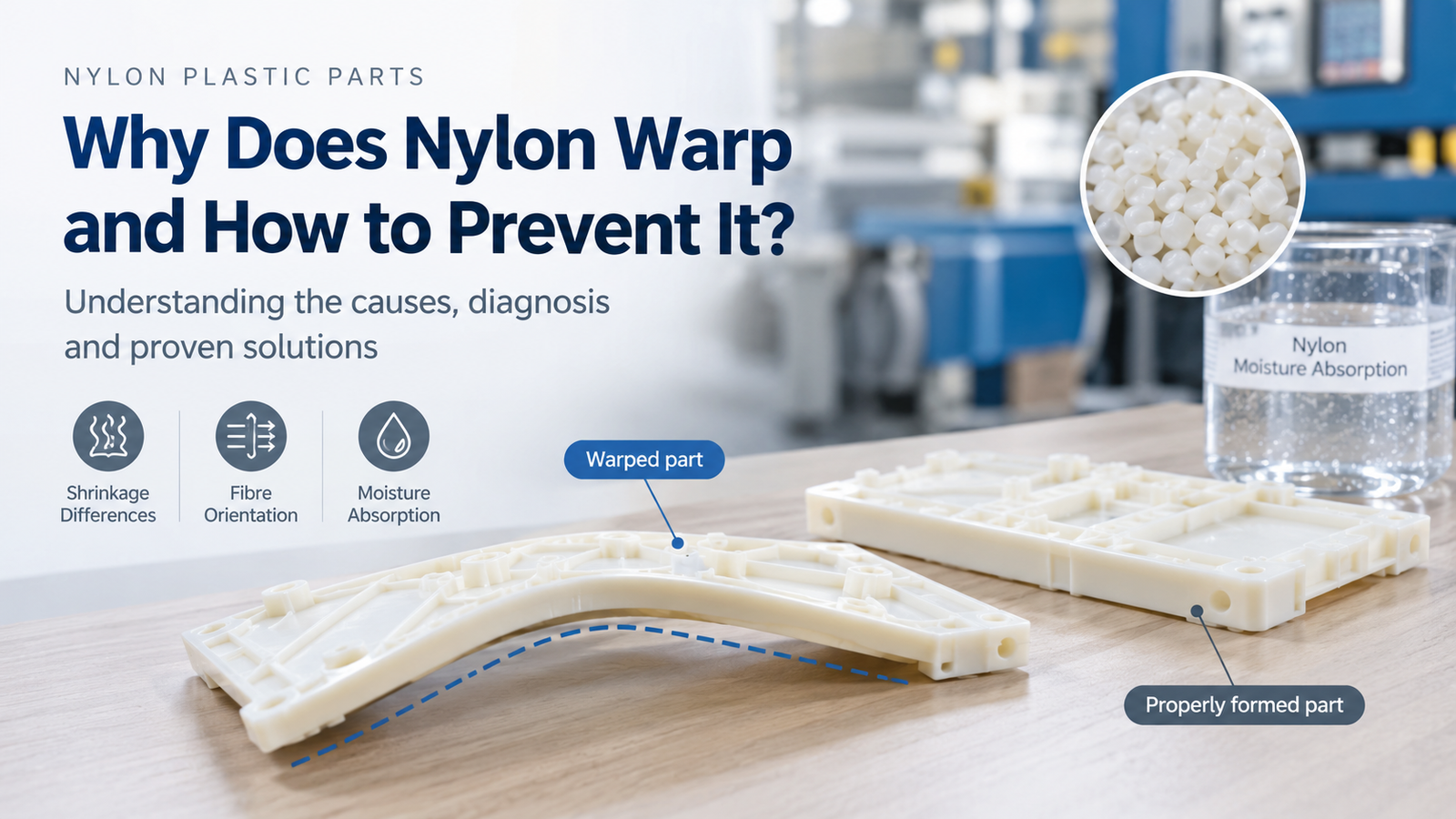
Nylon is the most warpage-prone of the common engineering plastics, and the reason is structural rather than accidental. PA6 and PA66 are semi-crystalline with high shrinkage, they shrink at very different rates along and across the melt flow, and they keep moving after ejection as they absorb moisture. A flat nylon part is not the default outcome — it is the result of controlling all three.
This guide explains why nylon warps, how to diagnose which mechanism is causing it, and the process, tooling and design changes that flatten the part.
Why Nylon Warps More Than Other Plastics
Shrinkage is the underlying mechanism; for the material-agnostic version of that topic, see our guide on how to reduce shrinkage in polypropylene.
Three mechanisms work at the same time.
| Mechanism | What causes it | When it shows up |
|---|---|---|
| Differential shrinkage | Uneven cooling and uneven crystallisation across the part | Immediately after ejection |
| Fibre orientation | Glass fibres align with flow and resist shrinkage along their length | Immediately, worst in flat parts |
| Moisture absorption | Nylon absorbs water from the air and swells | Days to weeks after moulding |
Most warpage investigations stop at the first mechanism, fix the cooling, and then cannot understand why the part is still moving a week later. The third mechanism is the one that catches people out, because the part was flat when it left the press.
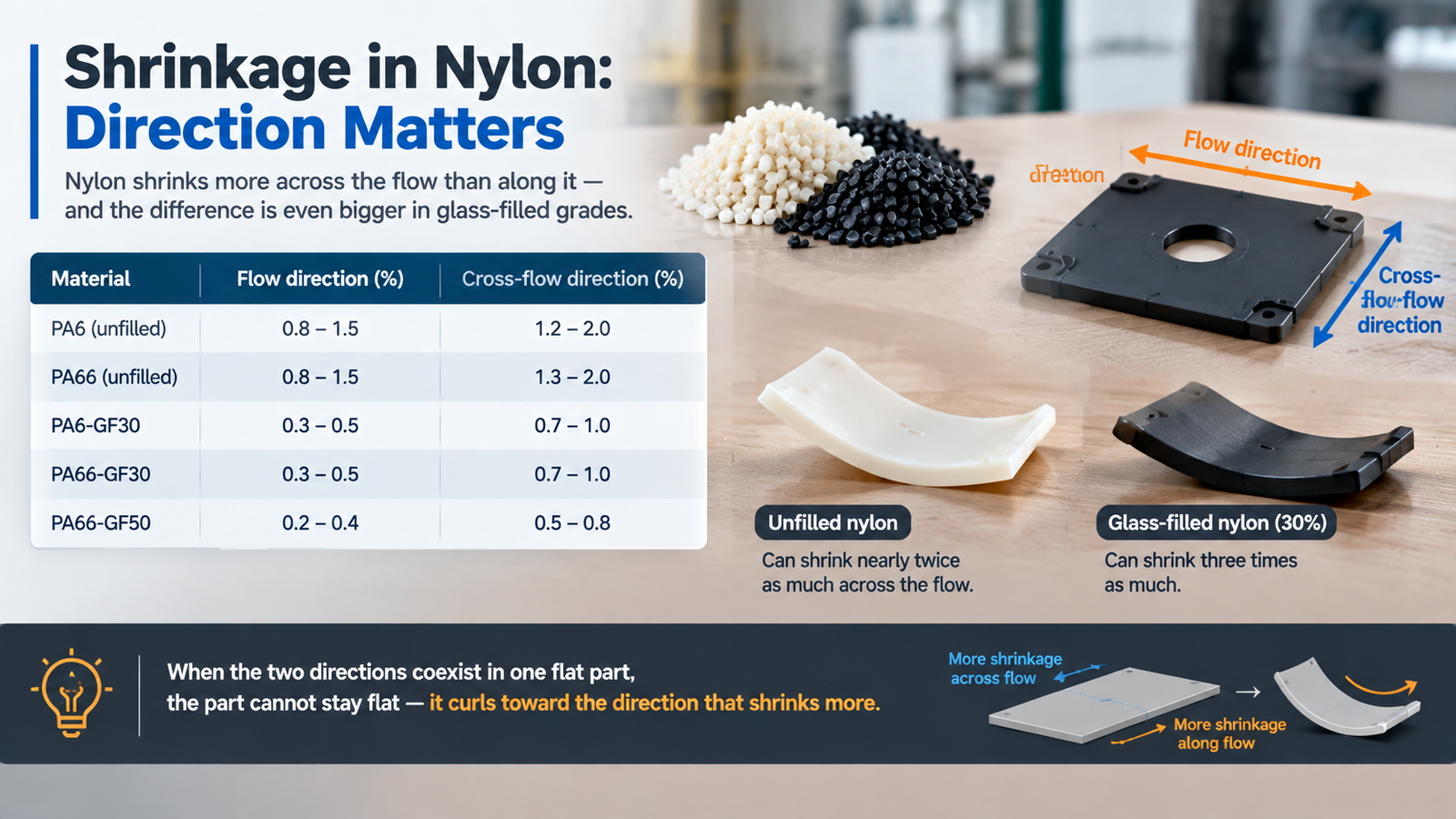
Shrinkage in Nylon: Direction Matters
| Material | Flow direction (%) | Cross-flow direction (%) |
|---|---|---|
| PA6 (unfilled) | 0.8 – 1.5 | 1.2 – 2.0 |
| PA66 (unfilled) | 0.8 – 1.5 | 1.3 – 2.0 |
| PA6-GF30 | 0.3 – 0.5 | 0.7 – 1.0 |
| PA66-GF30 | 0.3 – 0.5 | 0.7 – 1.0 |
| PA66-GF50 | 0.2 – 0.4 | 0.5 – 0.8 |
An unfilled nylon part can shrink nearly twice as much across the flow as along it; a 30 percent glass-filled grade can shrink three times as much. When those two directions coexist in one flat part, the part cannot stay flat — it curls toward the direction that shrinks more.
The Moisture Mechanism: Why Parts Move After Moulding
Nylon absorbs water and swells. PA66 can take up 8 – 9 percent of its weight in moisture at saturation, and even the 1.5 – 2.5 percent it picks up in normal indoor conditions produces a measurable increase in dimensions.
| Condition | Typical moisture content (% by weight) | Effect on dimensions |
|---|---|---|
| Dry as moulded | Below 0.2 | Reference dimension |
| Stored in normal indoor air | 1.5 – 2.5 | Measurable growth |
| Soaked in water | 6 – 9 (saturation) | Largest growth |
| Conditioned per standard practice | Defined target | Repeatable, specifiable |
This is why a nylon part that measured perfect on the day of moulding can bow, elongate or fail to fit a week later — a moisture-driven warpage effect. If a part must hold tight tolerances in service, the dimensional specification has to state the conditioning state, and the part should be conditioned before final inspection rather than after the customer receives it.
Diagnosing Which Mechanism You Have
| Observation | Most likely cause |
|---|---|
| Warp is present immediately, stable within hours | Cooling imbalance or differential shrinkage |
| Warp in fibre-filled parts, worst on flat surfaces | Fibre orientation |
| Warp increases over days or weeks | Moisture absorption |
| Warp follows the gate position | Packing and flow orientation |
| Warp at one end only | Uneven mould temperature across the cavity |
| Warp worsens at higher mould temperature | Crystallisation difference, not cooling rate |
The first row of that table is the useful test: check the part within minutes of moulding and again after a week. If it is flat then and warped later, stop chasing the mould — you have a moisture problem.
Fix 1: Balance the Cooling
Cooling balance is the highest-yield fix, and the cheapest to verify.
- Measure actual cavity surface temperature with a contact probe across the part, not just at the inlet and outlet
- Match flow rates between the fixed and moving halves — unequal flow is a common cause of one-sided warp
- Bring cooling channels closer to the cavity in thick sections; thick regions cool last and shrink last
- Where baffles or bubblers are used, verify they are actually working rather than blocked or bypassed
- Avoid cooling the part too fast at the surface while the core stays hot: the skin freezes, the core shrinks, and the part bows
Fix 2: Use Mould Temperature as a Crystallisation Control
Nylon needs a hot mould, and the requirement is not about cooling speed — it is about allowing uniform crystallisation.
| Material | Recommended mould temperature (°C) |
|---|---|
| PA6 | 80 – 100 |
| PA66 | 80 – 100 |
| PA6-GF30 / PA66-GF30 | 90 – 110 |
| Thin-wall nylon parts | 90 – 110 |
A cold mould produces a partly amorphous skin around a crystalline core, and the mismatch between the two is a warp generator. Running nylon at 40 – 50 °C to save cycle time trades a few seconds for rejects.
Fix 3: Control Fibre Orientation Through Gating
In glass-filled nylon, gate position decides fibre direction, and fibre direction decides warp. This is a tooling decision, not a process tweak.
- Place the gate so flow is symmetrical relative to the part's centreline where geometry allows
- Avoid a single edge gate on a large flat part: it produces strong orientation down the flow path and severe curl
- Consider multiple gates, or a central gate, to balance orientation
- Watch weld lines: fibre orientation reverses across them, producing a hinge-like weak line that also warps differently from its surroundings
- For flat covers and housings, a flow simulation is worth the cost — it predicts the curl before the tool is cut
Fix 4: Packing and Hold Profile
| Setting | Effect on warpage |
|---|---|
| Too little packing | Higher, less uniform shrinkage, more warp |
| Excessive packing | Over-packed gate area, internal stress, warp and flash |
| Single-stage hold with a long gate | Gate freezes unevenly across cavities |
| Profiled hold with gate seal | More uniform shrinkage across the part |
The practical approach is a hold pressure profile with a clear gate-seal point, validated by weighing parts from successive cycles to confirm the gate has sealed.
Fix 5: Design and Wall Thickness
Warpage that survives good process control usually has a design cause.
- Keep wall thickness uniform; nylon is less forgiving of thick sections than amorphous plastics
- Use ribs rather than thick walls — with rib thickness at 50 – 60 percent of the wall
- Avoid large flat areas: add a crown, a step or a rib pattern to break up the flat span
- Symmetry helps: asymmetric geometry with asymmetric cooling will bend
- Radius corners generously; sharp corners concentrate stress and slow cooling locally
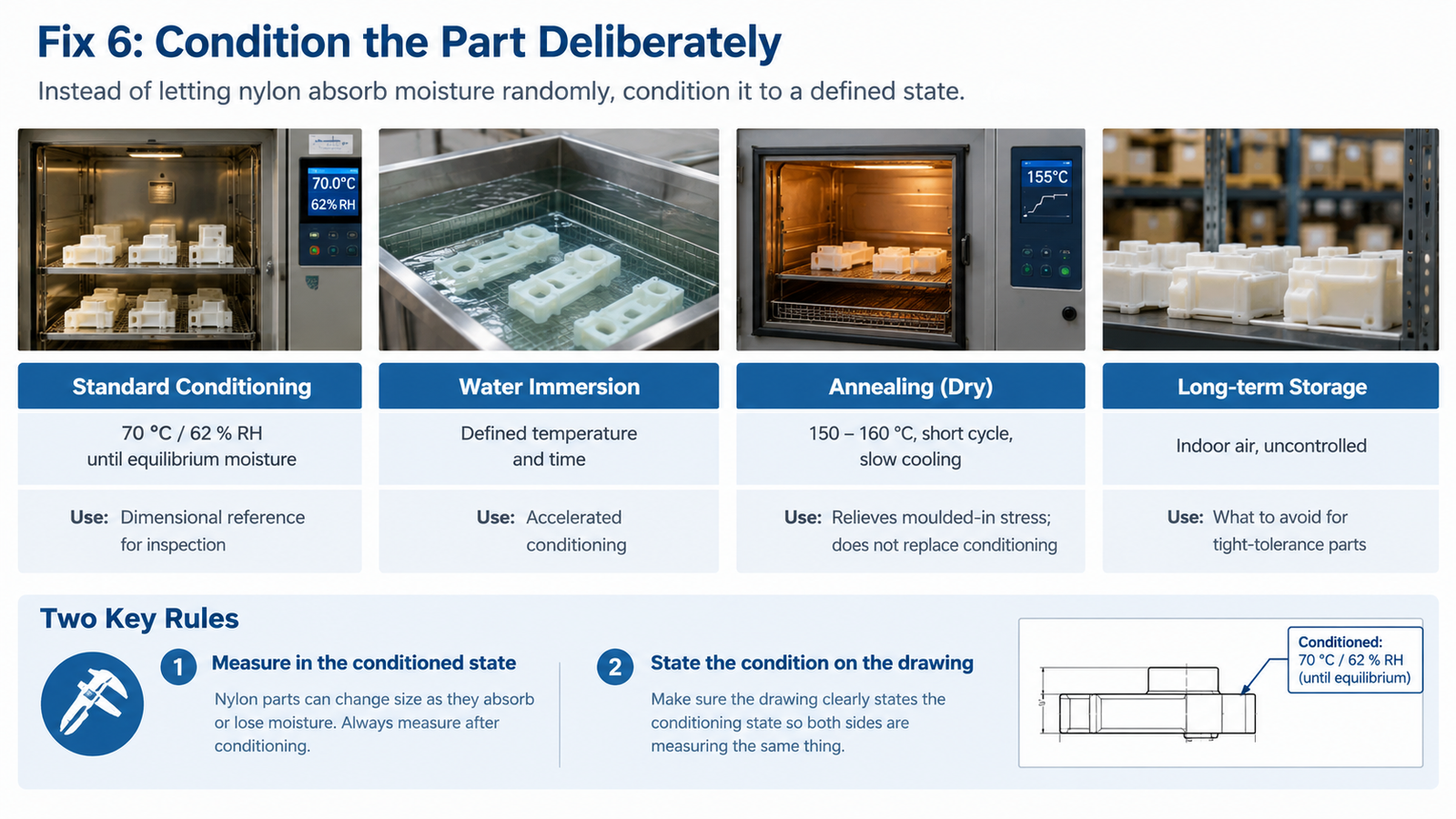
Fix 6: Condition the Part Deliberately
Instead of letting nylon absorb moisture randomly, condition it to a defined state.
| Method | Typical condition | Use |
|---|---|---|
| Standard conditioning | 70 °C / 62 % RH until equilibrium moisture | Dimensional reference for inspection |
| Water immersion | Defined temperature and time | Accelerated conditioning |
| Annealing (dry) | 150 – 160 °C, short cycle, slow cooling | Relieves moulded-in stress; does not replace conditioning |
| Long-term storage | Indoor air, uncontrolled | What to avoid for tight-tolerance parts |
Two rules follow from this (both are standard plastics engineering practice). First, measure nylon parts in the conditioned state. Second, state that state on the drawing so both sides are measuring the same thing.
Fix 7: Check the Material and the Machine
- Grade selection — lower-shrinkage, higher-glass grades warp less but are more orientation-sensitive
- Moisture before moulding — wet nylon hydrolyses; degraded material shrinks differently and behaves unpredictably
- Colour masterbatch — some carriers change shrinkage; confirm with the supplier
- Melt temperature stability — drifting melt temperature means drifting shrinkage
- Machine repeatability — check cushion stability and shot-to-shot weight variation
Common Mistakes
| Mistake | Consequence |
|---|---|
| Judging flatness only on the day of moulding | The moisture-driven warp appears later and is missed |
| Cooling the mould to shorten the cycle | Non-uniform crystallisation, worse warp |
| Adding ribs to a warped part without fixing cooling | Additional shrinkage from the ribs, same warp |
| Moving gates after the tool is made | Limited correction; big geometry changes need a new tool |
| Inspecting dry parts against a conditioned specification (measurement state) | Parts "fail" or "pass" depending on the day |
| Chasing process settings before checking dryer and dew point | Wet resin mimics every other fault |
Conclusion
Nylon warpage has three causes — differential shrinkage, fibre orientation, and moisture — and they have different fixes. Diagnose first: measure the part immediately after moulding and again after a week. If it moves later, no amount of cooling adjustment will help.
After that, the fix is usually a combination: balanced cooling, a hot mould for uniform crystallisation, gating that controls fibre orientation, a packing profile that seals the gate consistently, uniform wall thickness, and conditioning to a defined moisture state. A flow simulation before cutting steel is cheaper than correcting a warping tool afterwards.
With in-house mould design, flow and cooling analysis and dimensional inspection, we address warpage at the tooling stage instead of after production starts. Send us your drawing for a DFM review that includes the warpage strategy.
FAQ
Why do nylon parts warp after moulding?
Nylon is semi-crystalline and absorbs moisture. Uneven cooling and uneven crystallisation cause immediate warp, glass fibre orientation causes directional shrinkage, and moisture absorption causes the part to grow and distort over days or weeks after ejection.
How do I tell if warpage is from cooling or from moisture?
Measure the part within minutes of moulding and again after several days. A part that is flat at moulding and warped a week later has a moisture problem, not a cooling problem. A part that is warped immediately and stays stable has a shrinkage or orientation cause.
What mould temperature should nylon be run at?
Typically 80 – 100 °C for PA6 and PA66, and 90 – 110 °C for glass-filled grades and thin-wall parts. Running nylon colder to shorten the cycle produces non-uniform crystallisation and worsens warpage.
How does glass fibre cause warpage in PA66-GF30?
Glass fibres align with the melt flow and resist shrinkage along their length. Shrinkage along flow can be 0.3 – 0.5 percent against 0.7 – 1.0 percent across flow, so a flat part curls. Gate position controls fibre direction and is the main tooling lever.
Should nylon parts be annealed to reduce warpage?
Annealing at 150 – 160 °C relieves moulded-in stress and improves dimensional stability, but it does not replace conditioning. Parts that must hold tight tolerances should be moisture conditioned to a defined state matching the service environment before inspection.
Does the gate position really affect warpage?
Yes, especially in glass-filled nylon. Gate position determines the flow direction, and flow direction determines fibre orientation and directional shrinkage. Moving a gate to balance flow often reduces warpage more than any process adjustment.