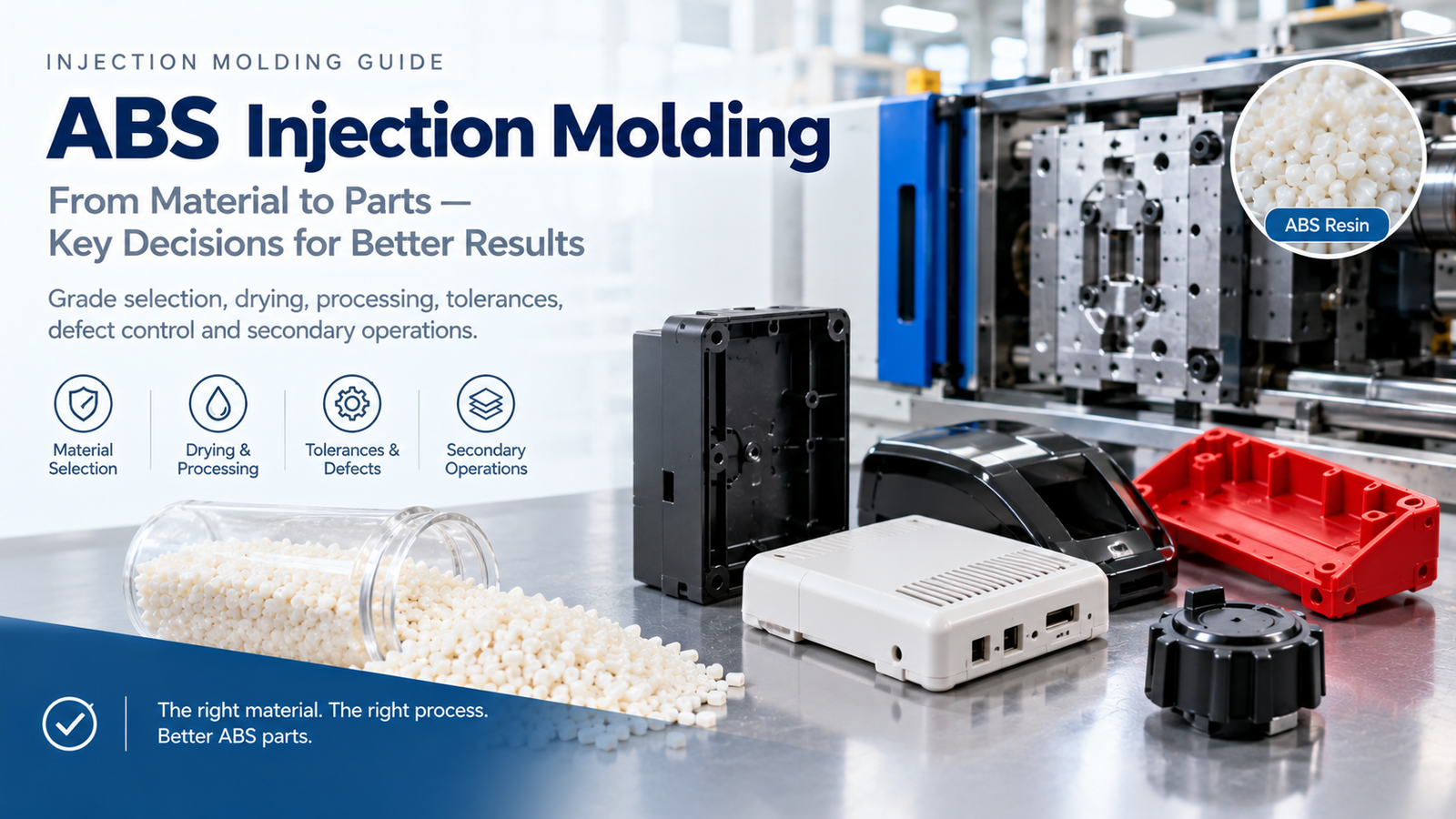
ABS is the plastic most injection moulders cut their teeth on, and for good reason: it processes easily, takes an excellent surface finish, bonds and plates well, and costs far less than the engineering plastics it often replaces. It is also the material that punishes assumptions. ABS absorbs moisture, shrinks more than most people expect, and produces silver streaks, weld lines and sink marks in ways that are entirely predictable once you know the material.
This guide covers ABS injection moulding from grade selection through drying, processing, tolerances, defect control and secondary operations — the practical decisions that decide whether an ABS part comes out right the first time.
Why ABS Is the Default Choice — and Where It Fails
ABS is a terpolymer of acrylonitrile, butadiene and styrene. The acrylonitrile provides chemical resistance and hardness, the butadiene provides impact strength, and the styrene provides the glossy, easily processed surface. Because it is amorphous rather than semi-crystalline, it shrinks in a relatively predictable way and does not warp the way semi-crystalline materials can — but it also has lower chemical resistance than polypropylene or nylon, and it is not suitable for sustained outdoor exposure without protection.
| Property | Typical ABS value | Practical meaning |
|---|---|---|
| Structure | Amorphous | Low, fairly uniform shrinkage; good dimensional stability |
| Shrinkage | 0.4 to 0.7 percent | Higher for high-impact grades; plan tooling accordingly |
| Water absorption | 0.2 to 0.45 percent at saturation | Must be dried before processing |
| Tensile strength | Around 40 to 50 MPa | Adequate for most housings and covers |
| Impact strength | Moderate to high | Rises with butadiene content, falls with heat and UV ageing |
| Heat deflection | Roughly 80 to 100 °C | Enough for appliances and consumer devices, not for engine bays |
| Chemical resistance | Poor against many solvents | Care needed with cleaning agents, adhesives and paints |
| Surface | Excellent | Paintable, platable, texturable, bondable |
| Flammability | V-2 to V-0 depending on grade | V-0 requires a flame retardant grade |
The failures are equally predictable: silver streaks from wet resin, weld lines at holes and ribs, sink marks over bosses, and stress cracking where the part meets a solvent-based cleaner or adhesive. Reference property data for a specific grade should always be checked against the supplier's own data sheet, because the range across ABS grades is wide.
ABS Grades and What Each One Is For
| Grade | Distinguishing feature | Typical application |
|---|---|---|
| General purpose | Balanced cost and properties | Housings, covers, enclosures |
| High impact | Higher butadiene content | Power tools, cases, parts likely to be dropped |
| High heat | Modified rubber and SAN phase | Appliances, parts near heat sources |
| Flame retardant | UL 94 V-0, often with a loss of impact strength | Electrical enclosures, adapters, chargers |
| Plating grade | Controlled rubber phase and purity | Chrome-plated automotive and sanitary parts |
| Transparent (MABS) | Methyl methacrylate for clarity | Clear covers, cosmetic parts |
| Extrusion grade | Higher melt strength | Sheet, pipe and profile |
| PC/ABS blend | Polycarbonate added | Laptop and appliance enclosures needing toughness plus heat resistance |
| Glass filled | Glass fibre added | Stiff structural parts where increased shrinkage anisotropy is acceptable |
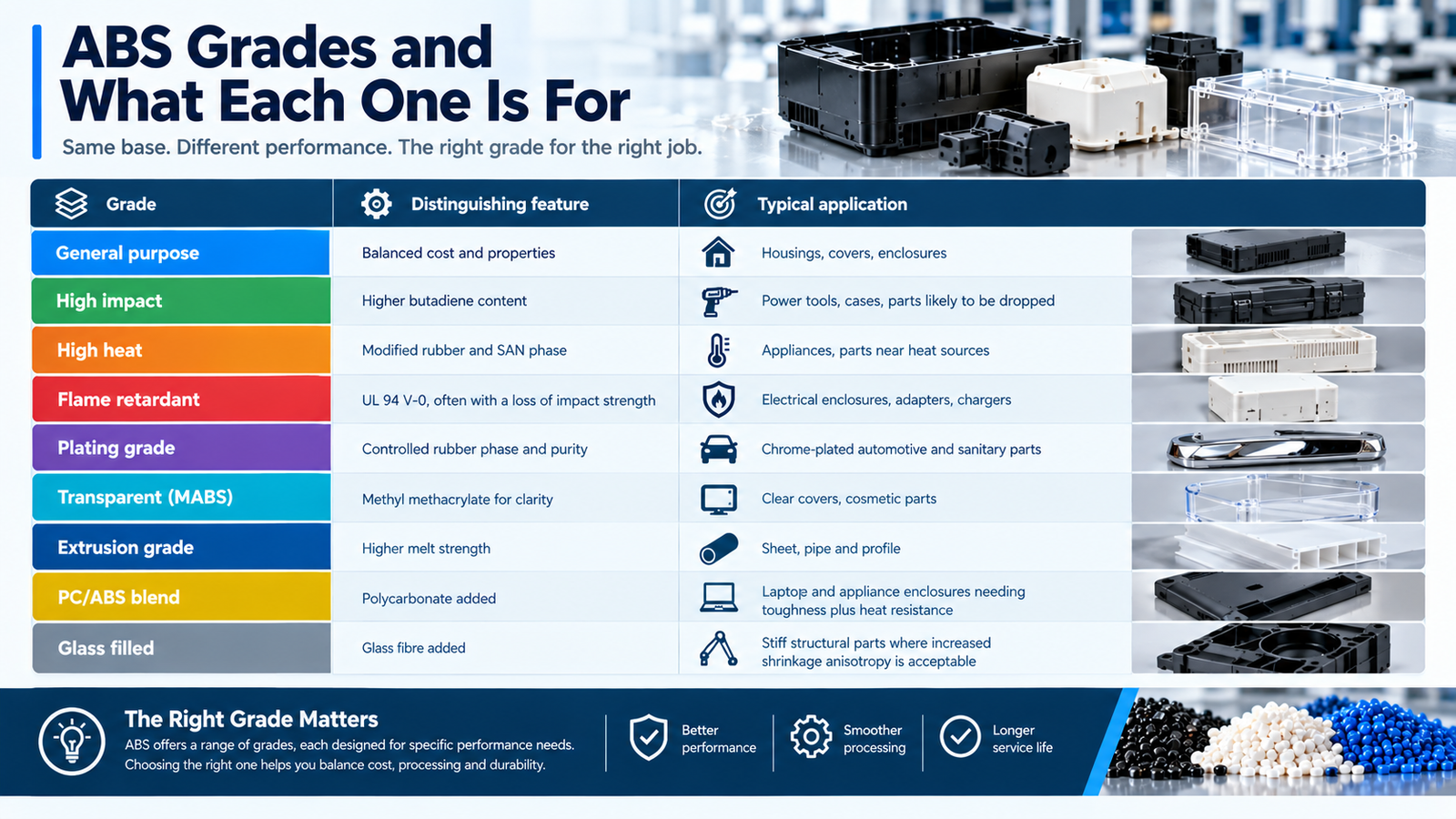
Grade selection usually follows from three questions: does the part need impact, does it need flame retardance, and does it need to look like a premium surface. Answering "yes" to flame retardance changes processing conditions and impact performance, so it should be decided before the tool is cut, not after.
Drying ABS: The Step That Prevents Most Defects
Wet resin is the single most common cause of ABS defects, and it is entirely preventable.
| Parameter | Recommendation |
|---|---|
| Drying temperature | 80 to 90 °C |
| Drying time | 2 to 4 hours at temperature |
| Dew point | Minus 20 °C or lower for a desiccant dryer |
| Target moisture content | Below 0.05 percent where possible, and 0.1 percent as a maximum before processing |
| Hopper | Keep the hopper dryer on during production; do not let dried resin sit out |
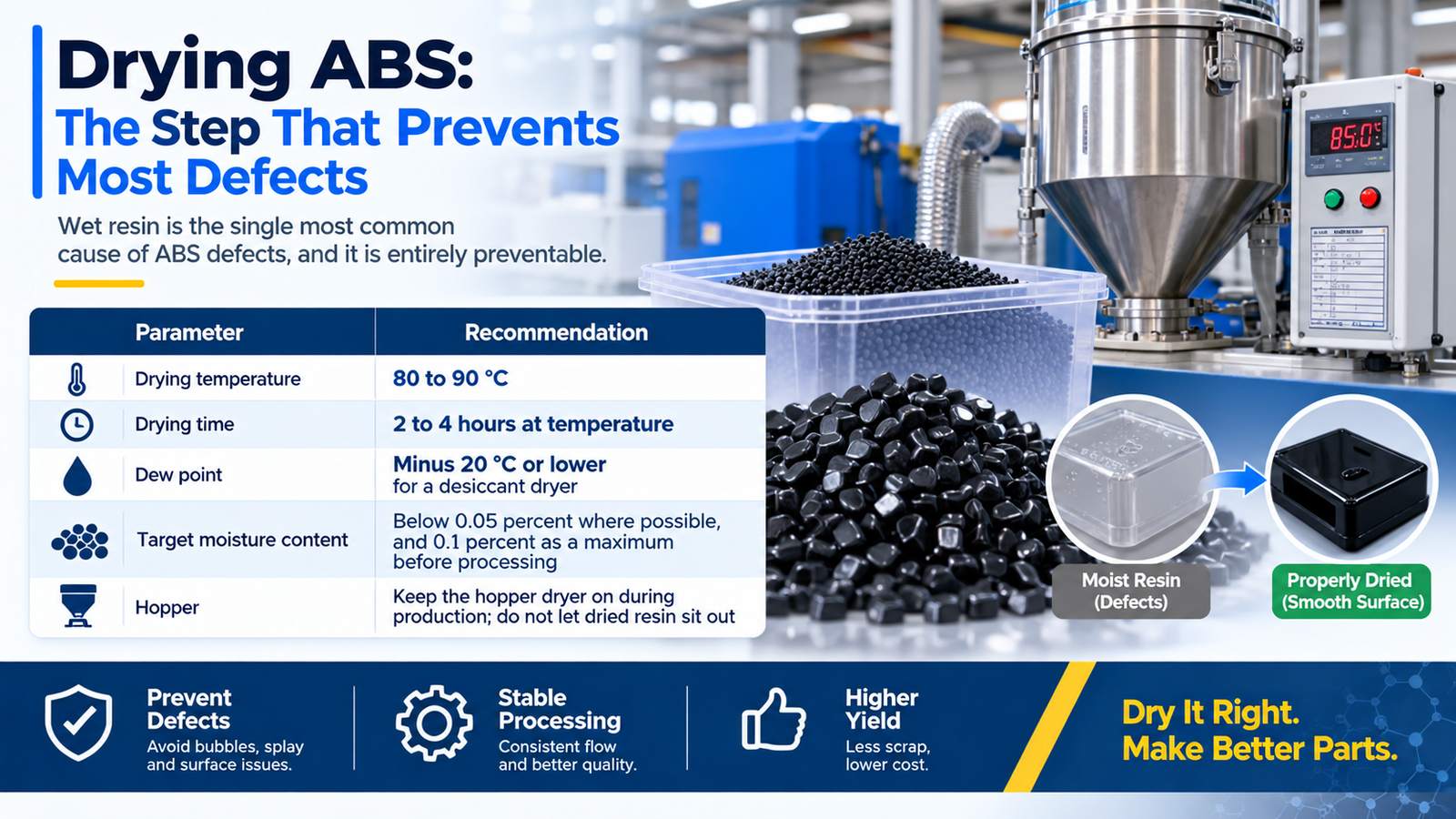
Wet ABS produces silver streaks, splay, surface bubbles and blisters in thick sections, and it weakens weld lines — so a part that looks acceptable in a quick trial can fail later at a weld line after conditioning. If you are troubleshooting a moisture-related defect on a lightweight part, our guide to identifying and solving lightweight ABS injection moulding defects covers the symptom-by-symptom diagnosis.
Processing Window
| Parameter | Typical range | Note |
|---|---|---|
| Melt temperature | 210 to 270 °C | Higher for high-impact and glass-filled grades; keep flame retardant grades at the lower end |
| Mould temperature | 40 to 80 °C | Higher mould temperature improves gloss and weld line strength |
| Injection pressure | Set to fill in 80 to 90 percent of the flow path before packing | Stage the profile so the end of fill is the slowest point |
| Holding pressure | 50 to 70 percent of injection pressure | Too low causes sink, too high causes stress and sticking |
| Back pressure | 5 to 15 bar | Enough to give a consistent shot, not enough to degrade the melt |
| Screw speed | Moderate | Excessive shear raises melt temperature without a beneficial effect |
| Shot size | 30 to 70 percent of barrel capacity | Keeps residence time under control |
Two points are worth emphasising. First, good gloss and strong weld lines both come from mould temperature — the cheapest quality improvement in ABS processing is often a warmer tool. Second, melt temperature must be measured with an air shot, not read off the controller, because the barrel set points and the actual melt temperature can differ considerably. Where filling is marginal, the fluidity of the ABS melt has to be balanced against the risk of degradation, which our note on controlling ABS melt fluidity to ensure filling examines in detail.
Shrinkage and Tolerances in ABS
| Grade | Typical shrinkage |
|---|---|
| General purpose | 0.4 to 0.6 percent |
| High impact | 0.5 to 0.7 percent |
| High heat | 0.4 to 0.6 percent |
| Flame retardant | 0.4 to 0.6 percent |
| Glass filled 20 to 30 percent | 0.2 to 0.4 percent, with much stronger directional difference |
| PC/ABS blend | 0.4 to 0.6 percent |
Achievable tolerances for a well-designed ABS part are plus or minus 0.05 mm on general dimensions, consistent with recognised dimensional practice,, with plus or minus 0.02 mm on critical features when the process is stable and the part is measured on an appropriate instrument. Glass-filled grades reduce shrinkage but increase directional difference, so flow direction affects final dimensions more than it does in unfilled ABS.
Because ABS is amorphous and shrinks uniformly, it is one of the most dimensionally predictable common materials — which is exactly why it is so widely used for parts that must fit together.
Common Defects and Their Causes
| Defect | Likely cause | Fix |
|---|---|---|
| Silver streaks | Wet resin, or melt decomposition | Dry to specification, check melt temperature, verify screw condition |
| Weld lines with poor strength | Low mould temperature, low injection speed, poor venting | Raise mould and melt temperature, speed up fill, add venting at the weld |
| Sink marks over bosses and ribs | Thick sections cooling last | Reduce wall thickness, core the boss, extend hold time |
| Warpage | Uneven cooling or packing, gate imbalance | Balance cooling circuits, review gate position and hold profile |
| Splay and blisters | Moisture or trapped gas | Dry the resin, improve venting, reduce injection speed |
| Jetting at the gate | Gate too small or fill too fast at entry | Enlarge the gate, slow the initial fill, adjust gate angle |
| Flow marks and dull patches | Cold melt front or too cold a tool | Raise mould temperature, adjust the fill profile |
| Stress cracking in service | Moulded-in stress plus solvent contact | Reduce packing stress, anneal where appropriate, change cleaning agents |
| Poor plating adhesion | Contamination, internal stress, wrong grade | Use a plating grade, control mould temperature, eliminate release agents |
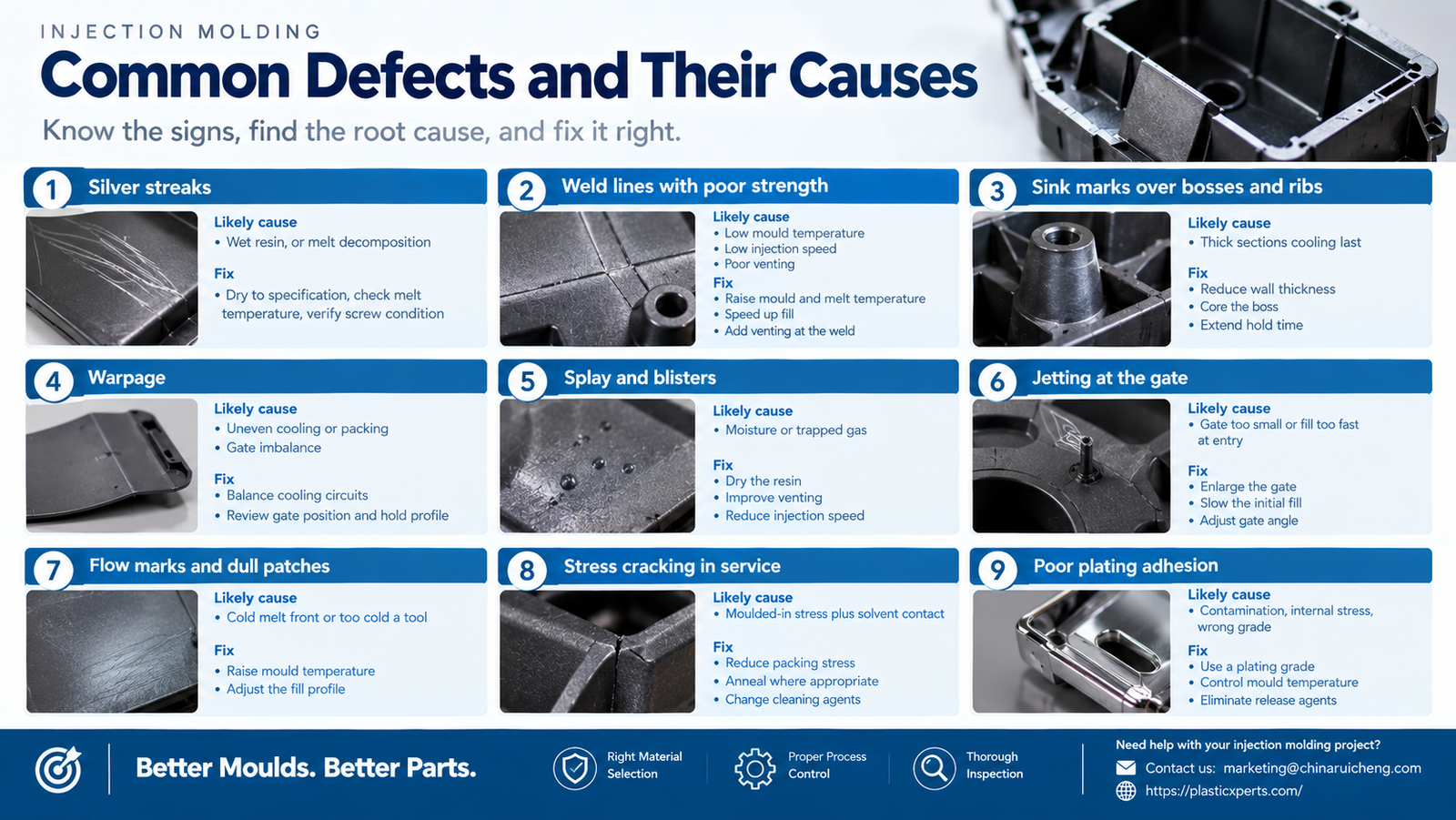
Most ABS defects fall into three families: moisture, temperature and thickness. Diagnosing which family you are in takes one trial with a corrected variable, not a new tool.
Surface Finish and Secondary Operations
The main commercial reason to choose ABS is what happens after moulding.
- Texture and gloss — texture is transferred from the tool; higher mould temperature and proper cavity pressure give better definition and gloss consistency.
- Painting — adhesion depends on surface polarity and cleanliness; a moulded-in surface with residual stress or release agent is the usual cause of poor adhesion, as described in our note on how the polarity of the ABS substrate affects paint adhesion.
- Electroplating — requires a plating grade and carefully controlled moulding to avoid stress and blistering.
- Laser marking, printing and hot stamping — all work well on ABS with the right grade and surface.
- Ultrasonic and solvent welding — ABS welds well; the joint design decides strength more than the process does.
- Electrical use — ABS is a good insulator, which suits enclosures and housings; the limits are covered in our discussion of ABS electrical insulation.
For any plated, painted or laser-marked part, the moulding parameters are a quality input, not just a production step. A part moulded with excessive stress can pass dimensional inspection and still fail adhesion tests weeks later.
Design Guidelines for ABS Parts
| Feature | Recommendation |
|---|---|
| Nominal wall | 1.5 to 3.5 mm; keep thickness consistent |
| Rib thickness | Around 60 percent of nominal wall |
| Boss wall | Around 60 percent of nominal wall, with a cored centre |
| Draft | 0.5 to 1 degree minimum, more on textured surfaces |
| Radii | Inside radius at least half the wall thickness; avoid sharp internal corners |
| Gate position | Fill the thickest section first; hide the gate on a non-cosmetic face |
| Venting | 0.02 to 0.03 mm deep at the last point to fill and at weld line locations |
| Holes and slots | Place them so that weld lines fall in low-stress areas |
Sharp internal corners and abrupt thickness changes concentrate stress and are the most common design cause of cracks in ABS parts, especially where the part is screwed or snapped into an assembly.
Quality Control for ABS Parts
| Check | Method | Frequency |
|---|---|---|
| Critical dimensions | CMM or optical measurement against the drawing | First article and after any tooling change |
| Appearance | Comparison against a limit sample under defined lighting | Every batch |
| Weld line strength | Peel or tensile testing in the weld zone on samples | Per tool qualification and periodically |
| Plating and paint adhesion | Cross-hatch or peel testing on processed samples | Per batch for decorated parts |
| Impact performance | Drop or instrumented impact testing where the application requires it | Per qualification |
| Moisture content of resin | Moisture analyser or loss on drying | Per material lot and after any drying change |
| Traceability | Resin lot to production batch to carton | Continuous |
ABS, PC/ABS or PP: Choosing Between Them
| Requirement | Best choice | Why |
|---|---|---|
| Lowest cost with good appearance | ABS | Best balance for housings and covers |
| Higher impact and heat resistance | PC/ABS | Polycarbonate adds toughness and heat resistance, and the blend ratio can be tuned to the application — see our note on customising PC/ABS blend ratios |
| Chemical resistance and living hinge | PP | Polypropylene resists chemicals and flexes without cracking |
| Chrome plating | Plating grade ABS | Only ABS has the established plating process |
| Outdoor exposure | ASA or UV-stabilised grade | Standard ABS yellows and embrittles outdoors |
| Flame retardance plus toughness | PC/ABS FR grade | Combines V-0 with acceptable impact |
The comparison between ABS and polypropylene comes down to whether the part needs to survive chemicals and repeated flexing, or to look good and take a secondary finish. That trade-off is examined in our guide to ABS versus polypropylene.
Conclusion
ABS injection moulding is not difficult; it is unforgiving of shortcuts. Dry the resin to specification, run the melt and the tool in the right temperature windows, design walls and corners so they do not concentrate stress, and remember that every secondary operation — plating, painting, welding — depends on how the part was moulded.
The material rewards that discipline with excellent surface finish, predictable shrinkage and one of the best cost-to-performance ratios available. It is the reason ABS remains the default choice for housings, covers and enclosures across consumer, automotive and industrial applications.
With injection moulding capability from 80 to 1,400 tonnes and in-house tooling, we run ABS across general purpose, high impact, high heat, flame retardant, plating and glass-filled grades. Through our custom injection moulding services we support projects from design review and material selection through first article inspection to stable volume production. Send us your part drawing to discuss grade selection, tolerances and the secondary operations your application requires.
FAQ
What is ABS injection moulding?
ABS injection moulding is the process of producing parts from acrylonitrile butadiene styrene, a tough amorphous thermoplastic. It is widely used for housings, covers and enclosures because it processes easily, takes an excellent surface finish, and can be painted, plated, printed and welded.
Does ABS need to be dried before injection moulding?
Yes. ABS absorbs moisture from the air, typically 0.2 to 0.45 percent at saturation. Dry it at 80 to 90 °C for 2 to 4 hours with a dew point of minus 20 °C or lower, and keep it in a hopper dryer during production. Undried ABS produces silver streaks, splay, bubbles and weak weld lines.
What is the shrinkage rate of ABS?
ABS shrinks about 0.4 to 0.6 percent for general purpose grades and 0.5 to 0.7 percent for high impact grades. Glass-filled grades shrink less, around 0.2 to 0.4 percent, but with a much greater difference between flow direction and cross-flow direction.
What is the best melt temperature for ABS?
Most ABS grades process between 210 and 270 °C. High impact and glass-filled grades generally run hotter, while flame retardant grades should run at the lower end of the range. Verify the actual melt temperature with an air shot rather than relying on the barrel set points.
Why do ABS parts get silver streaks?
Silver streaks are almost always caused by moisture in the resin or by melt decomposition. Dry the material to specification first, then check melt temperature and residence time. If drying is correct and streaks persist, inspect the screw and barrel for wear or degradation deposits.
Can ABS be chrome plated?
Yes, but only plating grades should be used. Plating requires a controlled rubber phase and a very clean, low-stress moulding. Excessive moulded-in stress, surface contamination or release agents are the usual causes of blistering and poor adhesion.