ABS and polypropylene (PP) are two of the most widely used thermoplastics in the world, and buyers constantly compare them for injection molded parts. Both are inexpensive, easy to mold, and versatile — but they serve very different applications. ABS offers strength and surface finish; polypropylene offers chemical resistance and fatigue endurance. This guide compares ABS vs PP across every key property to help you select the right material.
The Basic Difference
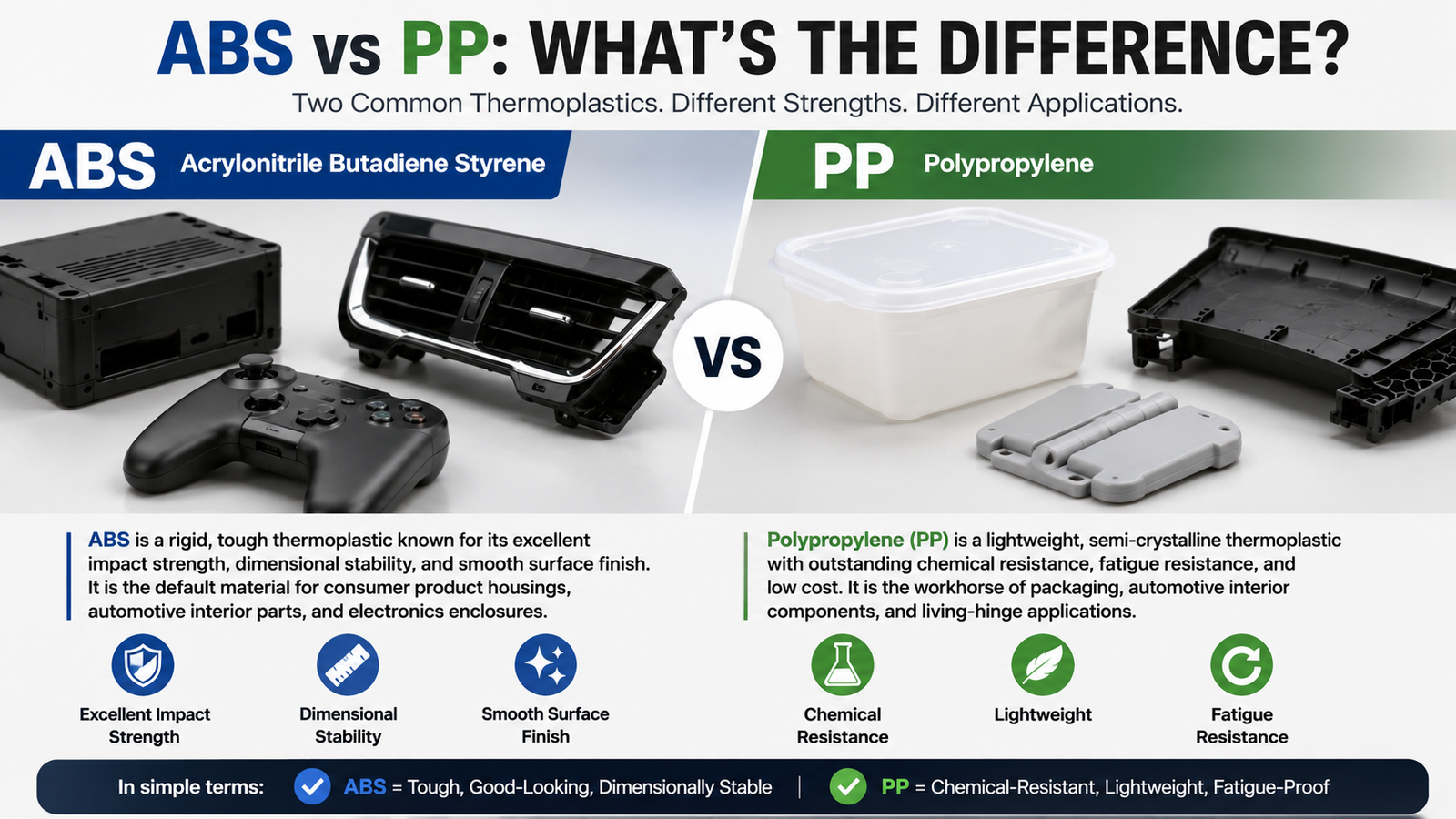
ABS (acrylonitrile butadiene styrene) is a rigid, tough thermoplastic known for its excellent impact strength, dimensional stability, and smooth surface finish. It is the default material for consumer product housings, automotive interior parts, and electronics enclosures.
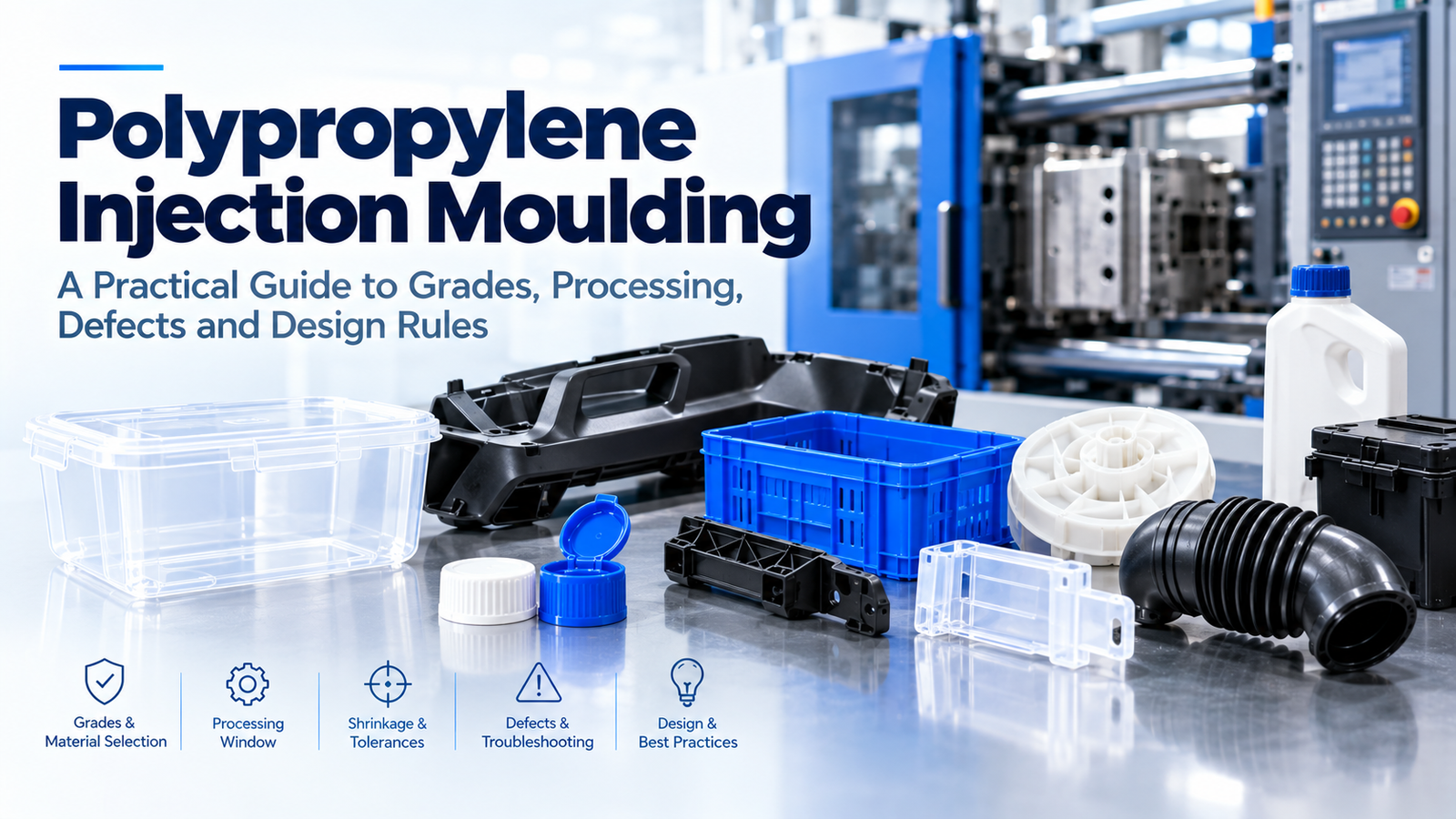
Polypropylene (PP) is a lightweight, semi-crystalline thermoplastic with outstanding chemical resistance, fatigue resistance, and low cost. It is the workhorse of packaging, automotive interior components, and living-hinge applications.
In simple terms: ABS = tough, good-looking, dimensionally stable. PP = chemical-resistant, lightweight, fatigue-proof.
Key Properties Comparison
| Property | ABS | Polypropylene (PP) |
|---|---|---|
| Density | 1.04-1.07 g/cm³ | 0.90-0.92 g/cm³ (lighter) |
| Impact strength | Excellent | Good (better at low temp) |
| Tensile strength | 40-50 MPa | 30-38 MPa |
| Surface finish | Glossy, smooth | Matte, softer |
| Chemical resistance | Poor (attacked by solvents) | Excellent |
| Fatigue resistance (living hinge) | Poor | Outstanding |
| Heat resistance (HDT) | ~98°C | ~90°C (unfilled) |
| Moisture absorption | ~0.3% | ~0.01% (very low) |
| UV resistance | Poor (degrades) | Poor (needs stabilizer) |
| Cost | Higher (PP is cheaper) | Lower |
Impact Strength and Toughness
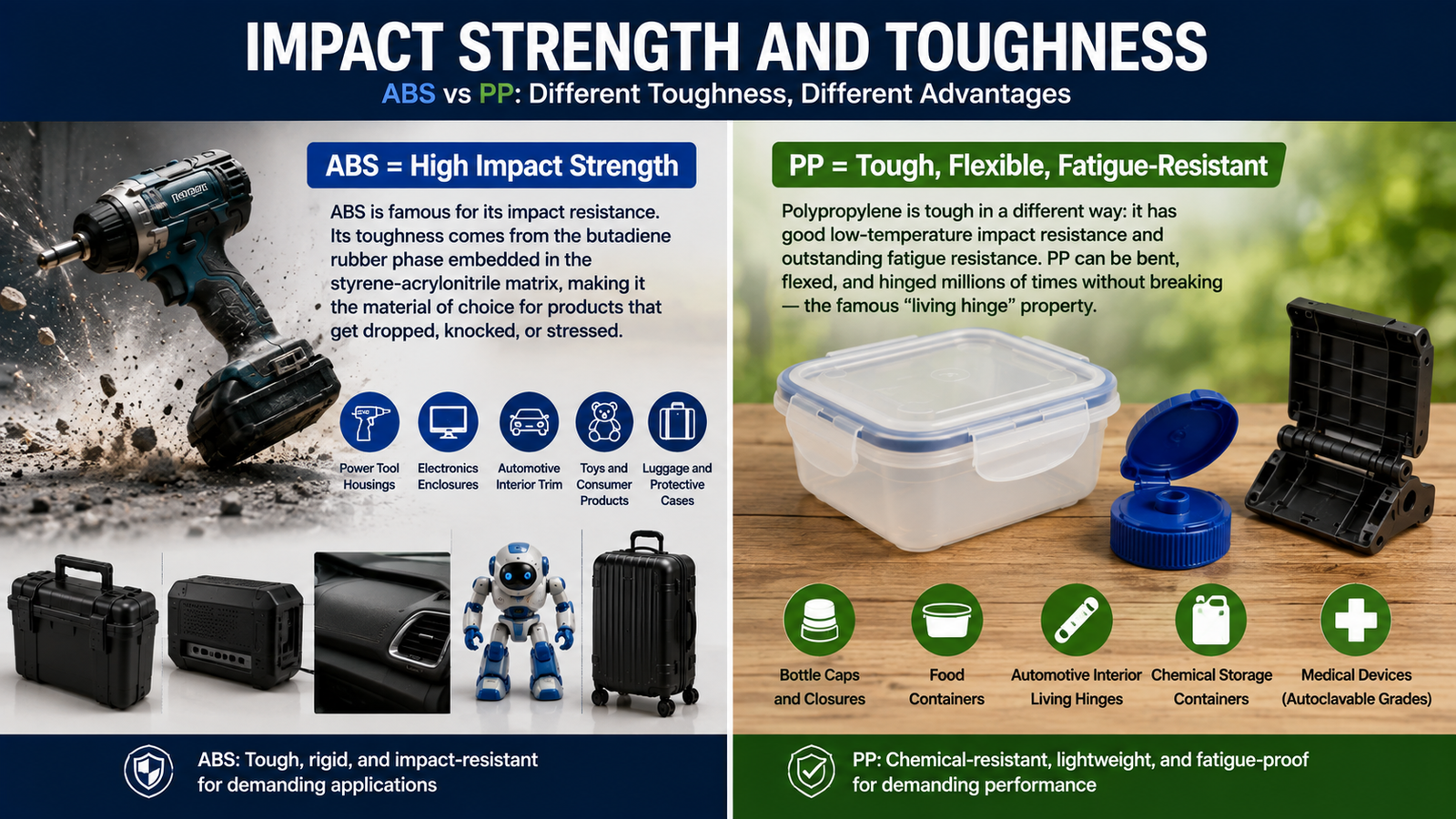
ABS is famous for its impact resistance — it is the material of choice for products that get dropped, knocked, or stressed. Its toughness comes from the butadiene rubber phase embedded in the styrene-acrylonitrile matrix. This makes ABS ideal for:
- Power tool housings
- Electronics enclosures
- Automotive interior trim
- Toys and consumer products
- Luggage and protective cases
Polypropylene is also tough, but differently: it has good low-temperature impact resistance and outstanding fatigue resistance. PP can be bent, flexed, and hinged millions of times without breaking — the famous "living hinge" property. PP is the choice for:
- Bottle caps and closures
- Food containers
- Automotive interior living hinges
- Chemical storage containers
- Medical devices (autoclavable grades)
Chemical Resistance: A Decisive Difference
This is where the materials diverge most dramatically:
| Exposure | ABS | Polypropylene |
|---|---|---|
| Diluted acids | Good | Excellent |
| Diluted alkalis | Good | Excellent |
| Alcohols | Poor | Excellent |
| Oils and greases | Good | Excellent |
| Solvents (acetone etc.) | Poor (dissolves!) | Excellent |
| Fuels | Poor | Good |
ABS is dissolved by many common solvents — acetone, MEK, and some cleaning agents will attack it. Polypropylene, by contrast, resists almost all chemicals at room temperature, making it the default choice for chemical containers, battery cases, and laboratory equipment.
Dimensional Stability and Moisture
ABS has low but measurable moisture absorption (~0.3%) and good dimensional stability, holding tight tolerances well. PP absorbs almost no moisture (~0.01%), so its dimensions do not change with humidity — but PP has higher shrinkage (1.5-2.5%) during molding, requiring careful mold design.
For precision parts with tight tolerances, ABS is often preferred because it warps less and maintains dimensions more predictably. For parts exposed to humidity or water, PP's near-zero moisture absorption is a major advantage.
Heat Resistance
| Material | HDT (0.45 MPa) | Continuous Use |
|---|---|---|
| ABS | ~98°C | Up to ~80°C |
| PP (unfilled) | ~90°C | Up to ~80°C |
| PP (glass-filled) | ~130°C | Up to ~110°C |
Both materials are similar in standard heat resistance. For higher-temperature applications, glass-filled PP or ABS blends (like PC/ABS) are used.
Cost Comparison
| Factor | ABS | Polypropylene |
|---|---|---|
| Raw material price | Higher | Lower (30-40% cheaper) |
| Price per kg (approx.) | $1.80-$2.50 | $1.00-$1.50 |
| Processing | Easy | Easy |
| Part cost | Higher | Lower |
Polypropylene is significantly cheaper than ABS — typically 30-40% less in raw material cost. For high-volume parts where the application allows, switching from ABS to PP can deliver substantial cost savings.
Which Should You Choose?
Choose ABS when:
- The part needs a smooth, glossy surface finish
- Impact and drop resistance is critical
- Tight dimensional tolerances must be held
- The part is a housing or enclosure
- Painting, plating, or bonding is required (ABS takes finishes well)
Choose polypropylene when:
- Chemical exposure is expected (acids, solvents, oils)
- The part needs a living hinge or repeated flexing
- Weight reduction matters (PP is ~15% lighter)
- The part contacts food (PP is food-safe)
- Cost is a primary driver
- Water or humidity exposure is expected
Conclusion
ABS and polypropylene are both workhorse thermoplastics with distinct strengths. ABS wins on impact strength, surface finish, and dimensional stability — ideal for housings and consumer products. Polypropylene wins on chemical resistance, fatigue resistance, lightweight, and cost — ideal for containers, hinges, and chemical exposure applications. Selecting based on the actual service conditions ensures the right performance at the lowest cost.
With experience in material selection and injection molding, PlasticXperts helps customers choose between ABS and polypropylene for their specific application. Contact our engineering team for a professional material recommendation.
FAQ
Is polypropylene stronger than ABS?
No. ABS has higher tensile strength (40-50 MPa vs 30-38 MPa) and better impact resistance for rigid parts. However, polypropylene has outstanding fatigue resistance, so it outperforms ABS in living hinge and repeated-flexing applications.
Which is cheaper, ABS or polypropylene?
Polypropylene is significantly cheaper — typically 30-40% less than ABS in raw material cost. For high-volume parts, switching from ABS to PP where the application allows can deliver substantial savings.
Can ABS and polypropylene be used interchangeably?
Not generally. ABS is preferred for impact resistance, surface finish, and dimensional stability. PP is preferred for chemical resistance, living hinges, and food contact. Substituting one for the other usually requires design changes.
Which material is better for a living hinge?
Polypropylene is the clear winner for living hinges. Its outstanding fatigue resistance allows it to flex millions of times without breaking. ABS will crack and fail under repeated flexing.
Is polypropylene food safe?
Yes. Polypropylene is FDA-approved for food contact and is widely used for food containers, bottles, and kitchenware. ABS can also be food-grade but is less common for direct food contact applications.
Which is better for outdoor use?
Neither material is naturally UV-stable. Both ABS and PP degrade under prolonged sunlight. For outdoor use, UV-stabilized grades should be specified, or the parts should be painted or coated. Polypropylene with UV stabilizers is commonly used for outdoor furniture.
If you have settled on ABS, our guide to ABS injection moulding covers grades, processing and common defects.