Why material selection is the decision that decides everything else
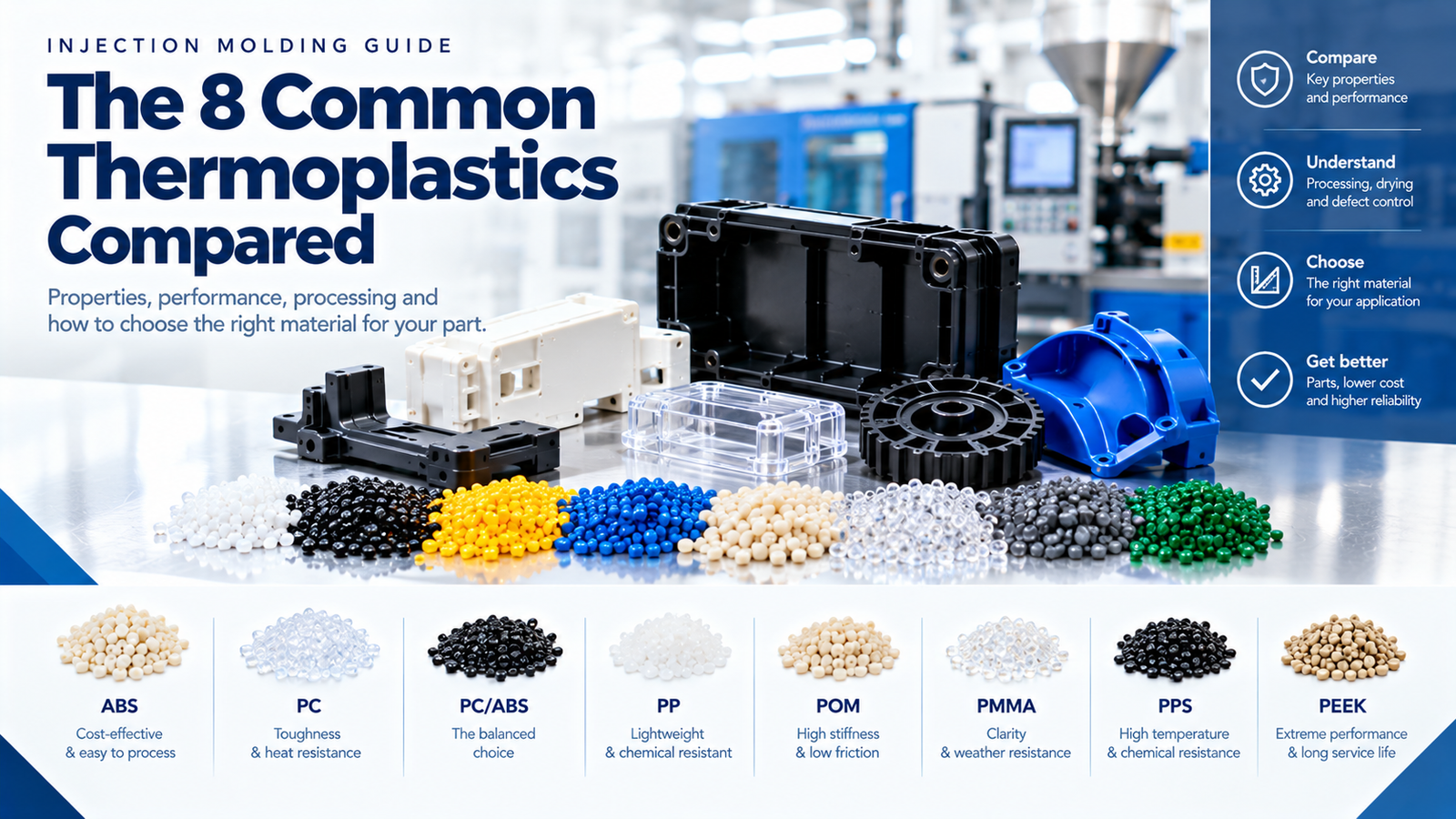
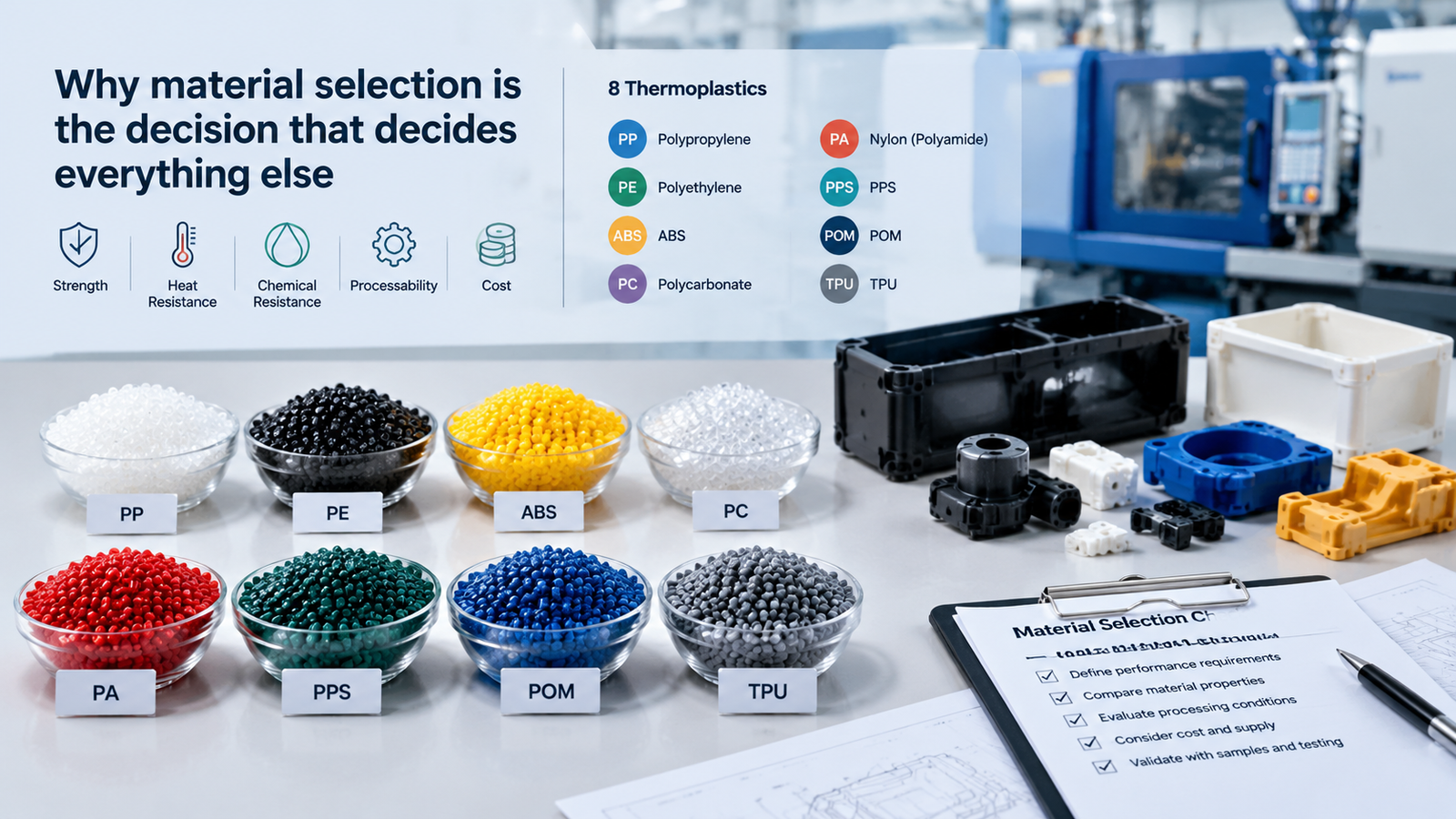
Every injection moulded part is a compromise between eight material families, and the choice is made long before a tool is cut. Pick the wrong one and no amount of process tuning saves the project: the part warps, cracks in the field, fails a drop test or simply costs twice what it should. Pick correctly and the mould runs wide, scrap stays low and the part passes validation the first time.
This guide is the entry point to our material-specific processing guides. It compares the eight thermoplastics we mould most often, sets out the numbers that actually drive selection, and gives you a five-step method for choosing — plus the four mistakes that cause most material-related failures.
The eight families at a glance
The table below is the short version of everything that follows. Values are typical ranges for unfilled grades; glass-filled versions change strength and shrinkage considerably.
| Material | Tensile strength (MPa) | Continuous service temp (°C) | Mould shrinkage (%) | Clarity | Relative cost |
|---|---|---|---|---|---|
| ABS | 40 – 50 | 80 – 90 | 0.4 – 0.8 | Opaque | Low |
| PC | 60 – 70 | 115 – 130 | 0.5 – 0.7 | Clear / tinted | Medium-high |
| PC/ABS | 50 – 60 | 100 – 110 | 0.4 – 0.7 | Opaque | Medium |
| PP | 25 – 40 | 90 – 105 | 1.0 – 2.5 | Opaque | Low |
| POM | 60 – 70 | 90 – 100 | 1.8 – 2.5 | Opaque | Medium |
| PMMA | 65 – 75 | 70 – 90 | 0.3 – 0.6 | 92% light transmission | Medium |
| PPS | 80 – 90 | 200 – 220 | 0.4 – 0.7 | Opaque | High |
| PEEK | 90 – 100 | 250 – 260 | 1.1 – 1.4 | Opaque | Very high |
Two things stand out. First, cost and temperature resistance track each other almost perfectly — every 100 °C of service temperature multiplies the resin price. Second, shrinkage varies by a factor of five across the table, which is why the material decision also decides your tool dimensions.
Drying is part of the material specification
Five of these eight families hydrolyse, which means moisture in the pellet breaks the polymer chain during melting and the part goes brittle. The table below is the drying step that must precede every run.
| Material | Drying temp (°C) | Drying time (h) | Target moisture (%) | Hygroscopic |
|---|---|---|---|---|
| ABS | 80 | 2 – 4 | below 0.10 | Slightly |
| PC | 120 | 3 – 4 | below 0.02 | Yes |
| PC/ABS | 100 – 110 | 3 – 4 | below 0.02 | Yes |
| PP | 80 | 1 – 2 | below 0.05 | No |
| POM | 80 – 90 | 2 | below 0.20 | Slightly |
| PMMA | 80 | 3 – 4 | below 0.05 | Yes |
| PPS | 150 | 3 – 4 | below 0.02 | Slightly |
| PEEK | 150 – 200 | 3 – 6 | below 0.02 | Yes |
Skipping or shortening drying is the single most common cause of brittle parts, silver streaks and unexplained field failures.
Chemical and outdoor resistance
| Material | Weak acids | Strong acids | Solvents | UV / outdoor | Hydrolysis |
|---|---|---|---|---|---|
| ABS | Fair | Poor | Poor | Poor | Good |
| PC | Good | Poor | Poor (ketones) | Fair | Poor |
| PC/ABS | Good | Poor | Fair | Fair | Fair |
| PP | Excellent | Excellent | Excellent | Poor | Excellent |
| POM | Poor | Poor | Good | Fair | Fair |
| PMMA | Good | Fair | Poor | Excellent | Good |
| PPS | Excellent | Excellent | Excellent | Good | Excellent |
| PEEK | Excellent | Good | Excellent | Good | Excellent |
If the part meets coolant, fuel, cleaning agents or direct sunlight, this table removes candidates faster than any mechanical property.
ABS: the low-cost workhorse
ABS is the default for housings, brackets, covers and anything that needs a good surface finish at low cost. It moulds easily, takes paint and plating well, and tolerates wide process windows.
Its weaknesses are equally well known: modest heat resistance (80 – 90 °C), poor resistance to ketones and chlorinated solvents, and a tendency to show weld lines and flow marks on textured surfaces. For a deeper look at grades, shrinkage and defect patterns, see our guide to ABS injection moulding.
Use ABS when the part is indoor, cosmetic and cost-driven.
PC: impact strength and clarity
Polycarbonate is chosen for one reason — toughness. Notched Izod impact values run five to ten times those of ABS, it holds 115 – 130 °C continuously, and clear grades transmit around 88 – 90% of visible light.
The cost of that performance is a narrow process window. PC must be dried to below 0.02% moisture or it hydrolyses and goes brittle, it needs melt temperatures of 280 – 320 °C and mould temperatures of 80 – 110 °C, and it is sensitive to residual stress and gate freeze. Our PC injection moulding guide covers the drying curve, tolerances and defect control in detail.
Use PC when the part must survive impact, see light, or work above 100 °C.
PC/ABS: the compromise that usually wins
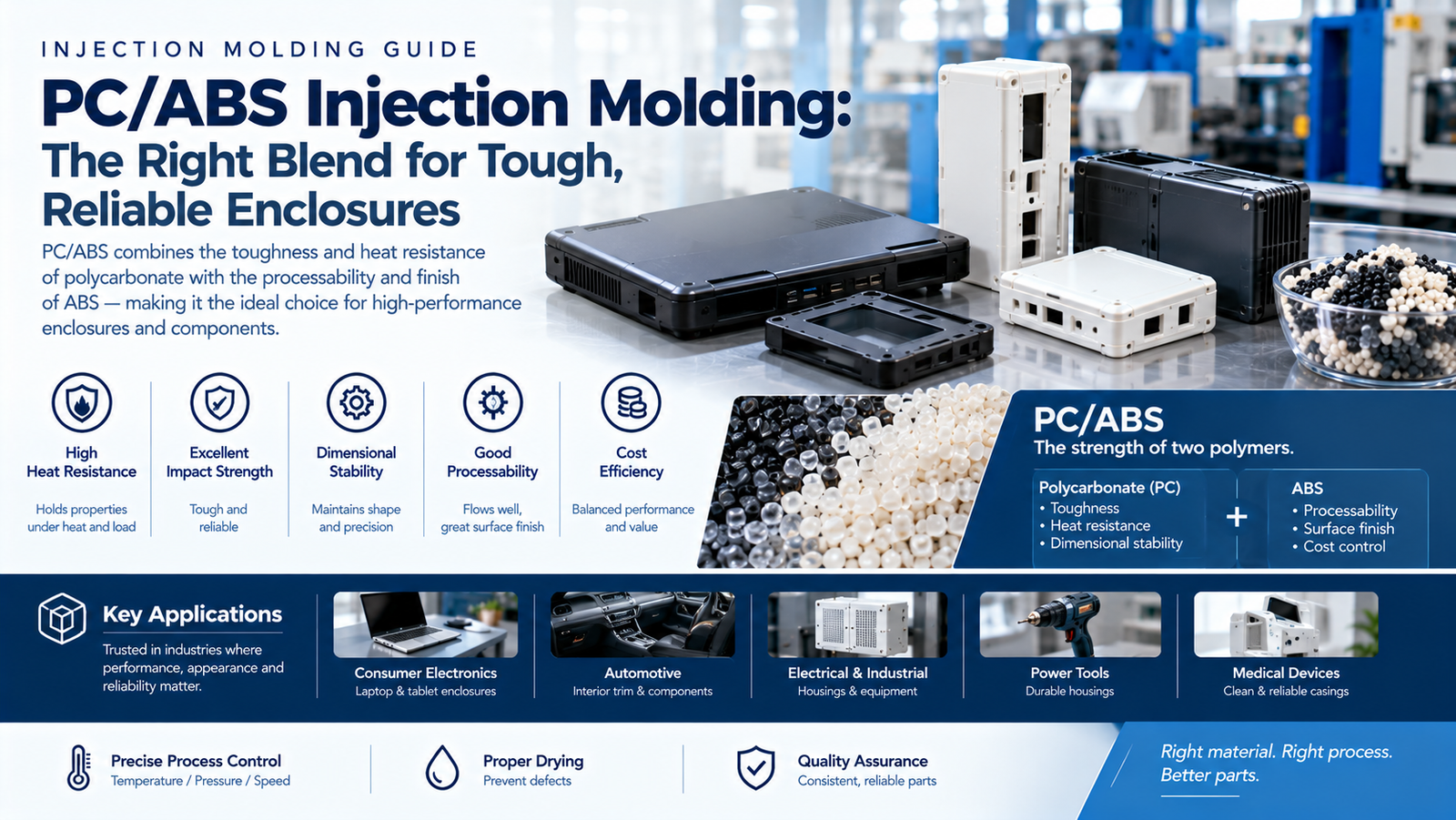
Blending polycarbonate into ABS raises heat resistance to 100 – 110 °C and nearly doubles impact strength, at roughly half the cost of pure PC. The blend also moulds more easily than PC and takes paint and plating almost as well as ABS.
Blend ratio is the design lever: more PC buys toughness and heat, more ABS buys flow and cost. Ratios between 60/40 and 80/20 cover most electronics housings. See PC/ABS injection moulding for ratio selection, drying and defect control.
Use PC/ABS when ABS is not quite tough or not quite hot enough, and PC is overkill.
PP: chemical resistance and living hinges
Polypropylene is the cheapest engineering-adjacent thermoplastic and the only one on this list that will survive a living hinge through a million cycles. It resists acids, bases, alcohols and most solvents that destroy ABS and PC, which is why it dominates caps, closures, containers, battery cases and under-hood fluid parts.
The price is high shrinkage (1.0 – 2.5%) and severe warpage on anything with uneven walls. PP also has poor UV resistance without stabilisers and cannot be painted or glued without surface treatment. Our PP injection moulding guide covers shrinkage prediction and warp control.
Use PP when the part sees chemicals, flexes repeatedly, or the volume demands the lowest resin cost.
POM: friction, fatigue and dimensional stability
Acetal — POM — is the material for gears, cams, bushings, sliders, clips and pump components. It has a low coefficient of friction, excellent fatigue resistance, high crystallinity and very low moisture absorption, so dimensions stay put in humid or wet service.
POM demands respect in processing. It degrades rapidly above 230 °C, releasing formaldehyde, and it must never be left sitting hot in the barrel. Shrinkage is high and anisotropic (1.8 – 2.5%), so tool dimensions need material-specific correction. Our guide to POM injection moulding sets out the grades, the drying rules and the degradation limits.
Use POM when the part moves, rubs, or must hold tolerance in humid conditions.
PMMA: optical clarity that lasts
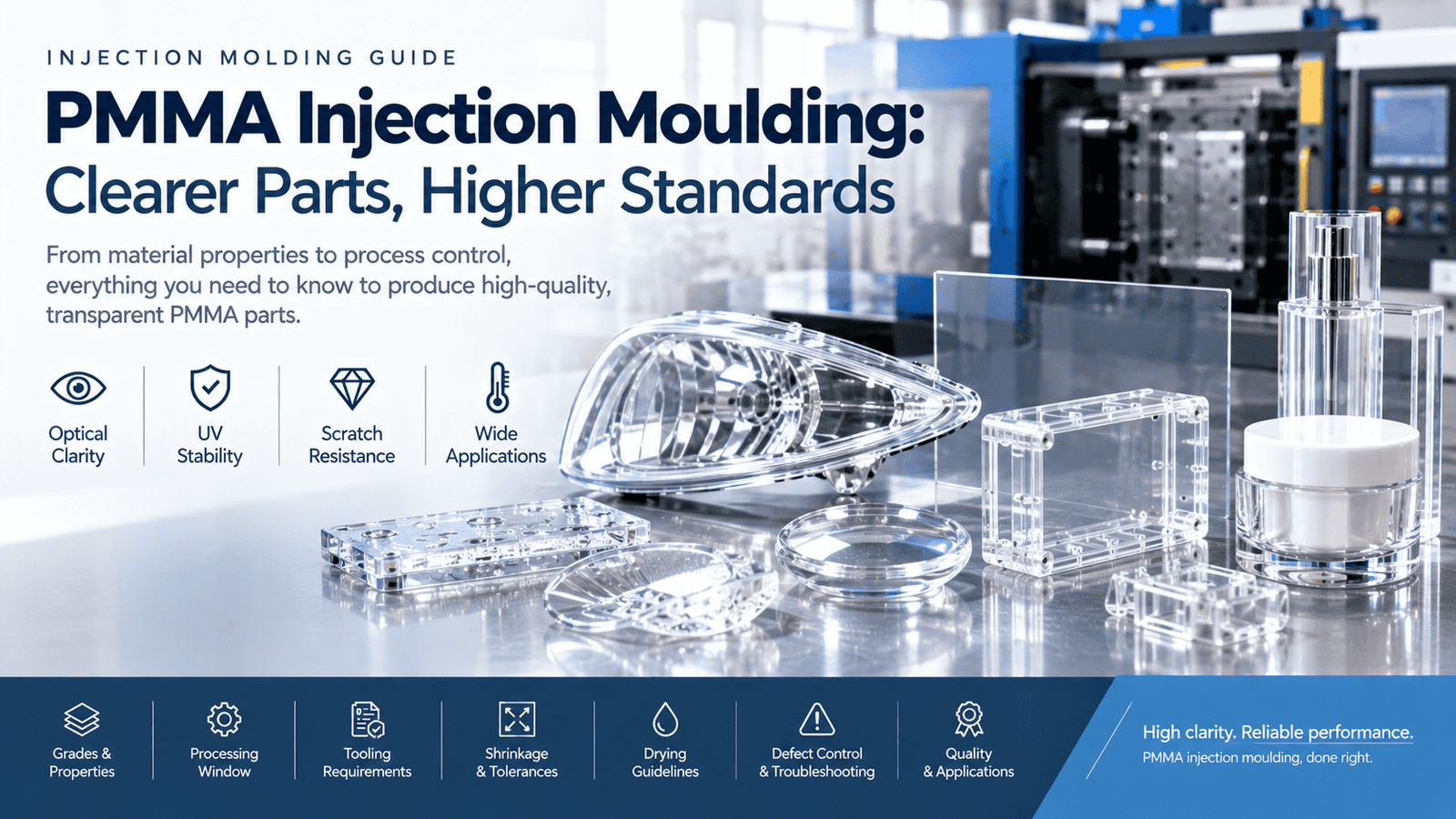
Acrylic transmits 92% of visible light — more than ordinary PC — and it resists UV yellowing far better, which is why it is used for lenses, light guides, display windows, covers and automotive lighting. Surface hardness is also higher than PC, so it resists scratching.
The trade-off is brittleness: PMMA has low impact strength and stress-crazes easily around gates, inserts and sharp corners. It also needs thorough drying and a hot mould (60 – 90 °C) to avoid flow marks and internal stress. See PMMA injection moulding for the clarity-critical process window.
Use PMMA when optical quality and UV stability matter more than impact resistance.
PPS: high temperature plus chemical resistance
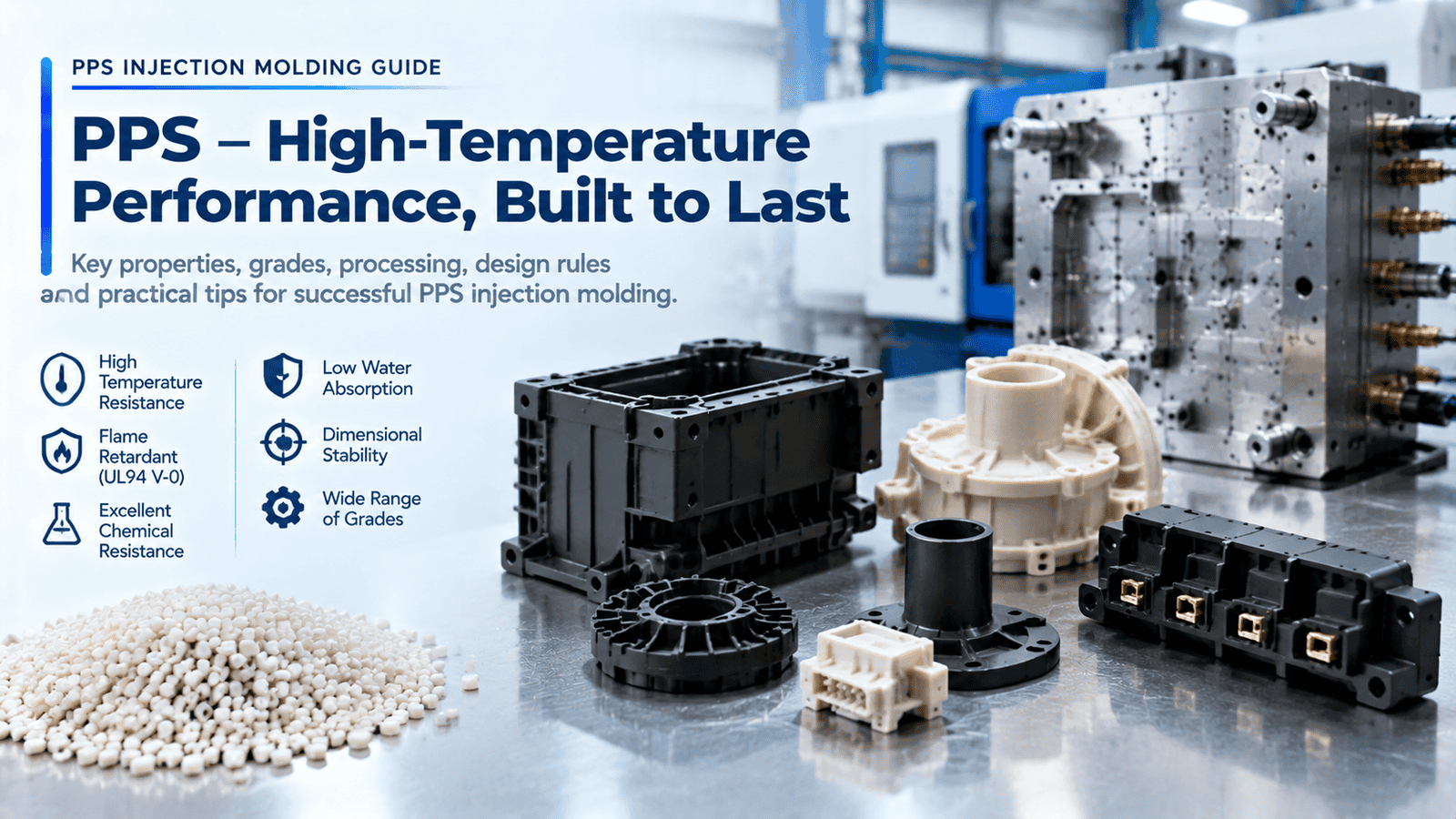
Polyphenylene sulphide holds 200 – 220 °C continuously, is inherently flame retardant to UL94 V-0 without additives, resists almost every solvent and acid, and absorbs very little water. Unfilled PPS is brittle; glass- and mineral-filled grades are the norm for pump housings, valve bodies, connectors, sensor shells, busbars and induction cooker parts.
PPS crystallises fast and needs high mould temperatures (130 – 150 °C) to reach full properties. Our PPS injection moulding guide covers grade choice, crystallinity control and the halogen-free requirement.
Use PPS when the part must work above 150 °C in aggressive chemistry or must pass V-0 without additives.
PEEK: the extreme end
PEEK is the material you specify when nothing else survives: 250 – 260 °C continuous, excellent creep resistance, near-universal chemical resistance, low outgassing and biocompatibility grades for medical use. It is also five to ten times the price of PPS and needs melt temperatures of 360 – 400 °C with mould temperatures above 170 °C.
Processing is the challenge — PEEK must be dried at 150 – 200 °C for several hours and processed in a hot tool, otherwise crystallinity and dimensional stability suffer. See PEEK injection moulding for grades, tooling and the processing window.
Use PEEK only when the application genuinely needs the top of the performance envelope.
How to choose: a five-step method
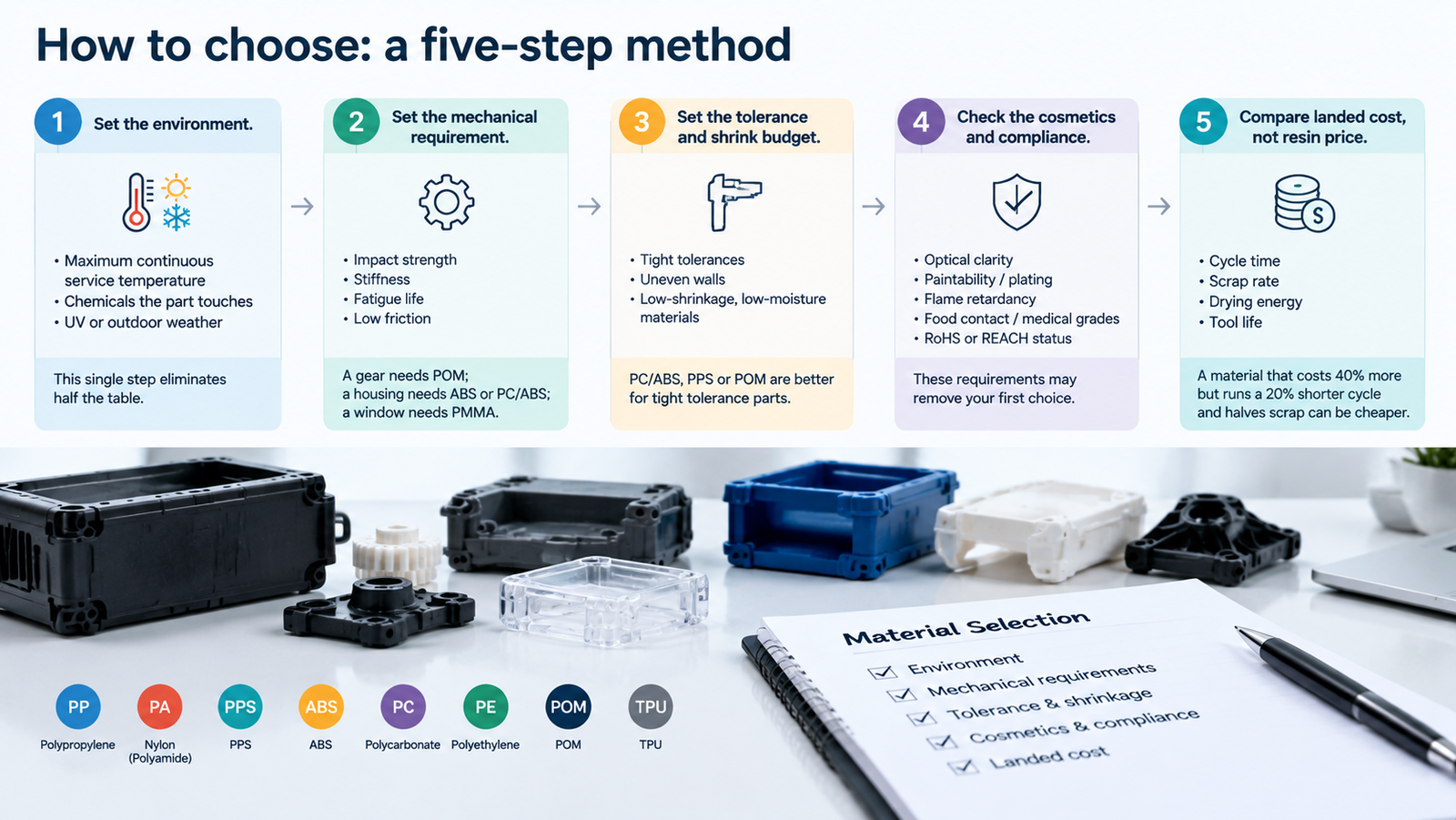
Step 1 — Set the environment. Write down the maximum continuous service temperature, the chemicals the part touches, and whether it sees UV or outdoor weather. This single step eliminates half the table.
Step 2 — Set the mechanical requirement. Does it need impact strength, stiffness, fatigue life, or low friction? A gear needs POM; a housing needs ABS or PC/ABS; a window needs PMMA.
Step 3 — Set the tolerance and shrink budget. Tight tolerances plus uneven walls favour low-shrinkage, low-moisture materials such as PC/ABS, PPS or POM. Wide-tolerance, large parts can accept PP.
Step 4 — Check the cosmetics and compliance. Optical clarity, paintability, plating, flame retardancy, food contact, medical grades and RoHS or REACH status may remove your first choice.
Step 5 — Compare landed cost, not resin price. Resin price is typically 30 – 50% of part cost. Cycle time, scrap rate, drying energy and tool life often reverse the ranking. A material that costs 40% more but runs a 20% shorter cycle and halves scrap can be the cheaper part.
The four mistakes that cause most failures
Choosing on resin price alone. A cheap resin with a 25% scrap rate is more expensive than an engineering grade that runs clean.
Ignoring moisture. PC, PMMA, PPS, PEEK and PA all hydrolyse. Drying is not optional — it is part of the material specification.
Forgetting shrinkage anisotropy. POM, PP and glass-filled grades shrink differently along and across flow. Tools must be corrected per material and per gate position.
Assuming the data sheet is the part. Data sheets describe ISO or ASTM test bars. Real parts have weld lines, corners, gates and varying wall thickness — expect 50 – 70% of the data sheet strength at a weld line.
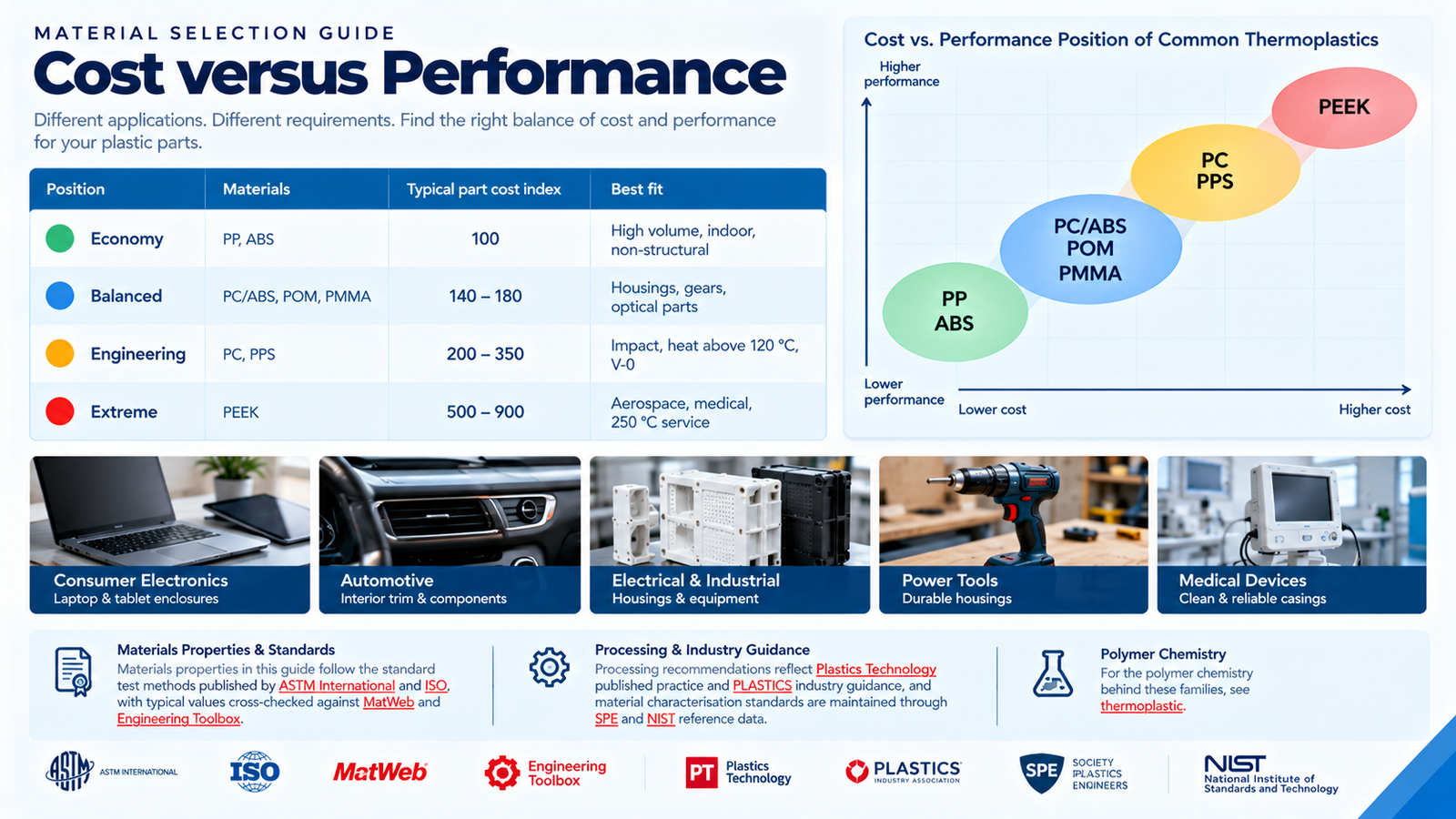
Cost versus performance
| Position | Materials | Typical part cost index | Best fit |
|---|---|---|---|
| Economy | PP, ABS | 100 | High volume, indoor, non-structural |
| Balanced | PC/ABS, POM, PMMA | 140 – 180 | Housings, gears, optical parts |
| Engineering | PC, PPS | 200 – 350 | Impact, heat above 120 °C, V-0 |
| Extreme | PEEK | 500 – 900 | Aerospace, medical, 250 °C service |
Materials properties in this guide follow the standard test methods published by ASTM International and ISO, with typical values cross-checked against MatWeb and Engineering Toolbox. Processing recommendations reflect Plastics Technology published practice and PLASTICS industry guidance, and material characterisation standards are maintained through SPE and NIST reference data. For the polymer chemistry behind these families, see thermoplastic.
Which material is cheapest for injection moulding?
Polypropylene is normally the lowest-cost resin among engineering-adjacent thermoplastics, followed by ABS and high-impact polystyrene. But part cost depends on cycle time and scrap as much as resin price — a cheap material that runs slowly or produces high scrap can cost more per good part than a mid-range grade.
Can I use one material for both a housing and a gear in the same assembly?
Usually not. Housings favour ABS or PC/ABS for cost, finish and impact; gears favour POM for friction, fatigue and dimensional stability. Using a housing material for a gear typically leads to wear, noise and premature failure.
How much does glass filling change the properties?
Glass fibre raises tensile strength and stiffness substantially and cuts shrinkage, but it also reduces elongation, increases anisotropy and abrasion, and dulls surface finish. Glass-filled grades need hardened tools and larger gates.
What is the maximum service temperature I should design to?
Design to 20 – 30 °C below the continuous service temperature on the data sheet, and check the heat deflection temperature under the actual load. A material rated 120 °C may deflect at 95 °C under a bending load.
Do I need a different tool for each material?
The tool geometry can usually be reused, but shrinkage correction, gate size, cooling layout and surface finish may need adjustment. Moving from ABS to a glass-filled grade, for example, normally requires hardened steel and larger gates.
How do I verify the material actually delivered matches the specification?
Ask for the lot certificate, check the melt flow index against the data sheet, and run a first-article inspection with dimensional and mechanical checks. For regulated industries, request RoHS and REACH declarations plus any UL yellow card for the specific grade.
Conclusion
Material selection is where cost, performance and manufacturability are decided, and it is cheaper to get right on paper than in a tool. Set the environment first, then the mechanical duty, then the tolerance budget — the table above will usually narrow eight families to two candidates, and the five-step method settles the choice.
At Rui Cheng we mould all eight families on 80 to 1,400 tonne machines, with in-house tooling, ±0.02 mm tolerance capability and ISO 9001 / IATF 16949 processes. If you send us your part drawing, application conditions and annual volume, we will come back with a material recommendation, a process window and an indicative part cost — usually within 24 hours.
For the material-specific detail, start with the guide for the family you are considering: ABS, PC, PC/ABS, PP, POM, PMMA, PPS or PEEK.