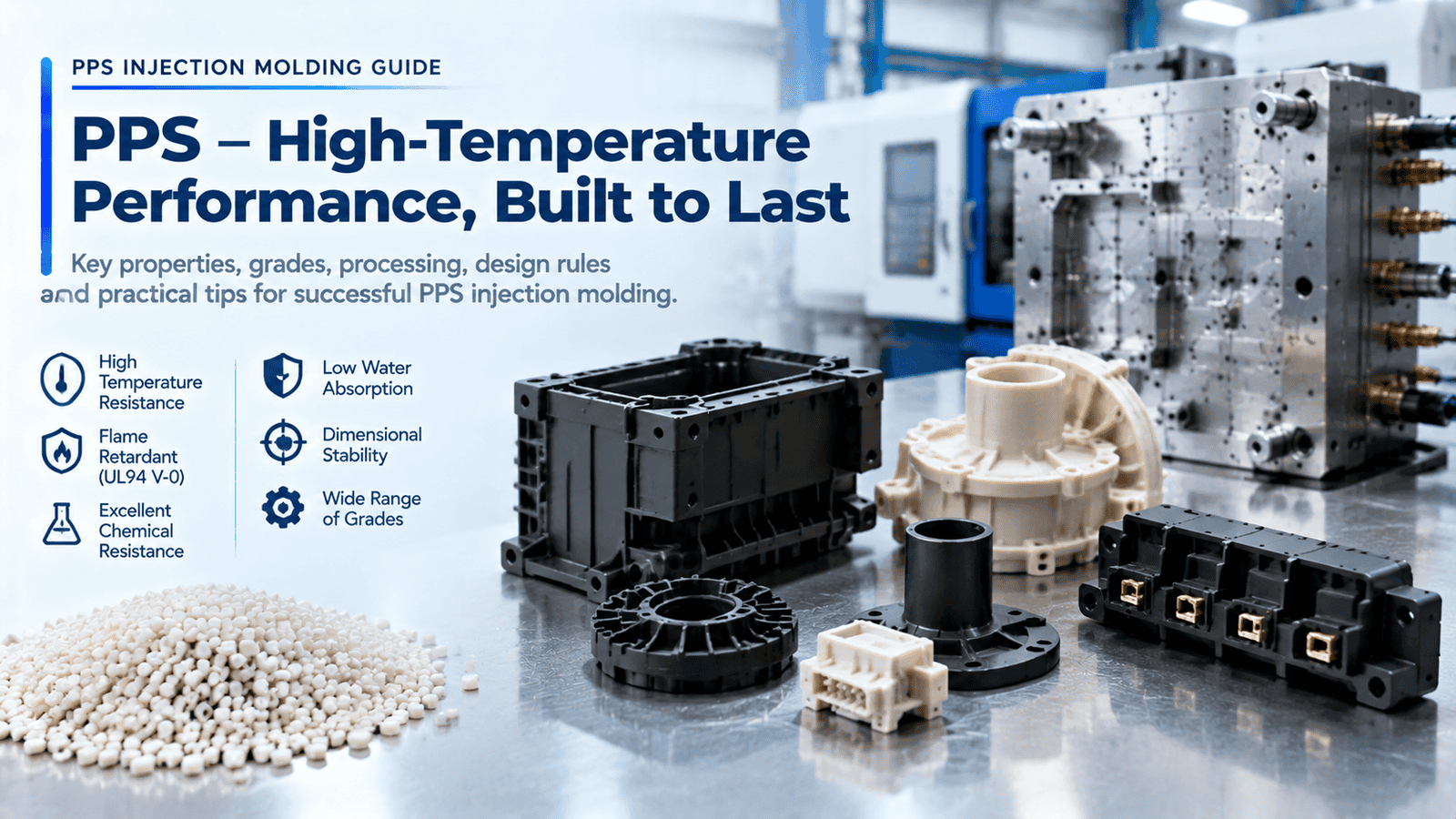
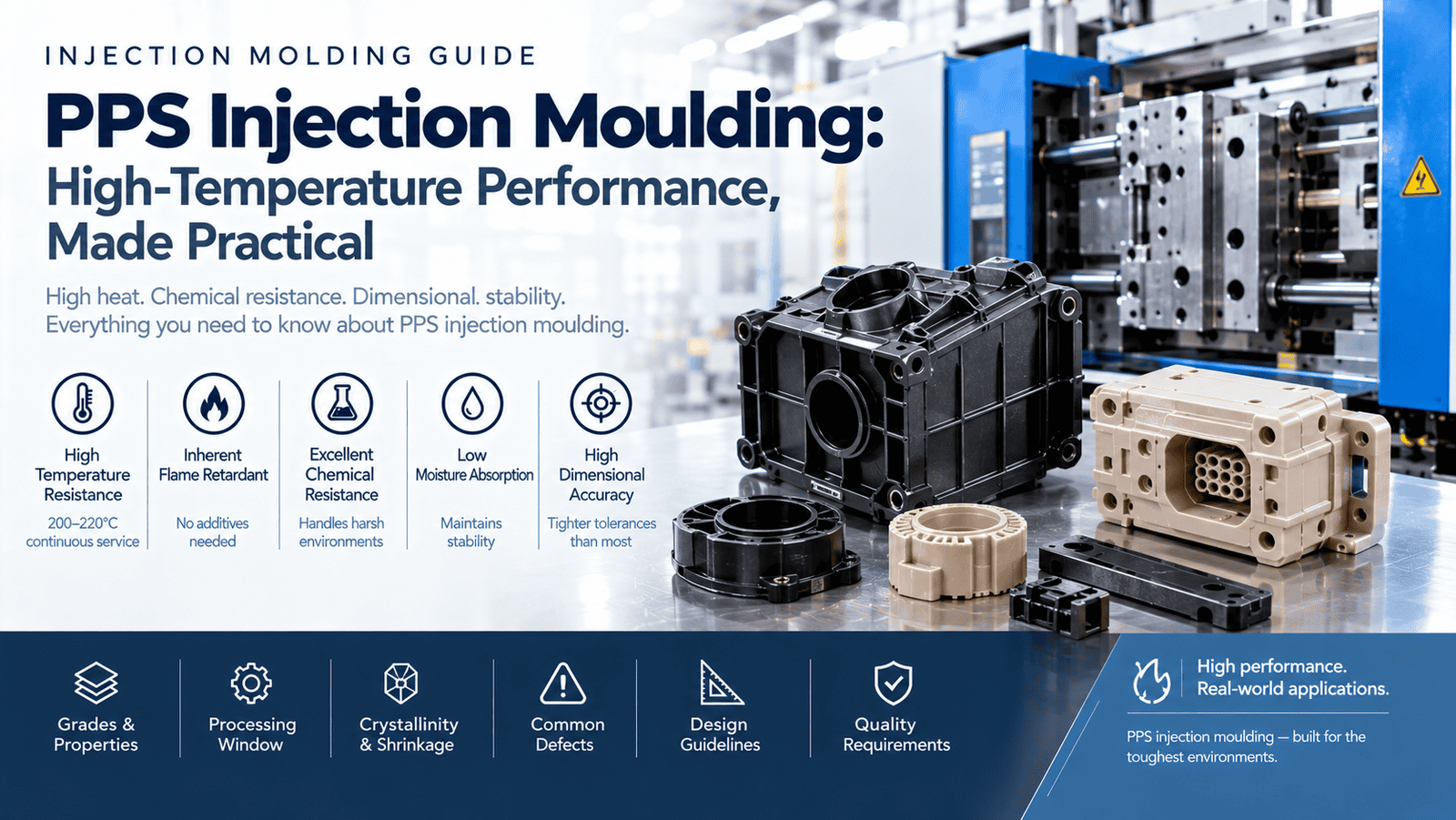
PPS — polyphenylene sulfide — is the workhorse of high-temperature engineering plastics. It holds its properties at continuous service temperatures around 200 to 220 °C, is inherently flame retardant without additives, resists almost every chemical a plant will handle, absorbs almost no water, and holds tolerances better than most semi-crystalline materials. It is the reason induction cooker brackets, bus bar insulation, chemical pump components and automotive under-bonnet parts can be moulded instead of machined or made in metal.
It is also brittle, expensive, and demanding to process: melt temperatures of 300 to 340 °C, a mould held at 130 to 150 °C, and a material that will happily flash through any tool with inadequate clamping. This guide covers grades, properties, the processing window, crystallinity, shrinkage, defects, design rules and quality requirements for PPS injection moulding.
Why PPS Is Specified
| Property | Typical value | What it does for the part |
|---|---|---|
| Continuous service temperature | 200 to 220 °C | Replaces metal and higher-cost polymers in hot locations |
| Heat deflection temperature | 250 to 265 °C at 1.82 MPa (glass filled) | Holds shape under load at soldering and under-bonnet temperatures |
| Flammability | Inherently UL94 V-0, no additives required | Meets electrical safety standards without FR packages |
| Chemical resistance | Outstanding — no known solvent below 200 °C | Chemical pumps, valves, process equipment |
| Water absorption | About 0.02 percent | Dimensions and electrical properties stay stable in humid service |
| Dimensional stability | Excellent, low CLTE in filled grades | Tight-tolerance parts that stay tight |
| Creep resistance | Very good, retained at temperature | Load-bearing parts in hot service |
| Density | About 1.35 g per cubic centimetre (unfilled) | Light compared with the metals it replaces |
| Impact | Brittle, notch sensitive | The main design limitation |
| Cost | High — several times PBT or PA66 | Justified only where heat or chemistry demands it |
The comparison that matters: PPS is roughly the same price bracket as PEEK's cheaper cousins and a fraction of PEEK's cost, while covering the majority of high-temperature electrical and chemical applications. Where 220 °C is enough, PPS is usually the correct answer.
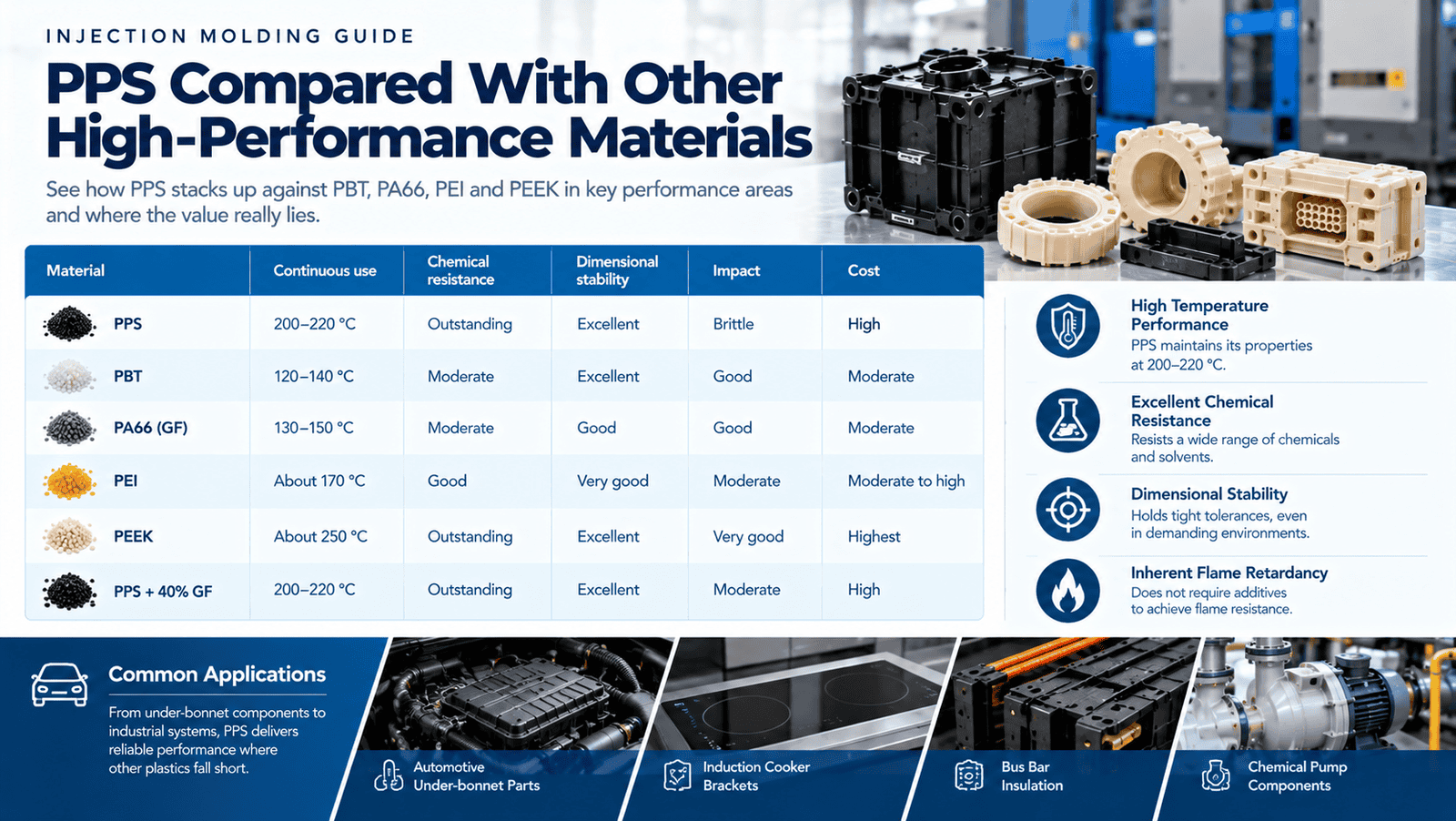
PPS Compared With Other High-Performance Materials
| Material | Continuous use | Chemical resistance | Dimensional stability | Impact | Cost |
|---|---|---|---|---|---|
| PPS | 200-220 °C | Outstanding | Excellent | Brittle | High |
| PBT | 120-140 °C | Moderate | Excellent | Good | Moderate |
| PA66 (GF) | 130-150 °C | Moderate | Good | Good | Moderate |
| PEI | About 170 °C | Good | Very good | Moderate | Moderate to high |
| PEEK | About 250 °C | Outstanding | Excellent | Very good | Highest |
| PPS + 40% GF | 200-220 °C | Outstanding | Excellent | Moderate | High |
The three-way comparison of PA66, PBT and PPS for automotive components is the one most under-bonnet projects actually need, and it sets out where the PPS premium pays back and where it does not.
PPS Grades and What Each One Is For
| Grade | What it adds | Typical use |
|---|---|---|
| Unfilled (neat) | Maximum chemical resistance and elongation | Chemical process components, linings |
| Glass filled 40% | High stiffness, low CLTE, excellent creep resistance | Structural electrical parts, pump housings |
| Glass and mineral filled | Low warpage, tight tolerances, good surface | Precision parts, bus bar supports |
| Impact modified | Improved toughness at some cost in stiffness | Parts exposed to assembly damage |
| Conductive / dissipative | ESD control | Electronics handling, semiconductor equipment |
| Thermally conductive | Heat spreading | Power electronics, LED modules |
| Food and medical grades | Compliance documentation | Food processing, medical equipment |
Glass filled grades dominate industrial use. Unfilled PPS is chosen for chemical resistance, not for strength — it is brittle and has limited elongation.
The Processing Window
| Parameter | Typical range | Note |
|---|---|---|
| Drying | 120 to 150 °C for 3 hours | PPS absorbs very little water, but drying is standard practice before processing |
| Melt temperature | 300 to 340 °C | High-temperature machine with corrosion-resistant screw and barrel |
| Mould temperature | 130 to 150 °C | Oil-heated tooling; mould temperature drives crystallinity and dimensional stability |
| Injection speed | Moderate to fast | PPS freezes quickly — hesitation produces short shots and weak welds |
| Hold pressure | Moderate to high | Parts are usually thin-walled with tight tolerances |
| Back pressure | Low to moderate | Avoid unnecessary shear heat |
| Residence time | Short | PPS is thermally stable but long dwell times cause discoloration |
| Regrind | Limited and re-dried | Degraded PPS loses the properties it was specified for |
| Tool steel | Hardened, corrosion-resistant | High melt and mould temperatures stress conventional tooling |
| Clamping force | Generous | High melt viscosity and thin walls demand it |
The parameter that decides whether a PPS part performs as specified is mould temperature. Running a PPS tool at 90 °C instead of 140 °C produces lower crystallinity, poorer chemical resistance, worse dimensional stability and a lower service temperature — all of the reasons the material was chosen in the first place.
Crystallinity, Annealing and Dimensional Stability
PPS is semi-crystalline, and its useful properties depend on reaching a sufficient degree of crystallinity. That is achieved through a hot mould and, where the geometry demands it, a post-mould anneal.
| Approach | Effect | When to use |
|---|---|---|
| Mould at 130-150 °C | Develops crystallinity in the tool | Default for production |
| Mould below 120 °C | Amorphous skin, lower chemical resistance, dimensionally unstable in service | Avoid for functional parts |
| Post-mould annealing | Completes crystallinity, relieves stress | Thick sections, tight-tolerance parts, parts exposed to hot solvents |
| Controlled cooling | Reduces internal stress and warpage | Large, flat or thin-walled parts |
Parts that look correct coming out of a cold tool can change dimension in service as they crystallise further. Where the tolerance matters, specify the mould temperature and the annealing condition on the drawing.
Shrinkage and Tolerances
| Grade | Typical shrinkage |
|---|---|
| Unfilled | 0.5 to 0.7 percent |
| Glass filled 40% | 0.1 to 0.3 percent, with strong directionality |
| Glass and mineral filled | 0.2 to 0.4 percent, more uniform |
| Conductive grades | 0.2 to 0.5 percent |
Three practical rules:
- Use the grade-specific data at the intended mould temperature — PPS shrinkage changes with crystallinity, so a value quoted at a cold mould is wrong for a hot one.
- Expect strong flow and cross-flow differences in glass filled grades. Gate position then decides which direction dominates, which is why mineral-filled grades are preferred for flat, tight-tolerance parts.
- Measure after stabilisation and, where specified, after annealing. PPS parts can move after moulding if crystallinity is incomplete.
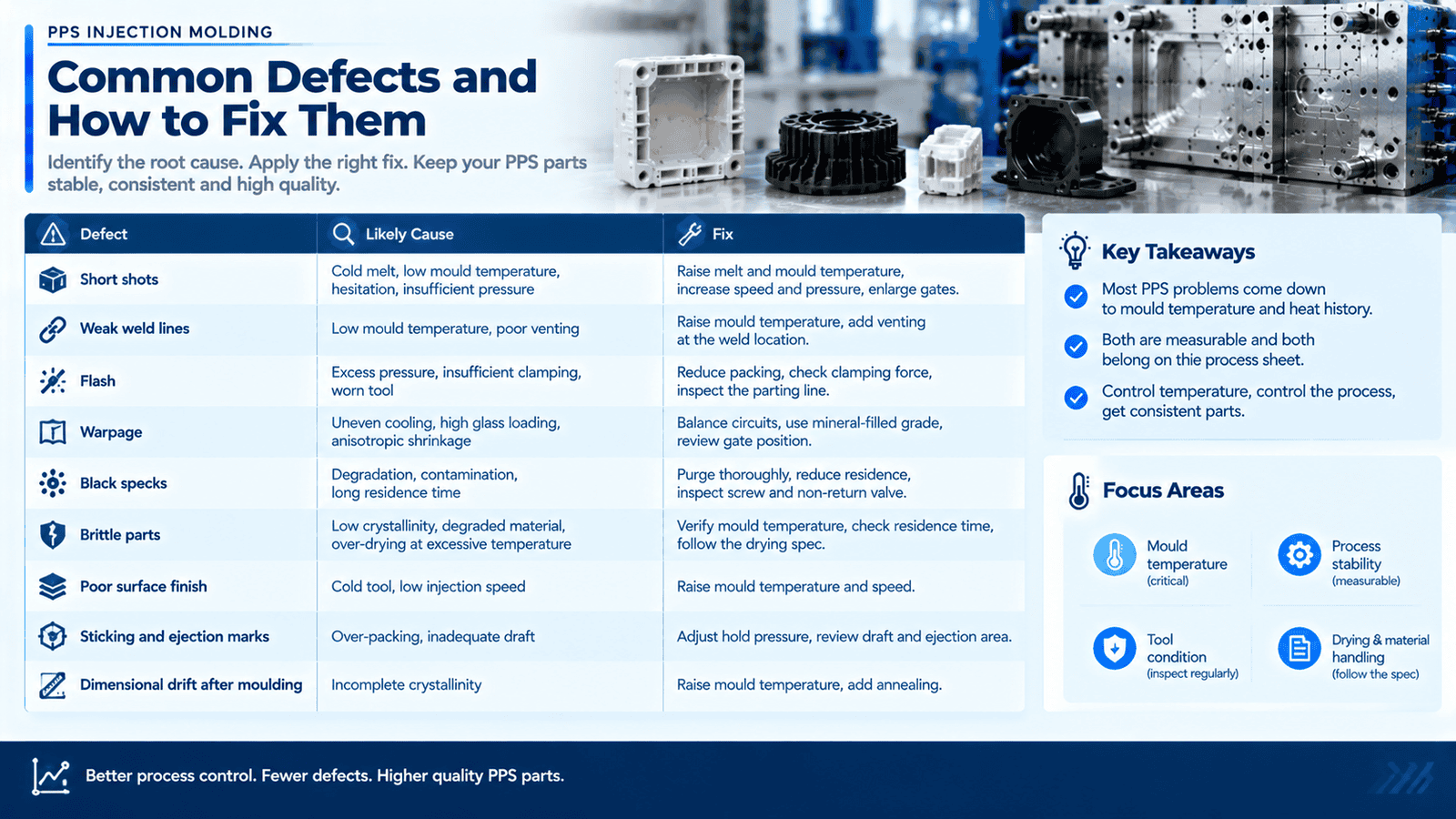
Common Defects and How to Fix Them
| Defect | Likely cause | Fix |
|---|---|---|
| Short shots | Cold melt, low mould temperature, hesitation, insufficient pressure | Raise melt and mould temperature, increase speed and pressure, enlarge gates |
| Weak weld lines | Low mould temperature, poor venting | Raise mould temperature, add venting at the weld location |
| Flash | Excess pressure, insufficient clamping, worn tool | Reduce packing, check clamping force, inspect the parting line |
| Warpage | Uneven cooling, high glass loading, anisotropic shrinkage | Balance circuits, use mineral-filled grade, review gate position |
| Black specks | Degradation, contamination, long residence time | Purge thoroughly, reduce residence, inspect screw and non-return valve |
| Brittle parts | Low crystallinity, degraded material, over-drying at excessive temperature | Verify mould temperature, check residence time, follow the drying spec |
| Poor surface finish | Cold tool, low injection speed | Raise mould temperature and speed |
| Sticking and ejection marks | Over-packing, inadequate draft | Adjust hold pressure, review draft and ejection area |
| Dimensional drift after moulding | Incomplete crystallinity | Raise mould temperature, add annealing |
Most PPS problems come down to mould temperature and heat history. Both are measurable and both belong on the process sheet.
Design Rules for PPS Parts
| Feature | Recommendation |
|---|---|
| Nominal wall | 1.5 to 3 mm; uniform, because thin walls fill poorly and thick ones crystallise unevenly |
| Radii | Generous throughout — PPS is notch sensitive and cracks from sharp internal corners |
| Draft | 1 to 2 degrees, more on textured faces |
| Ribs | 50 to 60 percent of nominal wall |
| Bosses | Radiused and ribbed; metal inserts for repeated assembly |
| Gates | Generous and radiused; position to control glass orientation |
| Tool steel | Hardened, corrosion-resistant; thermal expansion designed in |
| Tool heating | Oil circulation capable of 150 °C |
| Insulation | Insulating plates between the hot cavity and the machine platens |
| Tolerance strategy | Write tolerances to the process capability of a hot tool, with a stated measurement condition |
PPS tooling has to survive being hot all day, and the steel, seals, ejector system and sensors all need to be specified for it. A standard water-cooled tool will not hold 140 °C reliably.
Where PPS Wins
- Electrical and electronics — bus bar insulation, coil formers, connector housings, switchgear, semiconductor handling components
- Appliances — induction cooker brackets and heating plate supports, where heat and safety standards both apply
- Automotive — under-bonnet components, pump parts, sensor housings, thermal management parts
- Chemical processing — pump housings, valve bodies, impellers, tower packings exposed to aggressive media
- Industrial equipment — wear rings, seals, bearing cages in hot or chemically aggressive service
- Medical and food — compliant grades for equipment that must withstand repeated sterilisation
The bus bar application is a good illustration of why PPS is chosen: high temperature, V-0 without additives, excellent dielectric strength and dimensional stability under thermal cycling. The induction cooker bracket case is the same story with a household-safety standard attached. Where the requirement is chemistry rather than heat, the corrosion-resistant components PPS can serve in chemical equipment are the applications to look at.
For buyers sourcing to a tolerance rather than a drawing dimension only, the questions worth asking a supplier are set out in our note on finding a reliable PPS low-shrinkage manufacturer.
Quality Control and Documentation
| Requirement | What it involves |
|---|---|
| Incoming material | Grade, batch and certificate of analysis verification |
| Drying records | Time and temperature logged, material kept dry to the feed throat |
| Process records | Melt temperature, mould temperature, hold and cycle parameters |
| Crystallinity | Verified by DSC where the application depends on it |
| Dimensional inspection | CMM or optical measurement after stabilisation, and after annealing where specified |
| Dielectric testing | Where the part is an insulator, verified against the requirement |
| Flammability evidence | UL yellow card for the specific grade and colour |
| Traceability | Resin lot to shipped carton, retained for the agreed period |
| Change control | Material, tool or process changes re-qualified before production |
For PPS, the documentation matters as much as the part. Buyers of high-temperature electrical components are audited, and a supplier who cannot produce a traceable process record is not supplying that market.
Conclusion
PPS covers the wide middle ground of high-temperature engineering plastics: 200 to 220 °C continuous service, inherent V-0, outstanding chemical resistance, almost no water absorption and excellent dimensional stability, at a fraction of PEEK's cost. It is specified where PBT and PA66 run out of temperature and where PEEK would be over-specified — bus bars, induction cooker brackets, chemical pump parts and under-bonnet components.
Moulding it well is a matter of two disciplines: running the tool hot enough to develop crystallinity, and keeping the melt clean and inside its window. Both are measurable, both belong on the process sheet, and both determine whether the part delivers the properties the design assumed.
With injection moulding capability from 80 to 1,400 tonnes, in-house tooling and high-temperature process equipment, we mould PPS in unfilled, glass filled, glass and mineral filled, conductive and thermally conductive grades. Through our custom injection moulding services we support high-temperature projects from material selection and tooling design through crystallinity control, dielectric verification and traceable volume production. Send us your part drawing and service conditions — temperature, chemical exposure, dielectric requirement — to discuss the right PPS grade and process.
FAQ
What is PPS injection molding?
PPS injection moulding is the production of parts from polyphenylene sulfide, a semi-crystalline high-performance thermoplastic. It is used where continuous service temperatures of 200 to 220 °C, inherent UL94 V-0 flame retardancy, outstanding chemical resistance or very low water absorption are required — bus bar insulation, induction cooker brackets, chemical pump components and automotive under-bonnet parts.
What temperature does PPS need for injection moulding?
Melt temperature typically runs 300 to 340 °C with a mould temperature of 130 to 150 °C. The mould temperature is not optional: it drives crystallinity, and therefore the chemical resistance, dimensional stability and service temperature the part was specified for. PPS tooling must be oil-heated and designed to operate hot.
Does PPS need drying before moulding?
PPS absorbs very little water — around 0.02 percent — but drying at 120 to 150 °C for 3 hours is standard practice before processing, and material should be kept dry up to the feed throat. Moisture produces splay and surface defects, and at PPS's material cost it is not worth risking a production run on an undried pellet.
What is the shrinkage rate of PPS?
Unfilled PPS shrinks about 0.5 to 0.7 percent. Glass filled 40 percent grades shrink 0.1 to 0.3 percent with strong directionality, and glass and mineral filled grades 0.2 to 0.4 percent with better uniformity. Shrinkage depends on crystallinity and therefore on mould temperature, so use grade data obtained at the mould temperature you will actually run.
Why are PPS parts brittle?
Unfilled PPS is inherently brittle with limited elongation, and it is notch sensitive — sharp internal corners concentrate stress and crack. Impact-modified grades improve toughness at some cost in stiffness. Design measures matter as much as grade choice: generous radii, ribbed bosses, uniform walls and avoiding sharp transitions will prevent most field failures.
Can PPS replace PEEK?
For many applications, yes. PPS offers 200 to 220 °C continuous service, outstanding chemical resistance and inherent V-0 at a fraction of PEEK's cost, and covers the majority of high-temperature electrical and chemical applications. PEEK remains the right choice where the temperature ceiling approaches 250 °C, where hydrolysis resistance under steam is required, or where wear performance and impact strength must be higher.