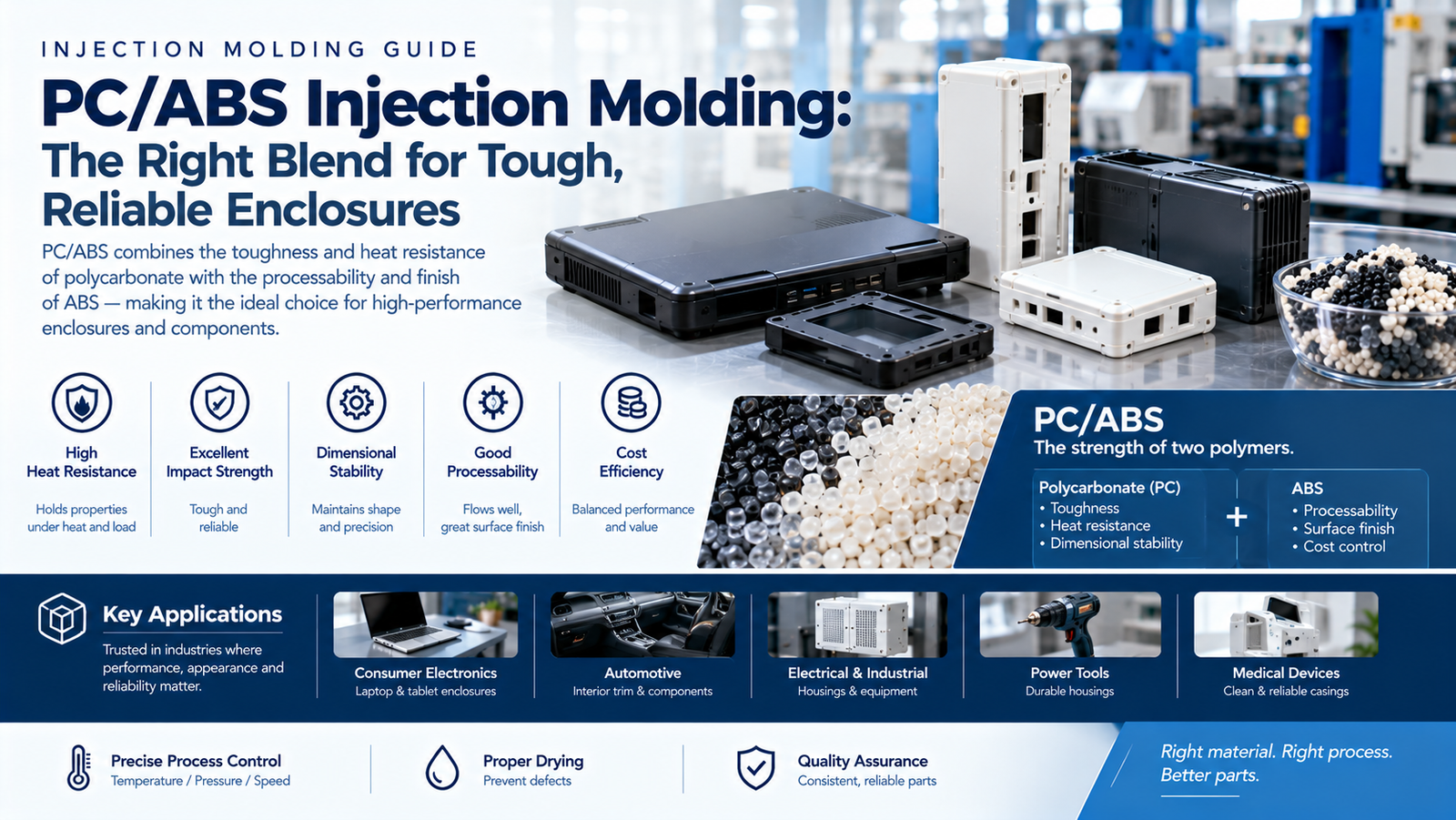
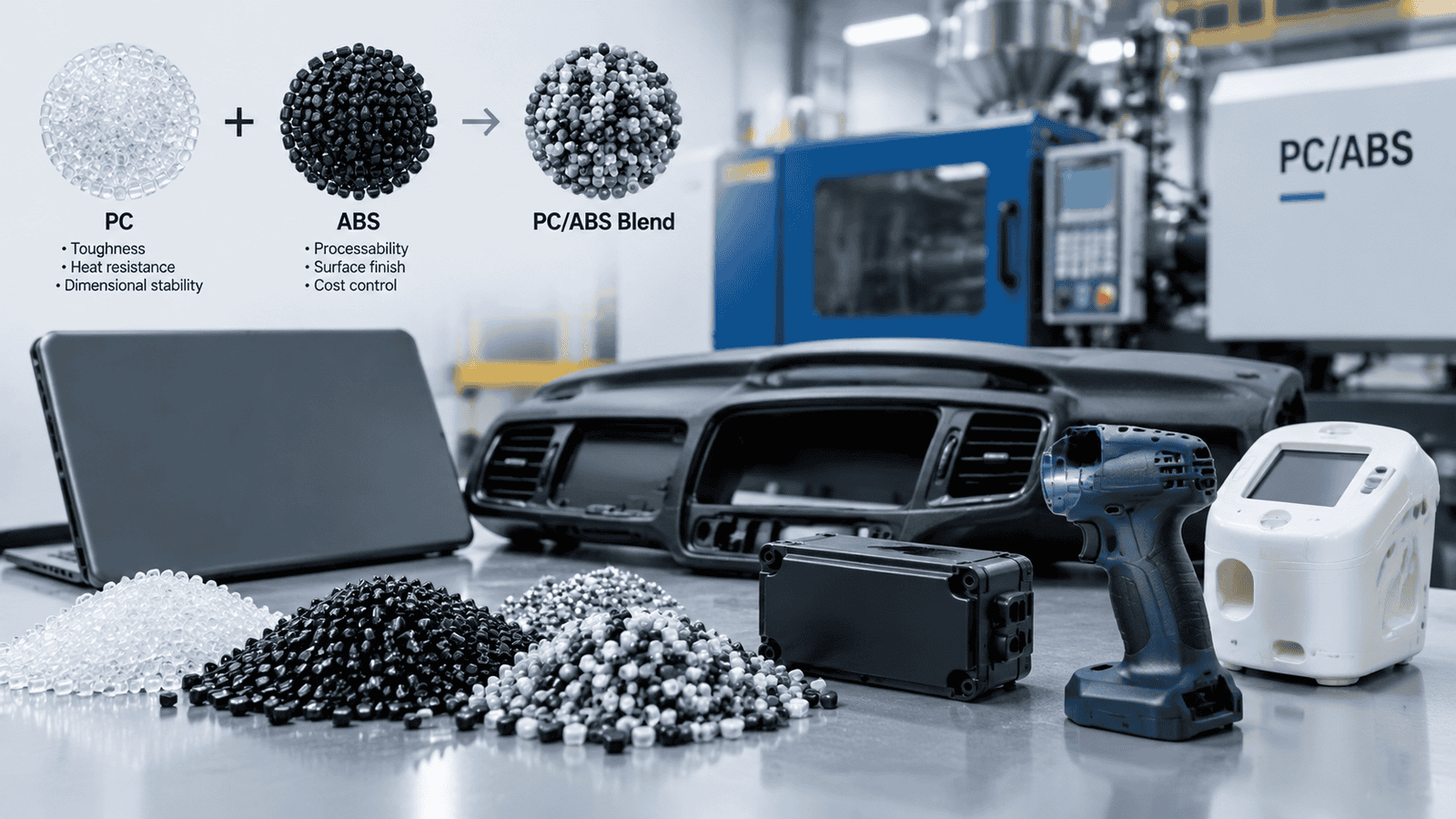
PC/ABS is not a polymer — it is a blend, engineered so that polycarbonate supplies toughness, heat resistance and dimensional stability while ABS supplies processability, surface finish and cost control. It is the material behind laptop and tablet enclosures, automotive interior trim, electrical housings, power tools and medical device casings, and it is one of the most widely specified engineering blends in the world.
It is also one of the least forgiving materials to run badly. Two polymers in one pellet means two melt behaviours, two shrinkage tendencies and a moisture sensitivity that punishes any shortcut in drying. This guide covers what PC/ABS actually is, how blend ratios change the properties, the processing window, drying, defect control, design rules and quality requirements.
What PC/ABS Actually Is
PC/ABS is a physical blend of polycarbonate and acrylonitrile butadiene styrene, normally compatibilised so that the two phases stay dispersed and do not separate during melt processing.
| Aspect | What it means |
|---|---|
| Composition | Typically 40 to 70 percent polycarbonate with the balance ABS, plus compatibilisers, stabilisers, lubricants and colour |
| Structure | Two-phase, not a copolymer — the properties come from the balance between the phases |
| Why it exists | PC alone is tough but hard to process and expensive; ABS alone is easy to process but limited in heat and impact |
| Resin behaviour | Not interchangeable with plain ABS or plain PC — each blend grade has its own process window |
| Key risk | Incompatibility or poor dispersion shows up as delamination, streaking and inconsistent mechanical performance |
The practical consequence is that a PC/ABS grade is defined by its ratio and its additive package, not by the words on the label. Two suppliers' "PC/ABS 60/40" can behave differently in the same tool.
Property Profile of PC/ABS
| Property | Typical value | Note |
|---|---|---|
| Density | 1.10 to 1.18 g per cubic centimetre | Between PC and ABS |
| Tensile strength | 40 to 65 MPa | Rises with polycarbonate content |
| Flexural modulus | 2.0 to 2.9 GPa | Higher than ABS, lower than unfilled PC |
| Heat deflection temperature | 95 to 125 °C at 1.82 MPa | The main reason PC/ABS replaces ABS in warm or loaded parts |
| Notched impact strength | 40 to 60 kilojoules per square metre | Outstanding, and far better than ABS |
| Shrinkage | 0.4 to 0.7 percent | Low and nearly isotropic compared with semi-crystalline materials |
| Coefficient of linear expansion | Around 6 to 8 times 10 to the minus 5 per degree Celsius | Low, giving good dimensional stability |
| Flame retardancy | Available to UL94 V-0, including halogen-free systems | With trade-offs in impact, heat and colour |
| Surface | Excellent moulded finish, easy to paint and print | Why it dominates consumer electronics |
Compared with ABS, the gains are heat resistance, impact strength and dimensional stability. Compared with polycarbonate, the gains are flow, lower processing temperature, lower cost and easier moulding in thin walls — at the price of peak toughness and clarity.
Blend Ratios and What Each One Buys You
| Ratio (PC / ABS) | Character | Where it is used |
|---|---|---|
| 40 / 60 | Easier flow, lower cost, moderate heat | General housings, low-demand enclosures |
| 50 / 50 | Balanced | General electrical and industrial parts |
| 60 / 40 | Higher heat and impact, still processable | Laptop and peripheral enclosures, automotive trim |
| 70 / 30 | Near-PC performance in heat and impact | Demanding enclosures, thin-wall and structural parts |
| High-heat grades | Heat deflection above 120 °C | Automotive interior parts exposed to sunlight and heat |
| Flame-retardant grades | UL94 V-0, halogenated or halogen-free | Information technology equipment, chargers, appliances |
| Low-gloss and scratch-resistant grades | Textured, matte or hard-wearing surfaces | Automotive interior trim, premium enclosures |
Ratio selection is a design decision with cost consequences: raising polycarbonate content improves heat and impact and raises the price, while also narrowing the process window. Our guide to customising PC/ABS blend ratios for different electronic devices works through that trade-off in detail.
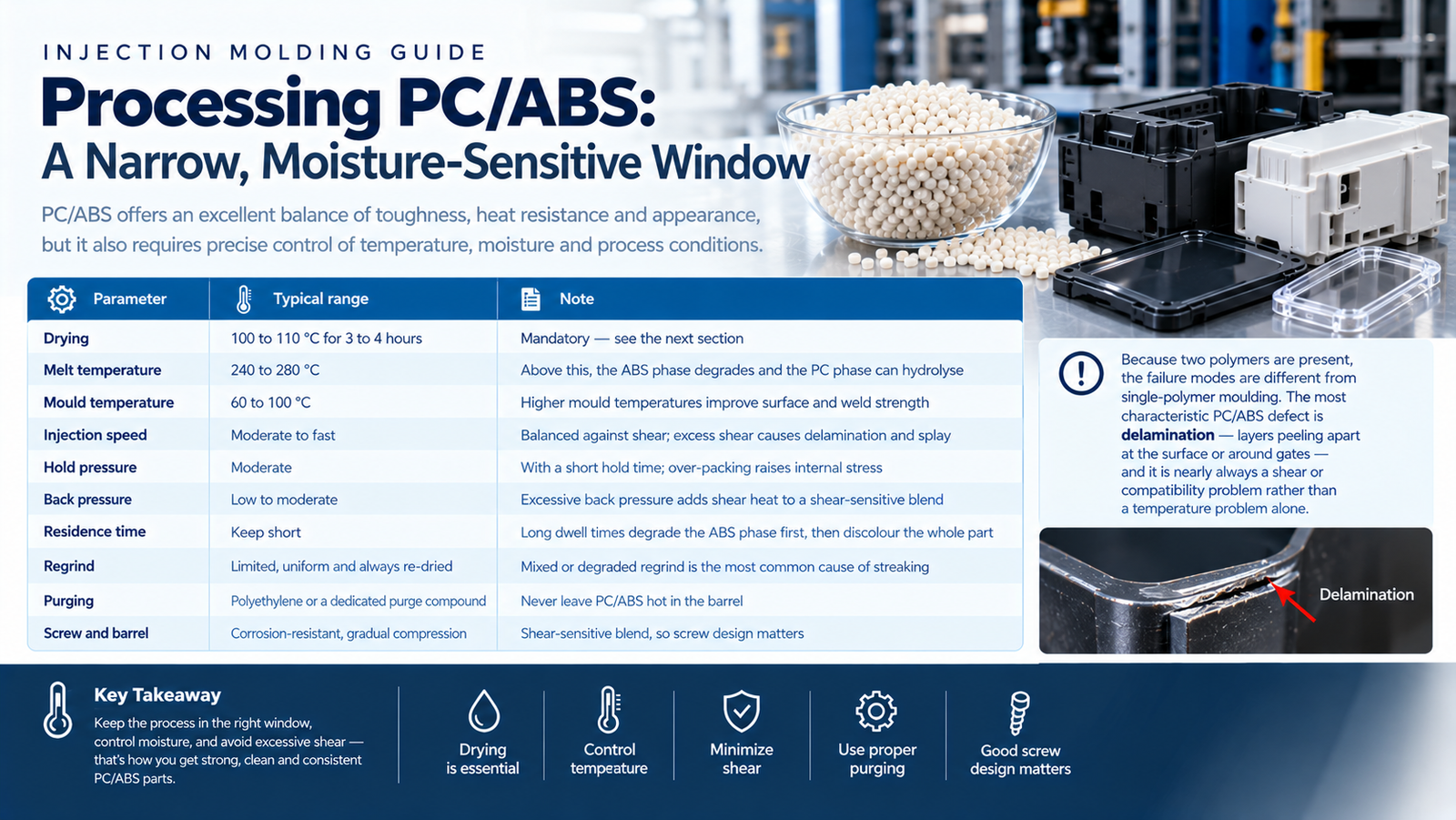
Processing PC/ABS: A Narrow, Moisture-Sensitive Window
| Parameter | Typical range | Note |
|---|---|---|
| Drying | 100 to 110 °C for 3 to 4 hours | Mandatory — see the next section |
| Melt temperature | 240 to 280 °C | Above this, the ABS phase degrades and the PC phase can hydrolyse |
| Mould temperature | 60 to 100 °C | Higher mould temperatures improve surface and weld strength |
| Injection speed | Moderate to fast, balanced against shear | Excess shear causes delamination and splay |
| Hold pressure | Moderate, with a short hold time | Over-packing raises internal stress |
| Back pressure | Low to moderate | Excessive back pressure adds shear heat to a shear-sensitive blend |
| Residence time | Keep short | Long dwell times degrade the ABS phase first, then discolour the whole part |
| Regrind | Limited, uniform and always re-dried | Mixed or degraded regrind is the most common cause of streaking |
| Purging | Polyethylene or a dedicated purge compound | Never leave PC/ABS hot in the barrel |
| Screw and barrel | Corrosion-resistant, gradual compression | Shear-sensitive blend, so screw design matters |
Because two polymers are present, the failure modes are different from single-polymer moulding. The most characteristic PC/ABS defect is delamination — layers peeling apart at the surface or around gates — and it is nearly always a shear or compatibility problem rather than a temperature problem alone.
Our guide to avoiding PC degradation from shear overheating covers the machine-level controls that keep a shear-sensitive material inside its window, and the same discipline applies to the ABS phase in a blend.
Drying Is Not Optional
Polycarbonate hydrolyses. Water in the melt breaks the polymer chains, and the damage is permanent — impact strength drops, splay appears on the surface, and the part looks and behaves like a different material. In a PC/ABS blend, the PC phase carries that risk.
| Situation | Action |
|---|---|
| Sealed, freshly delivered material | Dry per the supplier's data sheet before the first run |
| Opened bags, or material stored in a humid environment | Always dry |
| Regrind | Always dry, and check for degradation |
| High-gloss or transparent-tinted parts | Dry to the lower end of the moisture specification and verify |
| Splay, silver streaks or weak weld lines | Check drying before changing anything else |
| Recurring surface defects | Verify moisture with an analyser, not with a guess |
Drying at 100 to 110 °C for 3 to 4 hours in a desiccant dryer is the normal recommendation, with the material kept dry up to the feed throat. A common mistake is to dry at ABS temperatures: too low for the polycarbonate phase, and the moisture stays in the pellet.
Shrinkage and Dimensional Control
| Grade | Typical shrinkage |
|---|---|
| PC/ABS 40/60 | 0.5 to 0.7 percent |
| PC/ABS 50/50 | 0.5 to 0.7 percent |
| PC/ABS 60/40 | 0.4 to 0.6 percent |
| PC/ABS 70/30 | 0.4 to 0.6 percent |
| Glass filled PC/ABS | 0.2 to 0.4 percent, with directionality |
PC/ABS is amorphous in the polycarbonate phase and only partly crystalline overall, so shrinkage is low and much more uniform than in nylon, POM or polypropylene. Three practical points follow:
- Flow and cross-flow shrinkage are close, so gate position has less effect on warpage than in filled semi-crystalline materials — but not none, especially in glass filled grades.
- Warpage usually comes from cooling imbalance and packing differences, not from the material's inherent anisotropy.
- Measure the first article after stabilisation, and hold the process conditions fixed, because blend batches can vary more than single-polymer grades.
Common Defects and How to Fix Them
| Defect | Likely cause | Fix |
|---|---|---|
| Delamination or surface peeling | Excessive shear, poor dispersion, degraded regrind | Reduce injection speed and back pressure, check screw and gate design, verify regrind quality |
| Splay and silver streaks | Moisture, or thermal degradation | Dry to specification, verify melt temperature and residence time |
| Black specks and discoloration | Overheating, long dwell time, contaminated barrel | Lower melt temperature, shorten residence, purge thoroughly |
| Warpage | Uneven cooling or packing | Balance the cooling circuits, review gate position and hold profile |
| Weak weld lines | Low mould temperature, poor venting | Raise mould temperature, add venting at the weld location |
| Blush or streaks near gates | Local shear, gate too small | Enlarge and radius the gate, slow the fill through the gate |
| Sink marks | Insufficient packing in thick sections | Rework wall thickness, adjust hold pressure and time |
| Colour shift between batches | Blend or pigment inconsistency | Verify resin batch, control regrind ratio, re-qualify the colour |
| Brittle parts | Hydrolysis from wet resin, or degraded material | Verify drying, check residence time and melt temperature |
The pattern across this table is that PC/ABS failures cluster around two root causes: moisture and shear. Both are controlled by the process sheet, and both should be recorded for every production run.
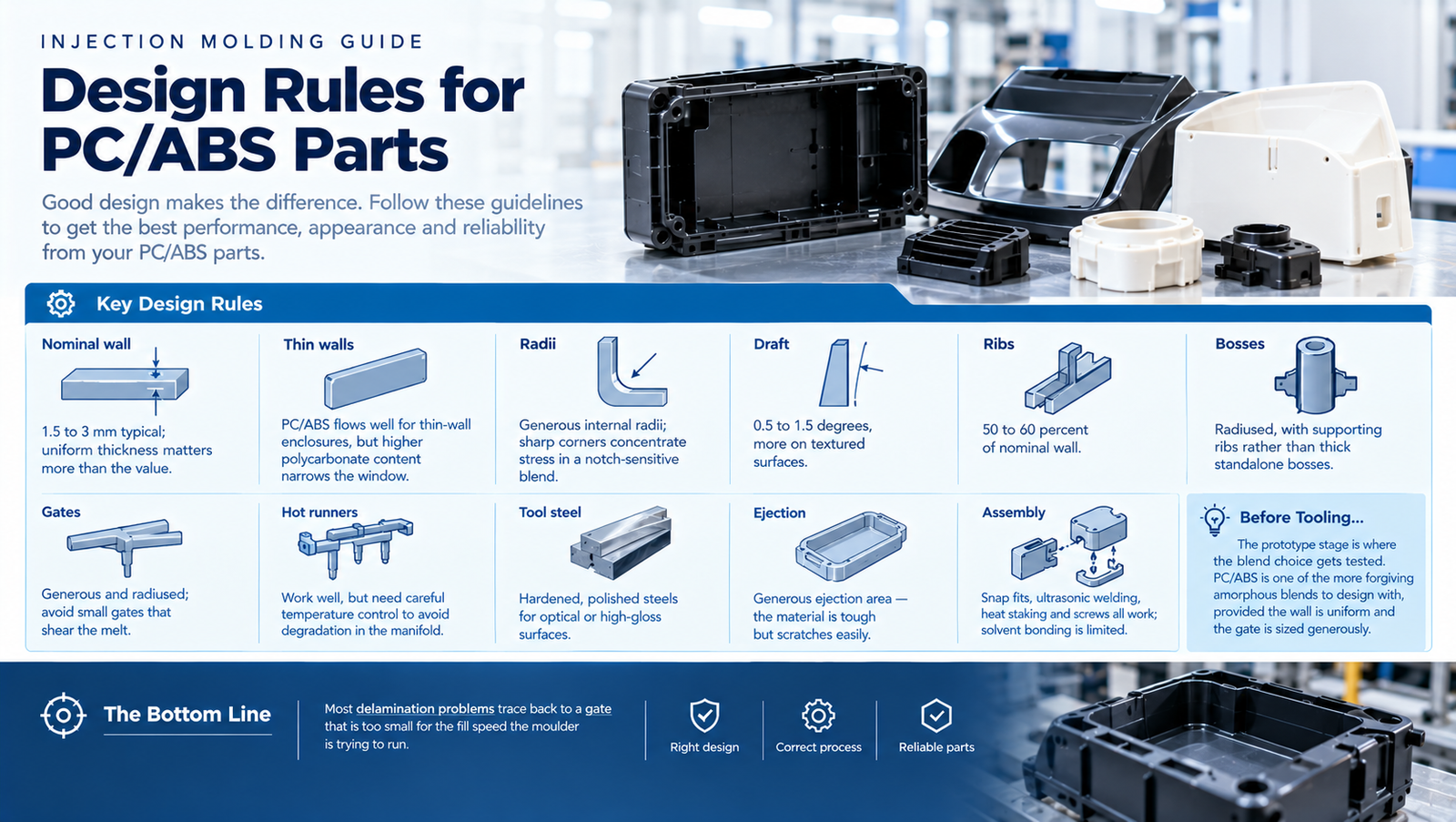
Design Rules for PC/ABS Parts
| Feature | Recommendation |
|---|---|
| Nominal wall | 1.5 to 3 mm typical; uniform thickness matters more than the value |
| Thin walls | PC/ABS flows well enough for thin-wall enclosures, but higher polycarbonate content narrows the window |
| Radii | Generous internal radii; sharp corners concentrate stress in a notch-sensitive blend |
| Draft | 0.5 to 1.5 degrees, more on textured surfaces |
| Ribs | 50 to 60 percent of nominal wall |
| Bosses | Radiused, with supporting ribs rather than thick standalone bosses |
| Gates | Generous and radiused; avoid small gates that shear the melt |
| Hot runners | Work well, but need careful temperature control to avoid degradation in the manifold |
| Tool steel | Hardened, polished steels for optical or high-gloss surfaces |
| Ejection | Generous ejection area — the material is tough but scratches easily |
| Assembly | Snap fits, ultrasonic welding, heat staking and screws all work; solvent bonding is limited |
Before tooling is committed, the prototype stage is where the blend choice gets tested, and our note on how PC/ABS prototypes with low strength and toughness meet engineering testing requirements covers what to verify. PC/ABS is one of the more forgiving amorphous blends to design with, provided the wall is uniform and the gate is sized generously. Most delamination problems trace back to a gate that is too small for the fill speed the moulder is trying to run.
Flame-Retardant PC/ABS
Flame-retardant grades are a large part of the PC/ABS market, because information technology equipment, chargers and appliances require UL94 V-0 housings.
| Approach | Advantages | Trade-offs |
|---|---|---|
| Brominated systems with antimony | Efficient, well established, good flow | Regulatory and customer scrutiny; colour and UV limitations |
| Halogen-free phosphorus based | Meets halogen-free specifications | Higher loading, lower impact, higher cost |
| Silicone based | Good impact retention | Higher cost, narrower processing window |
| High-heat FR grades | V-0 with heat deflection above 120 °C | Higher price, tighter process window |
Three practical points for FR PC/ABS:
- The UL yellow card applies to the specific grade and colour, not to the material family — verify the file number and the colour on the certificate.
- FR additives reduce impact and heat performance compared with the equivalent unfilled grade, so the design margins have to be checked again.
- Verify certificates rather than assuming them, which is the same discipline that applies when buying flame-retardant ABS electrical shells.
Where PC/ABS Wins
- Consumer electronics — laptop, tablet and peripheral enclosures, where toughness, finish and dimensional stability all matter
- Electrical and electronic housings — the combination of heat resistance, impact and flame retardancy
- Automotive interiors — trim, console and dashboard components in high-heat, low-gloss grades
- Power tools and industrial equipment — impact-resistant housings that survive drops and abuse
- Medical device housings — where impact resistance, surface quality and cleanability are required
- Telecom and network equipment — enclosures requiring V-0 ratings and dimensional stability
Our guide to how injection moulded parts perform in electronic devices covers the wider set of requirements these applications bring, from tolerances and ESD control to cosmetic acceptance criteria.
PC/ABS Compared With Other Materials
| Material | Heat resistance | Impact | Flow and processability | Cost | Notes |
|---|---|---|---|---|---|
| PC/ABS | Good to very good | Very good | Good | Moderate | The balanced choice for enclosures |
| ABS | Moderate | Good | Very good | Low | Cheaper, easier, less heat and impact |
| PC (unfilled) | Very good | Outstanding | Moderate, needs high temperature | High | Maximum toughness and clarity |
| PC/ASA | Very good | Very good | Good | High | Better weather resistance for outdoor parts |
| PC/PBT | Good | Very good | Moderate | Moderate to high | Better chemical resistance, more crystalline |
| Glass filled PC/ABS | Very good | Moderate | Moderate | Moderate | For stiffness and dimensional stability |
Polycarbonate on its own remains the reference point for maximum toughness, and our guide to PC injection moulding covers grades, tolerances and defect control for that comparison. The comparison that matters most in practice is PC/ABS against plain ABS: if the part does not need elevated heat resistance, higher impact or tighter dimensional control, ABS will usually be cheaper and easier to run. PC/ABS earns its premium when the operating conditions demand it.
Quality Control and Documentation
| Requirement | What it involves |
|---|---|
| Incoming resin control | Grade, ratio and batch verification against the data sheet |
| Moisture control | Drying records and incoming moisture checks |
| Blend consistency | Verified by melt flow rate and, where required, by thermal analysis |
| Process records | Documented melt temperature, mould temperature, hold and cycle parameters |
| Dimensional inspection | CMM or optical measurement against the drawing, after stabilisation |
| Cosmetic inspection | Defined appearance criteria agreed before production, not after |
| Impact and mechanical testing | Coupon or part testing where the specification requires it |
| Traceability | Resin lot to production batch to shipped carton, retained for the agreed period |
| FR documentation | UL file number verified for the specific grade and colour |
| Change control | Any resin, tool or process change re-qualified before production |
Because blends vary more than single polymers, incoming resin verification matters more in PC/ABS than in most materials. A supplier who cannot state the ratio, the UL file and the batch history is not supplying the industry this material belongs to.
Conclusion
PC/ABS is the blend that made tough, heat-resistant plastic enclosures affordable: polycarbonate supplies the heat deflection, impact strength and dimensional stability, ABS supplies the flow, finish and cost control, and the ratio decides where on that spectrum the finished part sits. It is a genuine engineering material and it is thoroughly proven across consumer electronics, electrical equipment, automotive interiors and industrial housings.
It is also a material that punishes shortcuts. Wet resin hydrolyses the polycarbonate phase and the loss is permanent. Excessive shear delaminates the blend at the gate. Long residence times discolour it. Producing PC/ABS parts to specification is mostly a matter of discipline: dry properly, run inside the temperature window, keep shear under control and hold the process conditions fixed from batch to batch.
With injection moulding capability from 80 to 1,400 tonnes, in-house tooling and controlled drying and process monitoring, we mould PC/ABS across the ratio range in unfilled, glass filled, high-heat and UL94 V-0 grades. Through our custom injection moulding services we support enclosure projects from material selection and blend ratio specification through tooling, thin-wall moulding, cosmetic approval and volume production. Send us your part drawing and requirements — wall thickness, heat exposure, impact and flammability rating — to discuss the right blend and process for your application.
FAQ
What is PC/ABS material?
PC/ABS is a blend of polycarbonate and acrylonitrile butadiene styrene, normally compatibilised so the two phases stay properly dispersed. It combines the heat resistance, impact strength and dimensional stability of polycarbonate with the flow, surface finish and cost of ABS, which is why it dominates laptop enclosures, electrical housings and automotive interior parts.
What is the difference between PC/ABS and ABS?
ABS is a single material: cheap, easy to mould and good enough for many housings, but limited in heat resistance and impact strength. PC/ABS is a blend containing 40 to 70 percent polycarbonate, which raises heat deflection from around 80 °C to 95 to 125 °C and greatly improves impact strength and dimensional stability. PC/ABS costs more and is more moisture sensitive, and it is not interchangeable with ABS in the same tool without checking the shrinkage.
Does PC/ABS need drying before moulding?
Yes, and drying is not optional. The polycarbonate phase hydrolyses when moisture is present in the melt, which permanently reduces impact strength and produces splay and weak weld lines. The standard recommendation is 100 to 110 °C for 3 to 4 hours in a desiccant dryer, with the material kept dry through to the feed throat. Drying at ABS temperatures is a common and expensive mistake.
What causes delamination in PC/ABS moulding?
Delamination and surface peeling are usually caused by excessive shear, poor phase dispersion, degraded regrind or an undersized gate. PC/ABS is shear sensitive: running a small gate at high injection speed forces the two phases apart at the surface. Reducing injection speed, enlarging and radiusing the gate, lowering back pressure and verifying regrind quality will resolve most cases.
What is the shrinkage rate of PC/ABS?
PC/ABS shrinks about 0.4 to 0.7 percent, lower than ABS and much more uniform than semi-crystalline materials such as nylon or POM. Glass filled grades shrink 0.2 to 0.4 percent with some directionality. Flow and cross-flow shrinkage are close, so gate position has less influence on warpage than in filled crystalline materials — warpage is more often a cooling or packing issue.
Is PC/ABS flame retardant?
Not by itself. Standard PC/ABS grades are not UL94 V-0, and flame-retardant versions are formulated specifically to reach V-0 using brominated or halogen-free additive systems. FR grades carry trade-offs: lower impact strength, sometimes lower heat resistance, higher cost and a narrower colour range. The UL yellow card applies to the specific grade and colour, so the certificate should be verified rather than assumed.