Yes — polypropylene is the most widely used plastic in the automotive industry, and for good reason. It is the lightest of the common polymers, it resists the chemicals a car throws at it, it survives millions of fatigue cycles, and it costs less than any engineering alternative. But "good for car parts" is not a single answer: PP is excellent for bumper fascias, interior trim carriers and under-hood air ducts, and the wrong choice for anything that must hold tight tolerances at 130 °C or survive years of direct sunlight without stabilisation.
This guide explains where polypropylene genuinely wins in a vehicle, which grade to use, the temperature and UV limits, and how the material is specified, designed and quality-controlled for automotive work.
Why Polypropylene Suits Automotive Applications
| Property | PP behaviour | Why it matters in a vehicle |
|---|---|---|
| Density | About 0.9 g per cubic centimetre | The lightest common plastic — directly improves fuel economy and range |
| Chemical resistance | Excellent against acids, bases, oils and coolants | Battery trays, fluid reservoirs, under-hood ducting |
| Fatigue resistance | Outstanding — the basis of the living hinge | Latches, clips, hinges and moving components survive millions of cycles |
| Impact (copolymer) | Good, and retained at low temperature | Exterior parts that must not shatter in a cold-weather knock |
| Cost | Lowest of the common polymers | Large parts — bumpers, door panels — stay affordable |
| Recyclability | Widely recyclable, and increasingly specified as recycled content | Regulatory and OEM sustainability targets |
| Thermal expansion | High | Fits and clearances must be calculated at temperature extremes |
| Stiffness | Low without fillers | Structural parts need talc or glass fibre reinforcement |
| Heat resistance | Moderate | Above roughly 100 °C continuous, PP stops being the right answer |
| UV resistance | Poor without stabilisation | Unpainted exterior parts need stabilised grades |
| Surface energy | Low | Painting, bonding and printing need pre-treatment |
| Scratch resistance | Moderate in unfilled grades | Interior trim needs purpose-made scratch-resistant compounds |
The pattern is consistent: PP wins on weight, cost, chemistry and fatigue, and loses on stiffness, heat and surface appearance unless a filled or specially compounded grade is used.
Automotive Polypropylene Grades
| Grade | What it adds | Typical automotive use |
|---|---|---|
| Homopolymer | Highest stiffness and heat resistance | Structural brackets, fluid reservoirs, fan shrouds |
| Block copolymer | Low-temperature impact strength | Bumper fascias, wheel arch liners, crates |
| Talc filled | Higher stiffness, lower shrinkage, better dimensional control | Interior trim carriers, instrument panel structures |
| Mineral filled | Stiffness with improved scratch behaviour | Door panels, pillar trims |
| Glass filled | Strength and creep resistance | Brackets, battery trays, under-hood structural parts |
| Scratch-resistant compound | Surface hardness and low surface damage | Visible interior surfaces |
| UV stabilised | Resistance to yellowing and embrittlement | Unpainted exterior trim |
| TPO / TPE | Elastomer-modified, soft touch | Bumper skins, overmoulded grips, airbag covers |
| Flame retardant | UL 94 and automotive electrical requirements | Electrical housings, connectors |
| Recycled compounds | Post-consumer or post-industrial content | Non-visible carriers and housings |
Grade selection usually starts with one question: which zone of the vehicle is the part in, and what temperature does it see there. Interior and exterior parts often run block copolymer or talc filled compound; under-hood parts move to homopolymer, glass filled or a different polymer entirely. Choosing between homopolymer and copolymer is the decision that shapes everything else, and our guide to selecting homopolymer and random copolymer PP works through the trade-offs.
Property data — stiffness, allowable strain, creep behaviour, impact at temperature — should come from the supplier's data sheet for the specific compounded grade, because automotive PP is almost always a compounded material rather than a neat polymer. For the full material picture — grades, shrinkage, the processing window and defect control — see our guide to PP injection moulding.
Where Polypropylene Is Used in a Car
| Zone | Typical parts | Why PP |
|---|---|---|
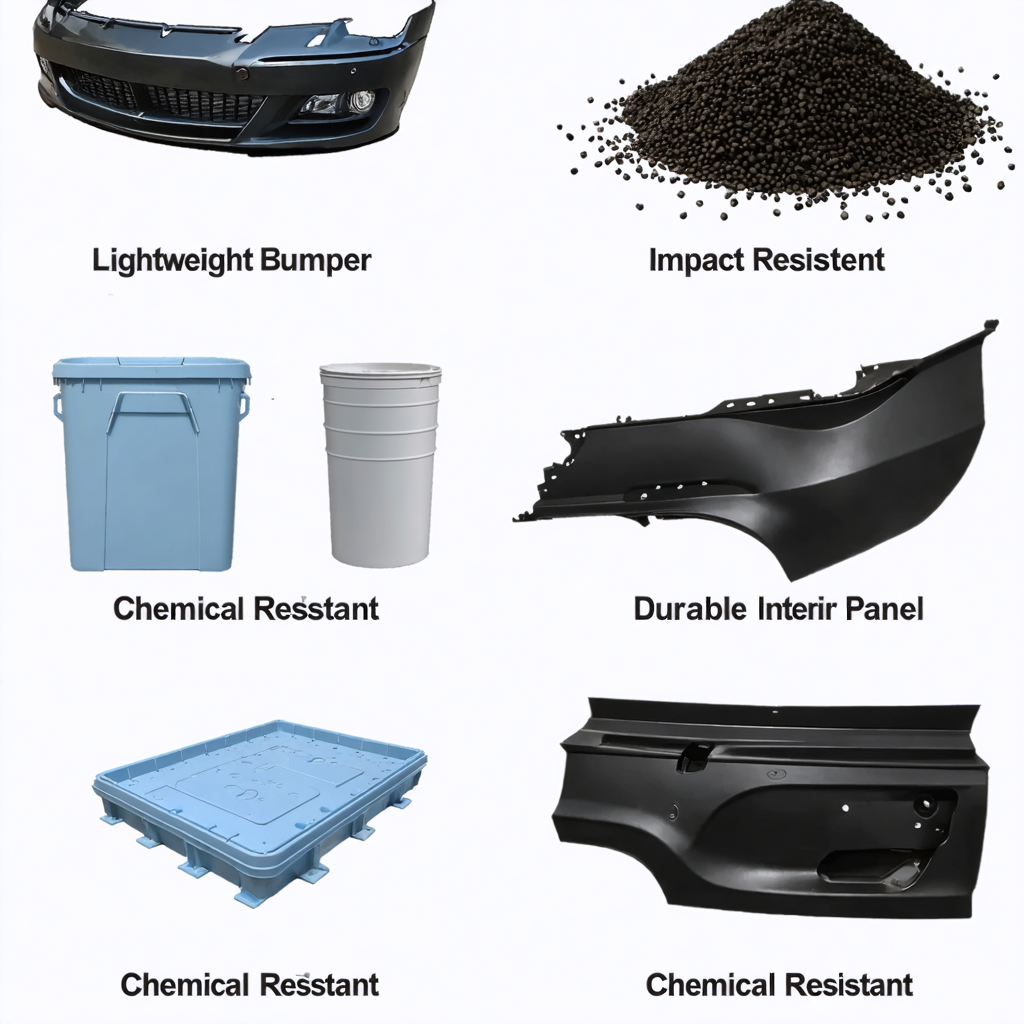
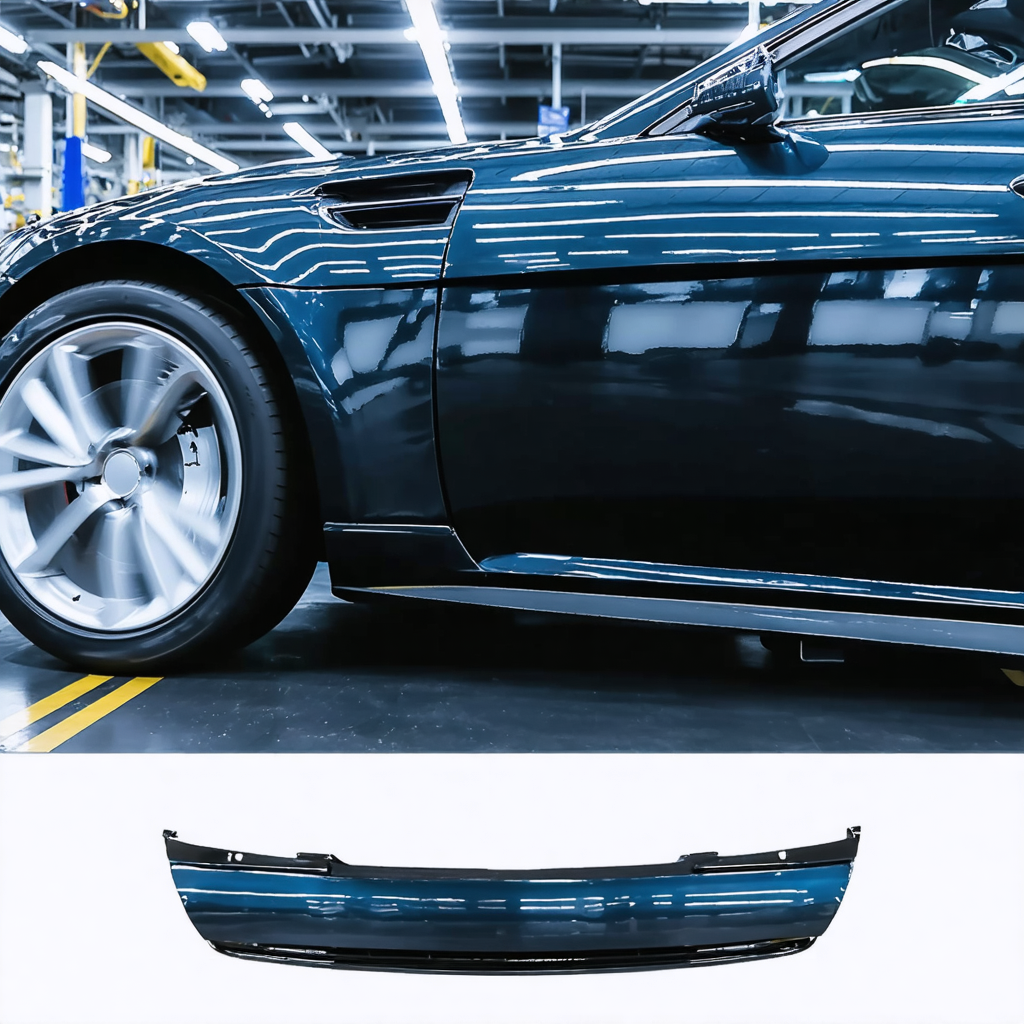
| Exterior | Bumper fascias, wheel arch liners, grilles, mudguards, exterior trim | Impact strength, low weight, cost, paintability with the right grade |
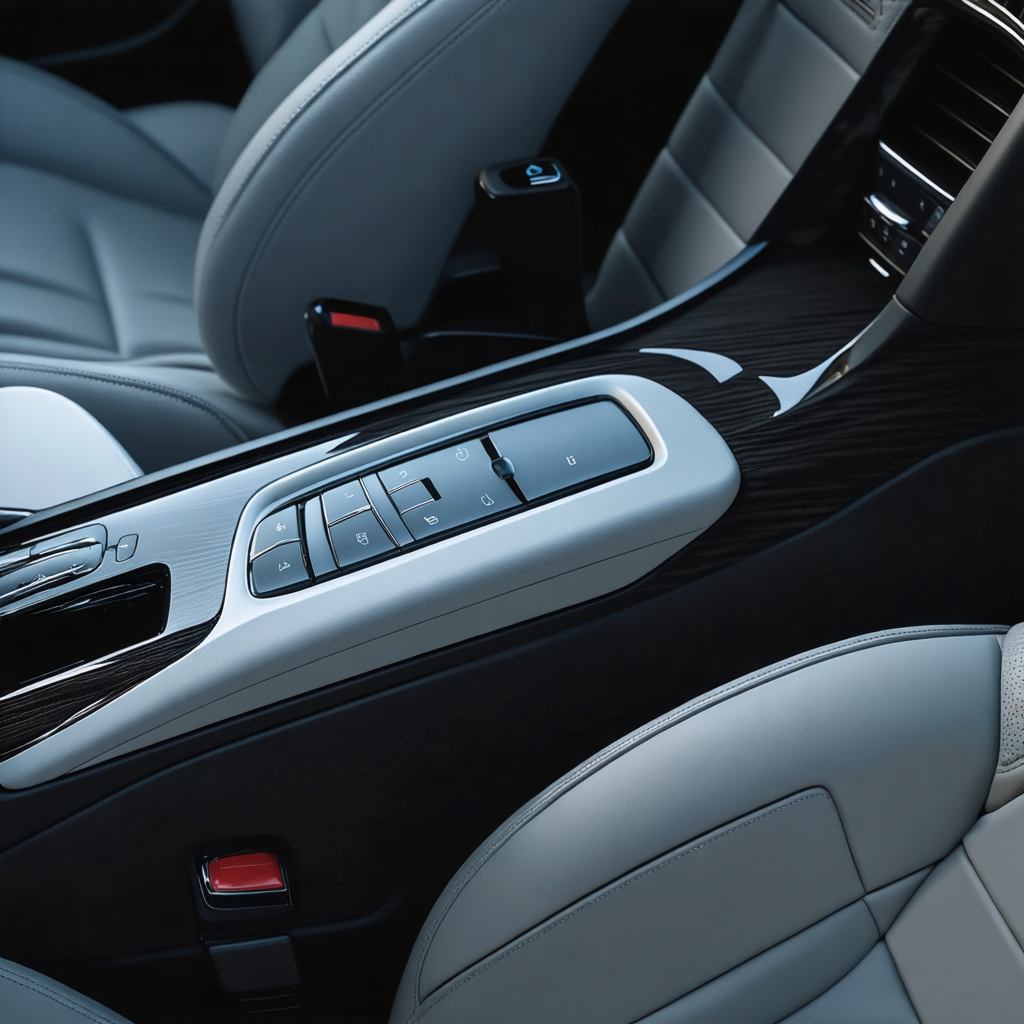
| Interior | Instrument panel carriers, door panels, pillar trims, HVAC ducts, glove boxes, seat structures | Stiffness with talc filling, NVH damping, mouldability of large parts |
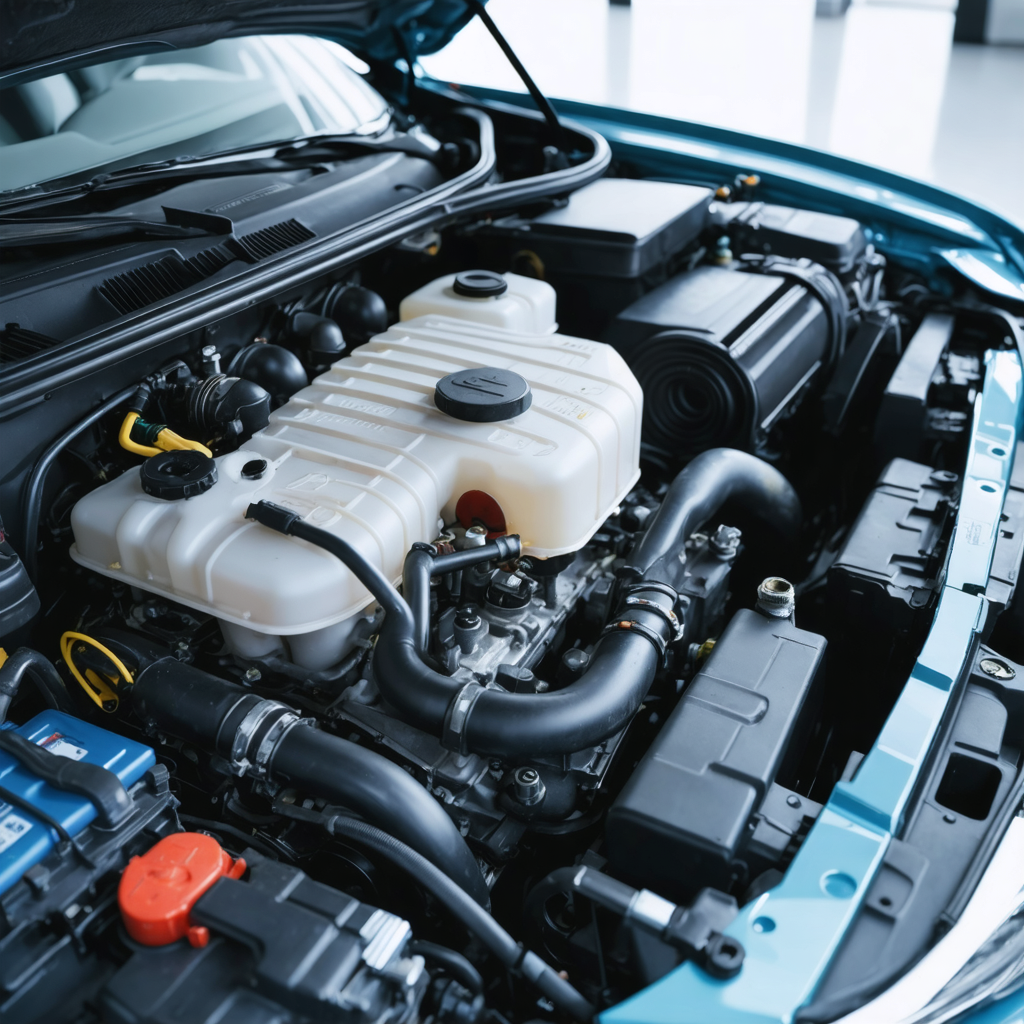
| Under-hood | Battery trays, fan shrouds, coolant reservoirs, air intake ducts, washer bottles | Chemical resistance, heat resistance within limits, low weight |
| Electrical | Connector housings, cable ducts, battery covers | Dielectric properties with the right grade, chemical resistance |
| Fluid handling | Reservoirs, filler necks, washer systems | Broad chemical resistance |
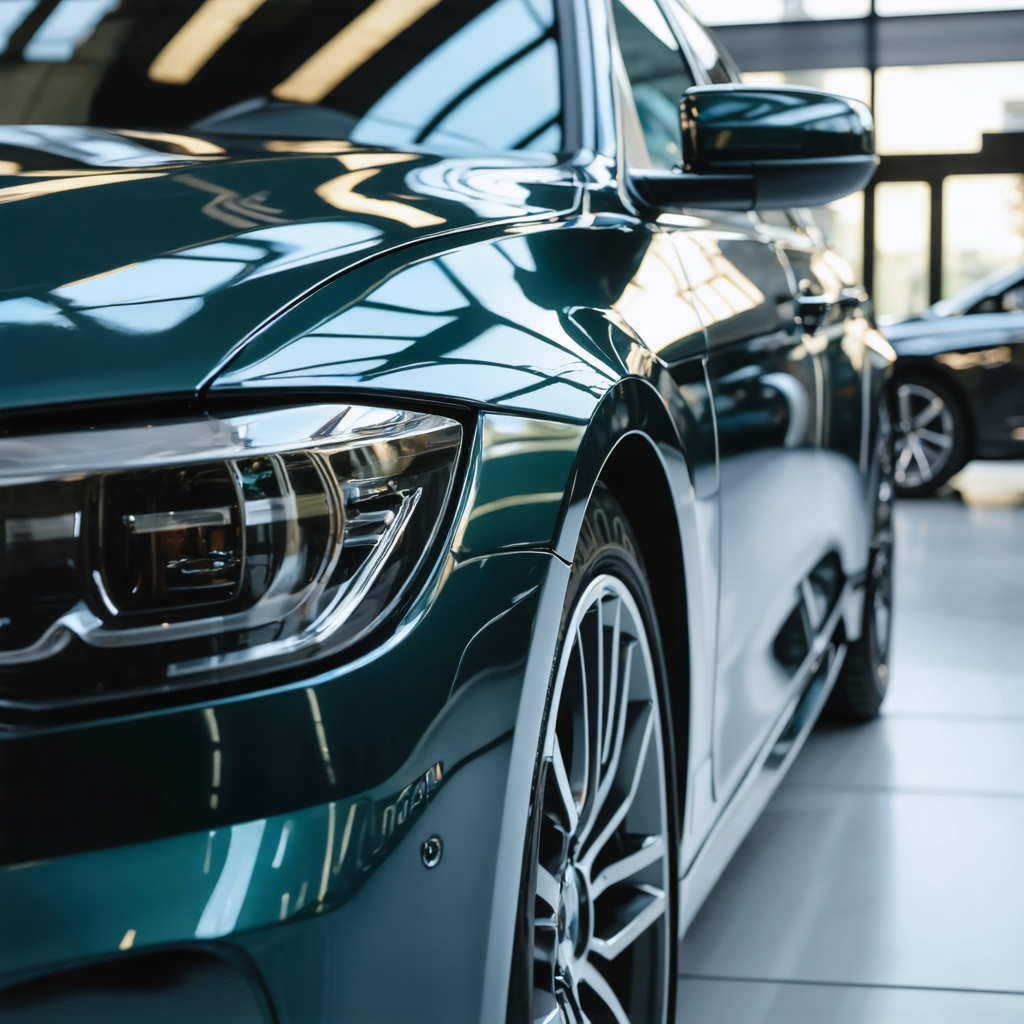
The volume is dominated by interior and exterior applications, where PP's combination of low weight and low cost is decisive at the scale of a bumper fascia or a door carrier.
Temperature Limits: Where PP Stops Working
| Service condition | Typical PP behaviour | Practical consequence |
|---|---|---|
| Up to roughly 70 °C | Fully within its comfort zone | Interior parts, ducts, exterior trim |
| 70 to 100 °C | Usable, with grade selection and creep allowances | Under-hood parts away from the hottest zones |
| 100 to 120 °C | Only heat-stabilised or filled grades, with reduced life | Marginal — verify with the supplier's data |
| Above 120 °C continuously | Not a PP application | Move to PA, PBT, PPS or a metal part |
| Short-term peaks | Tolerated far above the continuous limit | Painting, e-coat bake, assembly processes |
The mistake to avoid is designing to the melting point. PP's melting temperature is around 165 °C, but its continuous service ceiling is far lower, and creep accelerates well before that. High-temperature under-hood parts usually belong to nylon, PBT or a higher-performance polymer; our guide to glass fibre reinforced PP for automotive brackets covers how far filled grades can be pushed on structural parts.
Where stiffness and allowable strain under sustained load govern the design, our material data note on the elastic modulus and allowable strain of PP gives the numbers to work from.
Interior Applications: Scratch Resistance, Odour and Fogging
Interior parts are judged by the customer's fingertips and nose, not just by the drawing. Three requirements drive grade selection:
Scratch resistance. Visible interior surfaces — door panels, pillar trims, instrument panel upper surfaces — must resist scratching through years of use, cleaning and abrasion. This is achieved with mineral or talc filled compounds, purpose-formulated scratch-resistant PP compounds, and careful control of surface texture and mould temperature during moulding.
Odour and fogging. Automotive interiors are specified against odour and volatile emission limits, because volatiles condense on the windscreen as fog. Compounders supply low-odour, low-fogging grades, and the moulder must avoid thermal degradation, which generates exactly the volatiles these tests measure.
Colour and appearance consistency. Interior parts in the same vehicle must match. This requires colour control at the compounder, tight process control at the moulder, and master samples agreed with the customer.
For a scratch-resistant interior compound, the specific compound and its filler system matter more than the polymer type — which is why the grade is usually specified by the OEM or tier-one supplier rather than chosen freely by the moulder.
Design Rules for PP Automotive Parts
| Feature | Recommendation |
|---|---|
| Shrinkage allowance | 1.2 to 2.5 percent depending on grade; measure after 24 to 48 hours |
| Flow and cross-flow shrinkage | Expect a difference, especially in glass filled grades — plan the gate to control it |
| Nominal wall | 1.5 to 3 mm, uniform; thick sections sink and void |
| Ribs | 50 to 60 percent of nominal wall |
| Radii | Generous — sharp corners are stress raisers and crack starters |
| Draft | 0.5 to 1 degree minimum; more on textured surfaces |
| Gates | Position to align flow direction with the dominant load or appearance direction |
| Venting | 0.02 mm deep — PP flashes easily, so vents must be shallow |
| Texturing | Texture hides flow marks and improves scratch appearance |
| Assembly | Snap fits, welding and mechanical fastening; bonding needs pre-treatment |
Two rules matter most for large automotive parts. First, the shrinkage allowance and the flow direction must be decided together, because a bumper fascia or a door carrier warps when the flow and cross-flow shrinkage do not line up with the part's geometry. Second, warpage control starts in the cooling circuit — uneven cooling is the most common root cause, and no amount of process tuning fixes an unbalanced tool. The tooling allowances and process settings that hold PP dimensions are covered in our guide to reducing shrinkage in polypropylene.
Polypropylene Compared With Other Automotive Plastics
| Material | Density | Stiffness | Heat resistance | Typical automotive use |
|---|---|---|---|---|
| PP | 0.9 | Low to moderate | Up to about 100 °C | Bumpers, trim, ducts, reservoirs |
| PP + talc or glass | 1.0 to 1.2 | Moderate to high | Up to about 120 °C | Carriers, brackets, trays |
| ABS | 1.04 | Moderate | Up to about 90 °C | Interior trim, small housings |
| PC/ABS | 1.1 to 1.15 | Moderate to high | Up to about 110 °C | Instrument panels, visible interior parts |
| PA6 / PA66 | 1.13 | High | Up to about 150 °C | Under-hood parts, air intake manifolds |
| PBT | 1.3 | High | Up to about 140 °C | Electrical housings, sensors, connectors |
The comparison that comes up most often at the drawing stage is PP against ABS, because both are cheap, widely available and easy to mould, yet they behave very differently in service. Our comparison of ABS and polypropylene examines that choice directly.
Manufacturing and Quality Requirements
Automotive work is defined less by the process than by the documentation around it.
| Requirement | What it involves |
|---|---|
| Quality system | IATF 16949-aligned processes for automotive supply |
| Part approval | PPAP documentation, including dimensional, material and performance evidence |
| First article inspection | Full dimensional report against the drawing before volume release |
| Traceability | Resin lot to production batch to shipped carton |
| Colour and appearance | Master sample agreement and batch-to-batch control |
| Dimensional control | CMM or optical measurement, after the part has stabilised |
| Process monitoring | Documented melt temperature, mould temperature and cycle parameters |
| Change control | Any material, tool or process change re-validated and re-approved |
A moulder who can hold dimension on an automotive part but cannot produce the documentation is not an automotive supplier. The paperwork is part of the product.
Challenges With PP in Vehicles and How They Are Solved
| Challenge | Root cause | Solution |
|---|---|---|
| Warpage on large parts | Uneven shrinkage from unbalanced cooling or gate position | Balance the cooling circuit, review the gate, allow the full shrinkage range |
| Poor paint adhesion | Low surface energy | Flame or plasma pre-treatment, correct primer system |
| UV degradation and yellowing | Unstabilised polymer exposed to sunlight | UV stabilised grade or a protective coating |
| Creep under sustained load | Inherent to the material, worse with temperature | Design on long-term data, add fillers, increase section |
| Scratch visibility on interior trim | Soft surface, unsuitable filler system | Purpose-made scratch-resistant compound, texture the surface |
| Odour and fogging failures | Volatiles from compounding or thermal degradation | Low-odour grade, control melt temperature and residence time |
| Weld lines weakening a part | Low mould temperature, poor venting, gate location | Raise mould temperature, add venting, reposition the gate |
Nearly every PP automotive failure traces back to one of four causes: heat, shrinkage, surface energy or volatiles. Each has a known engineering answer, but each has to be designed in rather than fixed later.
Conclusion
Polypropylene is good for car parts — demonstrably good — for the applications that suit it: bumpers, interior carriers, ducts, reservoirs, trims and housings, where low weight, low cost, chemical resistance and fatigue performance decide the outcome. It is the wrong material for parts that must hold tight tolerances at high temperature, survive direct sunlight unpainted, or carry sustained structural load without reinforcement. Automotive PP is almost always a compounded material, and the compound — talc filled, mineral filled, glass filled, scratch resistant, UV stabilised, low odour — is where the performance actually comes from.
Design it with the right grade, the right shrinkage allowance and a balanced tool, document it to automotive standards, and polypropylene delivers one of the best cost-to-performance ratios available to a vehicle programme.
With injection moulding capability from 80 to 1,400 tonnes and in-house tooling, we run polypropylene in homopolymer, copolymer, talc filled, glass filled and specially compounded automotive grades, supported by IATF-aligned quality processes. Through our custom injection moulding services we support automotive PP projects from grade selection and design review through tooling, PPAP documentation and stable volume production. Send us your part drawing and service conditions to discuss grade, tolerances and process capability for your application.
FAQ
Is polypropylene good for car parts?
Yes. Polypropylene is the most widely used plastic in vehicles because it is light, cheap, chemically resistant and outstanding in fatigue, which makes it ideal for bumpers, interior trim carriers, HVAC ducts, reservoirs and battery trays. It is not suitable for parts that must hold tight tolerances above about 100 °C continuously, or for unpainted exteriors without UV stabilisation.
What car parts are made of polypropylene?
Bumper fascias, wheel arch liners, grilles, instrument panel carriers, door panels, pillar trims, HVAC ducts, battery trays, fan shrouds, coolant and washer reservoirs, connector housings and cable ducts. Interior and exterior applications dominate the volume.
What temperature can polypropylene withstand in a car?
Unfilled PP is generally used up to around 100 °C continuous, with heat-stabilised and filled grades extending that range somewhat. Short-term peaks far above that are tolerated in processes such as paint bake. Above roughly 120 °C continuously, nylon, PBT or a higher-performance polymer is usually the correct choice.
Which polypropylene grade is used for automotive interior parts?
Talc or mineral filled compounds are standard for interior carriers and trim, because the filler raises stiffness and reduces shrinkage. Visible surfaces use purpose-made scratch-resistant compounds, and all interior grades must meet the vehicle's odour and fogging limits.
Why do polypropylene car parts warp?
Warpage comes from uneven shrinkage: unbalanced cooling, a gate position that leaves long flow paths, wall thickness variation, or the natural difference between flow and cross-flow shrinkage — which is greater in glass filled grades. For large parts such as bumper fascias, cooling balance and gate position decide whether the part stays on dimension.
Can polypropylene be painted for automotive use?
Yes, with surface pre-treatment. PP has low surface energy, so paint does not bond reliably to an untreated surface. Exterior and visible interior parts are usually flame or plasma treated and primed before painting, and the treatment method should be specified at the design stage rather than after tooling is cut.