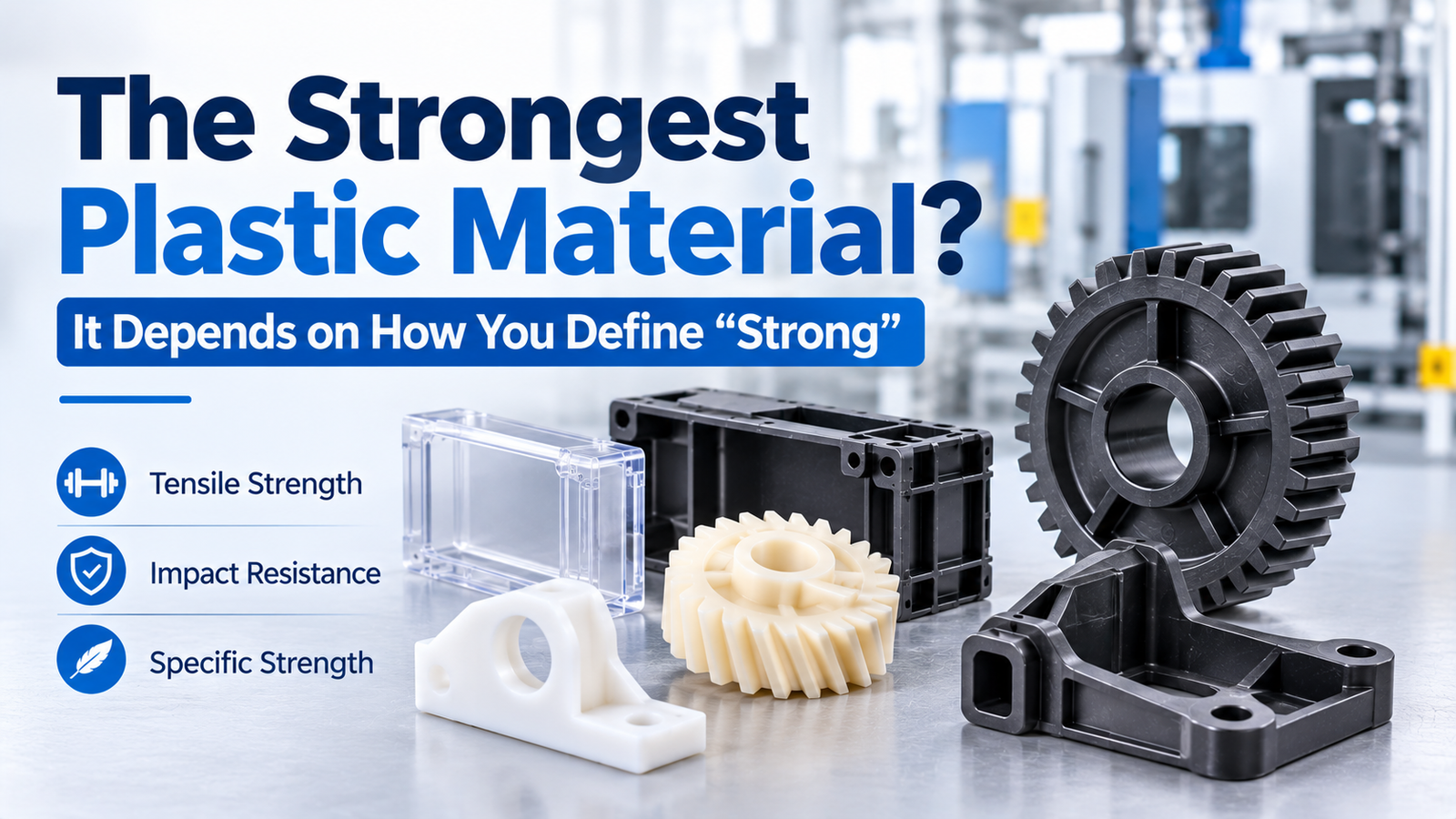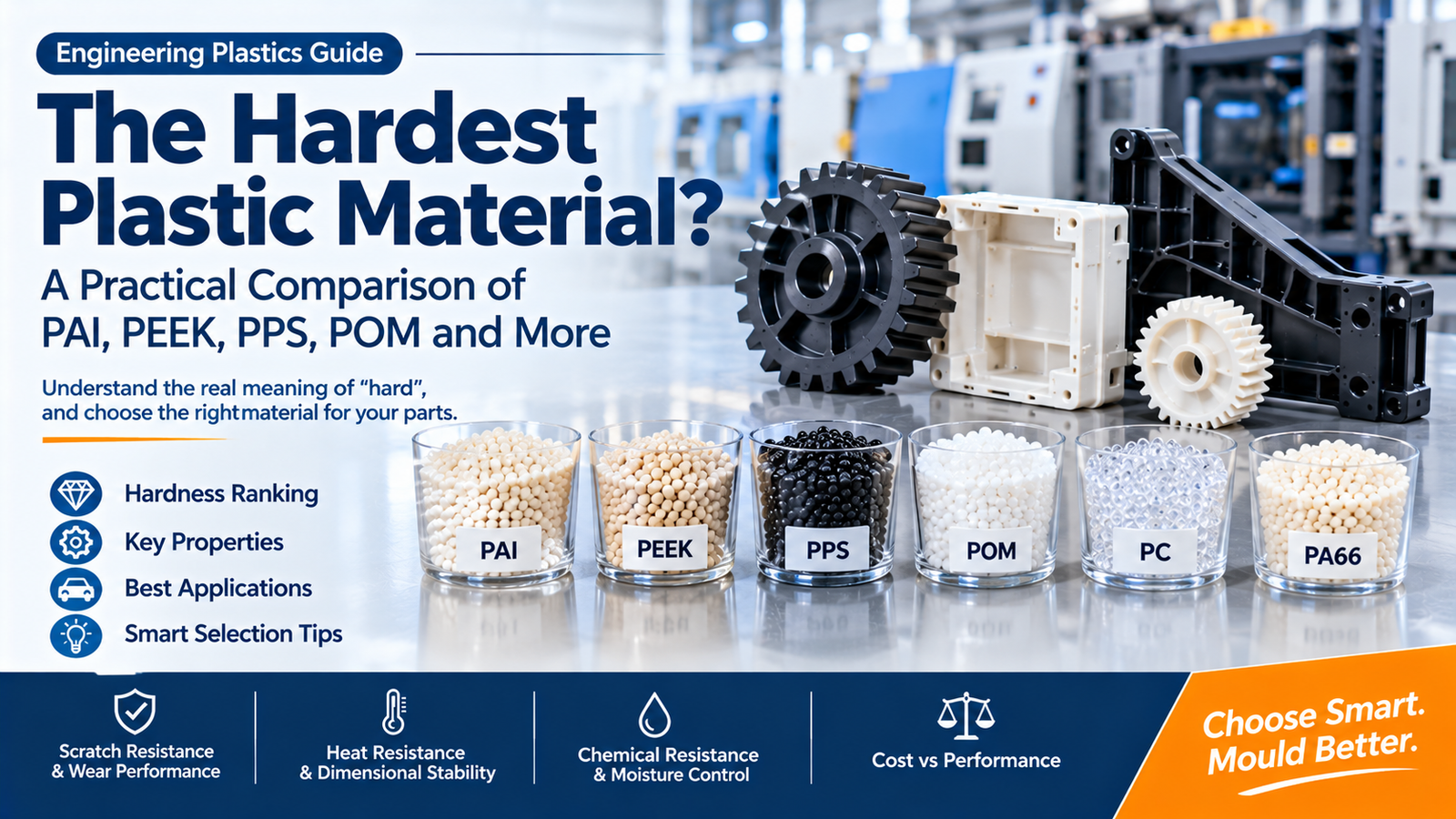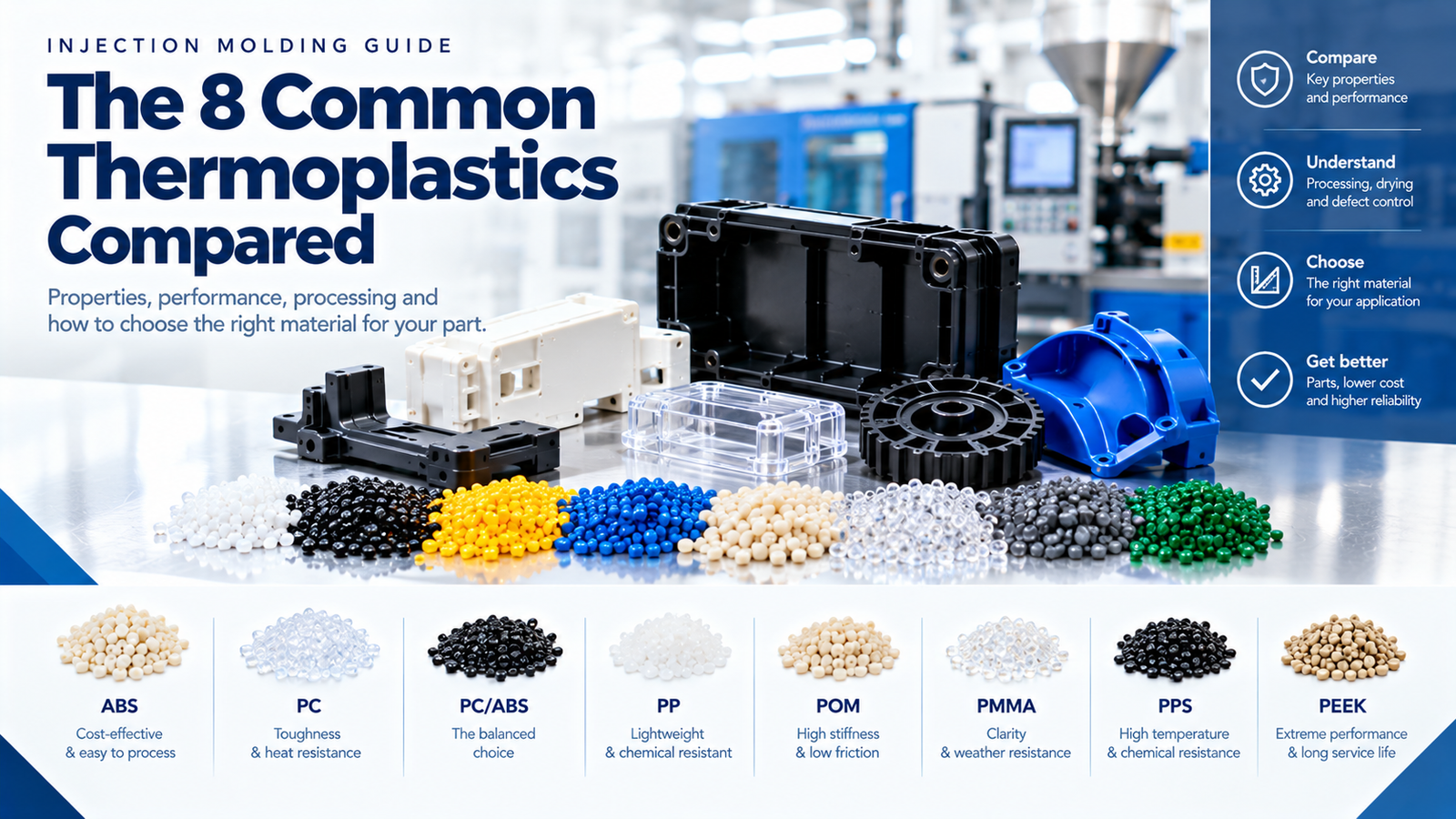
The hardest plastic material is not a single answer, because "hardest plastic" is one of the most misleading searches in plastics, because three different properties get called hard: resistance to scratching, resistance to bending, and resistance to wear. A material that wins on one loses on another, which is why the answer changes depending on what the part actually has to survive.
This guide ranks the engineering plastics by surface hardness, explains what each one is genuinely good at, and shows where "hardest" is the wrong question.
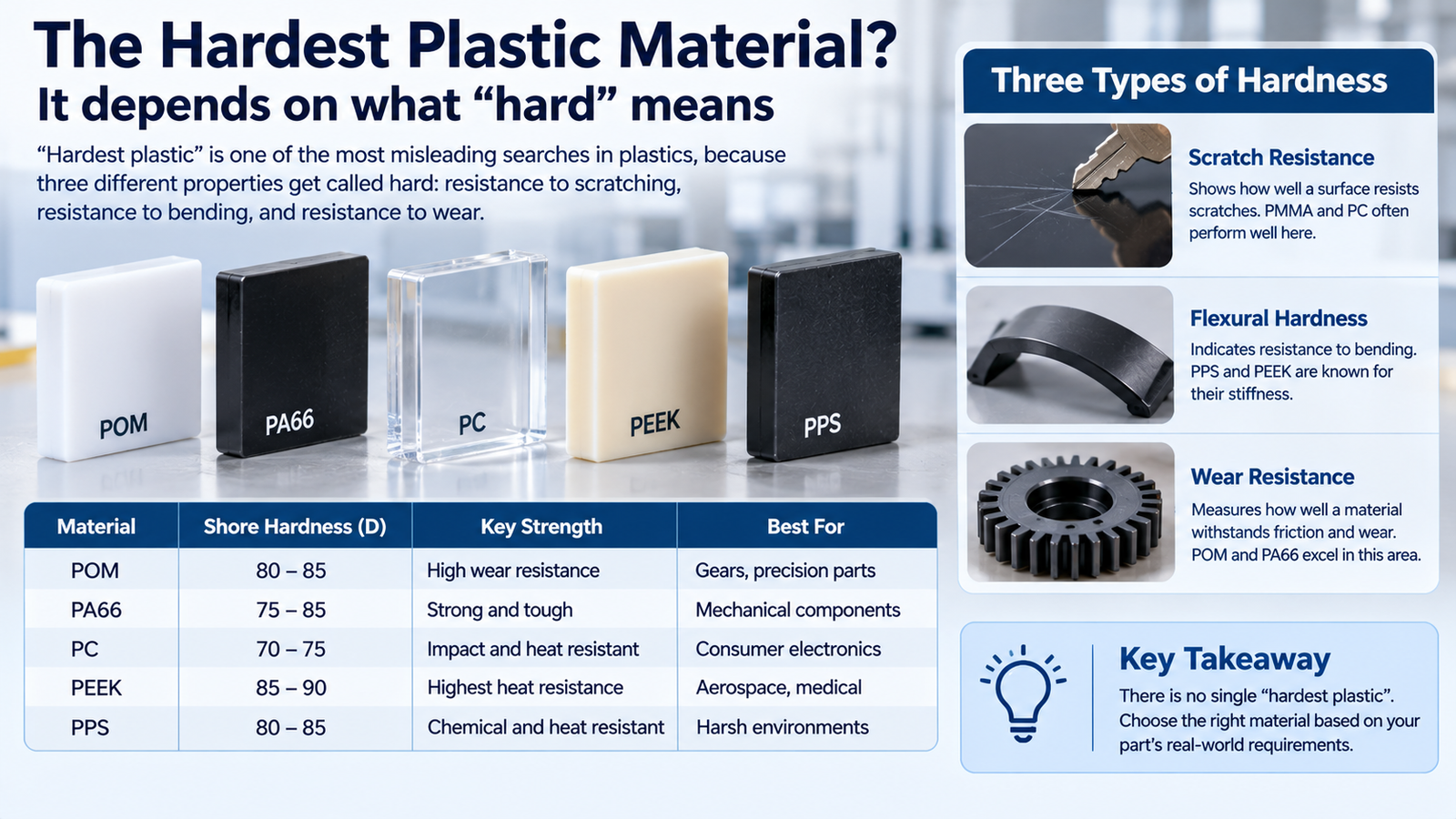
Three kinds of hard
| What the customer usually means | Property | Test | Best materials |
|---|---|---|---|
| "It scratches easily" | Surface hardness | Rockwell M, Shore D | PAI, PEEK, PPS, POM |
| "It bends too much" | Stiffness (modulus) | Flexural modulus | Glass-filled PA, PPS, PEEK |
| "It wears out" | Wear resistance | Taber abrasion | UHMW-PE, POM, PEEK |
| "It cracks when hit" | Toughness — the opposite of hard | Notched Izod | PC, PA, impact-modified grades |
A hard plastic is usually a brittle plastic. That trade-off is the single most important thing to understand before specifying "the hardest material you have."
Hardest plastic material: the surface hardness ranking
| Rank | Material | Rockwell M | Flexural modulus (GPa) | HDT at 1.8 MPa (°C) | Typical cost (USD/kg) |
|---|---|---|---|---|---|
| 1 | PAI (polyamide-imide, Torlon) | M 115+ (Rockwell E 80 – 90) | 4.5 – 5.5 | 260 – 280 | 60 – 100 |
| 2 | PI (polyimide, Vespel) | M 110 – 120 | 3.0 – 4.0 | 300+ | 150 – 300 |
| 3 | PEEK (unfilled) | M 99 | 3.6 – 4.0 | 315 | 60 – 110 |
| 4 | PPS (unfilled) | M 90 – 95 | 3.4 – 4.0 | 200 – 260 | 10 – 20 |
| 5 | POM (acetal, Delrin) | M 92 | 2.8 – 3.2 | 95 – 110 | 3 – 5 |
| 6 | PA66-GF30 | M 95 – 100 | 9.0 – 11.0 | 250 | 4 – 6 |
| — | PC (for reference) | M 70 | 2.4 | 128 | 3 – 5 |
| — | UHMW-PE (for reference) | Shore D 60 – 65 | 0.8 | 80 | 4 – 7 |
Two things jump out. First, PA66-GF30 has a higher modulus than anything on the list — 9 to 11 GPa — despite not being the hardest at the surface. Second, POM is nearly as hard as PPS at one-fifth the price, which is why it dominates mechanical parts.
What each one is actually for
PAI (Torlon) — the hardest machinable engineering plastic
| Property | Value |
|---|---|
| Rockwell | M 115+ |
| Continuous service | 250 °C |
| Wear | Excellent under load |
| Machining | Excellent — this is its main advantage |
| Cost | 60 – 100 USD/kg |
| Availability in injection molding | Limited — mostly machined |
Use it for wear pads, bearings and seals in high-temperature applications where PEEK is not quite enough and machining is acceptable. It is the hardest of the standard engineering plastics, and its price reflects that.
PEEK — the balanced high-performance choice
| Property | Value |
|---|---|
| Rockwell | M 99 |
| Continuous service | 250 °C |
| Chemical resistance | Excellent |
| Wear | Very good |
| Cost | 60 – 110 USD/kg |
PEEK is what most engineers mean when they say "the best plastic." It is hard, stiff, heat resistant, chemically resistant and FDA-compliant in food-contact grades. It is not the hardest, and it is not the toughest — but it has no weak property, which is worth more than a single peak number.
PPS — hardness at a workable price
| Property | Value |
|---|---|
| Rockwell | M 90 – 95 |
| Continuous service | 200 – 220 °C |
| Chemical resistance | Excellent |
| Dimensional stability | Excellent |
| Cost | 10 – 20 USD/kg |
PPS is the value pick for hard, dimensionally stable, chemically resistant parts — pump housings, valve bodies, under-hood components. Its limitation is toughness: unfilled PPS is brittle, and glass-filled PPS is worse at corners.
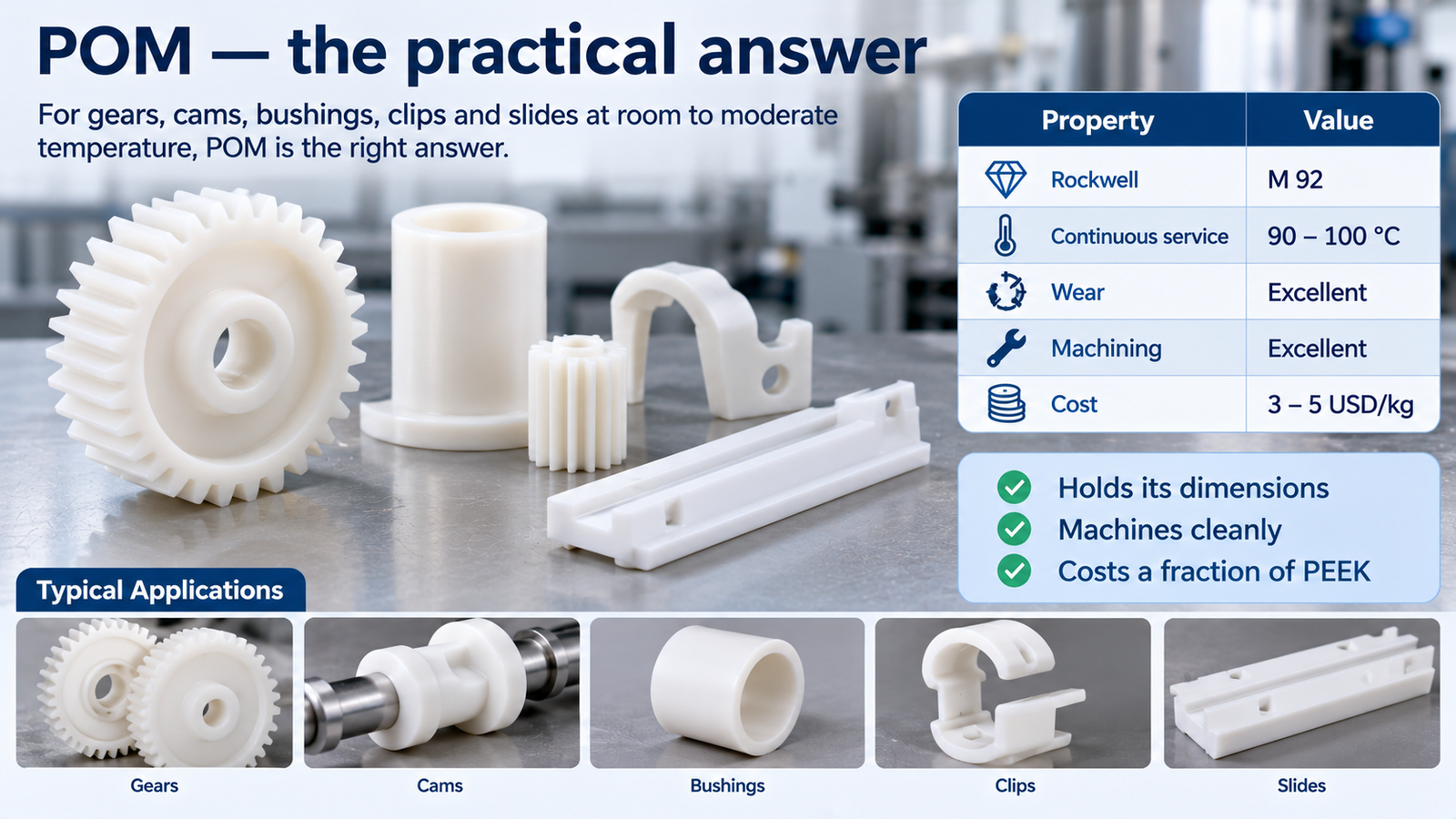
POM — the practical answer
| Property | Value |
|---|---|
| Rockwell | M 92 |
| Continuous service | 90 – 100 °C |
| Wear | Excellent |
| Machining | Excellent |
| Cost | 3 – 5 USD/kg |
For gears, cams, bushings, clips and slides at room to moderate temperature, POM is the right answer and the hardness ranking is irrelevant. It holds its dimensions, machines cleanly and costs a fraction of PEEK.
PA66-GF30 — highest stiffness, not hardest
Glass fiber raises modulus dramatically and surface hardness modestly. A 30% glass-filled nylon has a modulus of 9 to 11 GPa — four times unfilled POM — but its surface is no harder than POM and it is far more brittle at corners.
This is the most common specification error: a customer asks for "the hardest material" when the real requirement is "the stiffest," and ends up with a glass-filled grade that cracks at the boss instead of a tougher grade that would have worked.
Hardness versus the properties that usually matter more
| Requirement | Better metric | Better material |
|---|---|---|
| Part must not scratch in handling | Surface hardness | POM, PPS |
| Part must not deflect under load | Flexural modulus | PA66-GF30, PPS-GF40 |
| Part must survive impact | Notched Izod | PC, PA, impact-modified POM |
| Part must resist sliding wear | Taber loss, PV limit | UHMW-PE, POM, PEEK |
| Part must keep dimensions when hot | HDT, CLTE | PPS, PEEK, PAI |
| Part must resist chemicals | Chemical compatibility | PPS, PEEK, PVDF |
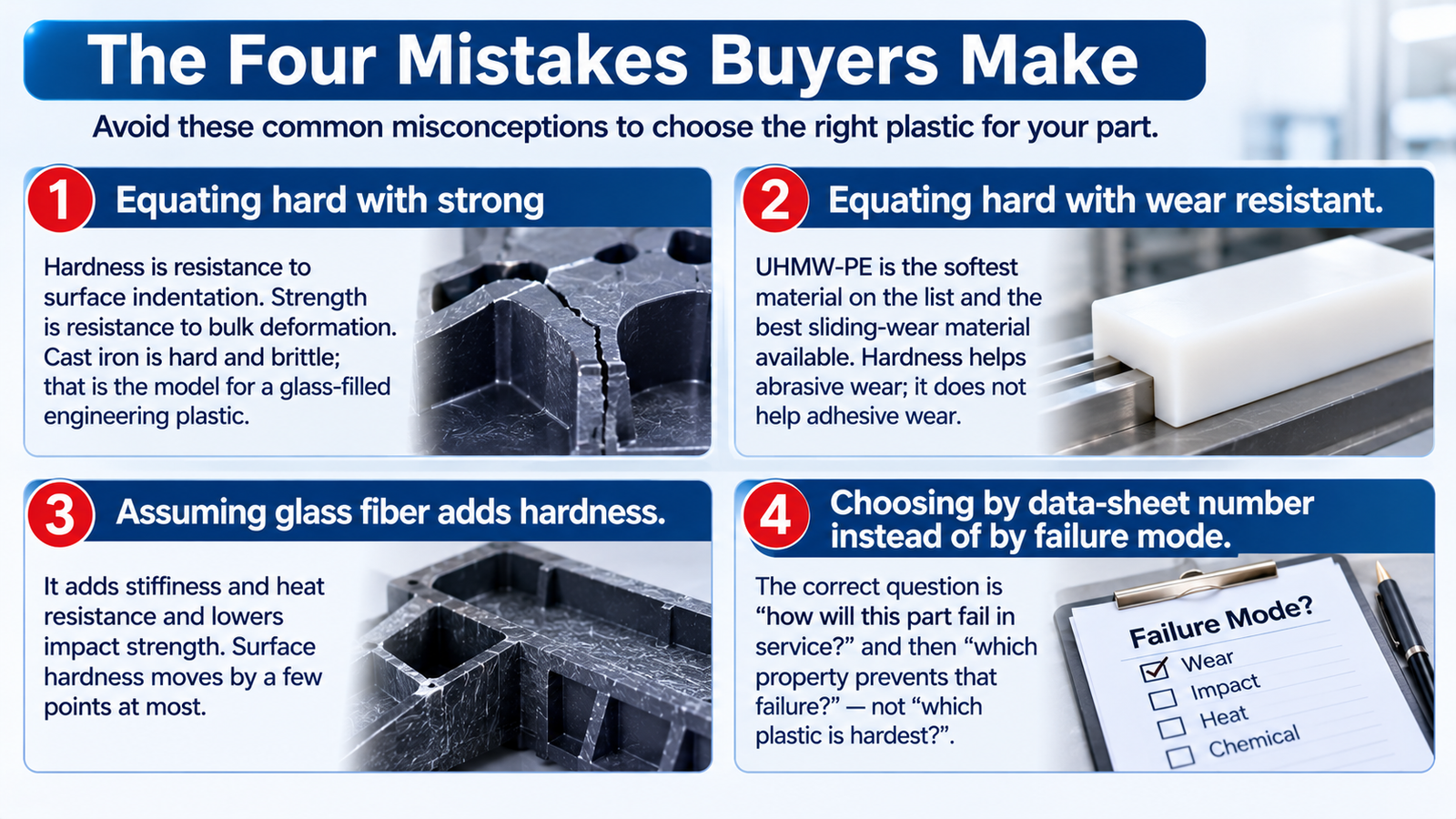
The four mistakes buyers make
1. Equating hard with strong. Hardness is resistance to surface indentation. Strength is resistance to bulk deformation. Cast iron is hard and brittle; that is the model for a glass-filled engineering plastic.
2. Equating hard with wear resistant. UHMW-PE is the softest material on the list and the best sliding-wear material available. Hardness helps abrasive wear; it does not help adhesive wear.
3. Assuming glass fiber adds hardness. It adds stiffness and heat resistance and lowers impact strength. Surface hardness moves by a few points at most.
4. Choosing by data-sheet number instead of by failure mode. The correct question is "how will this part fail in service?" and then "which property prevents that failure?" — not "which plastic is hardest?"
Selection by application
| Application | Recommended | Why |
|---|---|---|
| Gears and cams, room temperature | POM | Hard, wear resistant, dimensionally stable, cheap |
| Bearings in hot oil | PEEK or PAI | Hardness retained at temperature |
| Pump housings, chemical service | PPS | Chemical resistance plus dimensional stability |
| Structural brackets | PA66-GF30 | Highest modulus per dollar |
| Impact housings | PC or PC/ABS | Toughness, not hardness |
| Conveyor wear strips | UHMW-PE | Lowest friction, best abrasion resistance |
| Food-contact cutting boards | HDPE or POM | Compliant, hard enough, cleanable |
| High-temperature wear pads | PAI | Hardest at 250 °C |
Where hardness is measured, and how
| Test | Standard | Measures | Units |
|---|---|---|---|
| Rockwell M | ASTM D785 | Surface indentation, rigid plastics | M scale |
| Rockwell R | ASTM D785 | Softer rigid plastics | R scale |
| Shore D | ASTM D2240 | Durometer hardness | 0 – 100 |
| Ball indentation | ISO 2039-1 | Hardness under load | N/mm² |
| Taber abrasion | ASTM D4060 | Wear loss | mg/1000 cycles |
Two practical notes: Rockwell and Shore values are not interchangeable, and hardness falls sharply with temperature — a POM part at 80 °C is much softer than its data sheet suggests.
Our guides to common injection molding materials, POM injection molding, PPS injection molding, PEEK injection molding and PA66 nylon cover the individual grades. The impact side is in most durable plastic, the reinforcement trade-off in glass and carbon fiber in POM, and the material comparison framework in PA66 vs PBT vs PPS.
Hardness and property data in this guide follows the test methods published by ASTM International (D785, D2240, D4060) and ISO (2039-1), with typical values cross-checked against MatWeb and Engineering Toolbox. Processing practice reflects Plastics Technology guidance and PLASTICS industry standards, with material characterisation maintained through SPE and NIST reference data. For the polymer families, see engineering plastic.
What is the hardest plastic material?
PAI (polyamide-imide, sold as Torlon) is the hardest standard engineering plastic at Rockwell M 115+, followed by PI (Vespel) and PEEK at M 99. But hardness is rarely the property that decides whether a part works.
Is PEEK harder than POM?
Slightly — PEEK is Rockwell M 99, POM is M 92. The gap is small, while the price gap is 15 to 25 times. For room-temperature mechanical parts, POM is almost always the better choice.
Does glass fiber make plastic harder?
It makes it stiffer and more heat resistant, not much harder at the surface. A 30% glass-filled nylon has four times the modulus of POM but a similar surface hardness — and it is far more brittle at corners.
What is the hardest plastic that can be injection molded?
PEEK, PPS and PA66-GF30 all injection mold routinely. PAI and PI are usually machined from stock shapes rather than molded, because of their viscosity and price.
Is hard plastic the same as strong plastic?
No. Hardness is resistance to surface indentation; strength is resistance to bulk deformation; toughness is resistance to cracking. Hard materials are usually brittle, which is why PC — the softest material in this list at Rockwell M 70 — survives impacts that shatter harder grades.
How do I choose between hard and tough?
Ask how the part fails. If it scratches or wears, choose hardness. If it deflects, choose modulus. If it cracks or shatters, choose toughness. Most field failures are cracking, not scratching.
Conclusion
On surface hardness, the hardest plastic material is PAI, followed by PI and PEEK — but the honest answer is that hardness is a narrow property, and specifying "the hardest material" is usually a proxy for a different requirement. POM wins most room-temperature mechanical parts on cost and balance; PA66-GF30 wins on stiffness; PPS wins on chemical resistance with hardness; PC wins whenever the part has to survive impact.
At Rui Cheng we mold POM, PPS, PEEK, PA66-GF30, PC and PC/ABS on 80 to 1,400 tonne machines with material drying records and ISO 9001 / IATF 16949 processes. Send us the part drawing plus how it fails in service, and we will come back with a material recommendation and an indicative part cost.