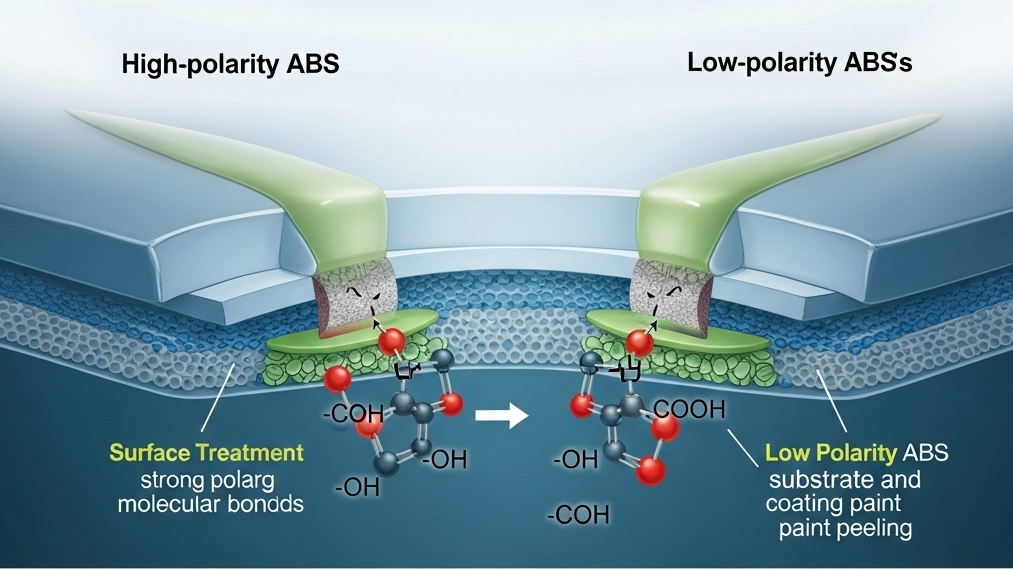
Paint adhesion on ABS fails for one reason above all others: the substrate surface is not polar enough, or something has been left on it that kills the polarity. The moulding can be perfect, the paint can be premium, and the part still peels — because adhesion is a surface-chemistry problem, not a paint problem.
This guide explains why ABS polarity governs adhesion, what surface energy a coating actually needs, the treatments that raise it, and the moulding-shop mistakes that destroy it before the paint line ever sees the part.
What polarity means on an ABS surface
ABS is a terpolymer of three monomers, and only one of them is polar:
| Monomer | Share | Polarity | What it contributes |
|---|---|---|---|
| Acrylonitrile (AN) | 15 – 35% | Polar | Adhesion sites, chemical resistance, hardness |
| Butadiene | 5 – 30% | Non-polar | Impact strength (the rubber phase) |
| Styrene | 40 – 60% | Non-polar | Flow, gloss, rigidity |
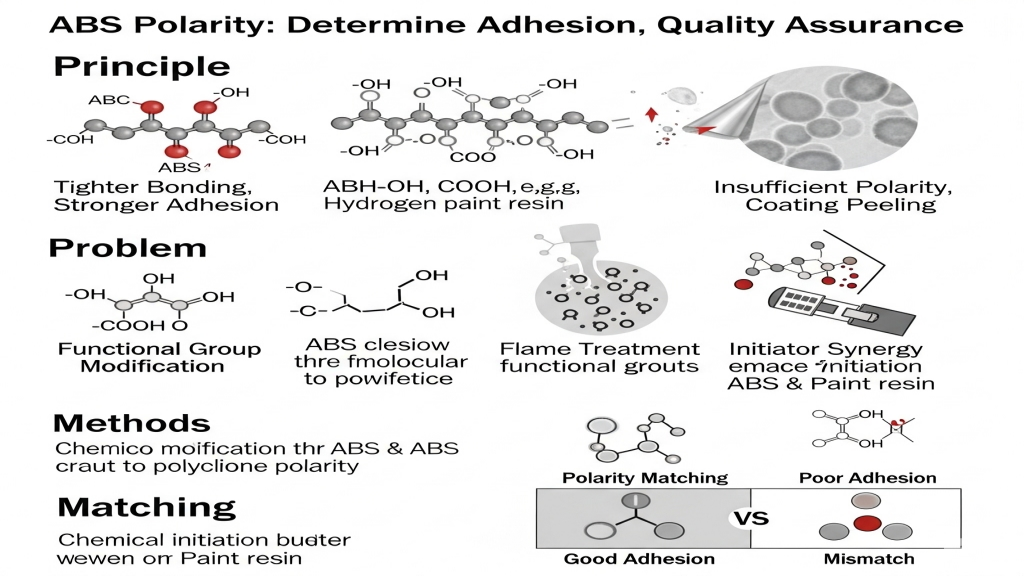
Paint bonds to the polar acrylonitrile groups. The butadiene and styrene phases give ABS its toughness and its glossy finish, but they offer almost nothing for adhesion. So the higher the AN content, the better ABS paints — and the more the paint job depends on the grade, not just the process.
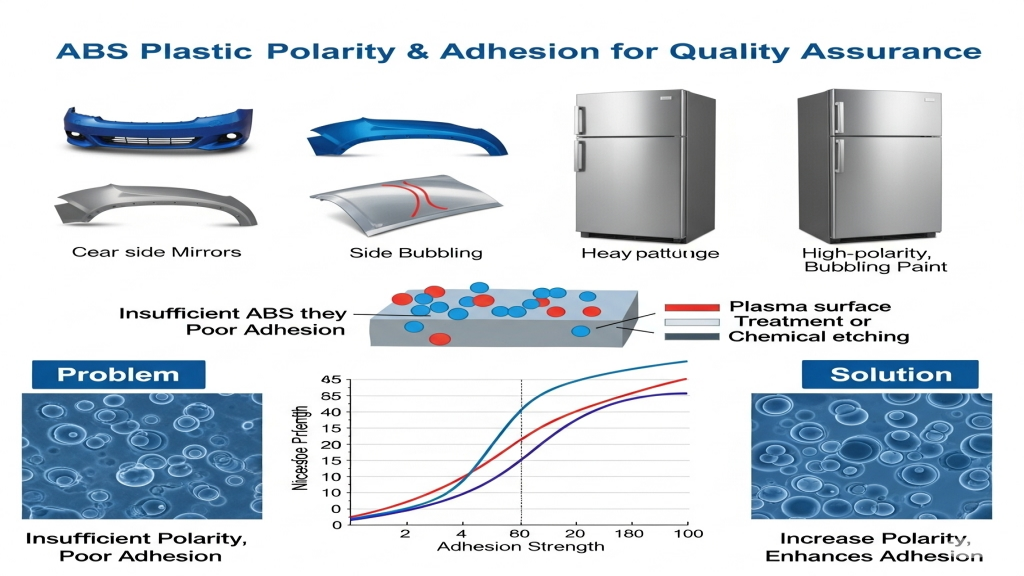
Typical surface energy for ABS sits at 34 to 42 mN/m. A solvent-borne coating needs a substrate at least 5 to 10 mN/m above its own surface tension, which is typically 28 to 32 mN/m. ABS clears that bar — but only just, and only when the surface is clean. A fingerprint, a smear of silicone mould release, or a film of moulded-in contamination drops the effective surface energy into the twenties, and the coating stops wetting properly.
Why low polarity shows up as coating defects
| Defect | Mechanism | Looks like |
|---|---|---|
| Peeling / flaking | No chemical bonding, only mechanical grip | Sheets lift from an edge |
| Fish eyes | Surface contamination refuses wetting | Circular craters in the film |
| Cissing / crawling | Surface energy below coating tension | Paint pulls back from areas |
| Blistering | Moisture or solvent trapped under the film | Raised bubbles after curing |
| Poor edge coverage | Surface tension pulls paint off sharp edges | Thin or bare edges |
| Adhesion loss after humidity | Water displaces the bond at the interface | Fails after a damp-heat cycle |
The last row matters most in practice: a part that passes the tape test on the day of painting can fail it after a week in a humid warehouse. Water reaches the interface and, on a low-energy surface, simply lifts the film.
Measuring adhesion the way a customer will
The standard test is cross-hatch, ASTM D3359 Method B. A lattice of cuts is made through the coating, pressure-sensitive tape is applied and pulled, and the result is graded.
| Grade | Area removed | Meaning |
|---|---|---|
| 5B | 0% | Perfect — the target for cosmetic ABS |
| 4B | under 5% | Acceptable for most industrial parts |
| 3B | 5 – 15% | Marginal; usually a process problem |
| 2B | 15 – 35% | Failing — surface preparation is wrong |
| 1B | 35 – 65% | Failing badly |
| 0B | over 65% | No adhesion at all |
Two rules for using this test properly: condition the part first (24 hours at ambient, or a damp-heat cycle if the specification calls for it), and test the same surface the customer will see, not a convenient flat area on the B-side.
Treatments that raise surface energy
| Treatment | Surface energy achieved | Durability | Best for |
|---|---|---|---|
| Solvent wipe only | 36 – 40 mN/m | Minutes to hours | Clean, freshly moulded parts |
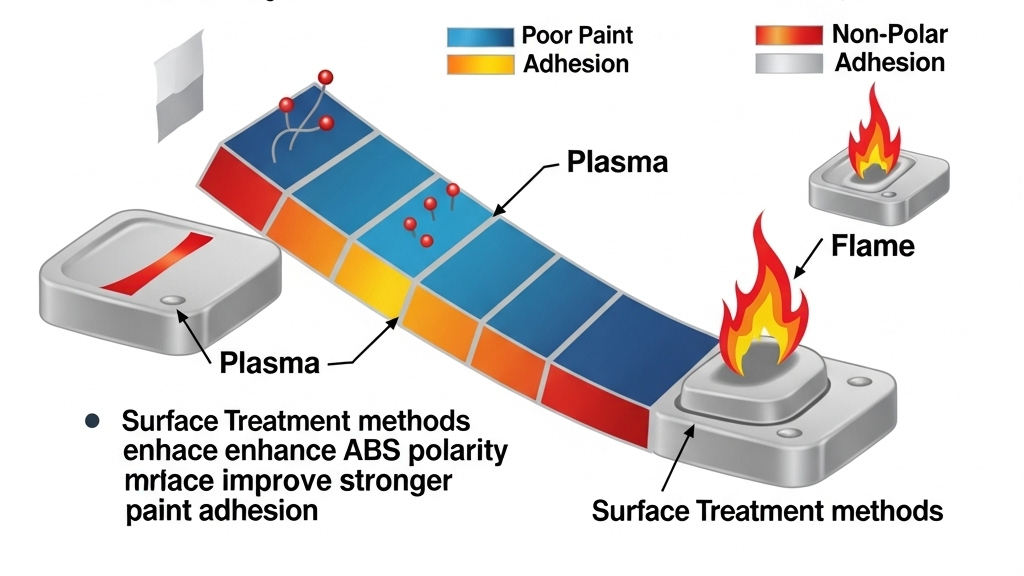
| Plasma (atmospheric) | 55 – 70 mN/m | Days to weeks | Complex 3D parts, in-line |
| Corona discharge | 45 – 55 mN/m | Hours to days | Flat sheet, film |
| Flame treatment | 45 – 55 mN/m | Hours to days | PP and PE, not usually ABS |
| Chemical etch (chromic) | 50+ mN/m, plus micro-porosity | Permanent | Plating, not painting |
| Primer (chlorinated polyolefin) | n/a — adds a tie layer | Permanent | Low-energy substrates, PP |
| Abrasion + clean | 38 – 45 mN/m | Hours | Small parts, repair work |
For ABS painting, the practical hierarchy is: clean properly first, then plasma if the part is complex or the coating is demanding, and only then consider a primer. Flame treatment is a polyolefin tool and does little useful for ABS.
The moulding-shop mistakes that ruin adhesion
These are the causes that most plants chase for weeks, because the fault is upstream of the paint line.
| Mistake | Why it destroys adhesion | Fix |
|---|---|---|
| Silicone mould release spray | Silicone migrates to the surface, surface energy collapses to 20 – 25 mN/m | Ban silicone release; fix ejection instead |
| Excess external release agent | Leaves a film that no solvent removes fully | Apply minimum, or switch to internal release |
| Oily or greasy handling | Fingerprints and machine oil are contamination | Gloves, bagging immediately after moulding |
| High moulded-in stress | Stress cracking at the interface after painting | Raise mould temperature, anneal |
| Moisture in the resin | Surface voids and splay under the film | Dry to the specification — see our guide to ABS water absorption |
| Wrong grade | Low AN content means low polarity | Specify a paint or plating grade |
| Over-packed or flashed parts | Flash removal exposes uncoated filler or stress | Fix the tool, not the paint |
Silicone release agent is the single most common cause of a paint-adhesion failure that the paint supplier gets blamed for. If a part cannot be ejected without silicone, the problem is draft, ejection area or mould temperature — fix those.
Process control on the paint line
| Parameter | Typical setting | Why it matters |
|---|---|---|
| Surface energy check | above 38 mN/m before coating | The one number that predicts adhesion |
| Cleanliness | wipe test, no visible residue | Contamination beats any treatment |
| Primer thickness | 5 – 10 μm | Too thin does not cover, too thick traps solvent |
| Topcoat thickness | 15 – 25 μm | Thick films build stress and fail at edges |
| Flash-off time | per supplier, typically 5 – 10 min | Solvent must leave before bake |
| Cure schedule | 60 – 80 °C for 20 – 30 min | Under-cure means poor crosslinking |
| Humidity in the paint booth | 45 – 60% RH | High humidity causes blushing and blisters |
Check surface energy with a dyne pen or test ink before every shift, on the actual part geometry that will be painted. It takes thirty seconds and it prevents the argument that follows a failed batch.
Why ABS is the easiest plastic to plate, and what that teaches about adhesion
ABS plating works because chromic acid etches away the butadiene rubber phase at the surface, leaving microscopic pores. The palladium catalyst then seeds those pores and the metal anchors mechanically — a different mechanism from painting, but the same lesson: the surface must be prepared deliberately.
Two practical points follow. A plating grade needs a controlled butadiene content and particle size, and the same contamination that ruins paint ruins plating. The surface defects that ruin both processes share a root cause, catalogued in our guide to silver and air lines in moulded parts, and the broader surface-defect patterns are in our injection moulding defects guide.
Choosing the right grade
| Application | Grade requirement | Why |
|---|---|---|
| Painted cosmetic housings | Standard or high-AN general purpose | Adequate polarity, good surface |
| Plated parts | Dedicated plating grade | Controlled butadiene phase |
| Painted + heat exposure | High-heat grade | Prevents stress cracking after bake |
| Painted + impact | High-impact grade | Balances rubber content and polarity |
| Painted PC/ABS | Standard PC/ABS, plasma preferred | Two-phase surface needs activation |
The grade choice is a conversation with the resin supplier: ask for their paint or plating recommendation and their typical surface energy, not just the mechanical data sheet. Our ABS injection moulding guide sets out the grade families, and the PC/ABS guide covers the blend side, where two phases make surface activation more critical. The full family comparison is in our injection moulding materials overview, and the over-moulding case is covered in the co-injection guide.
Surface energy and adhesion data in this guide follows the test methods published by ASTM International (D3359 for adhesion by tape test) and ISO, with typical values cross-checked against MatWeb and Engineering Toolbox. Coating and surface-treatment practice reflects Plastics Technology guidance and PLASTICS industry standards, with material characterisation maintained through SPE and NIST reference data. For the polymer chemistry, see ABS.
Why does paint peel off ABS even when the surface looks clean?
Because "looks clean" is not the same as "has surface energy". A thin film of silicone release agent is invisible but drops surface energy from around 38 mN/m to below 25, and paint cannot bond to that. Check with a dyne pen before painting.
What surface energy does ABS need before painting?
At least 38 mN/m, and preferably 40 or more. Solvent-borne coatings have a surface tension of 28 to 32 mN/m, and a substrate needs roughly 5 to 10 mN/m above the coating to wet and bond properly.
Is plasma treatment necessary for ABS?
Not always, but it is the most reliable option for complex 3D parts and demanding coatings. Plasma raises ABS surface energy to 55 to 70 mN/m and holds it for days, whereas a solvent wipe gives a few hours at best.
Do I need a primer for ABS?
Usually not. ABS is polar enough to paint directly when it is clean. Primers are needed for low-energy substrates such as PP, or to add a specific function such as UV resistance or conductivity.
Why does the paint pass the tape test on day one and fail a week later?
Moisture. Water reaches the interface and displaces the bond on a low-energy surface. Test after a damp-heat cycle, not only straight after curing, and specify a surface energy target high enough to survive it.
Can I use silicone mould release spray and still paint the parts?
No. Silicone migrates into the surface and cannot be fully removed by solvent wiping. If a part needs silicone to release, fix the draft, the ejection area or the mould temperature instead.
Conclusion
ABS paint adhesion is decided at the surface, before the paint line: by the acrylonitrile content of the grade, by whether the surface is clean, and by whether anything has been done to raise its energy. The mechanical properties of the part are irrelevant if the coating cannot wet it.
At Rui Cheng we mould ABS in paint and plating grades on 80 to 1,400 tonne machines, with controlled mould temperature, no silicone release, bagged handling and ISO 9001 / IATF 16949 processes. Send us the drawing, the coating system and the adhesion specification, and we will come back with a grade recommendation, a surface-preparation sequence and an indicative part cost.