A hydrocyclone is one of the few separation devices with no moving parts, no consumables and a capital cost measured in hundreds rather than thousands — yet most hydrocyclones are specified by diameter alone and then run at the wrong pressure for years.
This guide covers how a hydrocyclone separates, the FX series sizing range, the four numbers that decide selection, and why polyurethane is the material of choice for abrasive slurries.
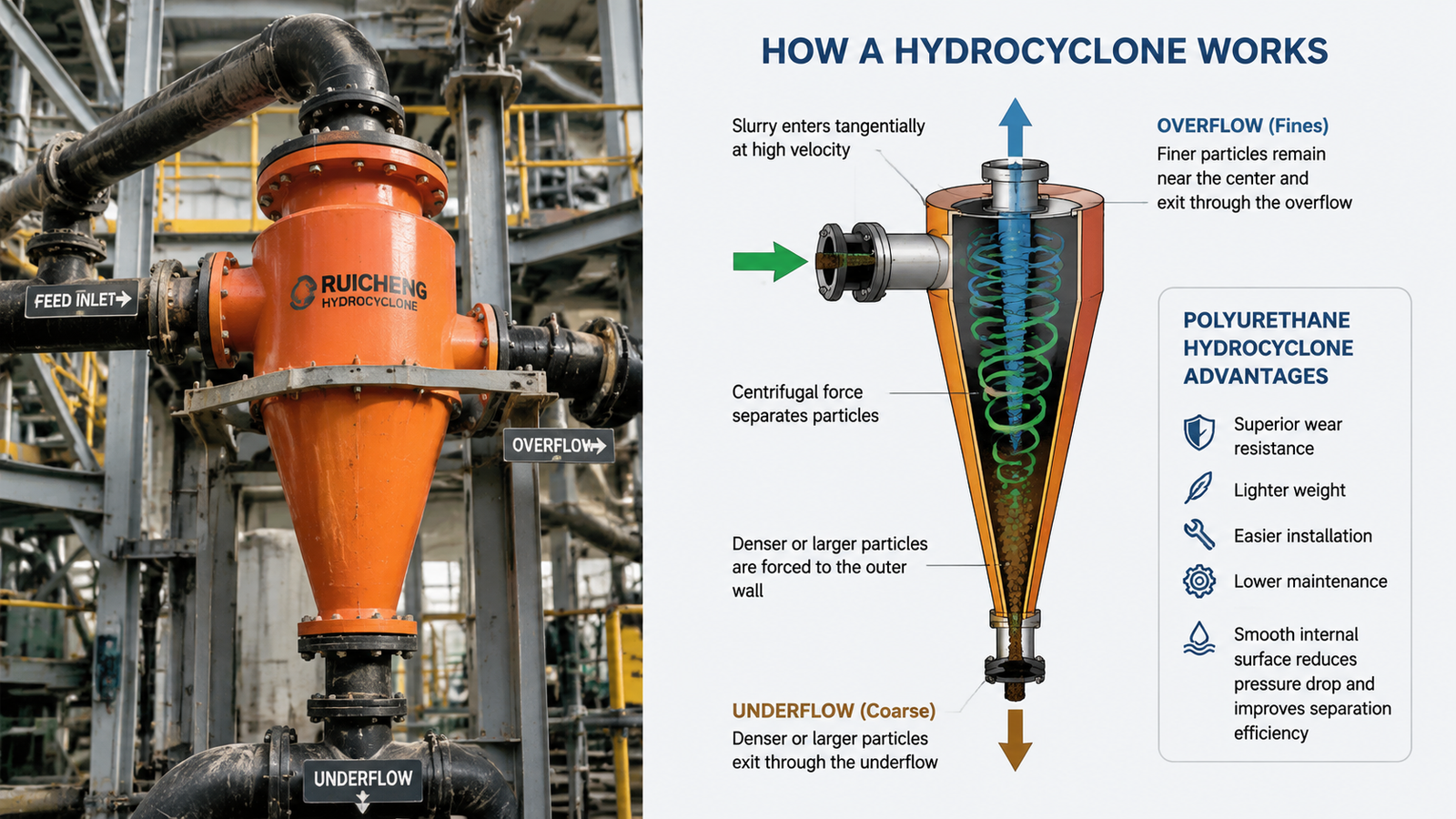
How a hydrocyclone separates
Slurry enters tangentially at the top and is forced into a spinning vortex. Centrifugal force throws the coarse, heavy particles outward to the wall, where they spiral down and exit through the apex (underflow). The fine, light particles stay near the axis and rise through the vortex finder to the overflow.
Three variables control the cut:
| Variable | Effect |
|---|---|
| Inlet pressure | Higher pressure means finer cut and higher capacity |
| Apex diameter | Larger apex means coarser underflow and more water carry-over |
| Vortex finder diameter | Larger finder means coarser cut and higher capacity |
| Body diameter | Larger diameter means coarser cut, higher throughput |
| Cone angle | Steeper cone means finer cut, longer residence |
The reason hydrocyclones are cheap to buy and expensive to run badly: the same unit can produce a clean cut or a bypass-heavy mess depending on pressure and apex choice, and nobody notices until the downstream process fails.
Polished versus unlined versus polyurethane
| Material | Wear life (abrasive slurry) | Cost | Best for |
|---|---|---|---|
| Mild steel | Weeks to months | Lowest | Non-abrasive, short duty |
| Rubber lined | 1 – 3 years | Moderate | Coarse abrasive, high flow |
| Ceramic lined | 2 – 5 years | High | Very abrasive, fine cut |
| Polyurethane (PU) | 2 – 4 years | Moderate | Fine abrasive, most mineral slurries |
| Cast polyurethane, one-piece | 3 – 5 years | Moderate | Where erosion is concentrated |
Polyurethane's advantage is that it is both abrasion resistant and flexible: it absorbs impact from coarse particles instead of chipping like ceramic, and it resists the sliding wear that destroys steel. Its limits are temperature (below 80 °C for standard grades) and swelling in some solvents.
For most mineral, coal and sand applications, polyurethane is the best cost-per-tonne compromise. The abrasion-resistant molded grades behind those liners are compared in our molding defects guide and the injection molding materials overview.
FX series sizing range
| Model | Body diameter (mm) | Typical capacity (m³/h) | Typical cut (µm) | Common application |
|---|---|---|---|---|
| FX-50 | 50 | 1 – 5 | 10 – 25 | Fine classification, test work |
| FX-75 | 75 | 3 – 12 | 15 – 35 | Small circuits, polishing |
| FX-100 | 100 | 8 – 25 | 20 – 45 | Sand washing, dewatering |
| FX-150 | 150 | 20 – 55 | 30 – 60 | Mineral classification |
| FX-250 | 250 | 50 – 130 | 40 – 80 | Coal, tailings |
| FX-350 | 350 | 100 – 220 | 50 – 100 | High-volume desliming |
| FX-500 | 500 | 200 – 400 | 60 – 130 | Primary desliming |
| FX-660 | 660 | 350 – 700 | 70 – 150 | Bulk dewatering |
The numbers are indicative — every manufacturer's range differs slightly, and the cut size shifts with feed density and pressure. What matters is the selection logic below, not the table alone.
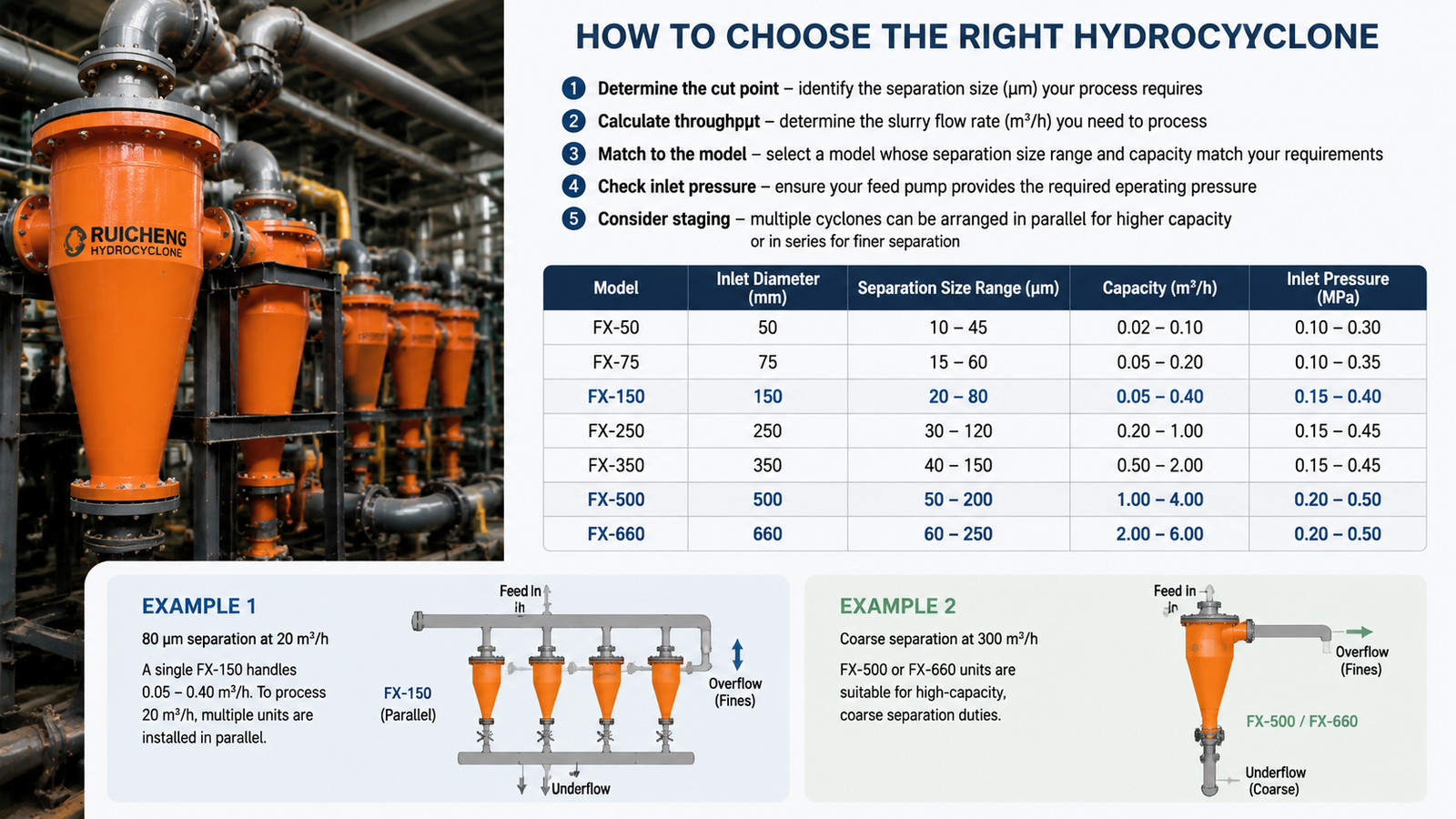
The four numbers that decide selection
1. Feed flow rate. Every cyclone has a narrow flow band. Below it, the vortex collapses and separation fails. Above it, wear accelerates and the cut coarsens. Size for 10 to 20 percent above nominal, not 100 percent.
2. Target cut size (d50). The particle size at which half reports to underflow. Smaller cyclones cut finer; larger ones cut coarser. Two small cyclones in parallel usually cut finer than one large one of the same total capacity.
3. Feed solids content. By weight and by volume. High solids change the effective viscosity and shift the cut coarser. Above 20 to 25 percent by volume, cyclone performance degrades and alternatives should be considered.
4. Inlet pressure. Typically 0.05 to 0.15 MPa (0.5 to 1.5 bar). Higher pressure gives a finer cut and more capacity but multiplies wear. A cyclone run at 0.03 MPa looks identical and separates nothing.
Hydrocyclone selection checklist
| Step | Question | Consequence |
|---|---|---|
| 1 | What is the feed flow, minimum and maximum? | Sets number and size of cyclones |
| 2 | What cut size is required? | Sets body diameter |
| 3 | What is the feed solids by weight and volume? | Adjusts the cut, may need larger units |
| 4 | What pressure is available? | Determines achievable cut and capacity |
| 5 | Is the slurry abrasive and at what temperature? | Determines liner material |
| 6 | What underflow density is needed? | Determines apex size |
| 7 | Is turndown needed? | Favours multiple small units over one large |
The seventh point is the one most often missed: a single large cyclone cannot be turned down. Three smaller units in parallel can run one, two or three at a time, which is what real plants need when feed rate varies.
Application areas
| Industry | Duty | Typical model range |
|---|---|---|
| Mineral processing | Classification, desliming | FX-100 to FX-350 |
| Coal washing | Heavy media recovery, desliming | FX-150 to FX-500 |
| Sand and aggregate | Washing, dewatering, fines recovery | FX-75 to FX-250 |
| Chemical processing | Catalyst recovery, clarification | FX-50 to FX-150 |
| Wastewater | Grit removal, sludge thickening | FX-75 to FX-250 |
| Drilling mud | Solids control, desanding | FX-75 to FX-150 |
Hydrocyclone maintenance: what actually wears
| Component | Wear pattern | Replacement interval |
|---|---|---|
| Apex / spigot | Highest wear point — abrasive slurry exits at high velocity | 3 – 12 months |
| Cone lower section | Sliding abrasion | 1 – 3 years |
| Inlet area | Impact and turbulence | 2 – 4 years |
| Vortex finder | Erosion from the overflow stream | 2 – 4 years |
| Body upper section | Least wear | 5+ years |
| Gaskets and seals | Compression set | 1 – 2 years |
The apex is the consumable. Carry spares, check it monthly, and replace when the diameter has grown by 10 percent — a worn apex silently coarsens the underflow and floods water to the underflow, which is the classic "the cyclone stopped working" complaint.
Operating checks that prevent most problems
| Check | Frequency | Target |
|---|---|---|
| Inlet pressure | Every shift | Within ±10% of design |
| Apex diameter | Monthly | Within 10% of nominal |
| Underflow shape | Every shift | Rope discharge, not spray |
| Overflow clarity | Every shift | No visible coarse solids |
| Feed density | Every shift | Within design range |
| Blockages | As required | Clear immediately — a blocked apex bypasses everything to overflow |
The underflow shape is the single most informative visual check: a rope discharge means the cyclone is working at the right underflow density; a spray discharge means too much water is reporting to underflow, usually because the apex is too large or worn.
Installation details that matter
| Detail | Requirement |
|---|---|
| Inlet pipe | Straight run of at least 5 diameters before the inlet |
| Manifold | Symmetric distribution to parallel units |
| Overflow | Free discharge or adequate head — never throttle |
| Underflow | Open to atmosphere or a sealed collection with air break |
| Support | Rigid — vibration destroys liners |
| Access | Apex reachable without disassembly |
A throttled overflow is the most common installation error: it back-pressures the vortex and destroys the cut. The overflow must discharge freely. For the wear parts themselves, see glass and carbon fiber in POM and PPS molding for chemical resistance.
Related guidance
Our guides to glass and carbon fiber in POM and PA66 nylon cover wear-resistant molded grades, PPS molding covers chemical resistance, and tolerance specification covers the dimensional side of molded parts.
Process and material data in this guide follows typical industry practice, with abrasion and pressure figures cross-checked against ASTM International and ISO test standards, material values against MatWeb and Engineering Toolbox, and processing guidance against Plastics Technology and PLASTICS industry standards, with material characterisation maintained through SPE and NIST reference data. For the separation principle, see hydrocyclone.
What size hydrocyclone do I need?
Size by feed flow first — a cyclone has a narrow flow band. Then check the required cut size, which sets the body diameter, and confirm the available inlet pressure (0.05 to 0.15 MPa). Three small units in parallel usually beat one large one where flow varies.
Why is polyurethane used for hydrocyclones?
Because it combines abrasion resistance with flexibility. It absorbs impact from coarse particles instead of chipping like ceramic, and resists sliding wear far better than steel. Standard grades are limited to about 80 °C.
How often should the apex be replaced?
Every 3 to 12 months in abrasive duty. Replace when the diameter grows by 10 percent — a worn apex coarsens the underflow and floods water through, which is the usual cause of "the cyclone stopped working".
What does the underflow shape tell me?
A rope discharge means correct underflow density. A spray discharge means too much water is reporting to underflow, usually from an oversized or worn apex. A blocked apex sends everything to overflow.
What pressure should a hydrocyclone run at?
0.05 to 0.15 MPa (0.5 to 1.5 bar) at the inlet. Higher pressure gives a finer cut and more capacity but accelerates wear. Below 0.05 MPa the vortex weakens and separation degrades sharply.
Can hydrocyclones handle high solids content?
Up to about 20 to 25 percent by volume. Above that the effective viscosity rises, the cut coarsens and separation efficiency drops. Thicken or dilute the feed rather than oversizing the cyclone.
Conclusion
Hydrocyclone selection is four numbers — flow, cut size, solids content and pressure — plus one habit: check the apex and the underflow shape every shift. Polyurethane bodies and apexes give the best wear-per-cost compromise for abrasive mineral and sand slurries, and the apex is the part that actually wears out.
At Rui Cheng we mold polyurethane and engineering plastic components for separation and wear applications on 80 to 1,400 tonne machines, with in-house tooling and ISO 9001 / IATF 16949 processes. Send us the duty conditions and the target cut size, and we will come back with a model recommendation and an indicative part cost.