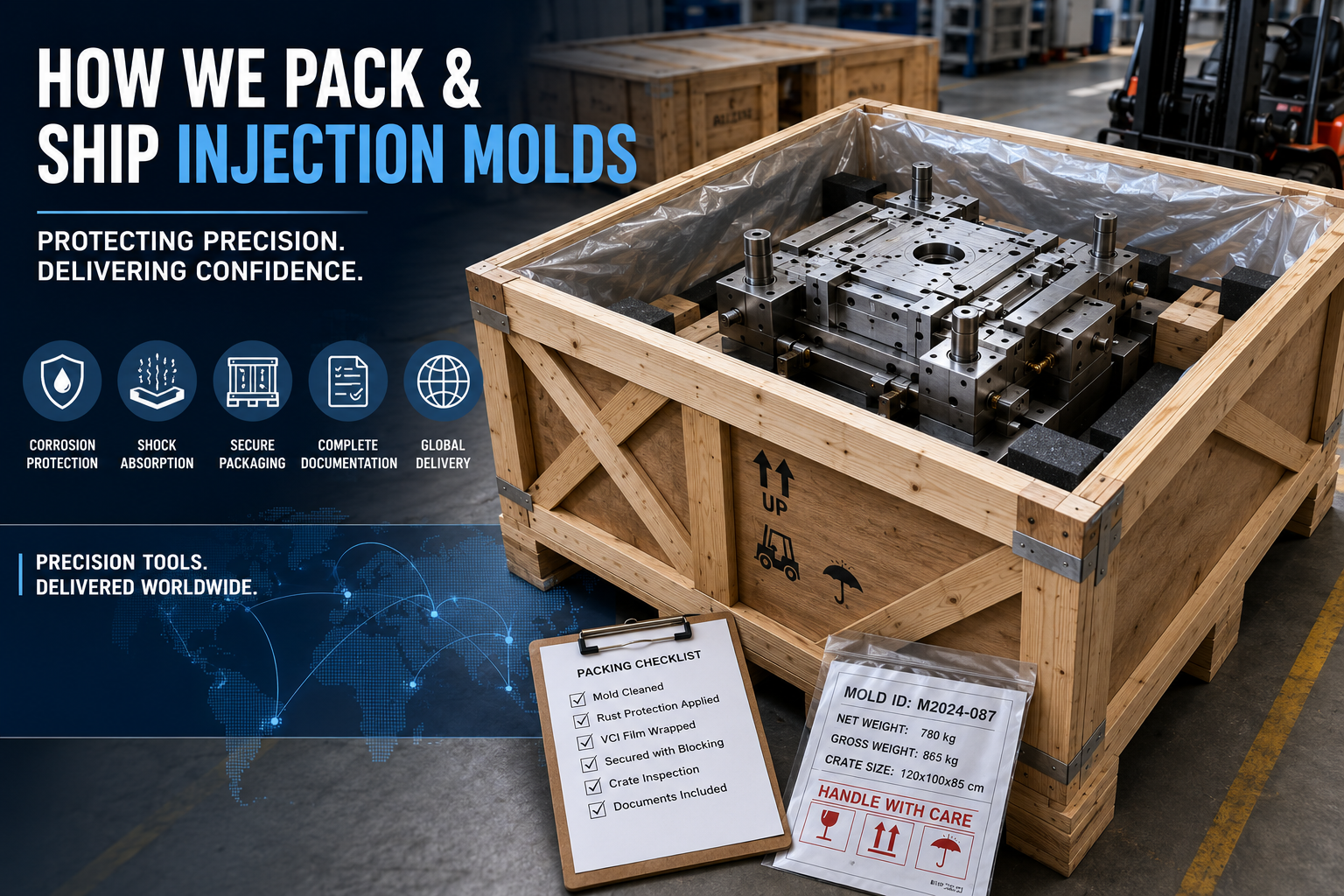
An injection mold is one of the most valuable assets a manufacturer owns — a precision tool that can represent tens of thousands of dollars and months of engineering. When a mold ships from the factory to the customer, how it is packed and transported determines whether it arrives ready to run or damaged beyond repair. This article explains how we pack and ship injection molds, and why proper mold packaging is essential for every tooling project.
Why Mold Packaging Matters
Injection molds are precision components. A mold half is machined to tolerances of ±0.005 mm, with polished cavity surfaces, delicate ejector systems, and precisely aligned guide pins. During transport, a mold faces three threats:
- Corrosion — moisture and humidity cause rust on steel surfaces, especially polished cavities
- Impact damage — rough handling, vibration, or drops can misalign plates and damage surfaces
- Contamination — dust and debris entering the mold can damage cavities and cooling channels
A mold damaged in transit can cost weeks of rework and thousands of dollars in repairs. Proper packaging is not an afterthought — it is part of the engineering process.
Step 1: Mold Preparation Before Packing
Before any mold is packed, it must be prepared correctly:
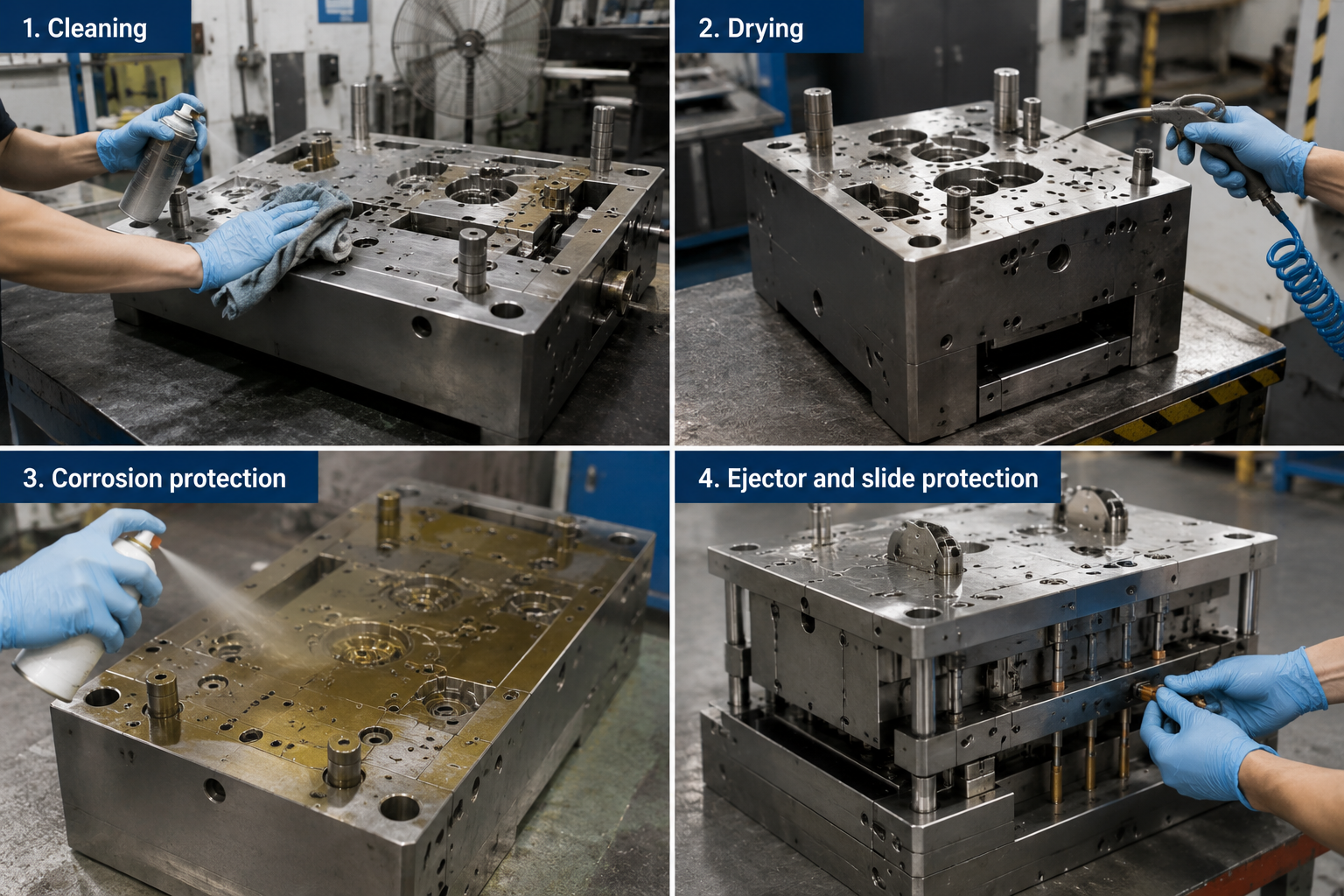
Cleaning. The mold is thoroughly cleaned to remove coolant residue, grease, and debris from the cavity surfaces, parting lines, and cooling channels.
Drying. All moisture is removed from the mold surfaces and cooling circuits. Compressed air is used to blow out water from cooling channels and ejector systems.
Corrosion protection. A rust-preventive coating or oil is applied to all steel surfaces, especially polished cavities and cores. This forms a protective barrier against humidity during transport. The corrosion inhibitor used is selected to be compatible with the mold steel and any in-mold components.
Ejector and slide protection. Ejector pins, slides, and lifters are retracted to their home positions and secured, preventing movement and damage during transit.
Step 2: Protective Sealing
Once prepared, the mold is protected from contamination and moisture:
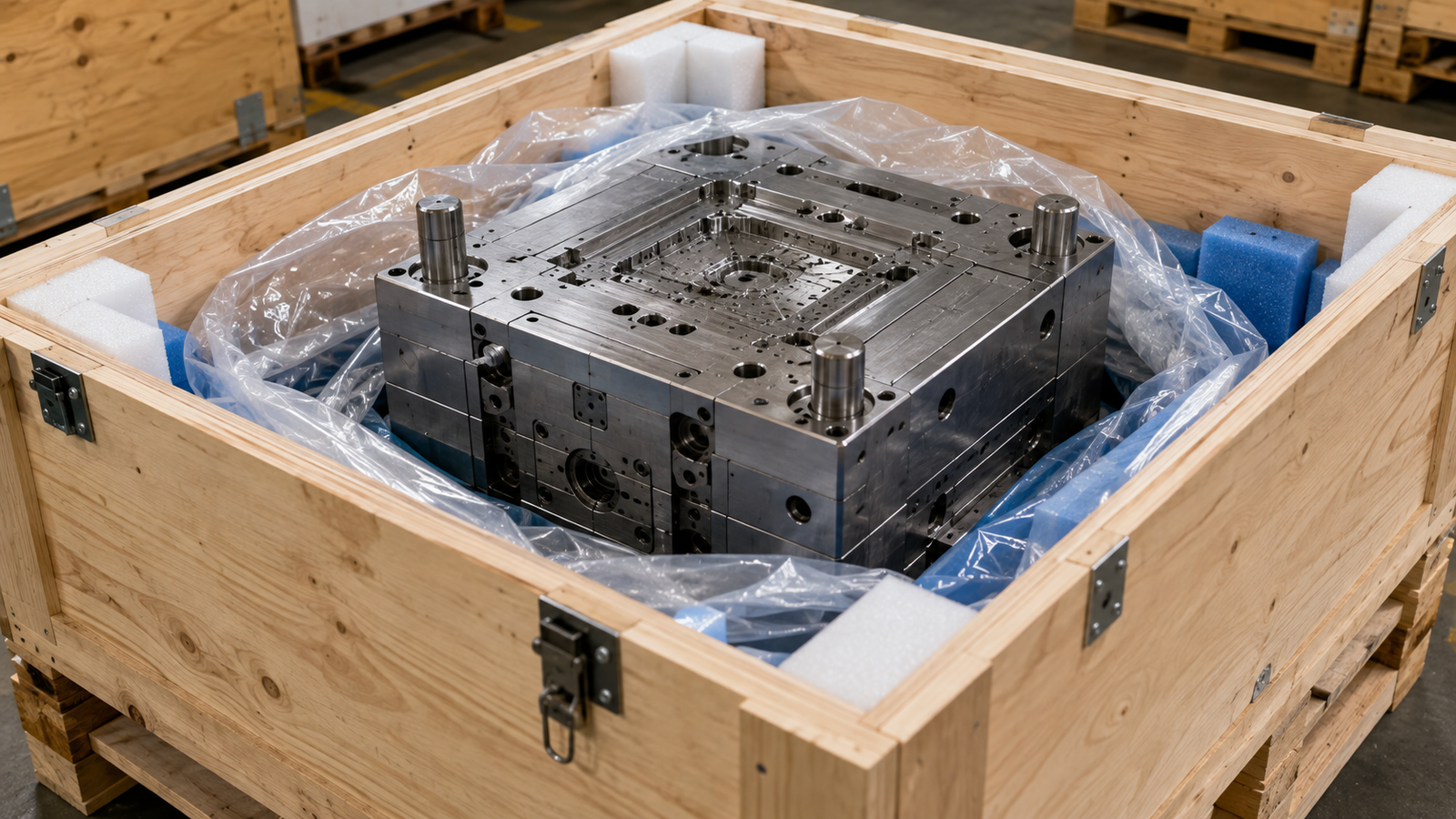
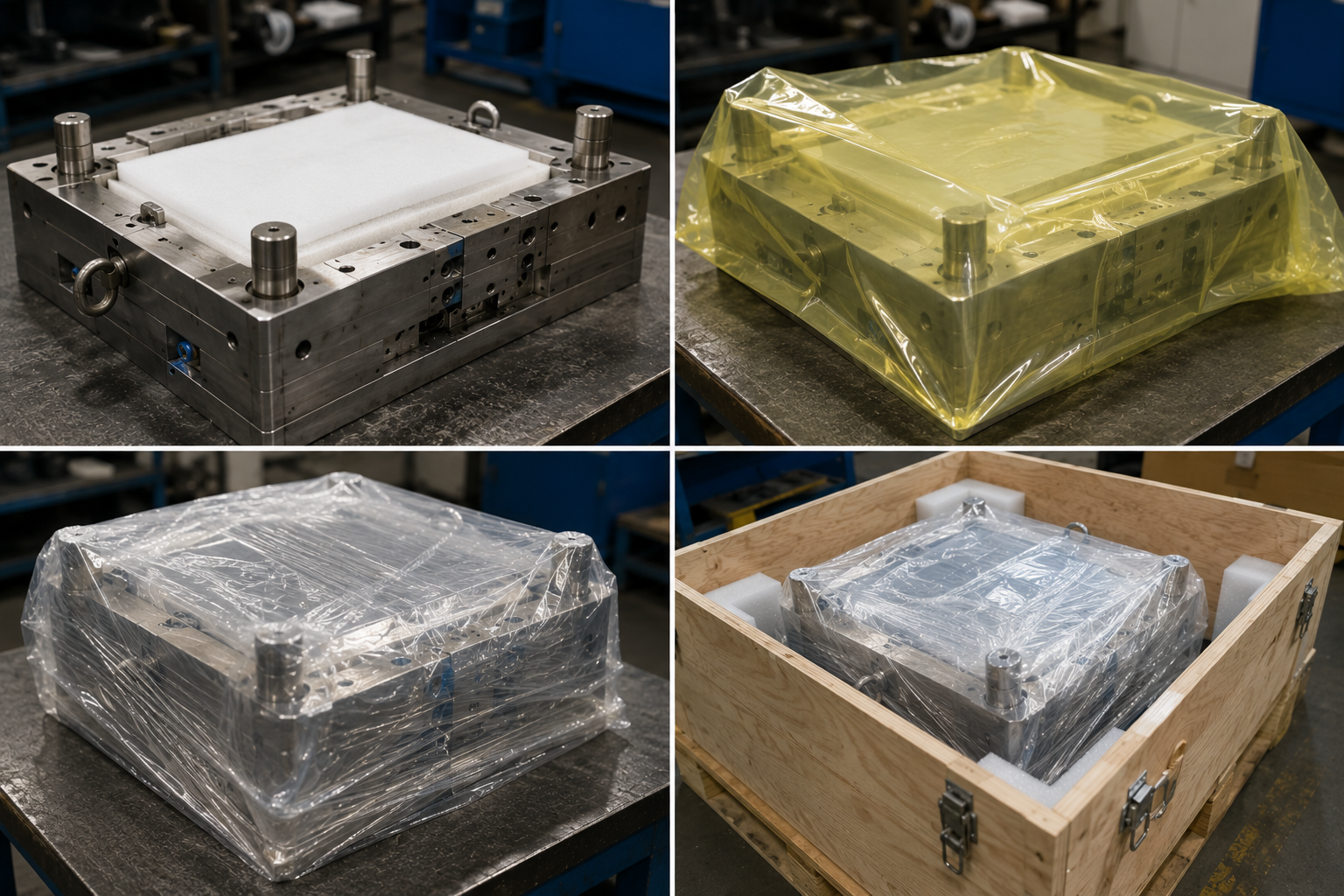
- Cavity protection: Foam or protective sheets are placed over cavity surfaces to prevent contact damage
- Sealing: The mold may be wrapped in VCI (vapor corrosion inhibitor) film, which releases corrosion-inhibiting vapor that protects steel surfaces even in enclosed spaces
- Waterproof wrapping: A moisture barrier is applied around the entire mold
The combination of rust-preventive coating, VCI protection, and waterproof wrapping ensures the mold arrives corrosion-free even on long ocean shipments through humid climates.
Step 3: Crate Construction
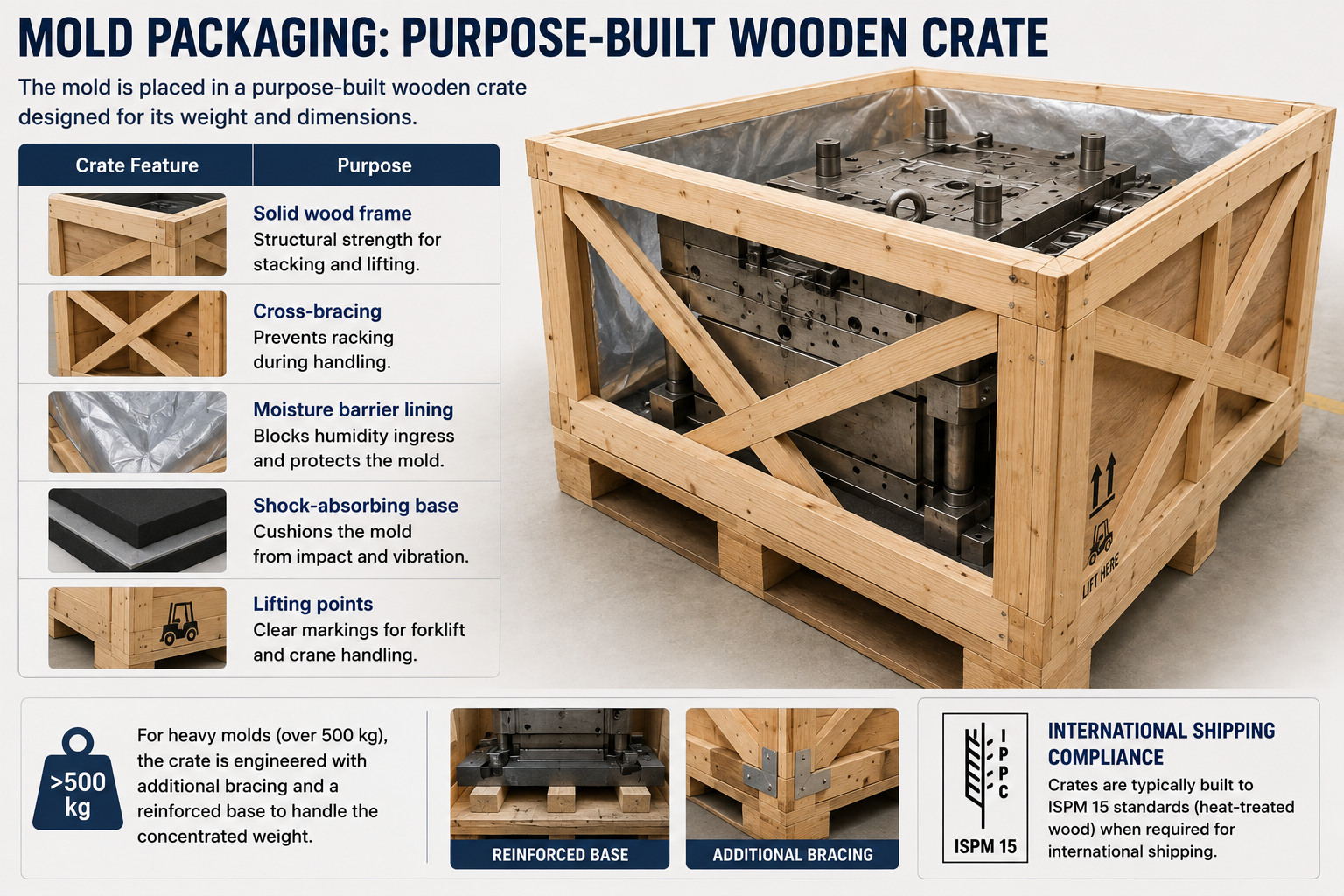
The mold is placed in a purpose-built wooden crate designed for its weight and dimensions:
| Crate Feature | Purpose |
|---|---|
| Solid wood frame | Structural strength for stacking and lifting |
| Cross-bracing | Prevents racking during handling |
| Moisture barrier lining | Blocks humidity ingress |
| Shock-absorbing base | Cushions the mold from impact |
| Lifting points | Clear markings for forklift and crane handling |
For heavy molds (over 500 kg), the crate is engineered with additional bracing and a reinforced base to handle the concentrated weight. Crates are typically built to ISPM 15 standards (heat-treated wood) when required for international shipping compliance.
Step 4: Securing Inside the Crate
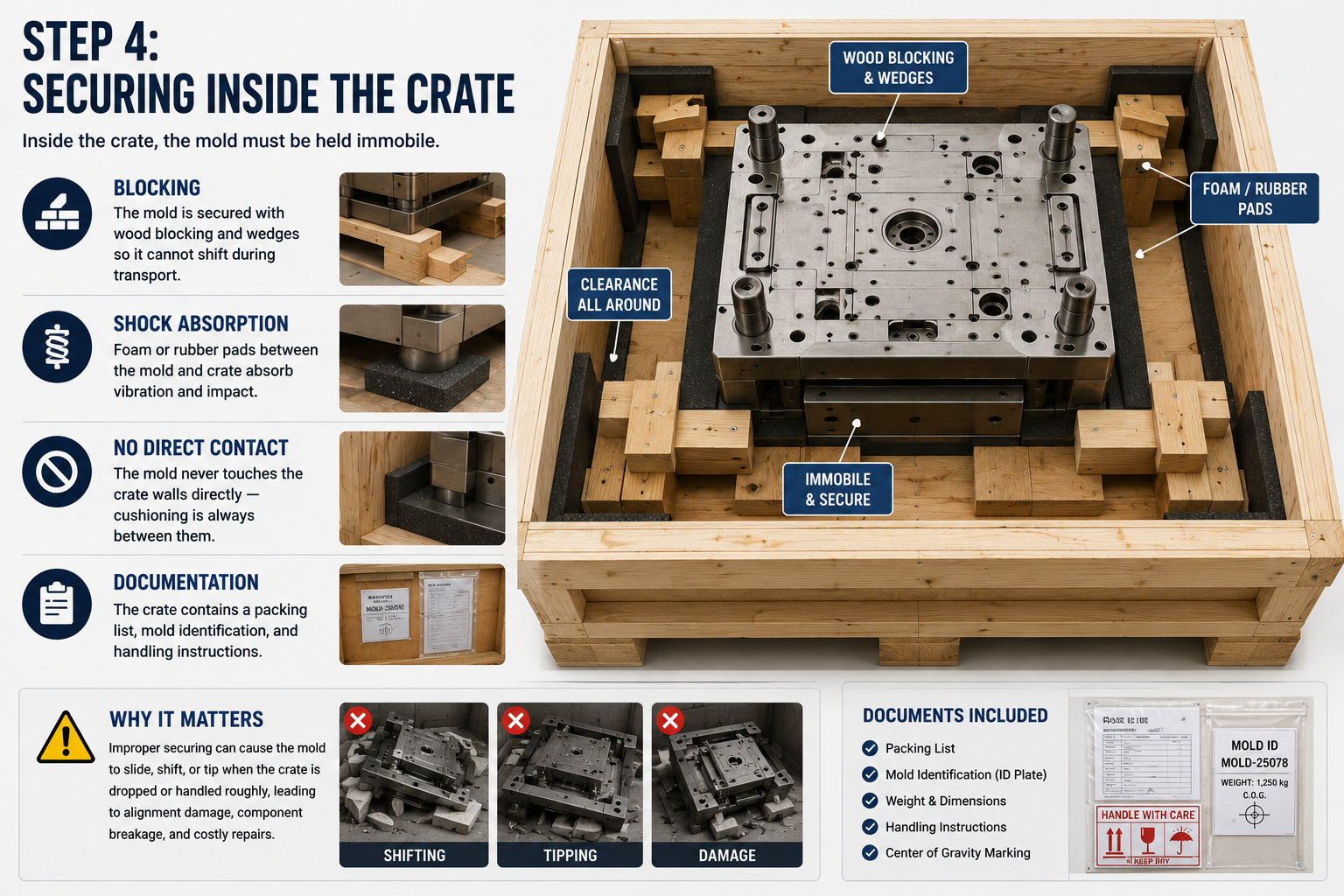
Inside the crate, the mold must be held immobile:
- Blocking: The mold is secured with wood blocking and wedges so it cannot shift during transport
- Shock absorption: Foam or rubber pads between the mold and crate absorb vibration and impact
- No direct contact: The mold never touches the crate walls directly — cushioning is always between them
- Documentation: The crate contains a packing list, mold identification, and handling instructions
Proper securing prevents the mold from sliding, which is a common cause of damage when crates are dropped or tipped during loading.
Step 5: Shipping and Documentation
For international mold shipments, we manage the complete export process:
Documentation provided:
- Packing list with crate dimensions and weight
- Commercial invoice
- Bill of lading or air waybill
- Certificate of origin (when required)
- Mold identification and specification sheet
| Shipping methods: | Method | Lead Time | Best For |
|---|---|---|---|
| Air freight | 3-7 days | Urgent molds, high-value tools | |
| Sea freight (LCL) | 20-40 days | Standard tooling shipments | |
| Sea freight (FCL) | 20-40 days | Multiple molds, large orders |
For each shipment, we select the method based on the customer's timeline, mold value, and destination. Insurance is available to cover the mold's full value during transit.
Quality Control at Every Step
Our mold packing process follows documented procedures aligned with ISO 9001 quality management principles:
- Pre-packing checklist — mold condition verified and photographed before packing
- In-process inspection — rust protection, sealing, and securing verified at each stage
- Final inspection — crate integrity, labeling, and documentation confirmed before loading
- Photo documentation — the packed and crated mold is photographed for the customer's records
This traceable process means both we and the customer know exactly what was shipped and in what condition — eliminating disputes and ensuring accountability.
Arrival and Commissioning Support
When the mold arrives at the customer's facility, we provide:
- Unpacking guidance — clear instructions for removing the mold from the crate safely
- First-run support — remote or on-site assistance for the first mold trial
- Documentation package — mold maintenance and handling recommendations
A mold that arrives protected and is commissioned correctly goes into production faster and serves longer.
Conclusion
Proper mold packing and shipping is a critical part of every tooling project. From corrosion protection and VCI sealing to engineered crates and complete export documentation, every step protects the customer's investment. With experience in international mold delivery, we ensure molds arrive at customer facilities worldwide in perfect condition, ready for production.
With experience in mold manufacturing, packing, and global shipping, we support customers from tooling development through delivery and commissioning. Contact our engineering team to discuss your mold project and delivery requirements.
FAQ
How are injection molds protected from rust during shipping?
Molds are cleaned, dried, and coated with a rust-preventive oil or VCI (vapor corrosion inhibitor). VCI film releases protective vapor that prevents corrosion on steel surfaces during transport, even in humid environments.
What type of crate is used for mold shipping?
Molds are shipped in purpose-built wooden crates with solid frames, cross-bracing, moisture barriers, and shock-absorbing bases. Crates are built to ISPM 15 standards when international shipping requires heat-treated wood.
Can molds be shipped by air freight?
Yes. Air freight is used for urgent or high-value molds, with lead times of 3-7 days. Sea freight (LCL or FCL) is used for standard shipments with lead times of 20-40 days.
How do you prevent mold damage during transport?
Molds are secured inside the crate with blocking, wedges, and foam cushioning so they cannot shift during transport. The mold never contacts the crate walls directly, and crates are engineered for the mold's weight and dimensions.
What documentation is provided with a mold shipment?
Each shipment includes a packing list, commercial invoice, bill of lading or air waybill, certificate of origin when required, and a mold identification sheet. Photo documentation of the packed mold is also provided.
Do you support mold commissioning after arrival?
Yes. We provide unpacking guidance, first-run support (remote or on-site), and a maintenance and handling documentation package to help customers commission molds quickly and correctly.