Delamination in multi-material overmolding is the failure where the two materials separate at the interface — sometimes immediately, sometimes after a week in a humid room. Delamination looks like a manufacturing defect and is usually a specification defect: the interface was never designed to bond.
This guide covers the four root causes in the order they should be checked, the material pairings that work, and how to test the bond before the customer does.
What delamination actually is
Two materials are molded together and, at the boundary, no bond forms. The interface behaves as a crack that is already present. Under load, humidity or thermal cycling, it propagates.
Three levels of failure:
| Level | What happens | Symptom |
|---|---|---|
| No adhesion | No bond formed at all | Peels off immediately, often in the tool |
| Weak adhesion | Bond forms but is thin | Passes initial test, fails in humidity |
| Local debonding | Bond is good except at edges, corners or flow ends | Lifting at edges, blistering |
The third is the most common in production and the most confusing, because the part usually passes a peel test taken from the middle.
Cause 1: surface energy
Adhesion needs wetting, and wetting needs the substrate surface energy to exceed the overmold's surface tension by 5 to 10 mN/m.
| Substrate | Surface energy (mN/m) | Overmold wetting |
|---|---|---|
| PP | 29 – 31 | Poor — requires treatment |
| PE | 30 – 31 | Poor — requires treatment |
| POM | 34 – 38 | Marginal |
| ABS | 38 – 42 | Good |
| PC | 40 – 42 | Good |
| PA66 | 40 – 45 | Good when dry |
| PBT | 42 – 45 | Good |
The two polyolefins are the problem cases. PP and PE have no polar groups, so no overmold resin will wet them without treatment.
| Treatment | Surface energy after | Durability |
|---|---|---|
| Plasma (atmospheric) | 60 – 70 | Days |
| Flame treatment | 45 – 55 | Hours to days |
| Corona (flat sheet) | 45 – 55 | Hours to days |
| Primer (chlorinated polyolefin) | Effective tie layer | Permanent |
| Abrasion + solvent clean | 38 – 45 | Hours |
For PP and PE, plasma or flame plus a grafted overmold resin is the combination that works. For polar substrates (ABS, PC, PA), cleaning and drying are usually enough — contamination, not surface energy, is the limiting factor.
Our guide to substrate polarity and adhesion covers the surface-chemistry mechanism, and overmolding adhesion on nylon covers the hygroscopic case.
Cause 2: temperature and pressure
| Parameter | Effect on bonding | Typical target |
|---|---|---|
| Substrate temperature at overmold | Too cold: overmold freezes before wetting | 60 – 80 °C |
| Overmold melt temperature | Too cold: no interdiffusion | Upper half of the range |
| Mold temperature | Too cold: interface freezes instantly | 40 – 80 °C depending on resin |
| Injection speed into the bond area | Too slow: freeze-off. Too fast: shear and jetting | Moderate to fast |
| Packing pressure | Too low: no contact. Too high: distorts substrate | Moderate |
| Cooling time | Too short: demolding tears the bond | Adequate |
The most common process cause is a cold substrate: the overmold melt touches a 20 °C surface and freezes in milliseconds, before any wetting can occur. Warming the insert to 60 to 80 °C changes the result more than any other single change.
The second most common is over-packing: the overmold is packed hard enough to deflect the substrate, and when the substrate springs back after ejection it peels the interface.
Cause 3: material incompatibility
| Substrate | Overmold | Adhesion |
|---|---|---|
| PP | TPE-S (SEBS) with PP base | Good |
| PP | TPE with MAH graft | Very good |
| PP | TPU | Poor |
| PA66 | TPE with MAH graft | Excellent |
| PA66 | TPU with MAH graft | Good |
| PC | TPU | Good |
| PC | TPE-SEBS | Poor |
| ABS | TPE-SEBS | Good |
| ABS | TPU | Good |
| PP | PA | None — incompatible |
| POM | Almost anything | Poor — POM resists bonding |
Two rules: same-family or grafted pairs bond; unrelated pairs do not. A TPE formulated for PP will not bond to PA, and a TPE formulated for PA will not bond to PP — they are different products with different compatibilisers, even though both are called TPE.
The POM row is worth noting: polyoxymethylene has no reactive groups and resists nearly all bonding. Mechanical interlock is essentially the only route.
Cause 4: structural design
| Feature | Requirement | Effect |
|---|---|---|
| Mechanical interlock | Through-holes, dovetails, knurling | Carries peel load the bond cannot |
| Edge overlap | 1.0 mm minimum | Prevents edge lifting |
| Bond-line radius | 0.5 mm | Reduces stress concentration |
| Overmold wall | 1.0 – 2.5 mm | Too thin tears, too thick shrinks |
| Gate position | Not directly onto the bond area | Jetting and shear damage the interface |
| Wall transitions | Gradual | Abrupt changes concentrate stress |
The design principle is the same as for any adhesive joint: make the bond fail inside the material, not at the interface. If the tear runs along the boundary, the interface is the weak link; if the TPE tears internally, the bond exceeds the material strength and the design is sound.

Testing the bond properly
| Test | Method | Acceptance |
|---|---|---|
| 180° peel | ASTM D903 | above 6 N/mm for grafted PA or PP pairs |
| T-peel | ASTM D1876 | above 4 N/mm |
| Pull-off | Tensile normal to interface | above 2 MPa |
| Humidity ageing | 40 °C / 93% RH, 7 days | Retain above 70% of initial |
| Thermal cycling | −20 to 70 °C, 10 cycles | No lifting at edges |
| Hot water immersion | 60 °C, 7 days | No blistering |
| Salt spray | 96 h | No undercut corrosion at edges |
The humidity and thermal-cycle tests are what separate a prototype that works from a product that ships. A dry peel test on a fresh part tells you very little about a part that will sit in a warehouse in Guangzhou in July.
Prevention checklist
| Check | Target | Priority |
|---|---|---|
| Contamination | No silicone release, no oil, gloves worn | 1 |
| Substrate dried | Per material spec | 2 |
| Substrate temperature at overmold | 60 – 80 °C | 3 |
| Overmold resin grafted for the substrate | MAH graft for PA, PP-based for PP | 4 |
| Surface treatment | Plasma or flame for PP/PE | 5 |
| Mechanical interlock | Holes, dovetails, texture | 6 |
| Edge overlap | 1.0 mm | 7 |
| Packing | Moderate, no substrate distortion | 8 |
| Peel + humidity test | Before production release | 9 |
Priority order matters: contamination and moisture cause more delamination than everything else combined, and they are free to fix.
Related guidance
Our guides to nylon overmolding adhesion, co-injection structures, water absorption, thick-part cracking and injection molding defects cover the adjacent failure modes, and materials overview covers the grade families.
Adhesion data in this guide follows the test methods published by ASTM International (D903, D1876) and ISO, with typical values cross-checked against MatWeb and Engineering Toolbox. Processing practice reflects Plastics Technology guidance and PLASTICS industry standards, with material characterisation maintained through SPE and NIST reference data. For the adhesion science, see adhesion.
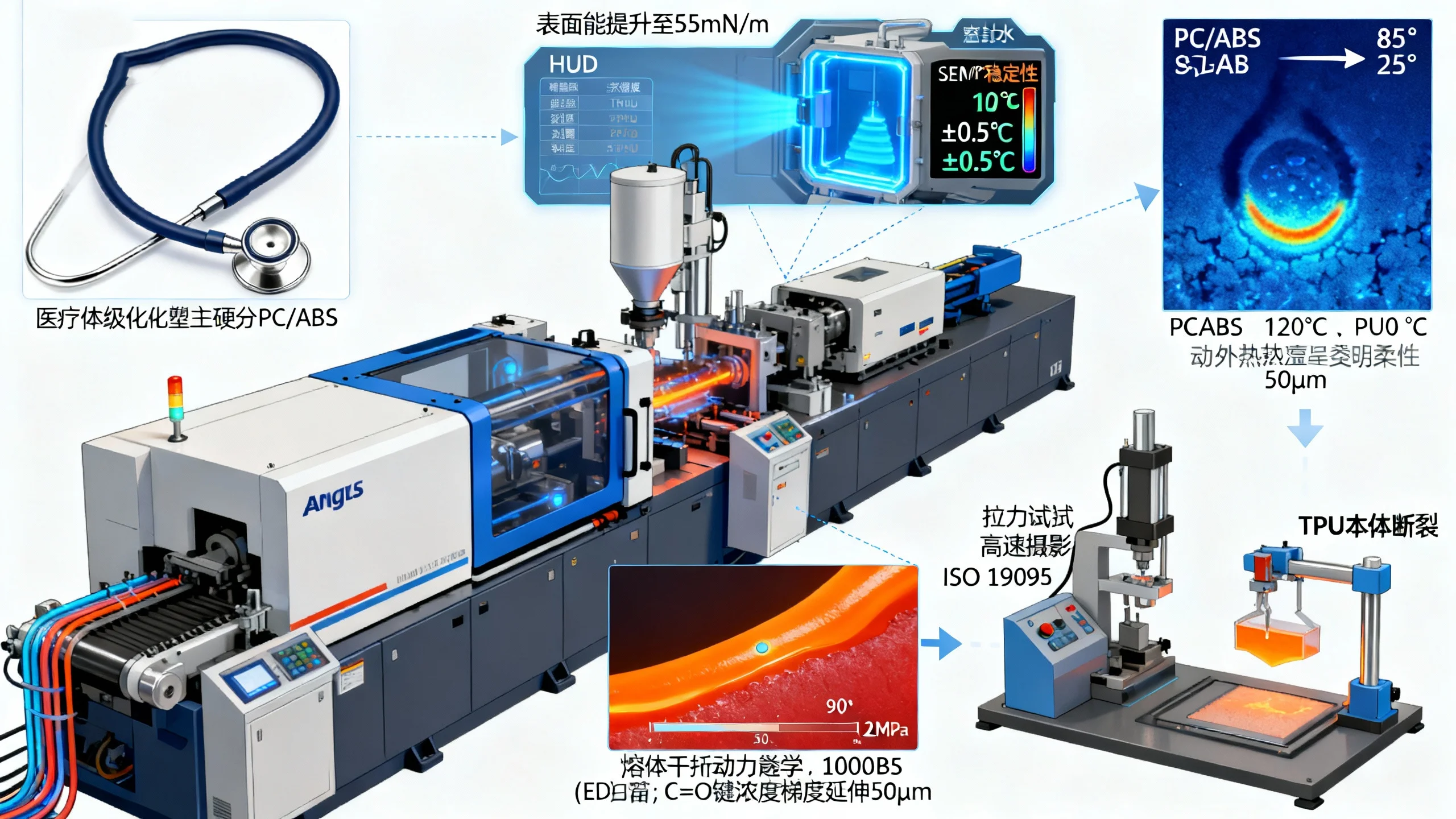
What causes delamination in overmolding?
Four causes, in order of frequency: contaminated surfaces (especially silicone release agent), insufficient surface energy on the substrate, wrong material pairing, and a cold substrate at the moment of overmolding.
How do I fix delamination between PP and TPE?
Use a PP-based or MAH-grafted TPE, treat the surface with plasma or flame, and overmold onto a substrate at 60 to 80 °C. Untreated PP has a surface energy of 29 to 31 mN/m, which no TPE will wet.
Does substrate temperature matter that much?
Yes — it is one of the two biggest levers. At 20 °C the overmold melt freezes on contact before wetting; at 60 to 80 °C the interface stays mobile long enough to bond.
Why does my part pass the peel test but fail in humidity?
Because the bond is thin and water reaches the interface. Test after 7 days at 40 °C / 93% RH, and retain at least 70 percent of the dry peel strength. A nylon substrate swells 0.2 to 0.5 percent with moisture, which loads the bond in shear.
Can POM be overmolded?
Only with mechanical interlock. POM has no reactive groups and resists almost all chemical bonding, so the joint has to be designed to carry the load mechanically.
What is the acceptance criterion for overmolding adhesion?
For grafted PA or PP pairs, 6 N/mm or more in 180° peel, retaining 70 percent after humidity ageing. Also require that failure occurs inside the overmold material rather than at the interface.
Conclusion
Delamination is an interface problem with four causes, and three of them — contamination, moisture and substrate temperature — cost nothing to fix and cause most of the failures. Get those right, use a grafted overmold resin for the specific substrate, add mechanical interlock, and test in humidity rather than in the lab.
At Rui Cheng we run two-shot and insert overmolding on 80 to 1,400 tonne machines with substrate drying, insert pre-heating, mold temperature control and documented peel plus humidity testing, under ISO 9001 / IATF 16949. Send us the material pairing and the service environment, and we will come back with a bonding recommendation and an indicative part cost.