"How much does injection molding cost?" is one of the most common questions buyers ask — and one of the hardest to answer with a single number. Injection molding costs depend on tooling, material, part complexity, and volume. This guide breaks down every cost component with real figures, so you can estimate your project cost accurately before requesting quotes.
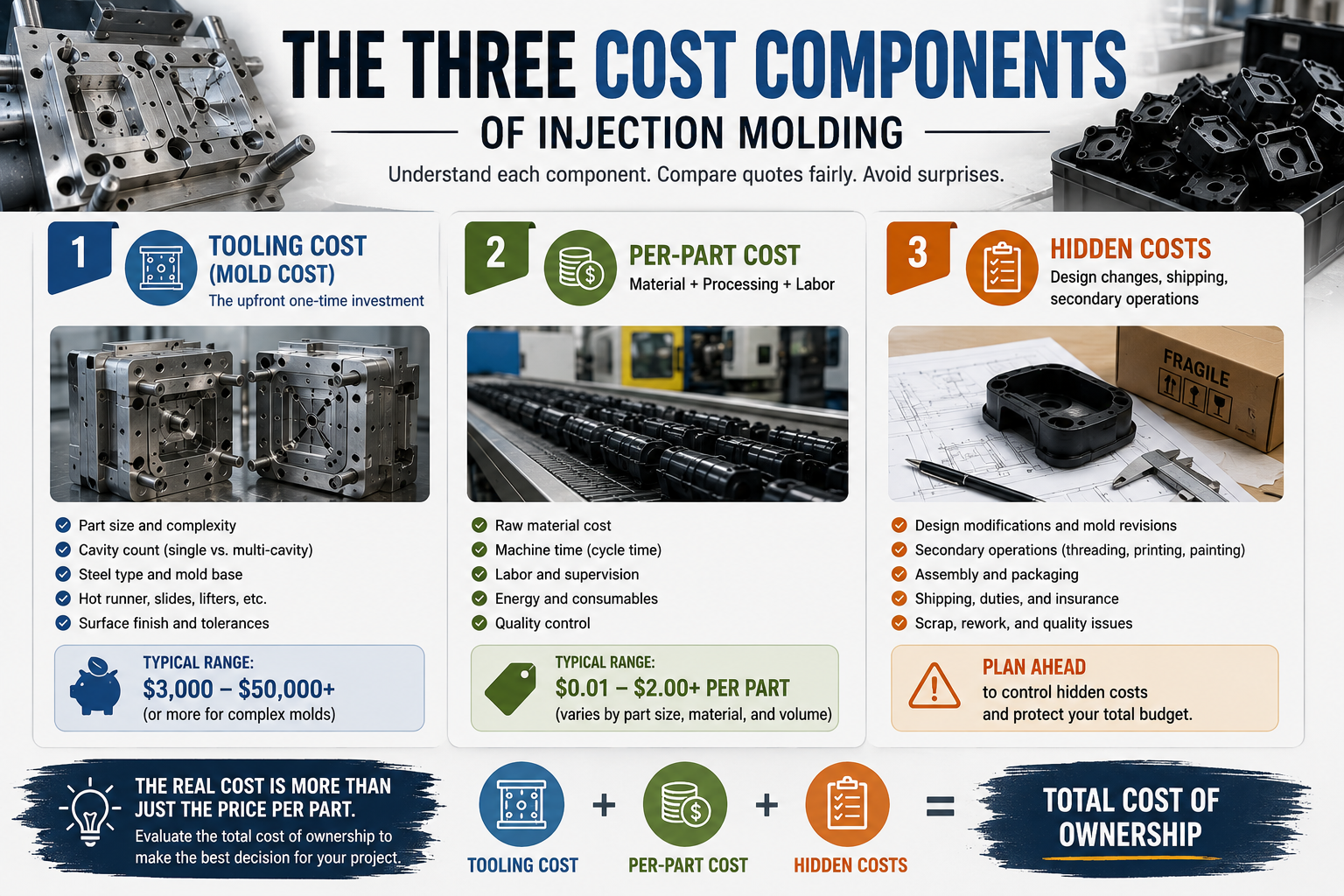
The Three Cost Components
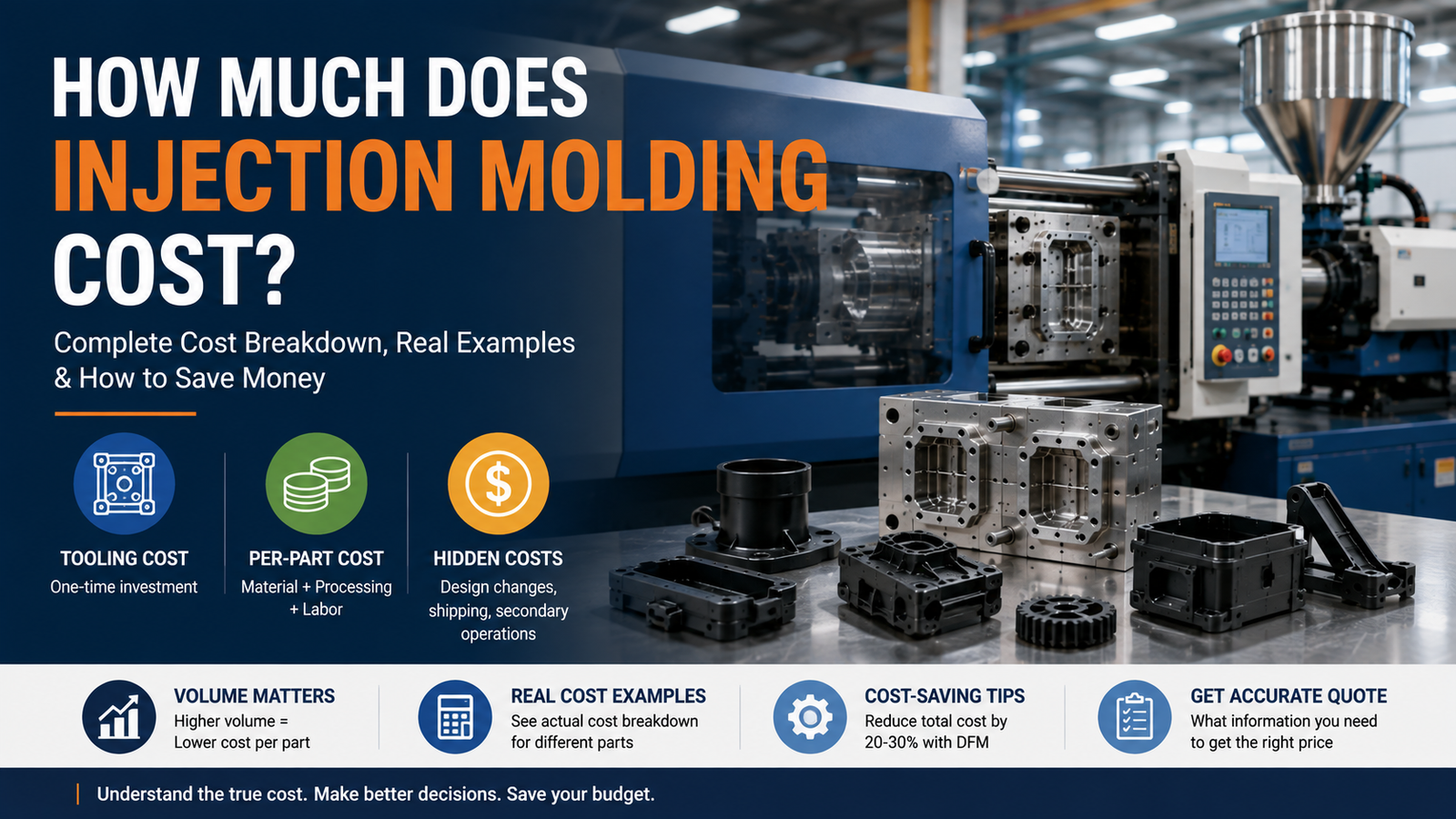
Injection molding costs fall into three categories:
- Tooling cost (mold cost) — the upfront one-time investment
- Per-part cost — material + processing + labor
- Hidden costs — design changes, shipping, secondary operations
Understanding each component helps you compare quotes fairly and avoid surprises.
Tooling Cost (Mold Cost)
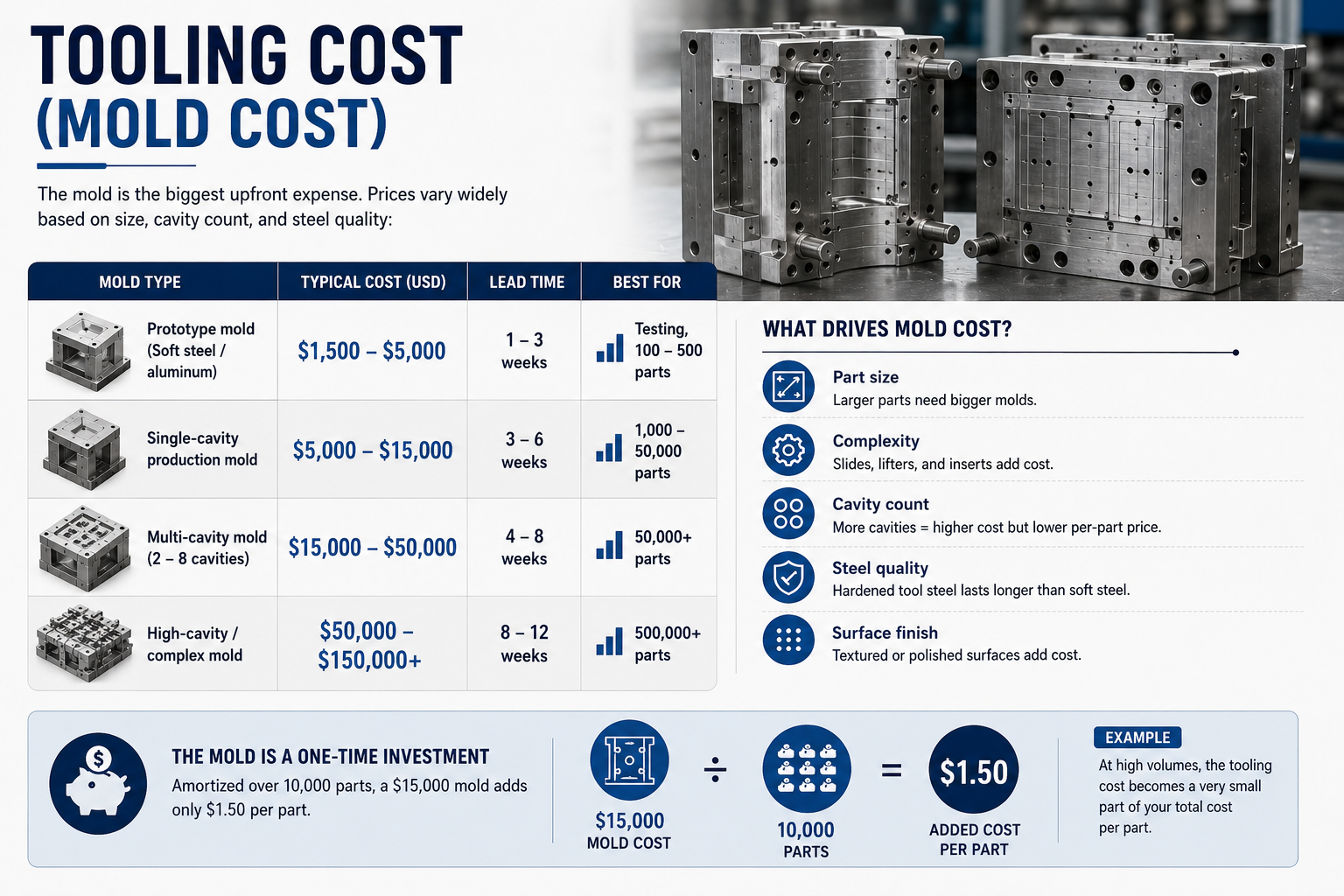
The mold is the biggest upfront expense. Prices vary widely based on size, cavity count, and steel quality:
| Mold Type | Typical Cost | Lead Time | Best For |
|---|---|---|---|
| Prototype mold (soft steel/aluminum) | $1,500-$5,000 | 1-3 weeks | Testing, 100-500 parts |
| Single-cavity production mold | $5,000-$15,000 | 3-6 weeks | 1,000-50,000 parts |
| Multi-cavity mold (2-8 cavities) | $15,000-$50,000 | 4-8 weeks | 50,000+ parts |
| High-cavity / complex mold | $50,000-$150,000+ | 8-12 weeks | 500,000+ parts |
Mold cost is driven by:
- Part size — larger parts need bigger molds
- Complexity — slides, lifters, and inserts add cost
- Cavity count — more cavities = higher cost but lower per-part price
- Steel quality — hardened tool steel lasts longer than soft steel
- Surface finish — textured or polished surfaces add cost
The mold is a one-time investment: amortized over 10,000 parts, a $15,000 mold adds only $1.50 per part.
Per-Part Cost Breakdown
Per-part cost includes material, processing, and labor:
| Cost Component | Typical Range | Notes |
|---|---|---|
| Material | $0.10-$5.00/part | Depends on resin price |
| Processing (machine time) | $0.05-$2.00/part | Depends on cycle time |
| Labor & overhead | $0.05-$1.00/part | Varies by region |
| Secondary operations | $0.10-$2.00/part | Painting, assembly, packaging |
Material cost examples (per kg):
| Material | Approx. Price/kg |
|---|---|
| Polypropylene (PP) | $1.00-$1.50 |
| ABS | $1.80-$2.50 |
| Polycarbonate (PC) | $3.00-$4.00 |
| Nylon 66 (PA66) | $3.50-$5.00 |
| PEEK | $80-$120 |
A typical part weighing 50g in ABS costs roughly $0.10-$0.15 in raw material alone.
How Volume Affects Cost
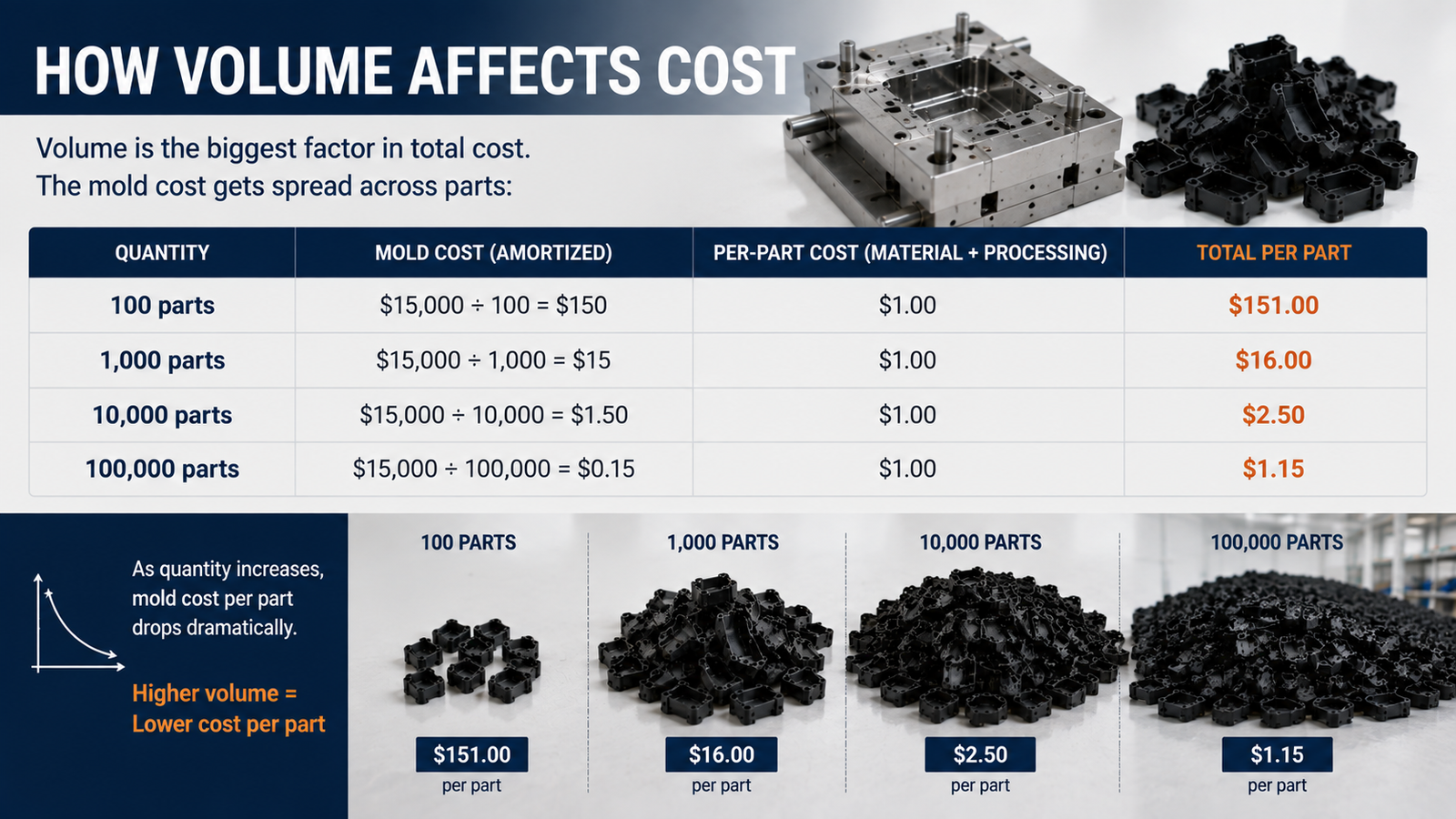
Volume is the biggest factor in total cost. The mold cost gets spread across parts:
| Quantity | Mold Cost (amortized) | Per-Part Cost | Total Per Part |
|---|---|---|---|
| 100 parts | $15,000 ÷ 100 = $150 | $1.00 | $151.00 |
| 1,000 parts | $15,000 ÷ 1,000 = $15 | $1.00 | $16.00 |
| 10,000 parts | $15,000 ÷ 10,000 = $1.50 | $1.00 | $2.50 |
| 100,000 parts | $15,000 ÷ 100,000 = $0.15 | $1.00 | $1.15 |
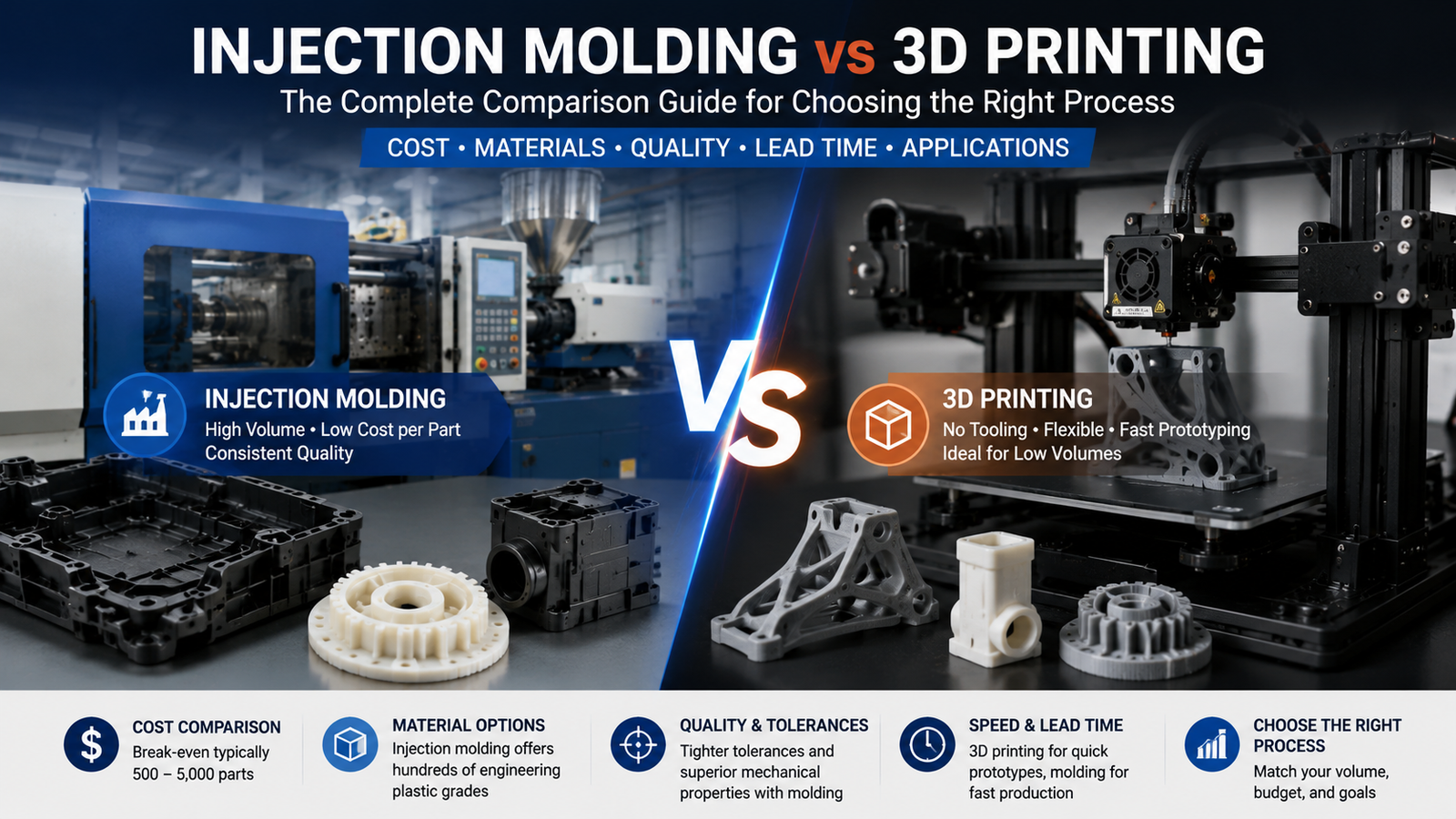
This is why injection molding is economical only at scale — and why 3D printing or prototyping molds make sense for small quantities.
Real Cost Estimate Examples
Example 1: Simple plastic cap (PP, 10g)
- Mold (2 cavities): $8,000
- Material: $0.03/part
- Processing: $0.03/part
- 50,000 parts: total ≈ $8,000 + $3,000 = $0.22/part
Example 2: Automotive connector housing (PA66-GF30, 25g)
- Mold (4 cavities, slides): $25,000
- Material: $0.25/part
- Processing + inspection: $0.15/part
- 100,000 parts: total ≈ $25,000 + $40,000 = $0.65/part
Example 3: Large enclosure (ABS, 400g)
- Mold (1 cavity): $18,000
- Material: $1.20/part
- Processing: $0.50/part
- 10,000 parts: total ≈ $18,000 + $17,000 = $3.50/part
How to Reduce Injection Molding Costs
- Design for manufacturability (DFM) — simplify geometry, reduce wall thickness, avoid undercuts
- Choose the right material — don't over-specify; a cheaper resin may work
- Optimize cavity count — balance mold cost against production volume
- Consolidate parts — combine multiple components into one molded part
- Order higher volumes — per-part cost drops significantly
- Source in lower-cost regions — injection molding labor rates vary globally
A professional DFM review can reduce total project cost by 20-30% before tooling begins.
Getting an Accurate Quote
To get an accurate injection molding quote, prepare:
- 3D CAD file (STEP or IGES format)
- Material requirement (or ask for recommendations)
- Annual volume and expected production quantity
- Tolerance requirements (standard vs. tight)
- Surface finish requirement
- Any certifications (IATF 16949, UL, FDA, etc.)
With this information, suppliers can quote tooling and per-part pricing accurately.
Conclusion
Injection molding costs combine one-time tooling ($5,000-$50,000+), per-part material and processing costs, and hidden costs. Volume is the key variable: higher quantities dramatically reduce per-part cost. By understanding these components and preparing complete project information, you can estimate costs accurately and choose the right manufacturing partner.
With experience in mold design, material selection, and cost optimization, PlasticXperts provides transparent injection molding quotes. Contact our engineering team with your 3D file for a professional cost estimate.
FAQ
How much does an injection mold cost?
A prototype mold costs $1,500-$5,000, a single-cavity production mold costs $5,000-$15,000, and multi-cavity or complex molds cost $15,000-$150,000+. The price depends on part size, complexity, cavity count, and steel quality.
How much does injection molding cost per part?
Per-part cost typically ranges from $0.10 to $5.00 depending on material, weight, and cycle time. At high volumes, total cost per part (including amortized tooling) can be as low as $0.20-$1.00. At low volumes, the tooling dominates the cost.
Why is injection molding tooling so expensive?
Tooling is expensive because molds are precision steel components machined to tight tolerances, often with complex features like slides, lifters, and cooling channels. A production mold can take 100-500 hours of skilled machining and must survive hundreds of thousands of injection cycles.
What is the minimum order quantity (MOQ) for injection molding?
MOQ varies by supplier, typically 500-5,000 parts for production runs. Some suppliers offer low-volume or rapid tooling options for 100-500 parts at higher per-part cost. For very small quantities, 3D printing or vacuum casting is more economical.
How can I reduce injection molding cost?
Simplify the part design, choose a lower-cost material, optimize cavity count, consolidate parts, and order higher volumes. A DFM (design for manufacturability) review before tooling can reduce total cost by 20-30%.
Is injection molding cheaper than 3D printing?
At volumes above roughly 1,000 parts, injection molding is cheaper per part. Below that, 3D printing avoids the tooling investment and is more economical. The break-even point depends on part complexity and mold cost.