Plasticizer migration is the slow failure that turns a soft PVC part into a brittle, sticky, contaminated one. Nothing breaks, nothing cracks visibly — the part just loses its flexibility over months, leaves an oily film on whatever it touches, and in the worst cases contaminates the product it was supposed to protect.
This guide explains what plasticizer migration actually is, the three mechanisms that cause it, the material and process choices that reduce it, and the regulatory limits that now govern which plasticizers can be used at all.
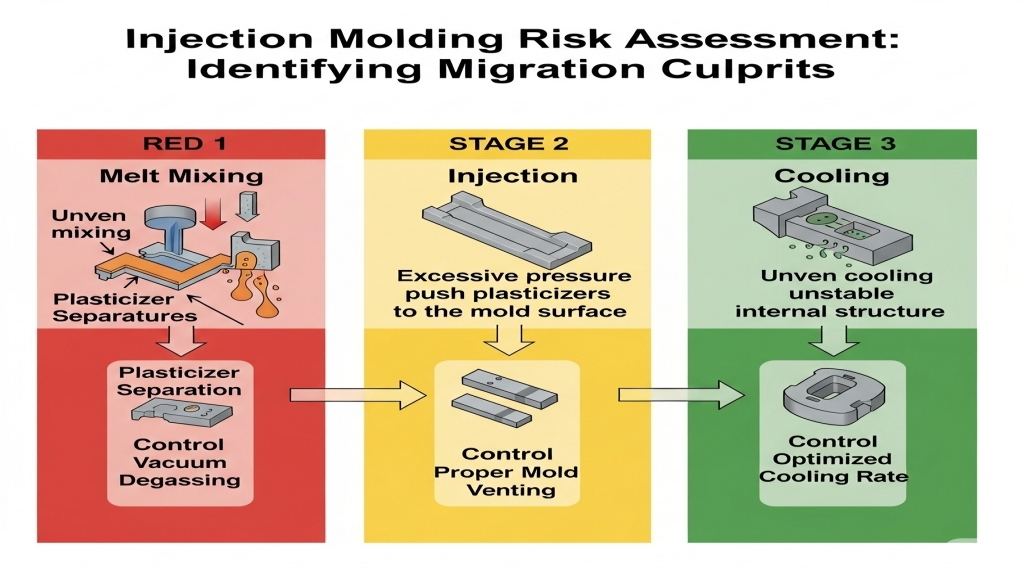
What migration actually is
A plasticizer is a small molecule — typically a phthalate ester — that sits between PVC chains and stops them packing tightly. That is what makes PVC flexible. It is not chemically bound to the polymer; it is dissolved in it. Anything dissolved can leave.
Three things happen as plasticizer leaves:
The part stiffens. Shore hardness rises, elongation falls, and a part specified at Shore A 60 measures A 75 two years later.
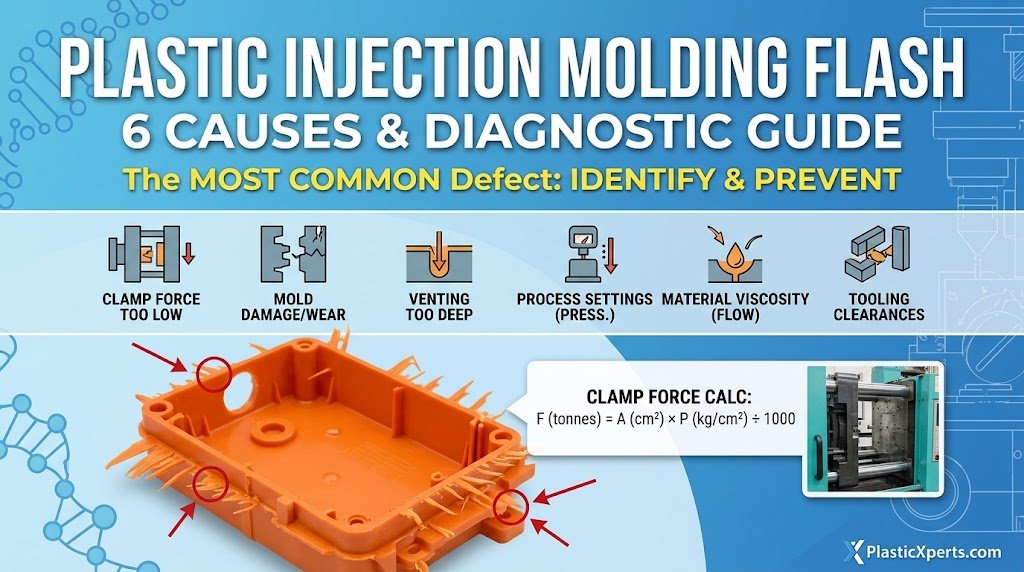
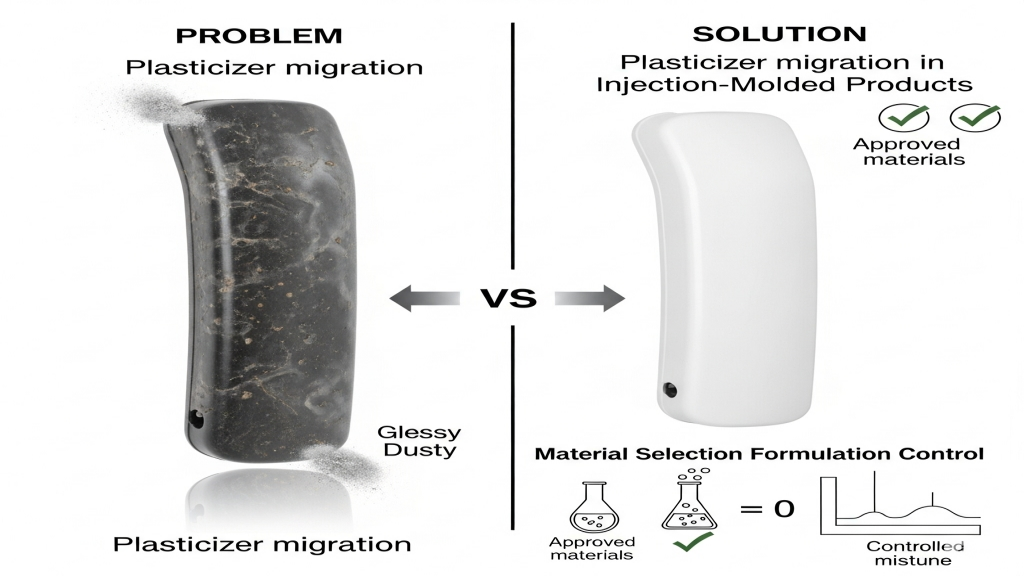
The surface changes. Plasticizer accumulating at the surface makes it tacky, dull, and prone to picking up dust.
Something else gets contaminated. The plasticizer has to go somewhere — into the air, into a solvent, or into whatever the part is touching.
The three mechanisms
| Mechanism | What happens | Driven by |
|---|---|---|
| Volatilisation | Plasticizer evaporates from the surface | Heat, time, large surface area, low molecular weight |
| Extraction | Plasticizer dissolves out into a liquid | Contact with oils, fuels, solvents, detergents, water |
| Contact transfer | Plasticizer migrates into an adjacent material | Direct contact with another polymer, adhesive, print, or food |
| Exudation (spewing) | Plasticizer separates and forms a film on the surface | Over-plasticising, poor compatibility, cold processing |
In real applications the three overlap. A cable in a hot engine bay volatilises and is also in contact with oil; a medical tube is extracted by disinfectants and transfers into the fluid path.
Why molecular weight decides everything
The single biggest material factor is the molecular weight of the plasticizer. Small molecules move easily; large ones do not.
| Plasticizer | Approximate MW | Volatility | Regulatory status |
|---|---|---|---|
| DEHP (DOP) | 390 | High | Restricted — REACH SVHC, RoHS restricted |
| DBP | 278 | Very high | Restricted — REACH Annex XVII |
| BBP | 312 | High | Restricted — REACH Annex XVII |
| DINP | 419 | Moderate | Restricted in toys and childcare |
| DIDP | 447 | Low | Restricted in toys and childcare |
| DOTP (DEHT) | 391 | Low | Not classified — the common DEHP replacement |
| DINCH | 425 | Very low | Not classified — medical and food grades |
| Polymeric / high-MW | 1,000+ | Very low | Preferred for long-life and critical parts |
The regulatory history follows the science: the small, mobile phthalates were restricted first, and the industry moved to higher-molecular-weight alternatives and to non-phthalate esters such as DOTP and DINCH.
Our guide to PVC sticking to the mould covers the processing side of plasticised PVC, and the electrical consequences are in PVC and ABS dielectric properties.
What increases migration
| Factor | Effect | Practical limit |
|---|---|---|
| Plasticizer loading | Higher loading means more mobile molecules | Keep below 40 phr where possible |
| Service temperature | Every 10 °C roughly doubles the rate | Design for the real service temperature |
| Contact with oil or fuel | Extraction is far faster than volatilisation | Specify an extraction-resistant grade |
| Contact with other plastics | Plasticizer transfers into PS, ABS, PMMA | Separate with a barrier or change the material |
| Surface area to volume | Thin films and foams lose plasticizer fastest | Thicker sections last longer |
| Sunlight and UV | Accelerates surface degradation | Stabiliser package plus pigmentation |
| Poor dispersion in processing | Unmixed plasticizer exudes | Proper compounding and melt homogeneity |
The temperature rule is the one that catches designers out. A part rated for 60 °C service and specified with a standard plasticizer will lose plasticizer roughly four times faster at 80 °C — which is why engine-bay and outdoor applications need a different grade, not a thicker wall.
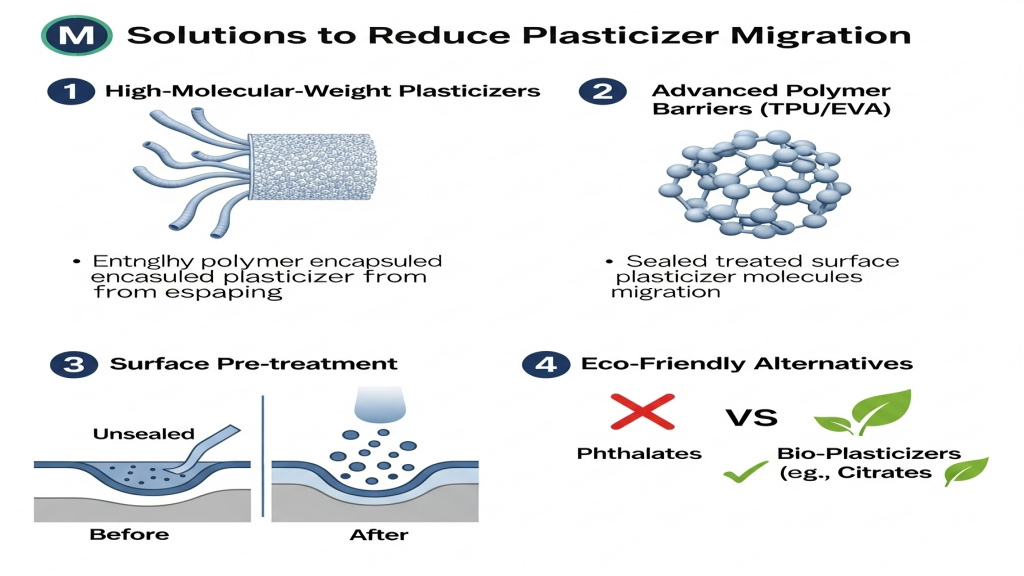
Prevention, in order of effectiveness
| Approach | Effectiveness | Cost impact |
|---|---|---|
| Change to a higher-MW plasticizer | High | Low to moderate |
| Reduce plasticizer loading, accept harder part | High | None — may reduce material cost |
| Switch to a non-plasticised material (TPE, TPU, PP) | Very high | Moderate — different processing |
| Barrier layer or coating | Moderate to high | Moderate |
| Control service temperature and contact media | Moderate | None — specification discipline |
| Improve compounding and dispersion | Moderate | Low |
| Surface treatment (post-mould) | Low to moderate | Moderate |
Changing the material is the only complete fix. If the part has to stay flexible for twenty years in contact with oil, no plasticised PVC formulation will match a TPE or a TPU, because those materials are flexible by polymer architecture rather than by dissolved additives. Our injection moulding materials overview compares the plasticised and non-plasticised options, and the PP case — where flexibility comes without any plasticizer at all — is covered in our PP injection moulding guide.
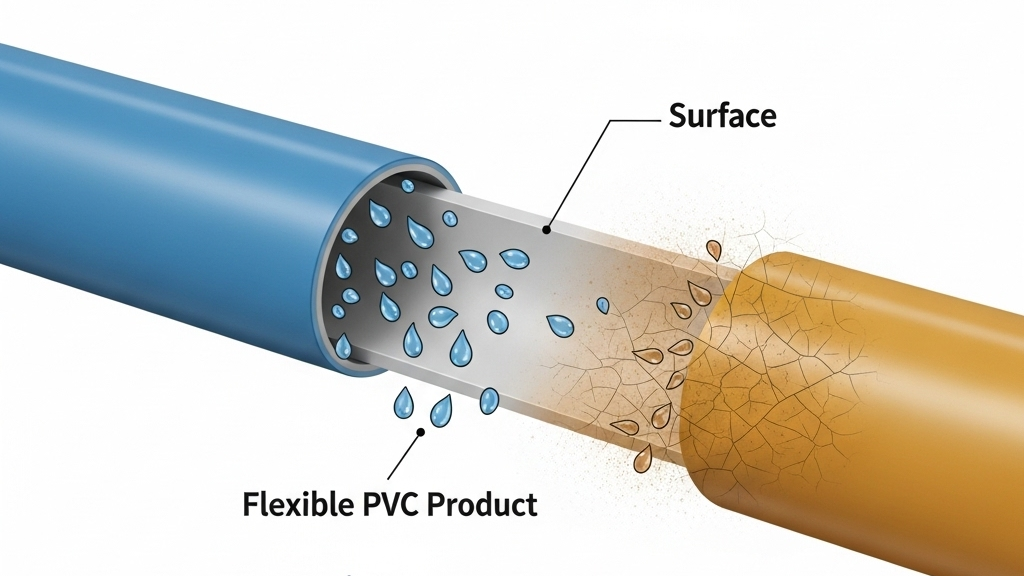
Processing factors
| Stage | Risk | Control |
|---|---|---|
| Compounding | Uneven dispersion leaves free plasticizer | Use pre-compounded compound, not dry blending |
| Drying | Volatile loss at high temperature | Dry at the supplier's recommended temperature, not higher |
| Melt temperature | Above 200 °C PVC degrades and plasticizer volatilises | Keep the melt profile within the window |
| Residence time | Long dwell times increase loss and degradation | Size the shot to the machine |
| Cooling | Fast cooling can trap plasticizer at the surface | Balanced mould temperature |
| Regrind | Repeated heat cycles deplete plasticizer and stabiliser | Limit regrind to 20% and re-test hardness |
| Packaging and storage | Hot warehouses accelerate migration | Store below 30 °C, sealed |
Regrind is the quiet one. A part made with 50 percent regrind can measure two to three Shore A points harder than the same part made from virgin compound, because the regrind has already lost plasticizer in its first pass. If hardness is a specified property, regrind content has to be controlled and verified, not assumed.
The regulatory limits
| Regulation | Scope | Limit |
|---|---|---|
| REACH Annex XVII | DEHP, DBP, BBP, DIBP in plasticised articles | 0.1% by weight each |
| REACH SVHC list | Candidate list substances | Notification and communication duties |
| RoHS | DEHP, BBP, DBP, DIBP in EEE | 0.1% by weight each |
| EU 10/2011 | Food contact plastics | Specific migration limits per substance |
| EN 14372 / REACH | Toys and childcare articles | Strict phthalate restrictions |
| US CPSIA | Children's products | 0.1% for specified phthalates |
| California Prop 65 | Consumer products | Warning or reformulation |
The practical consequence for a B2B supplier is that the plasticizer choice is not a purchasing decision — it is a compliance decision that has to be documented. Ask the compound supplier for the specific plasticiser identity and the migration test data, not just a "phthalate-free" statement.
Our heat-resistant PVC drainage pipes article shows how the formulation changes when the service temperature rises, and the wider defect context is in our injection moulding defects guide.
How to test for migration
| Test | Method | What it tells you |
|---|---|---|
| Volatile loss | Heat ageing, weight loss at 100 °C | How fast the part will stiffen in service |
| Extraction | Immersion in oil, fuel or water, then weight loss | Suitability for fluid contact |
| Migration into food simulants | EU 10/2011, FDA 21 CFR | Food contact compliance |
| Shore hardness drift | Measure before and after ageing | The visible consequence of migration |
| Surface analysis | FTIR or contact angle on the aged surface | Whether exudation is occurring |
| Contact transfer | Sandwich test with an absorbent material | Staining and print damage risk |
The specification that matters in practice is the aged property: Shore hardness, elongation and tensile strength after 7 or 28 days at the service temperature. A data sheet value measured on day one tells you nothing about year five.
Migration and formulation data in this guide follows the test methods published by ASTM International (D1203 for plasticizer loss, D2288 for volatile loss) and ISO, with typical values cross-checked against MatWeb and Engineering Toolbox. Formulation and processing practice reflects Plastics Technology guidance and PLASTICS industry standards, with material characterisation maintained through SPE and NIST reference data. For the regulatory basis, see the phthalate and plasticizer references, and the ECHA candidate list for SVHC status.
What causes plasticizer migration in PVC?
Three mechanisms: volatilisation from the surface driven by heat, extraction by oils, fuels or solvents the part touches, and contact transfer into an adjacent polymer, adhesive or food. All three are accelerated by low plasticizer molecular weight.
How do I stop plasticizer from migrating?
Use a higher-molecular-weight plasticizer (DOTP, DINCH, polymeric), reduce the loading, and keep the service temperature and contact media inside the specification. If the requirement is severe, switch to TPE or TPU, which are flexible without any dissolved plasticizer.
Is DOTP a safe replacement for DEHP?
DOTP is not classified as an SVHC and is not restricted under RoHS, which is why it became the standard DEHP replacement. It still migrates — just more slowly — so the service environment still has to be checked, particularly for food and medical contact.
Why has my PVC part gone hard and brittle?
Plasticizer loss. The part either volatilised it in service heat or the plasticizer was extracted by a fluid. Compare current Shore hardness against the original specification; a rise of 10 or more points means significant loss.
Can plasticizer migrate into other plastics?
Yes, and it is often the cause of a mysterious failure. Plasticised PVC in contact with polystyrene, ABS or PMMA transfers plasticizer into them, which softens and crazes the other part while hardening the PVC. Separate the materials or use a barrier.
How do I test for plasticizer migration?
Heat ageing with weight loss measurement, immersion in the actual contact fluid, and Shore hardness measurement before and after. For food contact, run the migration test defined by EU 10/2011 or FDA 21 CFR rather than relying on a generic data sheet.
Conclusion
Plasticizer migration is prevented by choosing the right molecule, not by processing around it. Higher-molecular-weight and polymeric plasticizers, lower loadings, and — where the requirement is severe — a switch to a material that needs no plasticizer at all are the only reliable answers. Everything else buys time.
At Rui Cheng we mould flexible and rigid PVC, TPE, TPU and PP on 80 to 1,400 tonne machines, with documented plasticizer identity, migration test data and ISO 9001 / IATF 16949 processes. Send us the drawing, the service environment and the contact media, and we will come back with a material recommendation, a compliance statement and an indicative part cost.