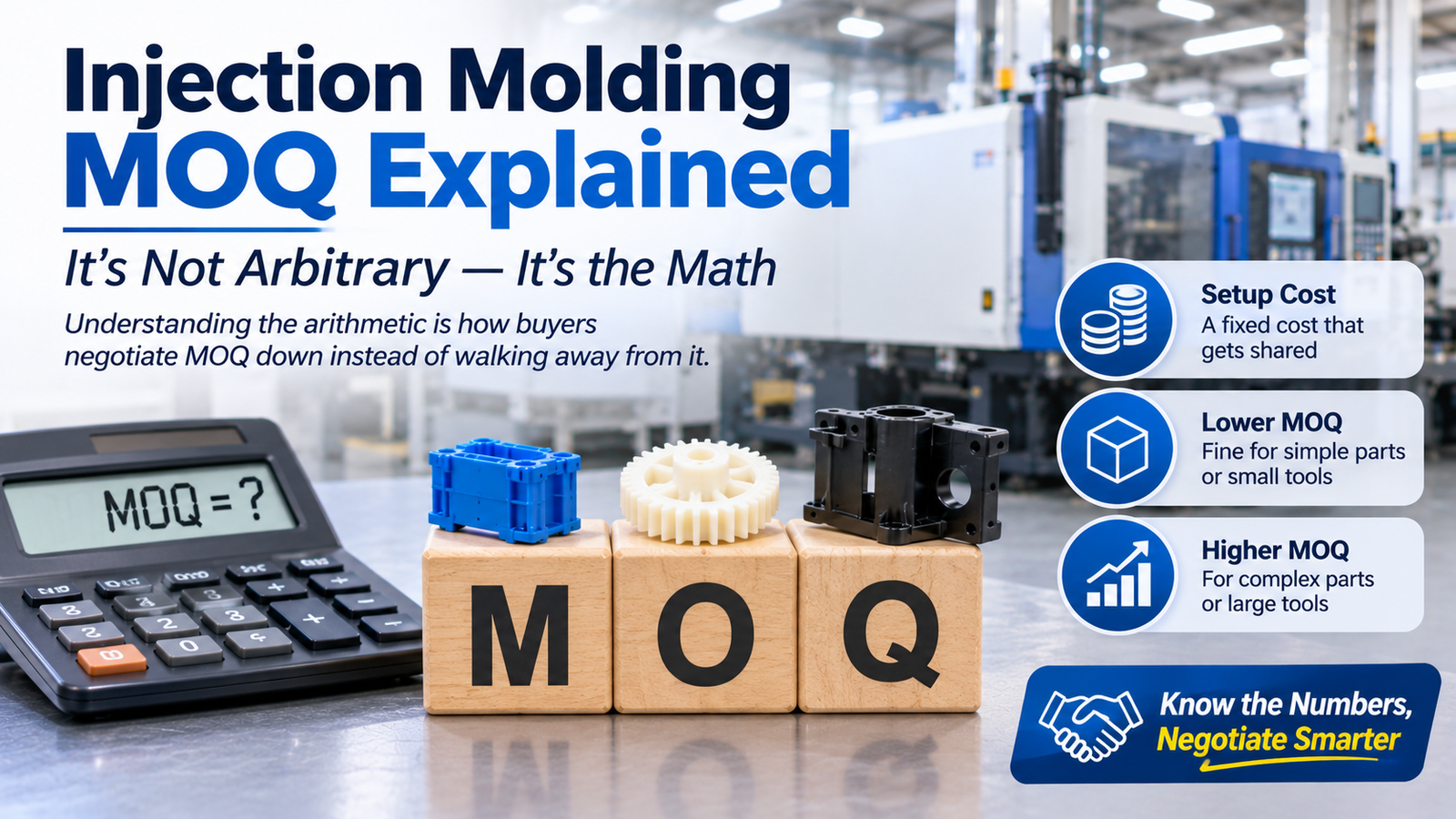
Injection molding MOQ is the number every buyer asks about and almost no supplier explains — and it is not arbitrary, it is the point below which the setup cost per part stops making sense.
Understanding the arithmetic is how buyers negotiate MOQ down instead of walking away from it.
Where the injection molding MOQ number comes from
| Cost item | Typical magnitude | Behaviour |
|---|---|---|
| Mold changeover | 1 – 3 hours of machine time | Fixed per run |
| Machine start-up scrap | 20 – 50 parts | Fixed per run |
| Process stabilisation | 30 – 90 minutes | Fixed per run |
| Material minimum purchase | 25 kg bag or full pallet | Fixed per order |
| QC / first article | 1 – 3 hours | Fixed per run |
| Packaging setup | Depends | Fixed per run |
Add those up for a 100 g part on a 250-tonne machine: roughly 2 hours of machine time, 30 scrap parts and 2 hours of QC — call it 200 to 400 USD of fixed cost per run.
At 500 pieces, that is 0.40 to 0.80 USD per part of overhead. At 5,000 pieces it is 0.04 to 0.08. The MOQ is simply the quantity at which the fixed cost stops dominating the piece price.
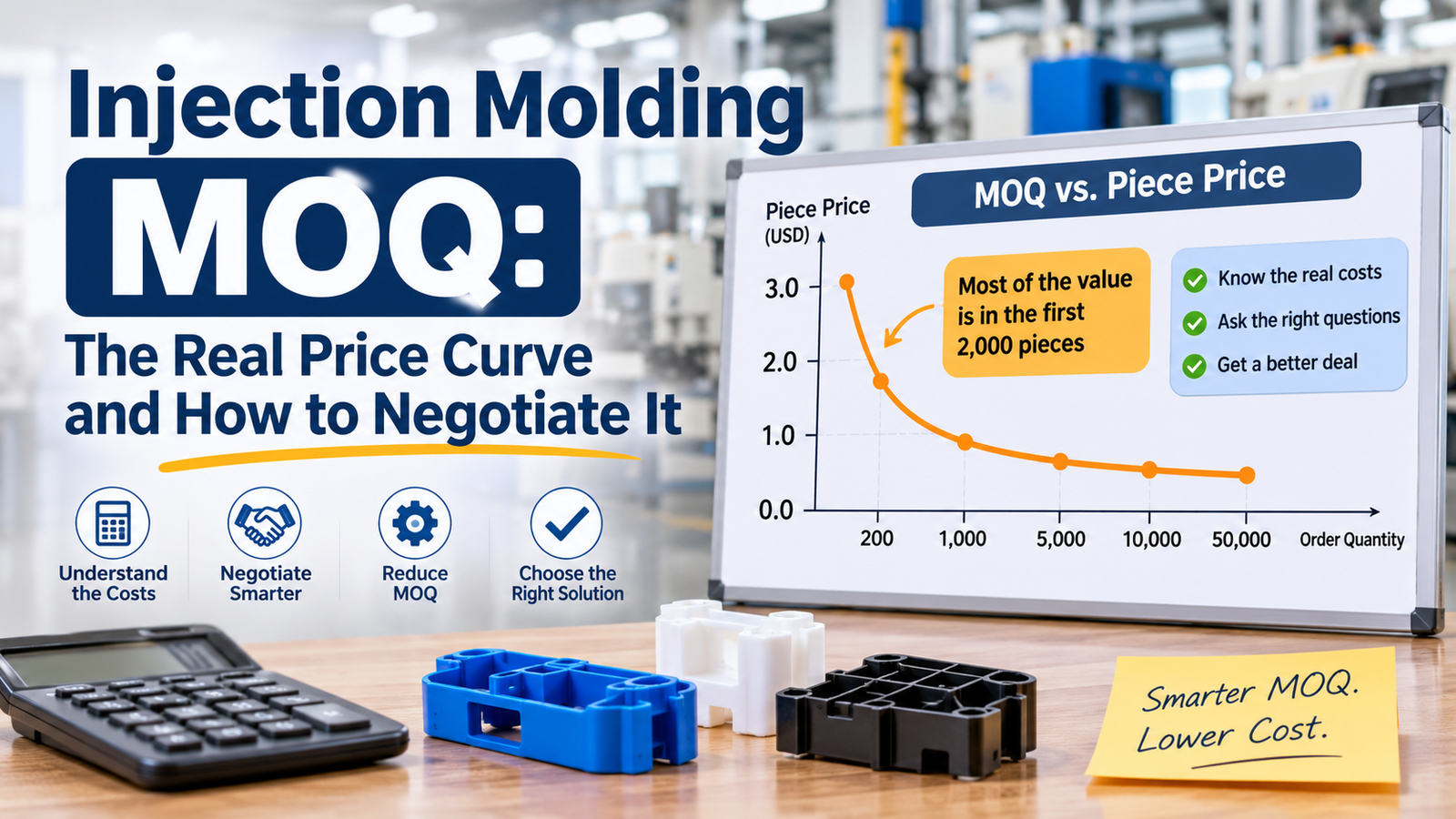
Injection molding MOQ: the real price curve
A 100 g ABS part, 2 cavities, 30-second cycle:
| Order quantity | Piece price (USD) | Why |
|---|---|---|
| 200 | 2.80 – 3.50 | Setup and tooling amortisation dominate |
| 500 | 1.60 – 2.00 | Setup still significant |
| 1,000 | 1.20 – 1.45 | Setup spreading |
| 2,000 | 1.00 – 1.15 | Approaching the economic point |
| 5,000 | 0.85 – 0.95 | Material and machine dominate |
| 10,000 | 0.80 – 0.88 | Tooling now small |
| 50,000 | 0.75 – 0.82 | Plateau |
| 200,000 | 0.73 – 0.79 | Marginal gains only |
Note the shape: the drop from 200 to 2,000 is 60 percent, and from 10,000 to 200,000 is under 10 percent. Most of the value is in the first 2,000 pieces.
Five things suppliers do not usually explain
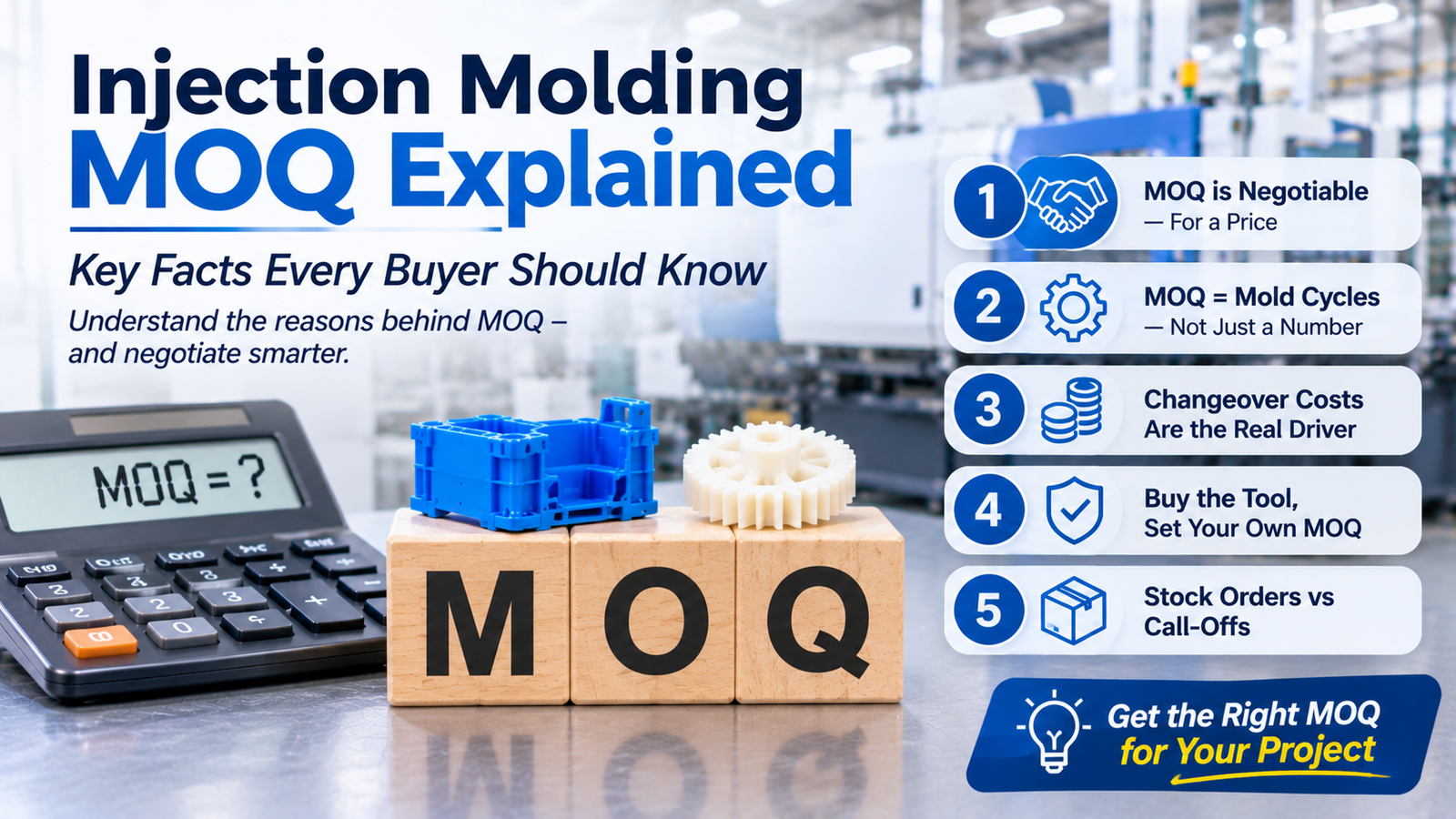
1. MOQ is usually negotiable — for a price
A supplier quoting MOQ 5,000 will usually run 1,000 if you accept a higher piece price, because the fixed cost has to be recovered somewhere. The honest conversation is:
"We need 1,000 to start. What piece price makes that worth running for you?"
That is a solvable question. "Reduce your MOQ" is not.
2. MOQ is really a number of mold cycles
If your tool has 4 cavities, an MOQ of 2,000 parts is 500 cycles — about 4 hours of production. Suppliers think in cycles because machine scheduling is in cycles. This is why a high-cavity tool often has a higher part MOQ than the buyer expects.
3. The hidden cost is changeover, not material
Material scales linearly. Changeover does not. A supplier who runs your 800 parts between two large jobs loses half a shift to setup, while the large jobs would have paid for the same shift with no setup at all.
4. You can buy the tool and set your own MOQ
If you own the tool outright and pay a per-run setup fee, most suppliers will run whatever quantity you ask. The commercial structure changes from "amortise the setup into the price" to "charge the setup separately".
5. Stock orders and call-offs are different
Many suppliers will produce 10,000 and ship 2,000 a month. The MOQ applies to the production run, not the shipment. Ask specifically — this is the single most useful MOQ question and it is rarely asked.
How to reduce injection molding MOQ legitimately
| Lever | Effect | Trade-off |
|---|---|---|
| Pay the setup separately | MOQ can drop to 200 – 500 | Higher piece price |
| Own the tool | Much lower MOQ | Full tooling cost up front |
| Accept standard colour | Removes colour-change cost | Limited colour choice |
| Use an existing tool (if available) | No tooling amortisation | Geometry must match |
| Run a stock order with call-offs | MOQ on production, small shipments | Inventory held by supplier |
| Reduce cavitation | Lower cycle count per run | Higher piece price |
| Accept a wider tolerance | Less scrap at start-up | Design implications |
| Combine with another buyer's run | Shares setup | Timing and colour constraints |
What to do when you are below the injection molding MOQ
| Situation | Better process | Note |
|---|---|---|
| Under 200 parts, simple geometry | CNC machining | No tooling, tolerance better |
| Under 200 parts, complex geometry | 3D printing (SLA/SLS) | Surface finish limited |
| 200 – 2,000 parts, simple | Aluminium bridge tool | 1,500 – 4,000 USD tooling |
| 500 – 5,000, commodity part | Check for an existing stock mold | Often the cheapest route |
| 2,000+ | Production tool | MOQ becomes reasonable |
Our guide to injection molding vs 3D printing covers the crossover point, and injection molding cost covers how the price is built.
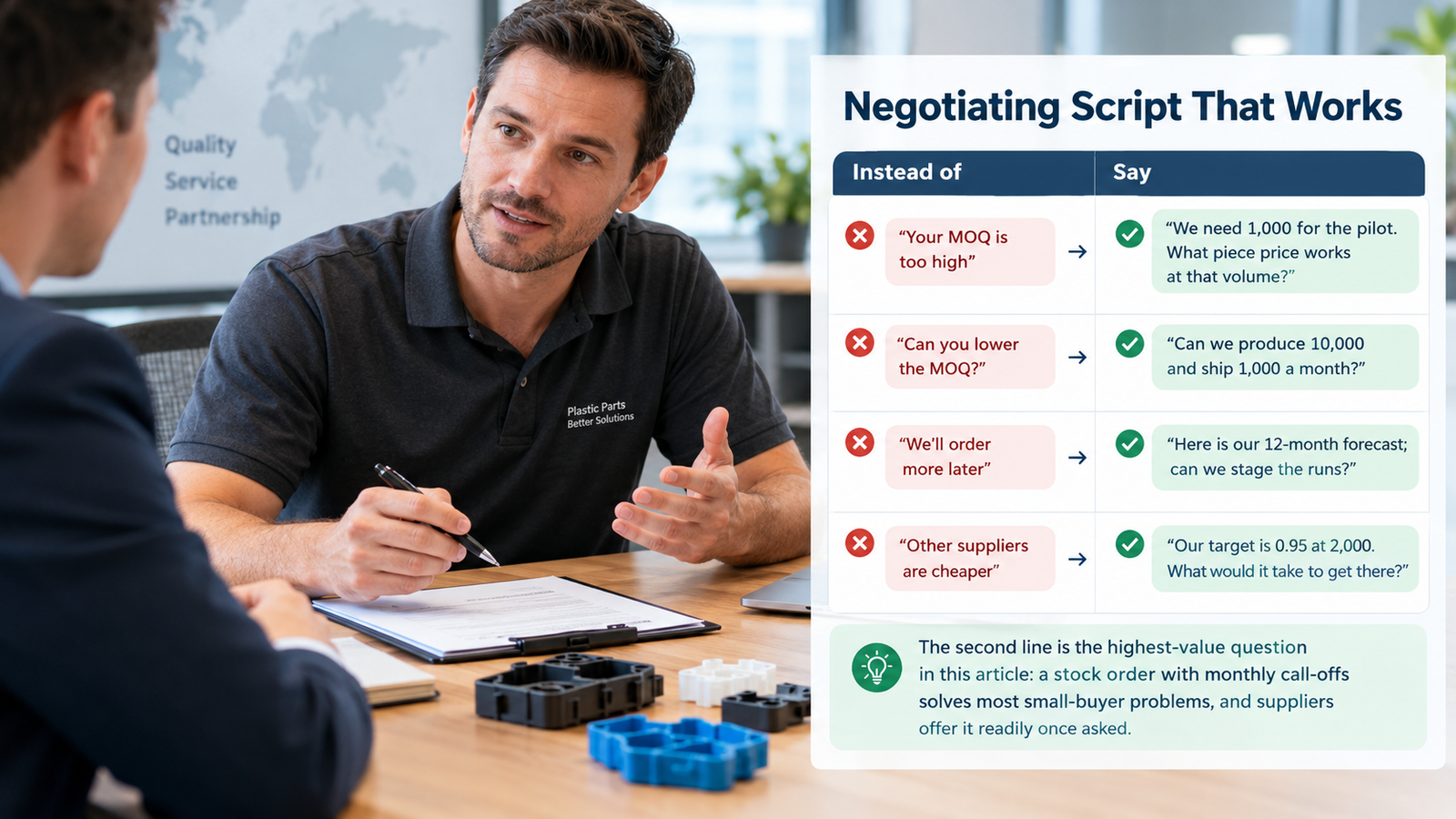
Negotiating script that works
| Instead of | Say |
|---|---|
| "Your MOQ is too high" | "We need 1,000 for the pilot. What piece price works at that volume?" |
| "Can you lower the MOQ?" | "Can we produce 10,000 and ship 1,000 a month?" |
| "We'll order more later" | "Here is our 12-month forecast; can we stage the runs?" |
| "Other suppliers are cheaper" | "Our target is 0.95 at 2,000. What would it take to get there?" |
The second line is the highest-value question in this article: a stock order with monthly call-offs solves most small-buyer problems, and suppliers offer it readily once asked.
Injection molding MOQ by part type
| Part type | Typical MOQ | Note |
|---|---|---|
| Small technical parts (connectors, caps) | 5,000 – 20,000 | High cavitation, low unit value |
| Mid-size housings | 2,000 – 5,000 | Balance of setup and material |
| Large parts (over 500 g) | 500 – 2,000 | Machine time dominates |
| Glass-filled engineering parts | 1,000 – 3,000 | Material minimum applies |
| Medical / regulated parts | 2,000 – 10,000 | Validation cost per run |
| Optical parts | 1,000 – 5,000 | Higher scrap, tighter QC |
The economics, stated plainly
| Quantity | Setup cost per part | Verdict |
|---|---|---|
| 100 | 2.00 – 4.00 | Uneconomic for injection molding |
| 500 | 0.40 – 0.80 | Acceptable if the part value is high |
| 1,000 | 0.20 – 0.40 | Workable |
| 2,000 | 0.10 – 0.20 | Comfortable |
| 5,000 | 0.04 – 0.08 | Economic |
| 10,000+ | under 0.04 | Fully economic |
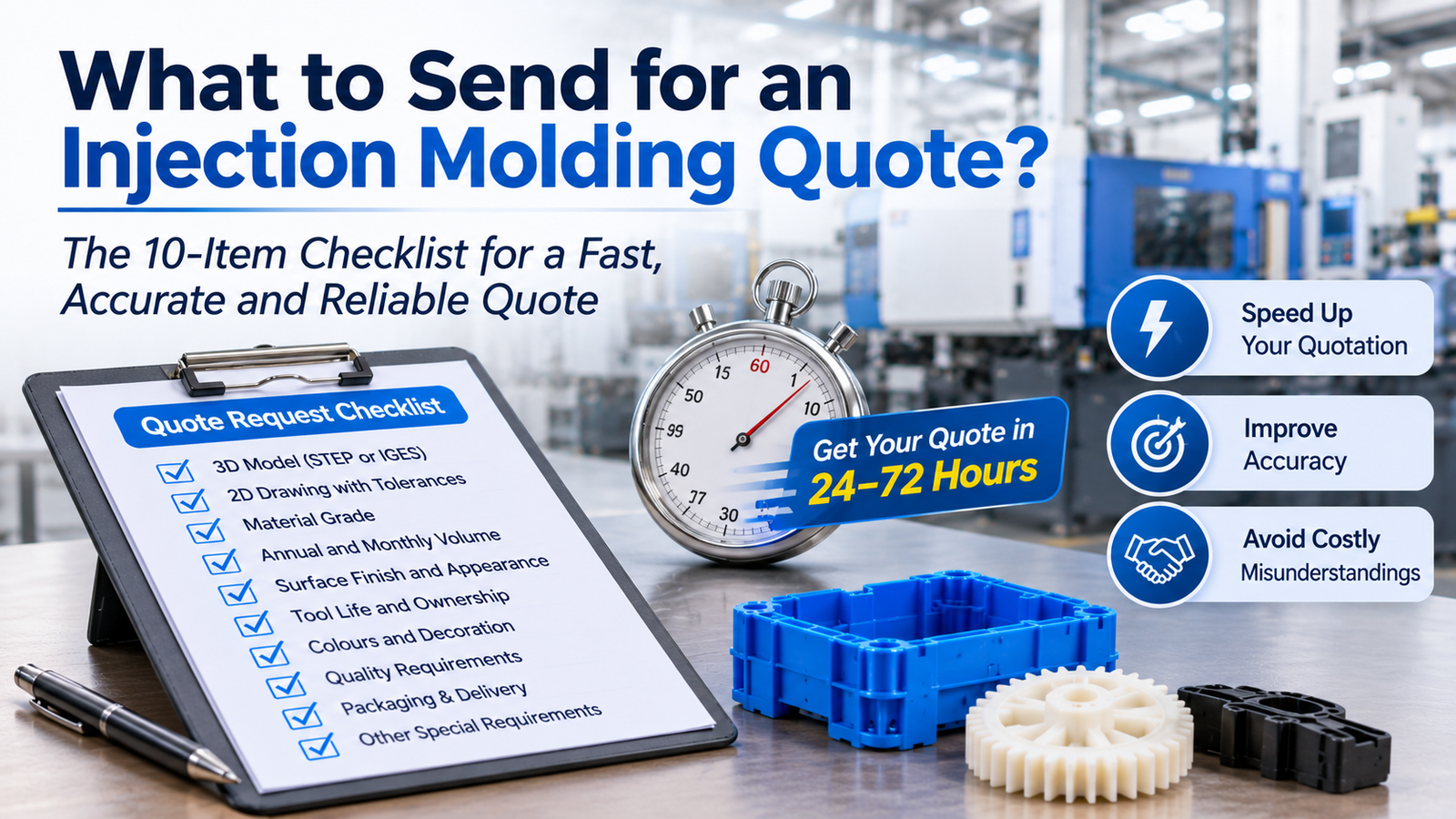
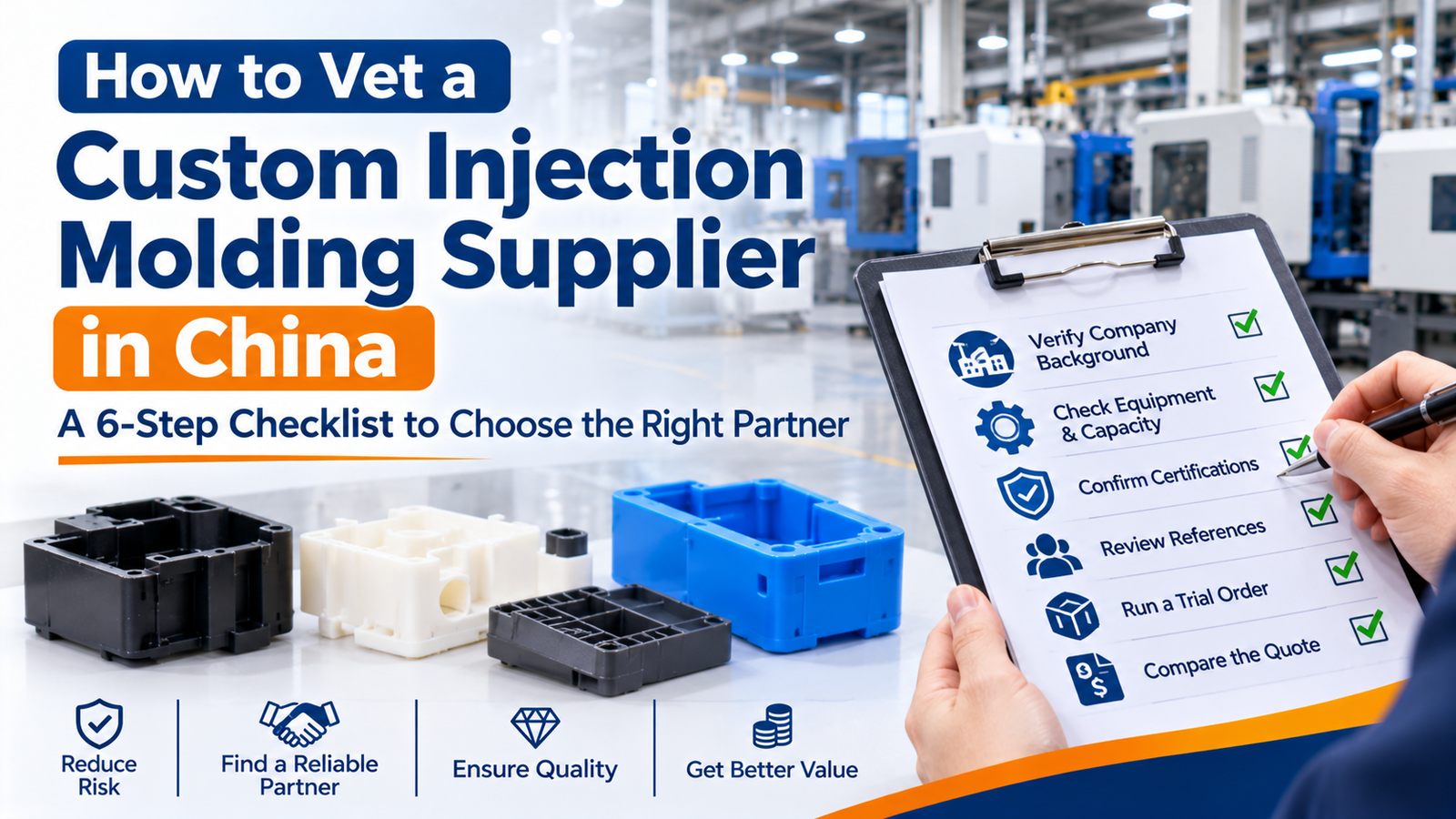
Our guides to mold cost, getting an injection molding quote, how many cavities, vetting a supplier and common injection molding materials cover the surrounding decisions.
MOQ and cost benchmarks in this guide reflect typical 2026 practice, with material data cross-checked against MatWeb and Engineering Toolbox, test standards from ASTM International and ISO, and processing guidance reflecting Plastics Technology and PLASTICS industry standards, with material characterisation through SPE and NIST reference data.
Why is there a minimum order quantity for injection molding?
Because each production run carries fixed costs — 1 to 3 hours of changeover, 20 to 50 start-up scrap parts, and QC time — that must be recovered. Below a certain quantity those fixed costs dominate the piece price.
Can I order less than the MOQ?
Usually yes, at a higher piece price. Ask what price makes a smaller run worthwhile rather than asking them to lower the MOQ. Paying the setup separately often brings the MOQ down to 200 to 500 pieces.
What is a typical MOQ for injection molding?
5,000 to 20,000 for small technical parts, 2,000 to 5,000 for mid-size housings, and 500 to 2,000 for large parts. Glass-filled and regulated parts usually sit higher.
Is the MOQ per shipment or per production run?
Per production run. Many suppliers will produce 10,000 and ship 2,000 a month — ask this specifically, because it solves most small-buyer problems and is rarely offered unless asked.
What if my volume is below the MOQ?
For under 200 pieces use CNC or 3D printing; between 200 and 2,000 consider an aluminium bridge tool, or look for an existing stock mold for a commodity part. Above 2,000 a production tool usually makes sense.
How do I negotiate a lower MOQ?
Offer a higher piece price for a smaller run, or ask for a stock order with monthly call-offs. Both are standard commercial structures and both are cheaper than walking away from injection molding entirely.
Conclusion
Injection molding MOQ is a fixed-cost recovery number, not an arbitrary policy: changeover, start-up scrap and QC cost the same whether you run 500 parts or 50,000. That is why the price curve is steep for the first 2,000 and flat afterwards — and why the two questions that matter are "what price works at my volume" and "can we produce a stock order and call it off monthly".
At Rui Cheng we run from 500 pieces for large parts and 2,000 for housings, with stock orders and monthly call-offs available, tooling quoted separately so you can set your own batch size. Send the drawing and your real volume and we will quote the quantity you actually need.