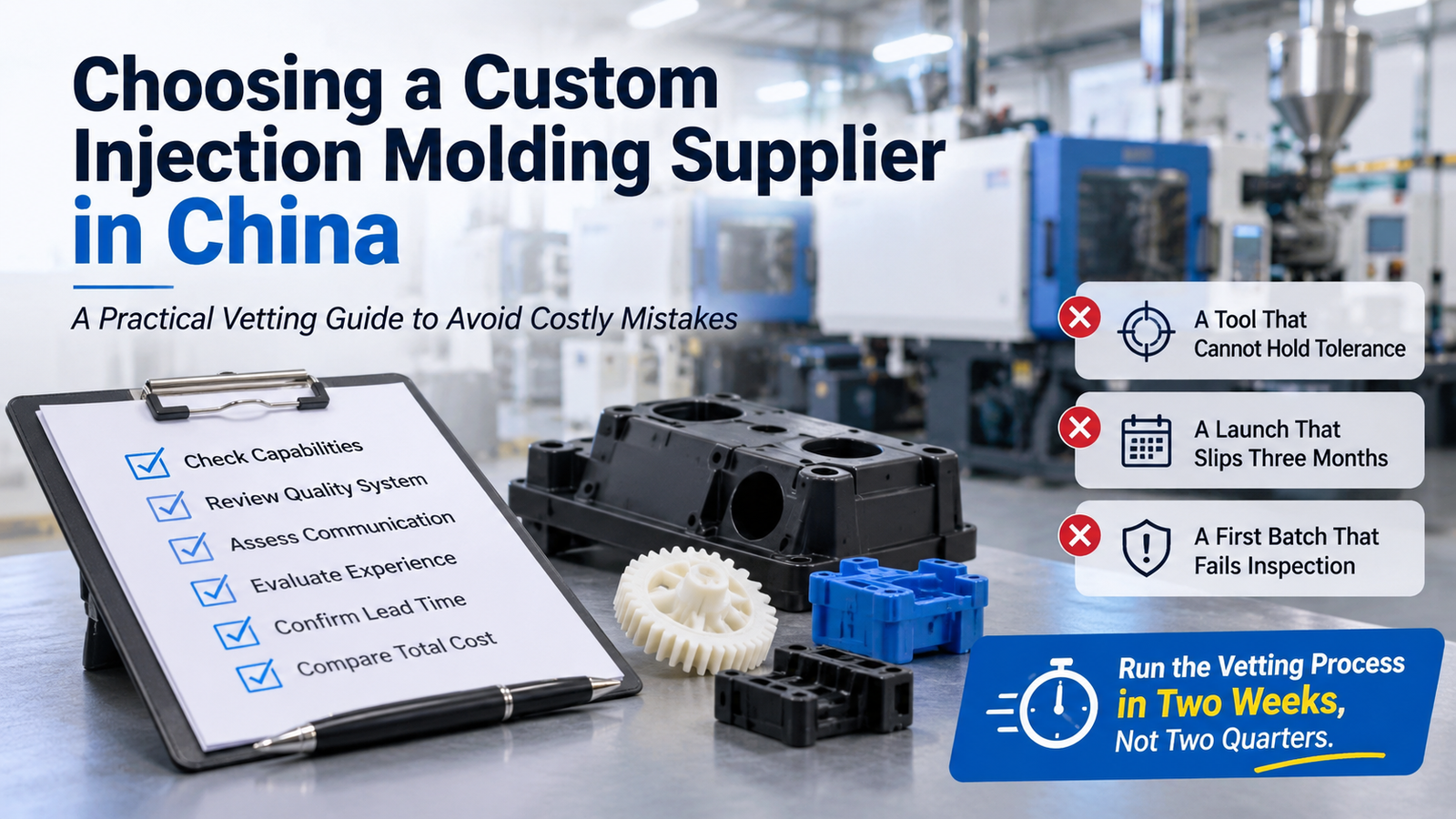
Choosing a custom injection molding supplier in China is the single most expensive decision in most plastic part projects — not because of the piece price, but because of what happens when the choice is wrong: a tool that cannot hold tolerance, a launch that slips three months, a first batch that fails inspection with the mold already paid for.
This guide is the vetting process we would want a buyer to run on us, written so you can run it in two weeks instead of two quarters.
Why this decision is expensive
| Failure mode | Typical cost |
|---|---|
| Tool made to the wrong steel or wrong tolerance | 100% of tooling, plus 6–10 weeks |
| Supplier cannot hold the tolerance you specified | Scrap, rework, or a new tool |
| Undisclosed subcontracting to a smaller shop | Quality drift you cannot audit |
| Delivery slip on first production | Air freight, line-down penalties, lost retail window |
| Supplier is a trading company, not a factory | 15–30% margin you did not budget, and no process control |
None of these show up in a price comparison. All of them are detectable in three to five days of structured checking.
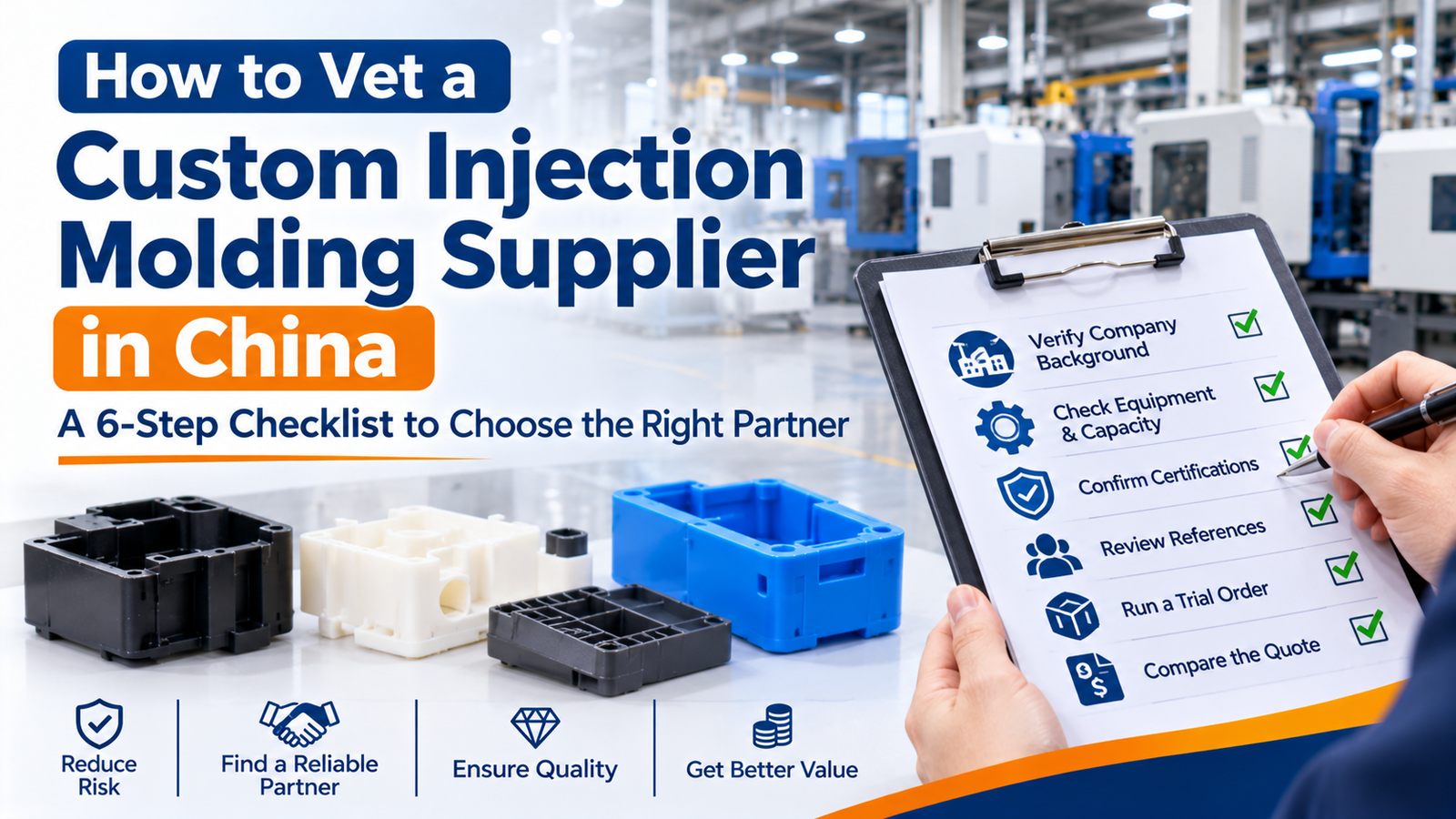
The six-step vetting process
Step 1 — Confirm the company exists (30 minutes)
Ask for the business licence (营业执照) and check the unified social credit code. Then verify:
| Check | What you are looking for |
|---|---|
| Company name | Matches the licence, and matches the invoice entity |
| Established date | Under 2 years is a caution, not a disqualifier |
| Registered capital | Paid-in capital matters more than the headline number |
| Business scope | Should include 生产 / 制造 (manufacture), not only 销售 (sales) |
| Registered address | Industrial park or factory unit, not an office tower |
| Insured employees (参保人数) | Under 10 means a small workshop; 50–200 is a mid-size plant |
The single most informative number is insured employees. It is hard to fake and it tracks real capacity. A company claiming 300 staff with 8 insured employees is a trading company.
Step 2 — Verify the equipment list (30 minutes)
A real custom injection molding supplier will send a machine list without hesitation. Ask for it in this format:
| Machine ID | Tonnage | Brand | Year | Screw diameter | Barrel type |
|---|---|---|---|---|---|
| 01 | 250T | Haitian | 2019 | 45 mm | Bimetallic |
| 02 | 530T | Engel | 2021 | 60 mm | Bimetallic |
| 03 | 1000T | Haitian | 2018 | 85 mm | Standard |
What the list tells you:
- Tonnage range must cover your part. A 250 g part with 300 cm² projected area typically needs 250–350T.
- Bimetallic barrels are required for glass-filled material. No bimetallic barrel, no glass-filled work.
- Brand and year indicate the maintenance culture. A plant with 2015 machines that still holds tolerance is better run than one with 2022 machines and no maintenance records.
- Screw diameter must match the shot size. A 45 mm screw cannot make a 900 g part properly.
Ask for a video walkthrough of the machine floor with the machines running. A factory will send it in a day; a trading company will send stock photos.
Step 3 — Verify the certifications (1 hour)
| Certificate | What it means | How to verify |
|---|---|---|
| ISO 9001 | Basic quality system | Check the certificate number on the issuing body's website |
| IATF 16949 | Automotive quality system | Verify on the IATF database, not just the PDF |
| ISO 13485 | Medical devices | Verify with the notified body |
| UL / cUL | Electrical safety, yellow card | Verify the file number on UL Product iQ |
| ISO 14001 | Environmental | Verify with the issuer |
Two rules: a PDF is not proof — every certificate has a number you can check on the issuer's site in two minutes; and scope matters — a certificate for "trading of plastic products" does not cover manufacturing.
Our guide to auditing a mold supplier before tooling covers the audit side in more depth.
Step 4 — Ask for references you can actually contact (1 day)
| What to ask | What a real supplier does | What a weak one does |
|---|---|---|
| Two customers in your industry | Provides names and countries | Says "confidential" for all |
| A part similar to yours | Sends photos, material, tonnage | Sends a generic catalogue |
| Permission to contact one | Arranges a call or email intro | Deflects |
| Failure story | Describes a project that went wrong | Claims zero defects ever |
Confidentiality is legitimate — most suppliers will not hand over a customer's contact without permission. But a supplier with real customers can usually arrange one reference call. The "failure story" question is the most revealing: a plant that has never had a problem is either new or not telling you the truth.
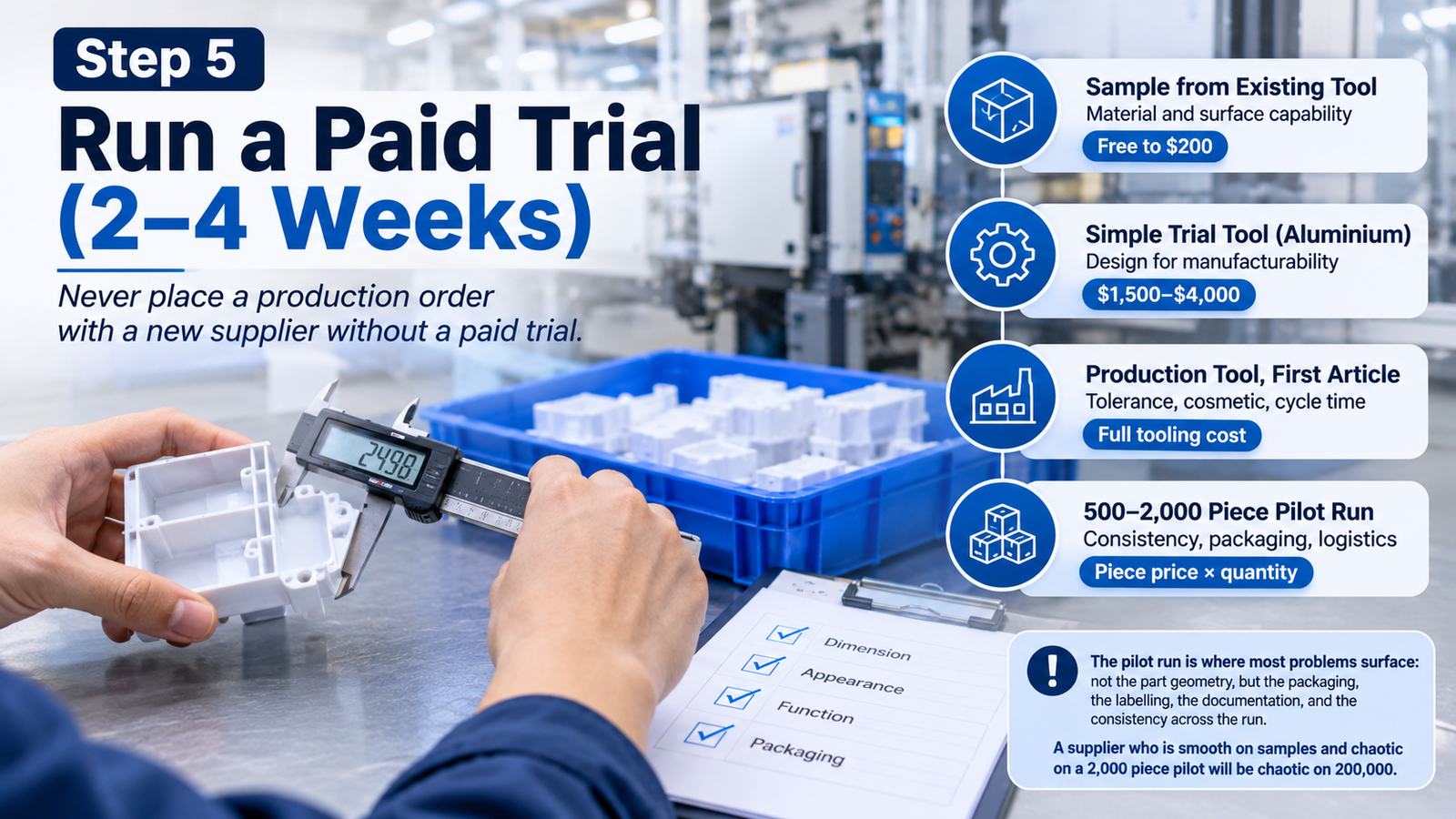
Step 5 — Run a paid trial (2–4 weeks)
Never place a production order with a new supplier without a paid trial.
| Trial stage | What it proves | Typical cost |
|---|---|---|
| Sample from existing tool | Material and surface capability | Free to $200 |
| Simple trial tool (aluminium) | Design for manufacturability | $1,500–4,000 |
| Production tool, first article | Tolerance, cosmetic, cycle time | Full tooling cost |
| 500–2,000 piece pilot run | Consistency, packaging, logistics | Piece price × quantity |
The pilot run is where most problems surface: not the part geometry, but the packaging, the labelling, the documentation, the consistency across the run. A supplier who is smooth on samples and chaotic on a 2,000 piece pilot will be chaotic on 200,000.
Step 6 — Audit in person or by video (1 day)
If you cannot visit, do a live video audit — not a recorded one. Ask them to walk the floor in real time and show you:
| Item | What to look for |
|---|---|
| Machine floor | Machines running, not idle; molds mounted |
| Mold storage | Organised racks, molds labelled, no rust |
| Material store | Sealed bags, desiccant dryers, labelled grades |
| QC room | Measuring equipment, CMM if precision work, calibration stickers |
| Assembly area | Clean, organised, work instructions visible |
| Warehouse | Finished goods packed and labelled consistently |
A live video walk with a specific request ("show me the dryer for the PA66 job") is very hard to fake. A pre-recorded video tour proves nothing.
Ten red flags
| # | Red flag | Why it matters |
|---|---|---|
| 1 | Will not provide the business licence | May not be the entity you are paying |
| 2 | Invoice entity differs from the company you contracted | No legal recourse |
| 3 | Insured employees under 10 but claims full in-house tooling | Trading company |
| 4 | No bimetallic barrels but quotes glass-filled work | Will wear out the barrel, or subcontract |
| 5 | Certificate PDF with no verifiable number | Forged or expired |
| 6 | Refuses any reference contact | No real customers, or bad ones |
| 7 | Price 30%+ below everyone else | Subcontracting, wrong material, or a quote designed to win and then change orders |
| 8 | Pushes for 100% payment upfront | No working capital of their own |
| 9 | Cannot explain a single past failure | New, or dishonest |
| 10 | Answers technical questions with marketing language | No engineer on the team |
Our guide to verifying supplier lab compliance covers the documentation side.
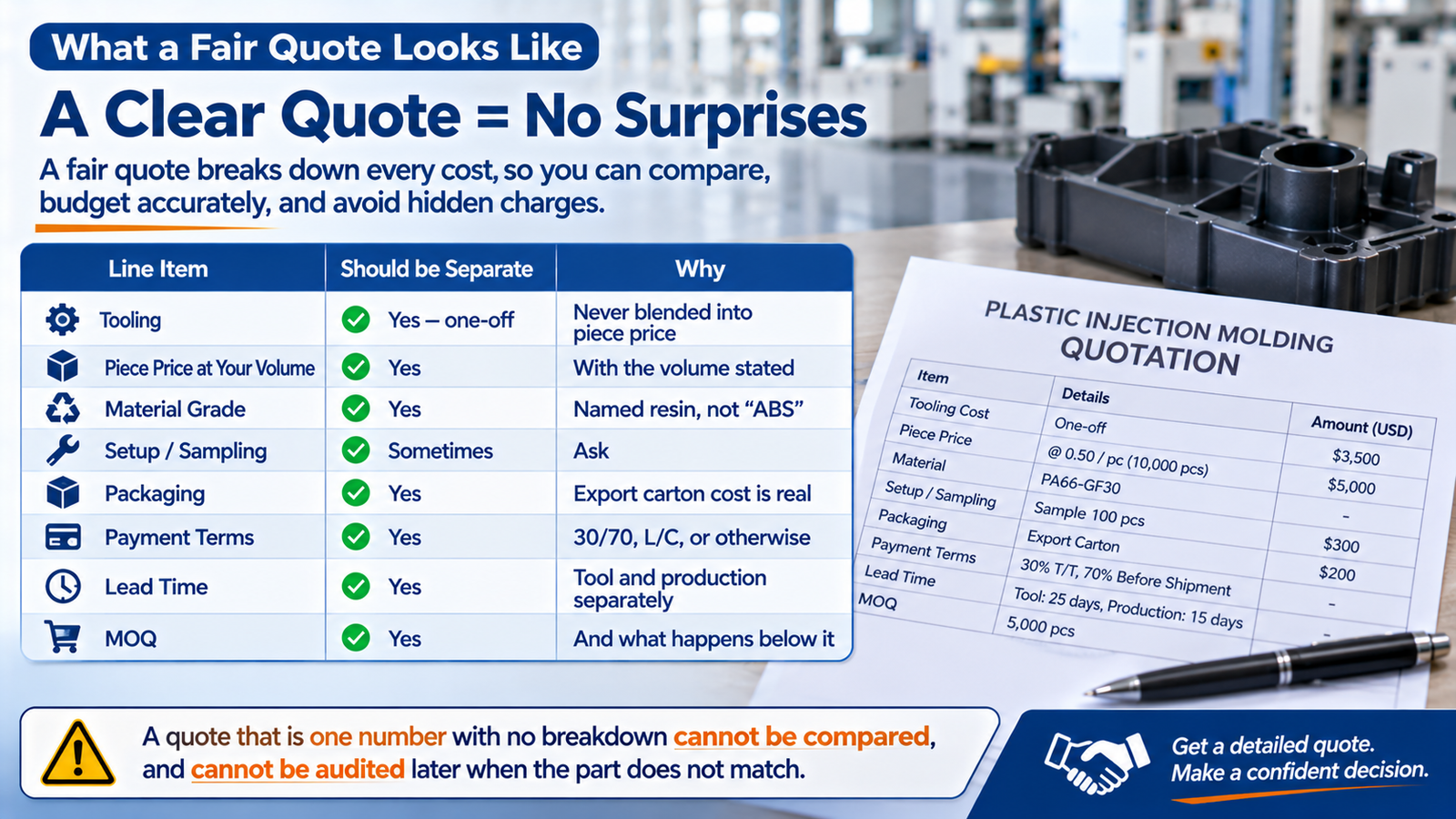
What a fair quote looks like
| Line item | Should be separate | Why |
|---|---|---|
| Tooling | Yes — one-off | Never blended into piece price |
| Piece price at your volume | Yes | With the volume stated |
| Material grade | Yes | Named resin, not "ABS" |
| Setup / sampling | Sometimes | Ask |
| Packaging | Yes | Export carton cost is real |
| Payment terms | Yes | 30/70, L/C, or otherwise |
| Lead time | Yes | Tool and production separately |
| MOQ | Yes | And what happens below it |
A quote that is one number with no breakdown cannot be compared, and cannot be audited later when the part does not match.
Payment terms and protection
| Term | Risk to buyer | Comment |
|---|---|---|
| 30% deposit / 70% before shipment | Moderate | Standard for China; inspect before the balance |
| 30/70 against B/L copy | Low | Best balance for both sides |
| L/C at sight | Low | Costs 1–2%, protects both |
| 100% upfront | Very high | Walk away |
| Open account (net 30/60) | Low for buyer | Rare with a new supplier |
| Escrow / trade assurance | Low | Platform-dependent, capped |
The 30/70 with inspection before the balance is the standard structure. Anyone demanding 100% up front is telling you they have no working capital, which means they cannot fund your order either.
Practical timeline
| Week | Activity |
|---|---|
| 1 | Shortlist 5 suppliers, request licences and machine lists |
| 1–2 | Verify certificates, check insured employees, ask for references |
| 2 | Video audits, technical discussion with their engineer |
| 3 | Compare quotes, request trial tool or sample |
| 4–6 | Trial run, first article inspection |
| 6–8 | Production order, tooling kick-off |
Two weeks of checking is proportionate to a project that will run for years.
Related guidance
Our guides to injection molding cost, tolerance specification, common injection molding materials and injection molding defects cover the technical side of what you are buying. The process comparison is in blow vs injection molding, and the audit checklist in mold supplier audit.
Verification methods in this guide follow standard procurement practice, with test and certification references from ASTM International and ISO, material data cross-checked against MatWeb and Engineering Toolbox, and processing practice reflecting Plastics Technology and PLASTICS industry standards, with material characterisation through SPE and NIST reference data. Company registry practice follows the Chinese national credit information system, described in unified social credit code.
How do I know if a Chinese supplier is a factory or a trading company?
Ask for the business licence and check the business scope (生產/制造 vs 销售 only) and the insured employee count (参保人数). Under 10 insured employees with a claim of full in-house tooling is a trading company. Then ask for a live video walk of the machine floor.
What certifications should a custom injection molding supplier have?
ISO 9001 as a baseline; IATF 16949 for automotive; ISO 13485 for medical; UL yellow card for electrical parts. Always verify the certificate number on the issuing body's website — a PDF alone proves nothing.
How much should I pay upfront?
30% deposit with 70% against the bill of lading, after inspection. Never 100% up front — a supplier that cannot fund its own working capital cannot fund your order either.
Should I visit China to audit the supplier?
Not necessarily, but a live video walk is close. Ask them to walk the floor in real time and show a specific machine and dryer. Recorded tours and stock photos prove nothing.
What is the biggest red flag?
Price 30% or more below every other quote. It usually means subcontracting to a smaller shop, a cheaper material than specified, or a quote designed to win the order and recover the margin through change orders later.
How long does it take to qualify a new supplier?
About two weeks of structured checking, plus two to four weeks for a trial or pilot run. That is proportionate to a tool and a production programme that will run for years.
Conclusion
Vetting a custom injection molding supplier in China is a two-week process with six steps: confirm the entity, verify the equipment, check the certificates, speak to a reference, run a paid trial, and audit in person or live on video. The cost of doing it is two weeks; the cost of skipping it is a tool you cannot use.
At Rui Cheng we publish our machine list, our certificates and our insured-employee count before being asked, and we run paid trials and live video audits for every new customer. If you are comparing suppliers, send us the drawing — we will tell you what we can hold and what we would change.