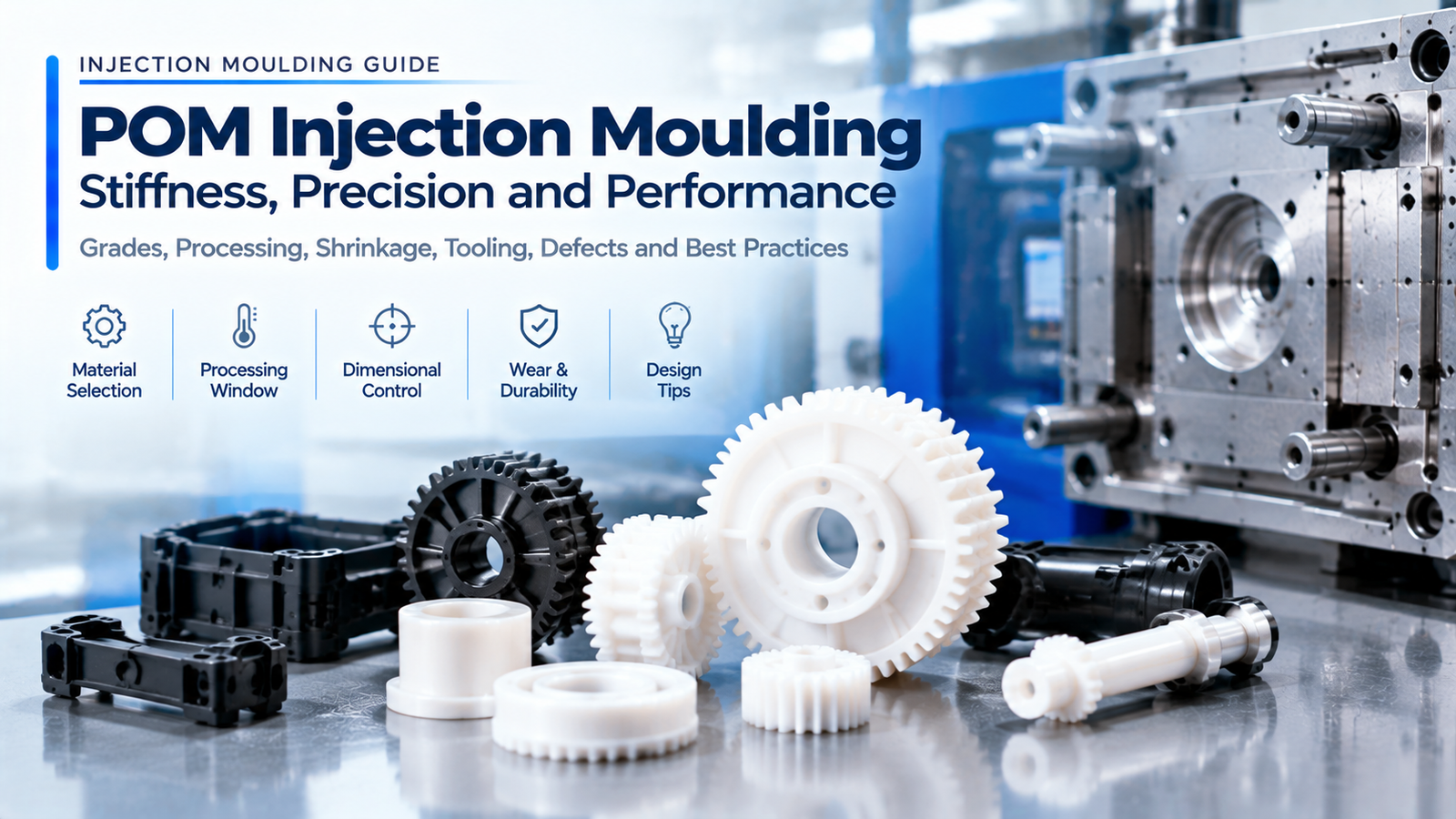
POM is what engineers specify when a part has to be stiff, stable and slick — gears, bushings, cams, precision slides, pump components. As acetal, or under the trade name Delrin, it holds tolerances like a machined metal part, runs against steel without oil, and keeps its shape in humid conditions. It is also the least forgiving of the common engineering plastics: the processing window is narrow, the material degrades quickly when overheated, and it cannot be glued the way most designers expect.
This guide covers POM injection moulding in practice: grades, shrinkage, the processing window, drying, defect analysis, mechanical behaviour, wear, self-lubrication, tooling rules and assembly.
What Makes POM Different
| Property | POM behaviour | What it means in practice |
|---|---|---|
| Structure | Semi-crystalline, high crystallinity | High stiffness and hardness; shrinkage continues after ejection |
| Density | About 1.41 g per cubic centimetre | Heavier than PP, ABS or nylon |
| Shrinkage | 1.5 to 2.5 percent depending on grade | Higher than ABS or PC; anisotropic and time dependent |
| Stiffness and hardness | High, and retained at temperature | The closest common plastic to a machined metal part |
| Friction | Low, with good wear resistance | Runs against steel without external lubrication |
| Fatigue resistance | Excellent | The standard material for precision gears and springs |
| Notch sensitivity | High | Sharp corners and deep scratches become cracks |
| Processing window | The narrowest of the common plastics | Overheating causes rapid degradation, not a slow decline |
| Thermal degradation | Releases formaldehyde | A sweet or pungent odour at the press means the material is already damaged |
| Bonding and printing | Poor without treatment | Adhesives, inks and labels need special preparation |
| UV resistance | Poor | Outdoor parts need stabilised grades or protection |
| Moisture absorption | Low | Dimensions are stable in humid service — a major advantage |
The combination of high crystallinity and a narrow processing window is what makes POM difficult. You get metal-like properties, but the material punishes temperature and residence time errors immediately.
POM Grades: Homopolymer or Copolymer
| Homopolymer | Copolymer | |
|---|---|---|
| Stiffness and strength | Higher | Slightly lower |
| Fatigue and creep | Better | Good |
| Wear resistance | Better | Good |
| Thermal stability in the barrel | Narrower window, easier to degrade | More forgiving |
| Chemical resistance to alkalis | Moderate | Better |
| Shrinkage | Around 2.0 to 2.5 percent | Around 1.5 to 2.2 percent |
| Typical use | Precision gears, bearings, thin sections | General parts, thicker sections, chemical contact |
The choice follows the part, not the preference. Thin, precision, high-load wear parts favour homopolymer; thick sections, chemically aggressive service, or a shop that needs a more forgiving process favour copolymer. Filled grades — glass fibre for stiffness, carbon fibre for lower friction, PTFE or molybdenum disulfide for wear — widen the available performance envelope further.
Property data should come from the supplier's data sheet for the exact grade and the intended wall thickness.
Shrinkage and Dimensional Control
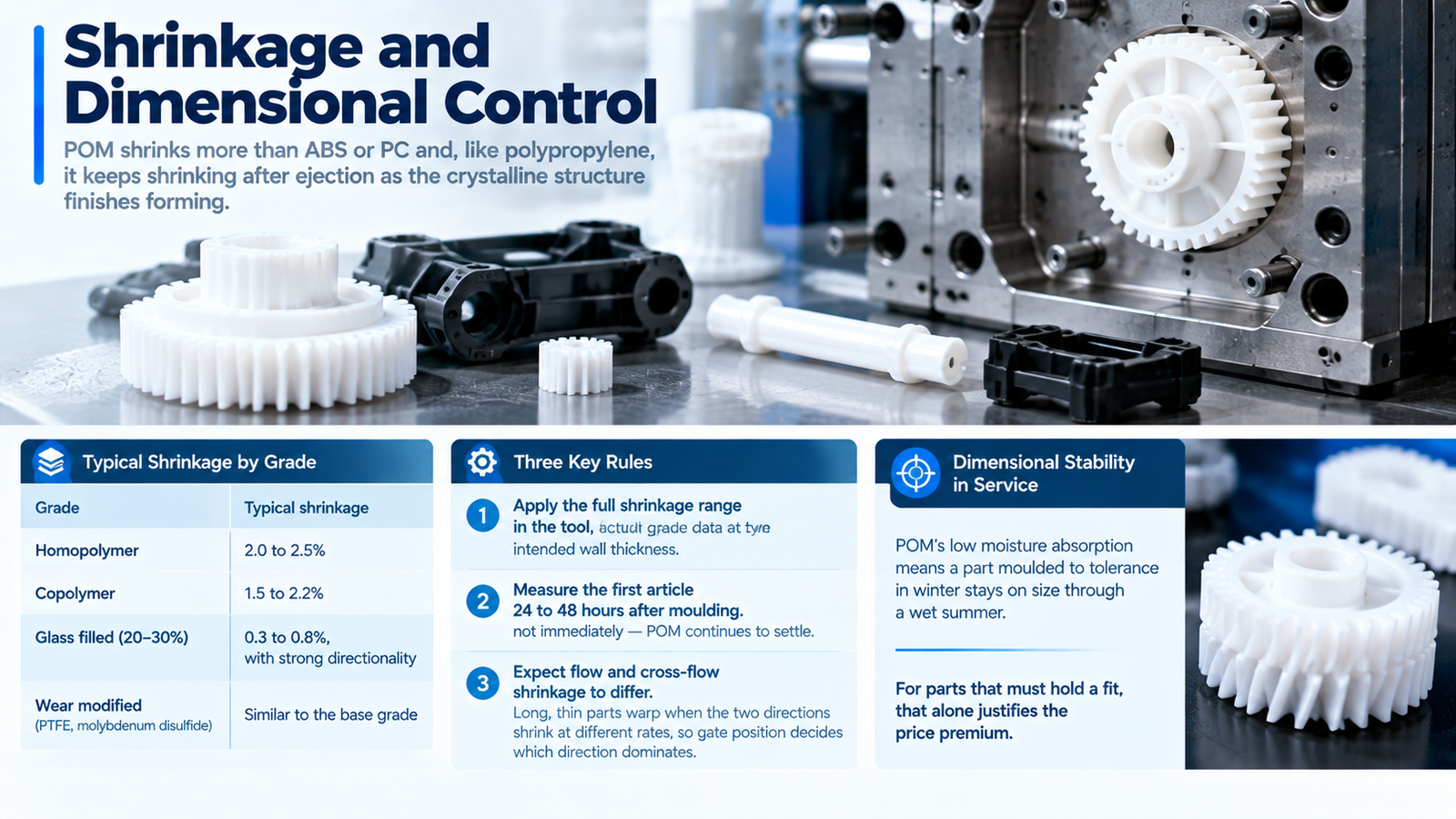
POM shrinks more than ABS or PC and, like polypropylene, it keeps shrinking after ejection as the crystalline structure finishes forming.
| Grade | Typical shrinkage |
|---|---|
| Homopolymer | 2.0 to 2.5 percent |
| Copolymer | 1.5 to 2.2 percent |
| Glass filled 20 to 30 percent | 0.3 to 0.8 percent, with strong directionality |
| Wear modified (PTFE, molybdenum disulfide) | Similar to the base grade |
Three rules follow:
- Apply the full shrinkage range in the tool, from the actual grade data at the intended wall thickness.
- Measure the first article 24 to 48 hours after moulding, not immediately — POM continues to settle.
- Expect flow and cross-flow shrinkage to differ. Long, thin parts warp when the two directions shrink at different rates, so gate position decides which direction dominates.
Dimensional stability in service is where POM beats nylon decisively: its low moisture absorption means a part moulded to tolerance in winter stays on size through a wet summer. For parts that must hold a fit, that alone justifies the price premium.
Processing Window: The Narrowest of the Common Plastics
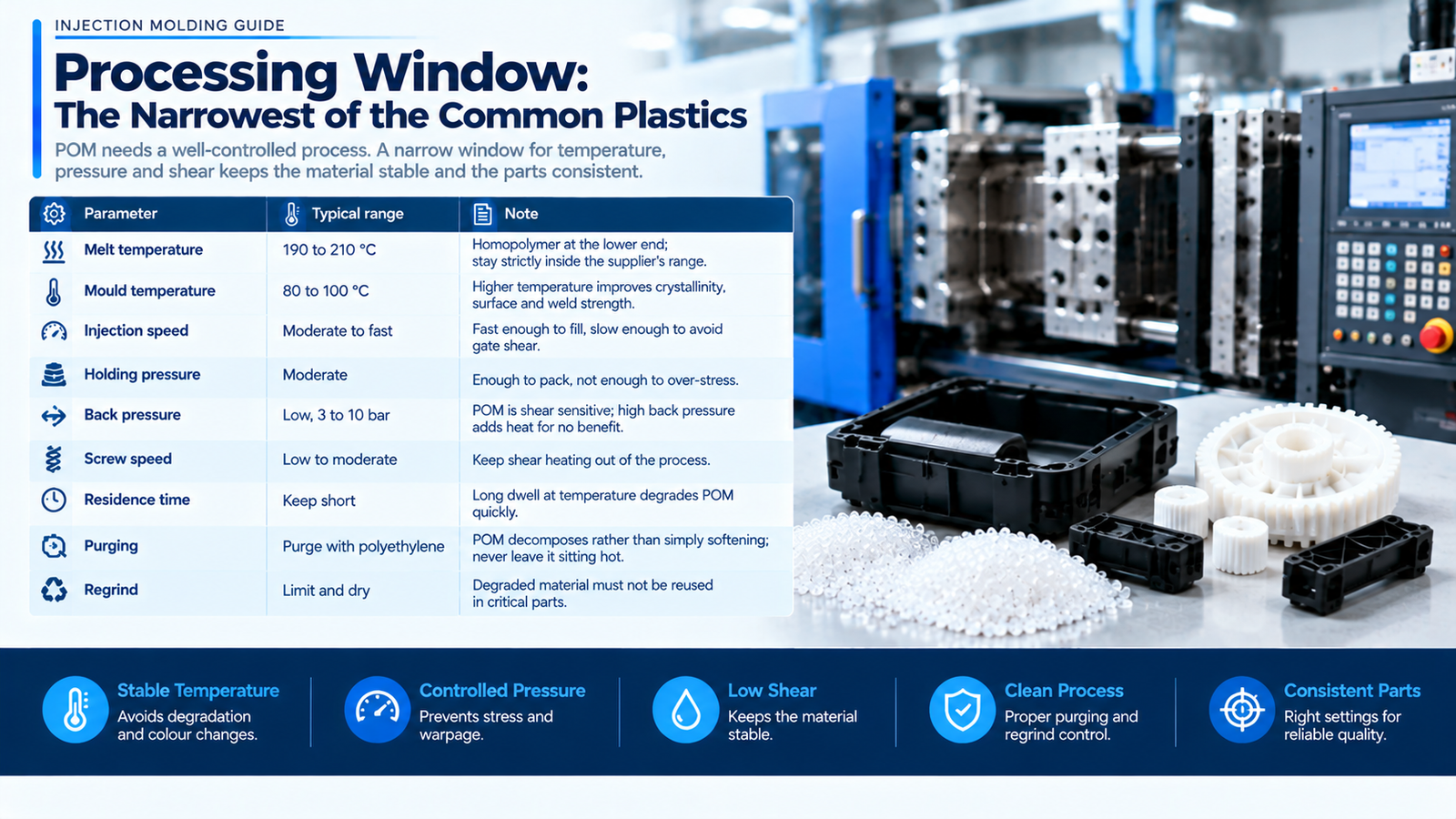
| Parameter | Typical range | Note |
|---|---|---|
| Melt temperature | 190 to 210 °C | Homopolymer at the lower end; stay strictly inside the supplier's range |
| Mould temperature | 80 to 100 °C | Higher temperature improves crystallinity, surface and weld strength |
| Injection speed | Moderate to fast | Fast enough to fill, slow enough to avoid gate shear |
| Holding pressure | Moderate | Enough to pack, not enough to over-stress |
| Back pressure | Low, 3 to 10 bar | POM is shear sensitive; high back pressure adds heat for no benefit |
| Screw speed | Low to moderate | Keep shear heating out of the process |
| Residence time | Keep short | Long dwell at temperature degrades POM quickly |
| Purging | Purge with polyethylene | POM decomposes rather than simply softening; never leave it sitting hot |
| Regrind | Limit and dry | Degraded material must not be reused in critical parts |
Two details decide quality more often than the numbers themselves. First, melt temperature must be verified with an air shot rather than trusted from the controller. Second, the formaldehyde odour is a diagnostic: if the press smells sweet or pungent, the material is already degrading and every part in that run should be questioned. Our guide to analysing POM injection moulding defects and failures works through the failure signatures in detail.
Does POM Need Drying?
The short answer is that homopolymer POM absorbs very little moisture and usually needs no drying, and copolymer needs only a short dry — but that simple answer hides the exceptions that catch people out.
| Situation | What to do |
|---|---|
| Homopolymer, sealed bags, normal climate | Generally no drying required |
| Copolymer, humid climate or opened bags | Dry around 80 °C for 2 hours |
| Regrind | Always dry before reuse |
| Any grade after long storage in a damp area | Dry before processing |
| A visible surface defect on the moulding | Check drying before blaming anything else |
Even though POM does not hydrolyse the way PC does, surface moisture still shows up as splay and silver streaks, and it weakens weld lines. Where drying is needed, our guide to drying acetal covers the time, temperature and water content targets.
Common POM Defects and Failure Analysis
| Defect | Likely cause | Fix |
|---|---|---|
| Silver streaks and splay | Surface moisture, or the first sign of degradation | Dry if required, check melt temperature and residence time |
| Black specks and discoloration | Overheating, long residence time, dead spots in the barrel | Reduce temperature, purge the barrel, check the screw and non-return valve |
| Formaldehyde odour | Thermal degradation in progress | Reduce temperature immediately, shorten residence time, purge |
| Short shots | Cold mould, insufficient speed, small gate | Raise mould temperature and speed, enlarge the gate |
| Flash | Excess pressure, worn tool faces | Reduce hold pressure, service the shut-offs |
| Sink marks | Thick sections, short hold | Reduce wall thickness, extend hold, core the boss |
| Warpage | Uneven crystallisation from unbalanced cooling | Balance the cooling circuits, review gate location |
| Voids in thick sections | Insufficient packing, thick walls | Reduce wall thickness, increase hold, check the gate |
| Parts cracking in service | Sharp corners or notches plus stress | Increase radii, reduce moulded-in stress, review assembly loads |
| Poor weld line strength | Low mould temperature, poor venting | Raise mould temperature, add venting at the weld |
| Sticking in the tool | Insufficient draft, over-packing, poor ejection | Increase draft, reduce hold, review ejection |
Most POM failures trace back to three root causes: heat history, sharp geometry and crystallisation that has not been allowed to finish.
Stiffness, Creep and Fatigue in Service
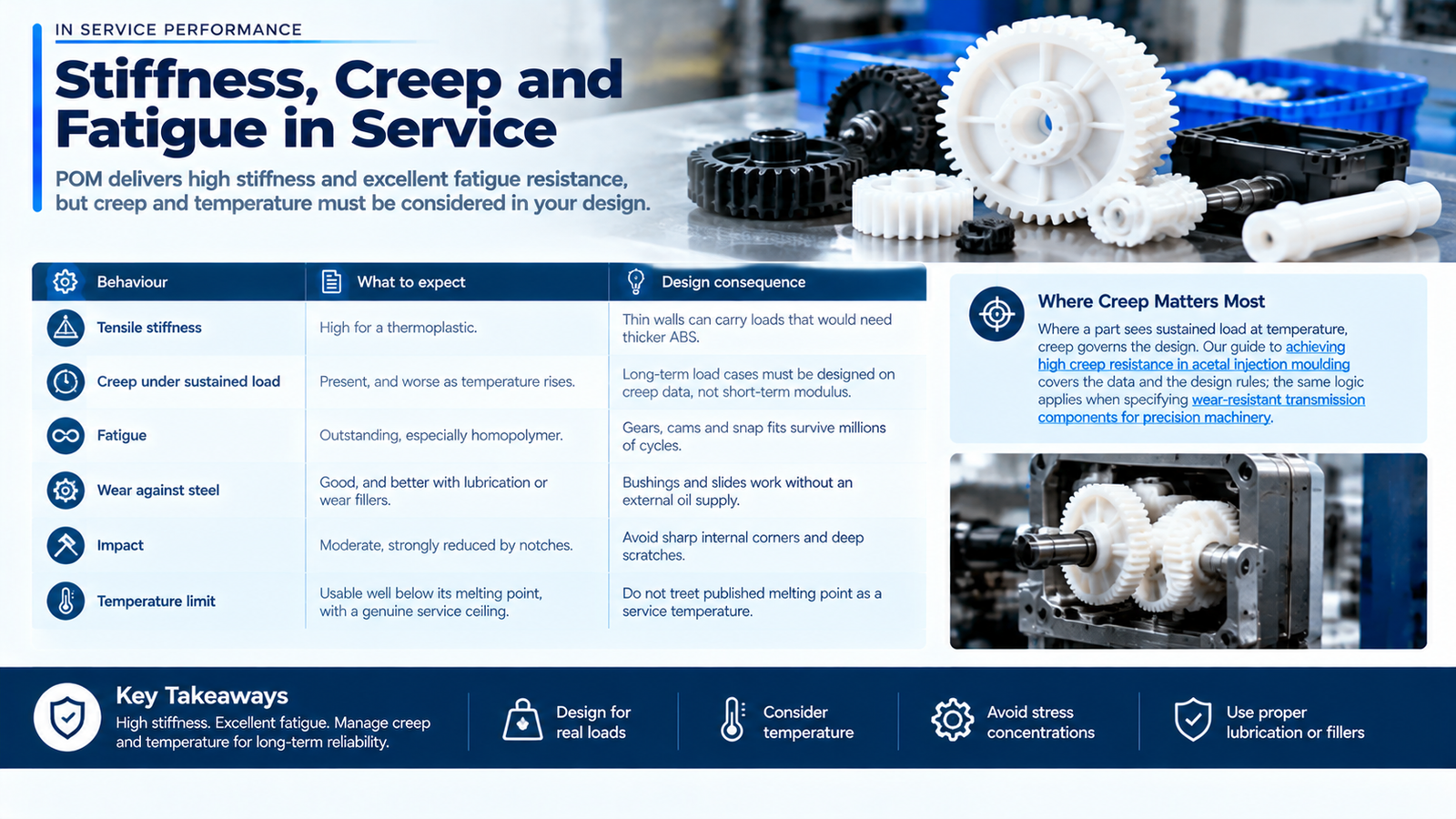
| Behaviour | What to expect | Design consequence |
|---|---|---|
| Tensile stiffness | High for a thermoplastic | Thin walls can carry loads that would need thicker ABS |
| Creep under sustained load | Present, and worse as temperature rises | Long-term load cases must be designed on creep data, not short-term modulus |
| Fatigue | Outstanding, especially homopolymer | Gears, cams and snap fits survive millions of cycles |
| Wear against steel | Good, and better with lubrication or wear fillers | Bushings and slides work without an external oil supply |
| Impact | Moderate, strongly reduced by notches | Avoid sharp internal corners and deep scratches |
| Temperature limit | Usable well below its melting point, with a genuine service ceiling | Do not treat published melting point as a service temperature |
Where a part sees sustained load at temperature, creep governs the design. Our guide to achieving high creep resistance in acetal injection moulding covers the data and the design rules; the same logic applies when specifying wear-resistant transmission components for precision machinery.
Self-Lubrication: What It Is and What It Is Not
POM's low friction comes from its smooth, hard, crystalline surface, not from an additive that gradually depletes. That gives a genuinely long-lasting low-friction surface — which is why Delrin bushings, slides and gears run without grease.
What self-lubrication is not:
| Misconception | Reality |
|---|---|
| "It never wears" | It wears far more slowly than most plastics, but wear still depends on load, speed and counterface |
| "Counterface finish does not matter" | A rough or corroded steel shaft will abrade the polymer regardless of its own lubricity |
| "It replaces lubrication under all loads" | Beyond the material's pressure and velocity limits, wear rises steeply |
| "Any POM grade behaves the same" | Wear-modified and glass-filled grades behave very differently |
The decisive factor is the pressure and velocity product of the application, together with the roughness of the metal it runs against. Our guide to Delrin self-lubrication covers how that plays out in real assemblies.
Tooling and Design Rules for POM
| Feature | Recommendation |
|---|---|
| Nominal wall | 1.5 to 3 mm typical, uniform; thick sections void and sink |
| Inside radii | At least half the wall thickness — POM is notch sensitive, so sharp corners are unacceptable |
| Outside radii | Inside radius plus wall thickness |
| Draft | 0.5 to 1 degree minimum, more on textured faces |
| Ribs | Around 60 percent of nominal wall to avoid sink |
| Bosses | 60 percent of wall thickness, cored, with generous base radii |
| Gates | Large enough to avoid shear degradation; gate into a thick section |
| Venting | 0.02 to 0.03 mm at the last point to fill and at weld lines |
| Shrinkage allowance | Full range from the actual grade data, confirmed after 24 to 48 hours |
| Ejection | Generous ejection area; POM sticks if it is over-packed |
Design is where most POM failures are created. A part with generous radii, uniform walls and a well-placed gate can run for years without trouble; the same part with sharp internal corners will crack in service no matter how good the moulding process is.
Assembly: Snap Fits, Press Fits, Welding and Bonding
| Method | Suitability for POM |
|---|---|
| Snap fits | Excellent — the material's fatigue resistance is the reason snap fits work |
| Press fits and interference fits | Work well; allow for thermal expansion differences against metal |
| Ultrasonic welding | Possible and strong, but the joint design must suit the material |
| Solvent bonding | Does not work — POM resists most solvents |
| Adhesive bonding | Difficult; requires surface treatment and the right adhesive system |
| Mechanical fastening | Reliable; use generous washers and avoid sharp edges |
| Printing and laser marking | Needs surface treatment for durable adhesion |
The practical consequence: if a design depends on gluing POM to something, it should be redesigned. Snap fits, press fits and mechanical fastening all play to the material's strengths.
Where POM Wins
- Precision gears, cams and racks — fatigue resistance and stiffness in one material
- Bushings, slides and wear pads — running against steel without lubrication
- Automotive interior mechanisms — latches, window mechanisms, seat components
- Industrial machinery — pump parts, conveyor components, valve bodies
- Precision instrument parts — dimensional stability in humid environments
- Food-contact parts — where the correct FDA-grade material is specified
- Medical device components — with the appropriate grade qualification
Where the application needs the highest stiffness and wear resistance for a critical transmission part, grade selection widens the envelope considerably.
POM Compared With Other Engineering Plastics
| Material | Stiffness | Fatigue | Moisture stability | Wear | Cost |
|---|---|---|---|---|---|
| POM | High | Excellent | Excellent | Excellent | Moderate |
| Nylon (PA66) | Moderate to high | Good | Poor — absorbs moisture | Good | Low to moderate |
| PBT | High | Good | Excellent | Very good | Moderate |
| PC | Moderate | Good | Excellent | Moderate | Moderate to high |
| ABS | Low to moderate | Moderate | Good | Poor | Low |
The most common comparison in practice is POM against nylon, since both are used for gears and moving parts at similar cost. Our comparison of POM and nylon for gears and moving parts examines where each one wins.
Quality Control for POM Parts
| Check | Method | Frequency |
|---|---|---|
| Critical dimensions, after stabilisation | CMM or optical measurement, 24 to 48 hours after moulding | First article and after tooling changes |
| Appearance and colour | Inspection under defined lighting against a limit sample | Every batch |
| Weld line integrity | Visual and functional checks, sectioning where needed | Per quality plan |
| Material verification | Resin lot traceability and, where required, laboratory identification | Per material lot |
| Wear and fatigue | Application-specific test rigs for gears and slides | Tool qualification |
| Flash, voids and internal defects | Visual, weight checking and X-ray or sectioning where specified | Per quality plan |
For gears and wear parts, dimensional inspection alone does not prove the part will survive service. Application-level testing is what confirms the design.
Conclusion
POM is the precision engineering plastic: stiff, stable, quiet, and able to run against steel for years without lubrication. It is also the material that most rewards discipline, because its processing window is narrow and its degradation is fast. Keep the melt temperature under control, verify it with an air shot, design out sharp corners, allow the full shrinkage range, and let the part finish its crystallisation before you measure it. Do that and POM delivers metal-like precision in a moulded part. Cut corners on temperature or geometry and it fails early, often in ways that only appear after the part is in service.
With injection moulding capability from 80 to 1,400 tonnes and in-house tooling, we run polyoxymethylene in homopolymer, copolymer, glass filled, carbon filled and wear-modified grades, including FDA-compliant materials for food-contact applications. Through our custom injection moulding services we support POM projects from grade selection and tooling design through dimensional approval to stable volume production. Send us your part drawing and service conditions to discuss grades, tolerances, wear requirements and the process window for your application.
FAQ
What is POM injection moulding?
POM injection moulding is the production of parts from polyoxymethylene, also known as acetal or by the trade name Delrin. It is a semi-crystalline engineering thermoplastic used where stiffness, dimensional stability, low friction and fatigue resistance are needed together — gears, bushings, cams, precision slides and pump components.
Does POM need drying before moulding?
Usually very little. Homopolymer POM absorbs almost no moisture and is normally processed straight from sealed bags. Copolymer, regrind and material stored in humid conditions should be dried at about 80 °C for around 2 hours. Where drying is skipped and the part shows splay, drying is the first thing to check.
What is the shrinkage rate of POM?
Homopolymer POM shrinks about 2.0 to 2.5 percent and copolymer about 1.5 to 2.2 percent. Glass filled grades fall to roughly 0.3 to 0.8 percent with strong directionality. Shrinkage continues after ejection, so dimensions must be measured 24 to 48 hours after moulding.
What is the processing temperature for POM?
Melt temperature is typically 190 to 210 °C, with homopolymer run at the lower end, and a mould temperature of 80 to 100 °C. The window is narrow by comparison with other common plastics, and residence time must be kept short because POM degrades quickly rather than gradually.
How do I know if POM is degrading?
The clearest sign is odour: POM releases formaldehyde when it degrades, so a sweet or pungent smell at the press means the material is already damaged. Discoloration, black specks and a fall in mechanical performance follow. Reduce melt temperature and residence time, and purge the barrel.
Can POM parts be glued or welded?
Solvent bonding does not work — POM resists most solvents — and adhesive bonding is difficult without surface treatment. Ultrasonic welding is effective when the joint is designed for it. In practice, snap fits, press fits and mechanical fastening play to the material's strengths and are the preferred assembly methods.