Injection molding and die casting are the two dominant mass-production processes for manufactured parts — one for plastics, one for metals. Engineers and buyers frequently compare them when deciding how to produce a component, and the choice depends on material requirements, volume, cost, and performance. This guide compares injection molding vs die casting across every key factor to help you make the right manufacturing decision.
The Basic Difference
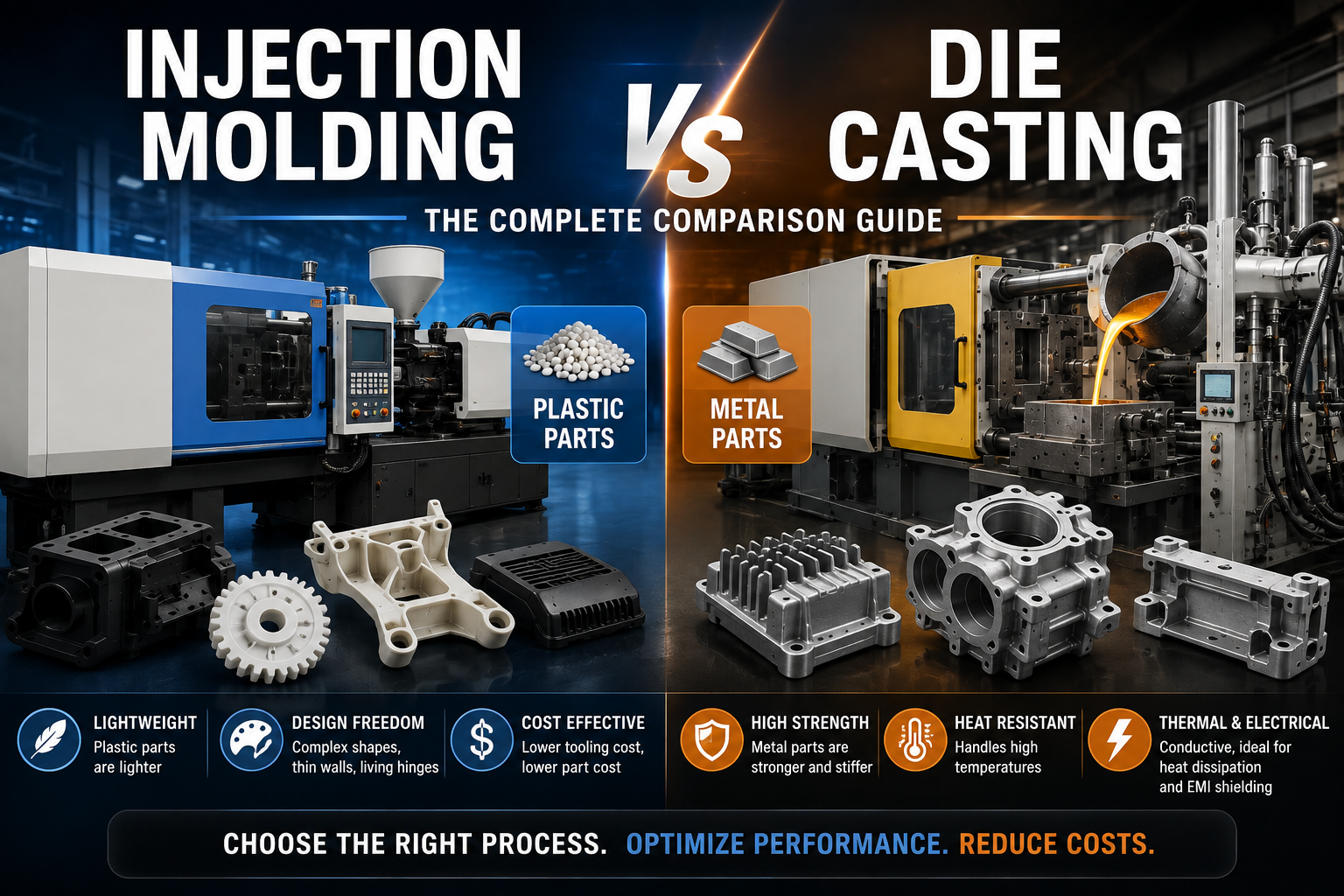
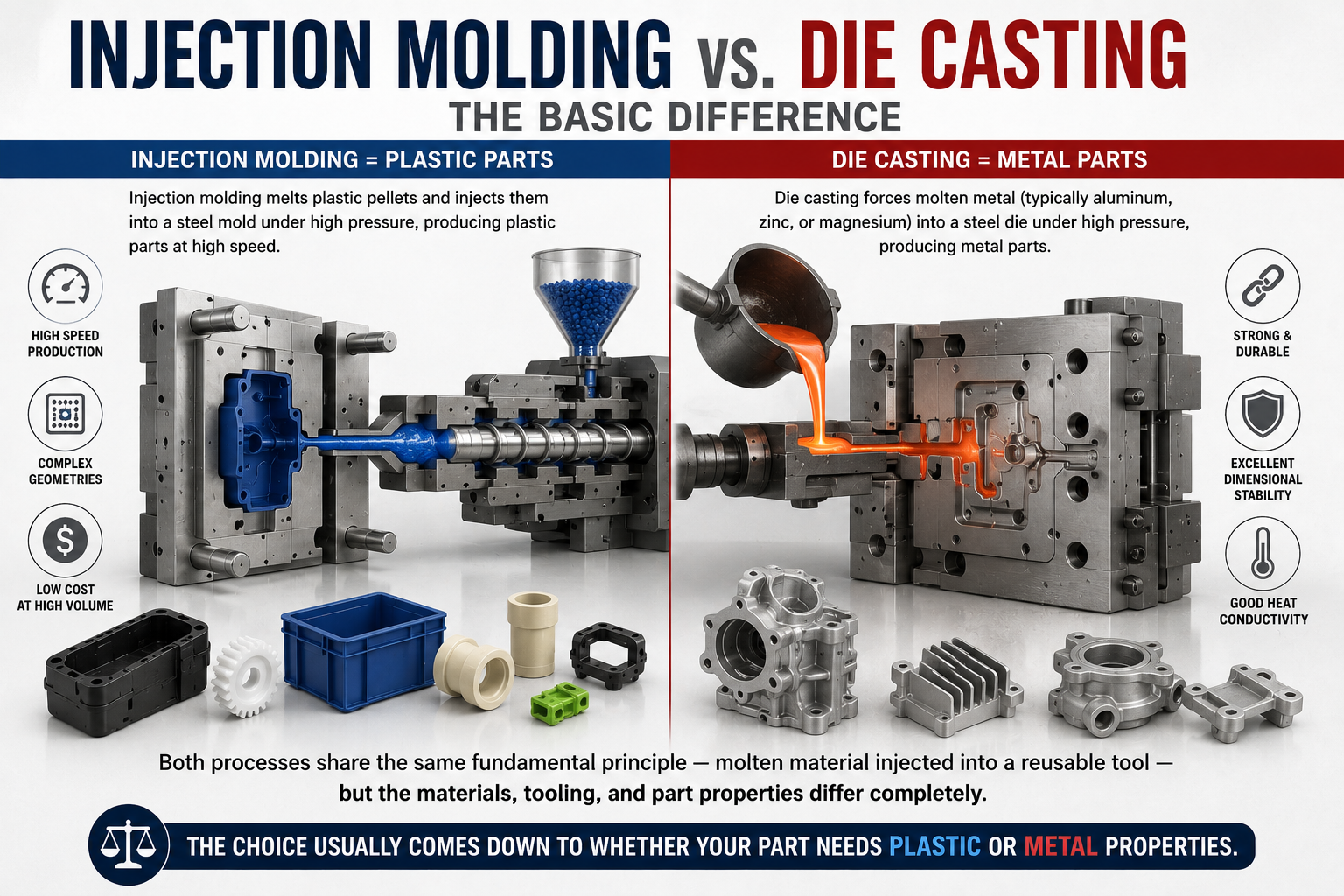
Injection molding melts plastic pellets and injects them into a steel mold under high pressure, producing plastic parts at high speed. Die casting forces molten metal (typically aluminum, zinc, or magnesium) into a steel die under high pressure, producing metal parts.
Both processes share the same fundamental principle — molten material injected into a reusable tool — but the materials, tooling, and part properties differ completely. Injection molding = plastic parts. Die casting = metal parts. The choice usually comes down to whether your part needs plastic or metal properties.
Key Comparison
| Factor | Injection Molding | Die Casting |
|---|---|---|
| Material | Thermoplastics (PP, ABS, PA, PC...) | Metals (Al, Zn, Mg alloys) |
| Part weight | 0.1g to 20kg+ | 1g to 20kg+ |
| Wall thickness | 0.5-4 mm typical | 1-10 mm typical |
| Strength | Plastic-level | Metal-level (much stronger) |
| Operating temperature | Up to ~150°C max | Up to 300°C+ |
| Surface finish | Excellent (molded) | Good (cast) |
| Electrical conductivity | Insulator | Conductive |
| EMI shielding | Needs treatment | Inherent |
| Tooling cost | $5k-$50k | $10k-$100k (higher) |
| Per-part cost at volume | Very low | Low |
| Lead time for tooling | 3-6 weeks | 6-12 weeks (longer) |
Mechanical Performance: The Core Difference
The most important difference is mechanical performance. Die-cast metal parts are dramatically stronger, stiffer, and more heat-resistant than any plastic part:
| Property | Injection Molded Plastic | Die Cast Aluminum |
|---|---|---|
| Tensile strength | 30-100 MPa (typical) | 150-300 MPa |
| Elastic modulus | 1-4 GPa | 70 GPa |
| Continuous service temp | Up to ~150°C | Up to 300°C |
| Impact strength | Good | Excellent |
Choose die casting when the part must carry structural loads, withstand high temperatures, or resist impact beyond plastic capability. Choose injection molding when weight, cost, and design freedom matter more than absolute strength.
Weight Comparison
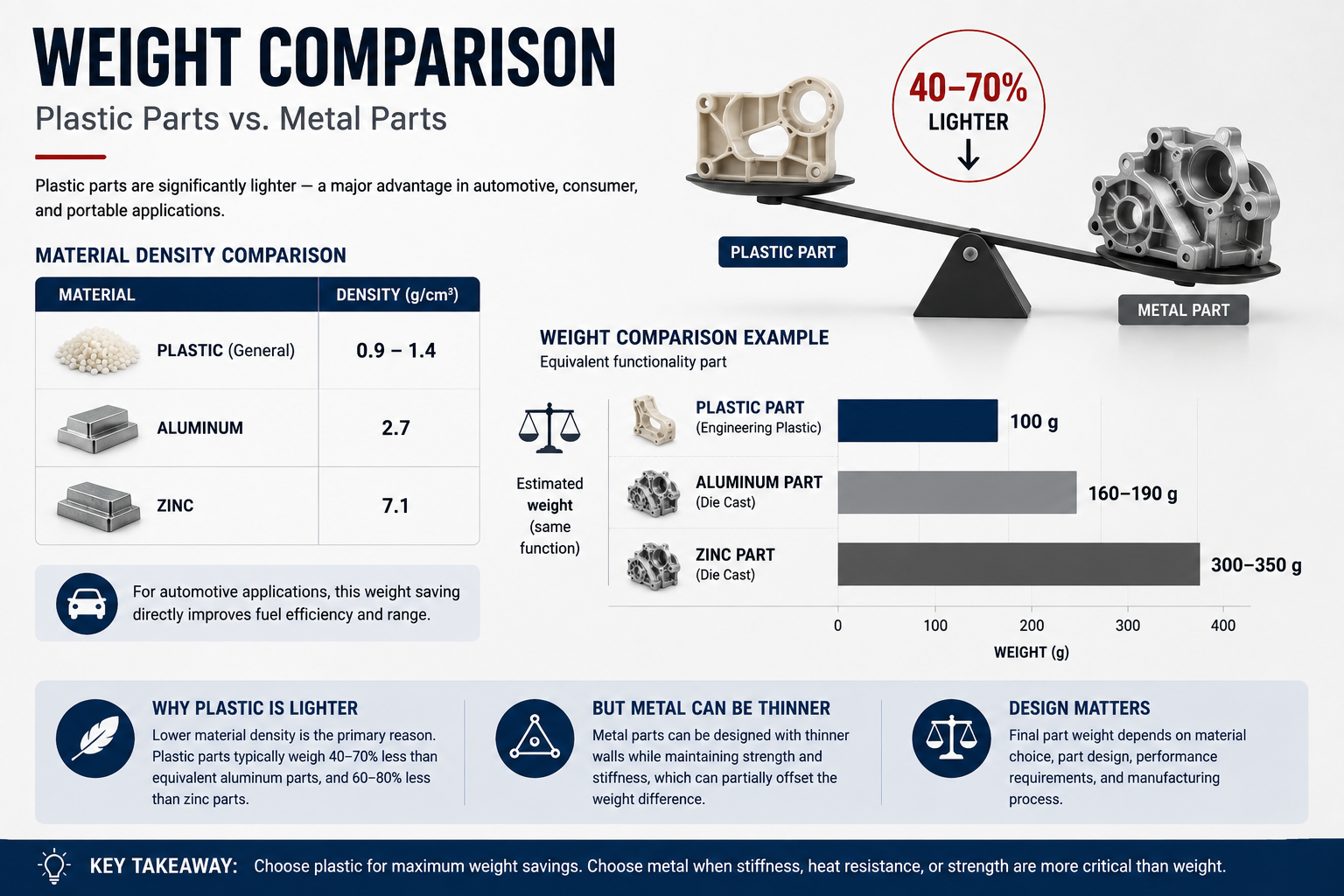
Plastic parts are significantly lighter — a major advantage in automotive, consumer, and portable applications:
- Plastic density: 0.9-1.4 g/cm³
- Aluminum density: 2.7 g/cm³
- Zinc density: 7.1 g/cm³
A plastic part is typically 40-70% lighter than an equivalent aluminum part. For automotive applications, this weight saving directly improves fuel efficiency and range. However, metal parts can be thinner and stiffer, partially offsetting the weight difference.
Thermal and Electrical Properties
Die-cast metal parts excel where heat or electricity is involved:
- Heat dissipation: Metal conducts heat, making die casting ideal for heat sinks, engine components, and housings that must shed heat
- Electrical conductivity: Metal parts provide natural grounding and EMI shielding, critical for electronics enclosures
- High-temperature service: Die-cast parts survive engine compartments and industrial heat that would soften plastic
Injection molded parts are electrical insulators by nature and can only handle moderate temperatures, though engineering plastics (PPS, LCP, PEEK) extend the range.
Design Freedom
Injection molding offers greater design freedom:
- Complex geometries with thin walls, ribs, and bosses
- Living hinges, snap fits, and internal threads
- Multi-material molding (overmolding, insert molding)
- Textured surfaces and molded-in colors (no painting needed)
Die casting is more limited: thicker minimum walls, draft angles are mandatory, and porosity must be managed. However, die casting can produce large, strong housings that plastics cannot match structurally.
Cost Comparison
| Cost Factor | Injection Molding | Die Casting |
|---|---|---|
| Tooling cost | $5,000-$50,000 | $10,000-$100,000 |
| Tooling lead time | 3-6 weeks | 6-12 weeks |
| Material cost | Low | Higher |
| Per-part cost at volume | Very low | Low |
| Secondary finishing | Often none (colored resin) | Often required (machining, coating) |
Die casting has higher upfront tooling and material costs, plus more secondary operations. Injection molding is generally cheaper for equivalent part complexity — which is why plastics have replaced metals in many applications.
When to Use Injection Molding
- The part is a housing, enclosure, or cover
- Weight reduction is critical
- The application is below 150°C and not structural
- Electrical insulation is needed
- Complex geometries or molded-in features are required
- Cost-sensitive consumer or automotive applications
When to Use Die Casting
- The part carries structural loads
- High temperature or fire resistance is required
- The part must conduct heat or electricity
- EMI shielding is needed (electronics housings)
- The part is exposed to harsh chemicals or impacts
- Long-term dimensional stability under load is critical
The Combined Approach
Many products use both processes in the same assembly — a die-cast aluminum frame or chassis for strength and heat dissipation, with injection molded plastic covers for appearance, insulation, and weight savings. Automotive components, power tools, and electronics commonly combine both.
Conclusion
Injection molding and die casting serve different material worlds. Injection molding delivers lightweight, low-cost, design-flexible plastic parts. Die casting delivers strong, heat-resistant, conductive metal parts. The right choice depends on the part's performance requirements — strength, temperature, weight, conductivity — and the production economics. For many products, using both processes in combination delivers the best result.
With experience in both plastic injection molding and metal processing, PlasticXperts helps customers select the right manufacturing process for their application. Contact our engineering team to discuss your part requirements and receive a professional recommendation.
FAQ
Which is stronger, injection molding or die casting?
Die-cast metal parts are much stronger. Die-cast aluminum has tensile strength of 150-300 MPa versus 30-100 MPa for typical injection molded plastics. Die casting is chosen when parts must carry structural loads or withstand high temperatures and impacts.
Is die casting more expensive than injection molding?
Yes, generally. Die casting has higher tooling costs ($10,000-$100,000 vs $5,000-$50,000), longer tooling lead times, higher material costs, and more secondary operations. Injection molding is typically cheaper for equivalent part complexity.
Can die casting replace injection molding?
Not for plastic applications. The processes serve different materials — die casting produces metal parts, injection molding produces plastic parts. A product may switch from metal to plastic (or vice versa) for weight, cost, or performance reasons, but the processes are not interchangeable.
What are the advantages of die casting over injection molding?
Die casting offers superior strength, higher temperature resistance, better heat dissipation, electrical conductivity, and inherent EMI shielding. Die-cast parts are chosen for structural, thermal, and electrical applications where plastics cannot perform.
What are the advantages of injection molding over die casting?
Injection molding offers lower tooling cost, faster tooling lead time, lighter parts, greater design freedom (thin walls, living hinges, complex geometry), molded-in color, and lower per-part cost at volume. Plastics are also electrical insulators.
Which process is faster for prototyping?
Injection molding is faster for prototyping because tooling takes 3-6 weeks versus 6-12 weeks for die casting. For even faster prototyping, 3D printing or CNC machining is used before committing to either process.