Polyurethane hydrocyclones are essential equipment in mineral processing plants for particle size classification, desliming, and concentration. Choosing the right cyclone model directly affects separation efficiency and plant throughput. This guide explains the FX series range, key specifications, and how to select the correct hydrocyclone for your process.
How a Hydrocyclone Works
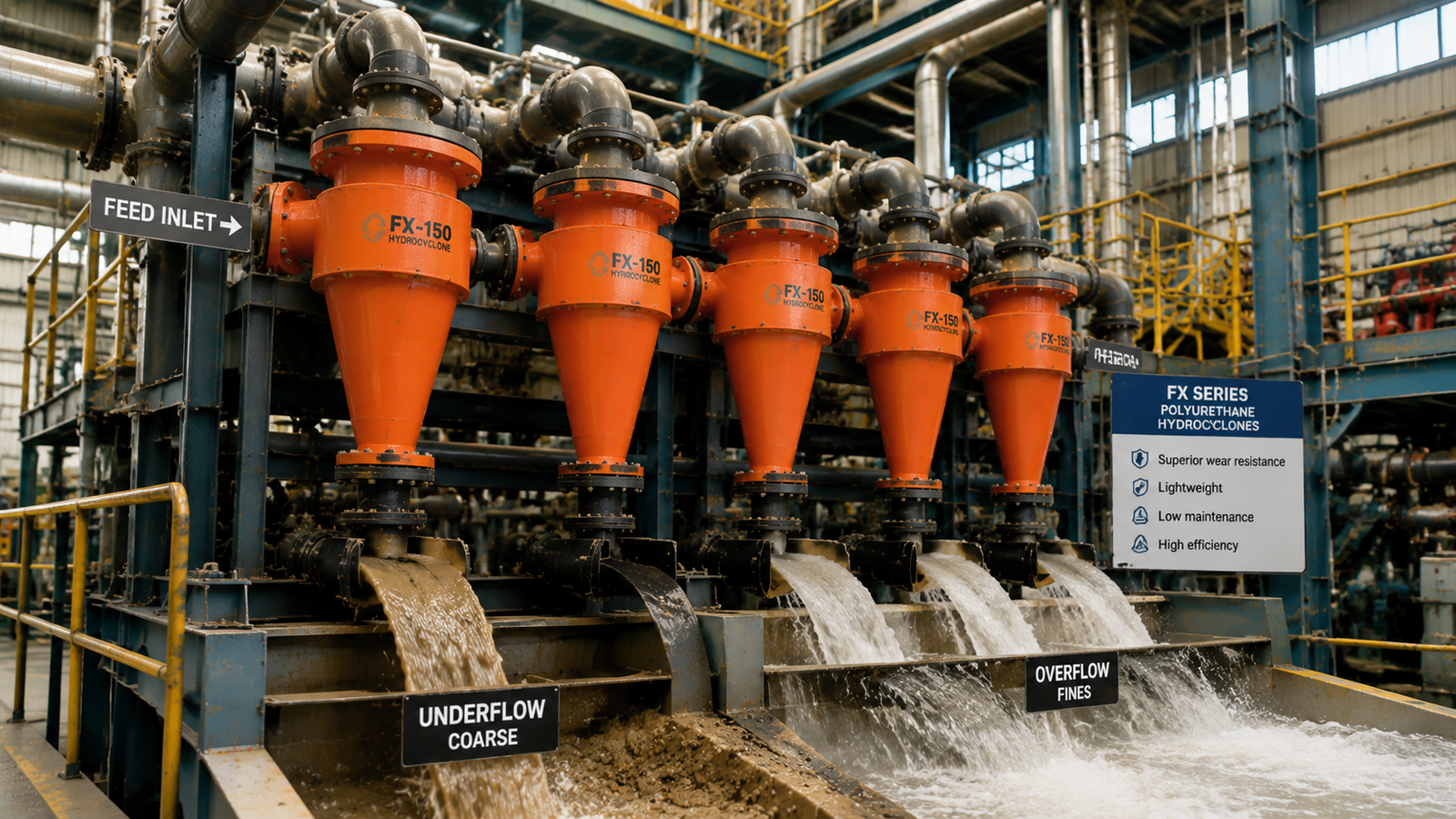
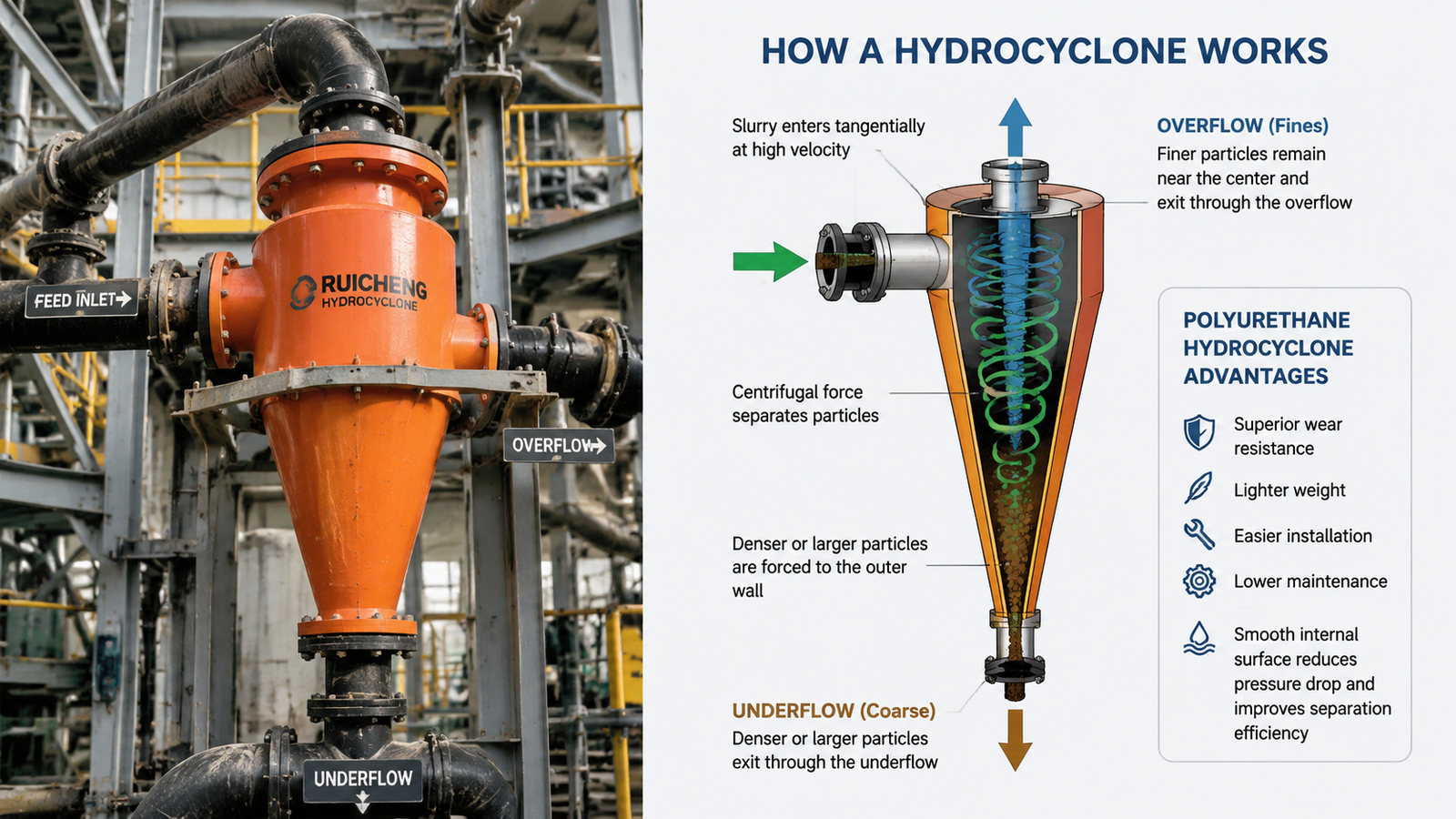
A hydrocyclone uses centrifugal force to separate particles in a slurry stream. The slurry enters tangentially at high velocity, creating a vortex. Denser or larger particles are forced to the outer wall and exit through the underflow, while finer particles remain near the center and exit through the overflow.
Polyurethane hydrocyclones offer significant advantages over metal or ceramic units: superior wear resistance, lighter weight, easier installation, and lower maintenance. The smooth internal surface reduces pressure drop and improves separation efficiency.
FX Series Model Range
The FX series covers a wide range of capacities and separation sizes:
| Model | Diameter (mm) | Feed Inlet (mm) | Capacity (m³/h) | Separation Size (μm) |
|---|---|---|---|---|
| FX-50 | 50 | 9 | 0.1-0.4 | 10-74 |
| FX-75 | 75 | 10 | 0.1-0.4 | 20-74 |
| FX-100 | 100 | 22 | 0.05-0.4 | 10-100 |
| FX-150 | 150 | 28-38 | 0.05-0.4 | 20-100 |
| FX-200 | 200 | 50-75 | 0.05-0.4 | 40-100 |
| FX-250 | 250 | 50 | 0.05-0.3 | 40-100 |
| FX-300 | 300 | 60 | 0.03-0.3 | 50-200 |
| FX-350 | 350 | 50-58 | 0.03-0.3 | 50-150 |
| FX-400 | 400 | 85-115 | 0.03-0.3 | 74-150 |
| FX-500 | 500 | 90-100 | 0.03-0.3 | 74-150 |
| FX-660 | 660 | 120-140 | 0.03-0.2 | 74-220 |
| FX-750 | 750 | 130-160 | 0.03-0.2 | 74-250 |
How to Select the Right Model
Follow these steps to choose the correct hydrocyclone:
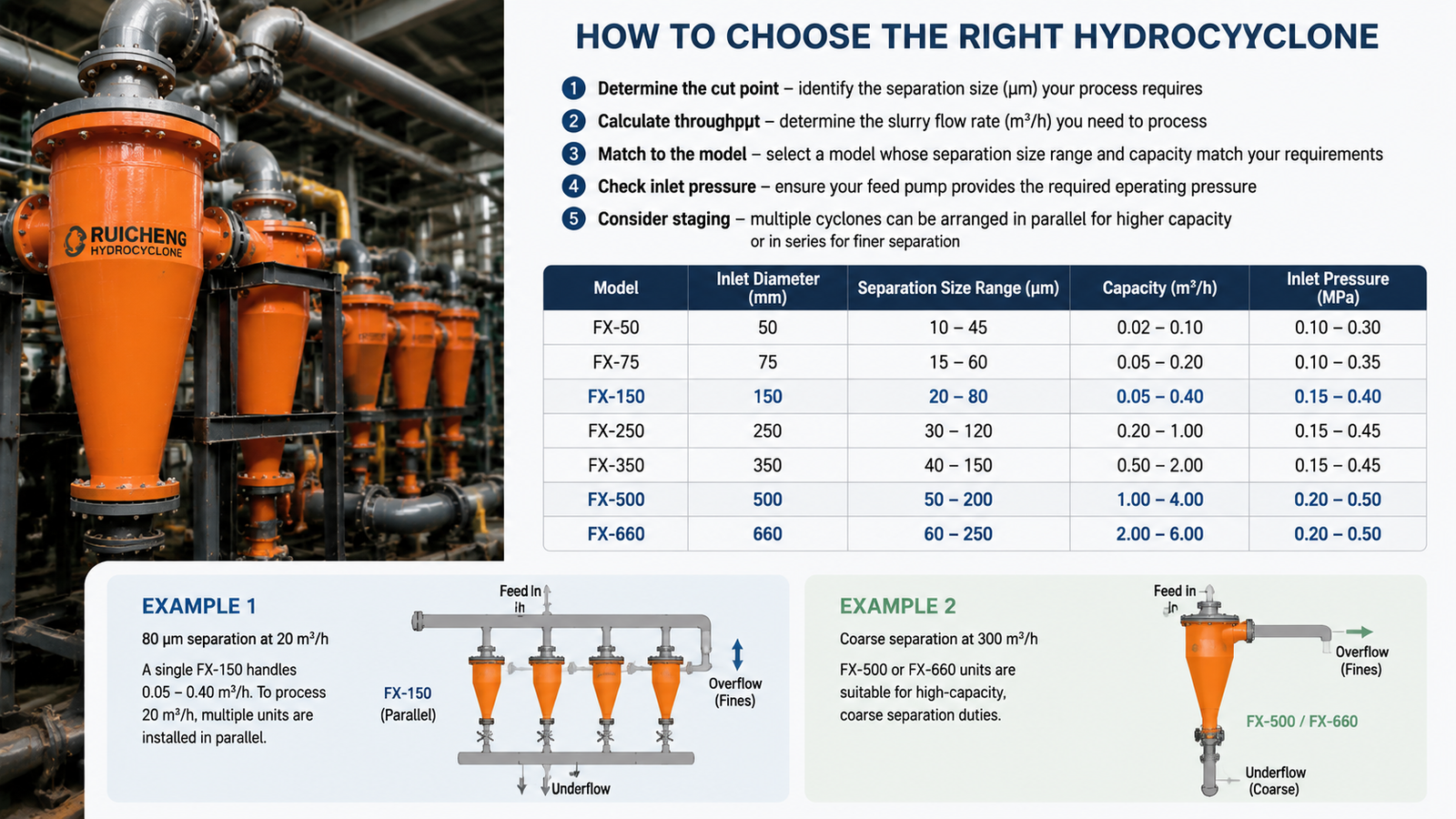
- Determine the cut point — identify the separation size (μm) your process requires
- Calculate throughput — determine the slurry flow rate (m³/h) you need to process
- Match to the model — select a model whose separation size range and capacity match your requirements
- Check inlet pressure — ensure your feed pump provides the required operating pressure
- Consider staging — multiple cyclones can be arranged in parallel for higher capacity or in series for finer separation
For example, a process requiring 80 μm separation at 20 m³/h would use multiple FX-150 units in parallel, since a single unit handles only 0.05-0.4 m³/h. A coarse separation duty at 300 m³/h would use FX-500 or FX-660 units.
Application Areas
Polyurethane hydrocyclones are used across mineral processing operations:
| Application | Typical Duty |
|---|---|
| Coal preparation | Desliming, classification |
| Iron ore | Classification, thickening |
| Sand & aggregates | Dewatering, classification |
| Tailings processing | Desliming, recovery |
| Industrial minerals | Classification, washing |
The wear-resistant properties of polyurethane make these cyclones particularly suited to abrasive slurries that would quickly erode metal units.
Maintenance Tips
- Inspect liners regularly for wear, especially at the feed inlet and underflow apex
- Rotate spare liners to extend overall service life
- Maintain consistent feed pressure for stable separation performance
- Check for blockages in the apex and vortex finder
- Replace worn apexes before they affect separation efficiency
With proper maintenance, polyurethane hydrocyclone liners typically last 12-24 months even in highly abrasive duties.
Conclusion
Selecting the right polyurethane hydrocyclone requires matching the model specifications to your process requirements for cut point, capacity, and pressure. The FX series offers a complete range of options for mineral processing applications, combining wear resistance with efficient separation performance.
With experience in hydrocyclone selection and application engineering, PlasticXperts helps mineral processing operations choose the right equipment configuration. Contact our engineering team to discuss your classification requirements and receive a tailored recommendation.