Injection molding payment terms decide whether an order runs smoothly or turns into a dispute — and injection molding payment terms are usually negotiated last, after the price is agreed and the tool is quoted, which is the worst time to negotiate anything.
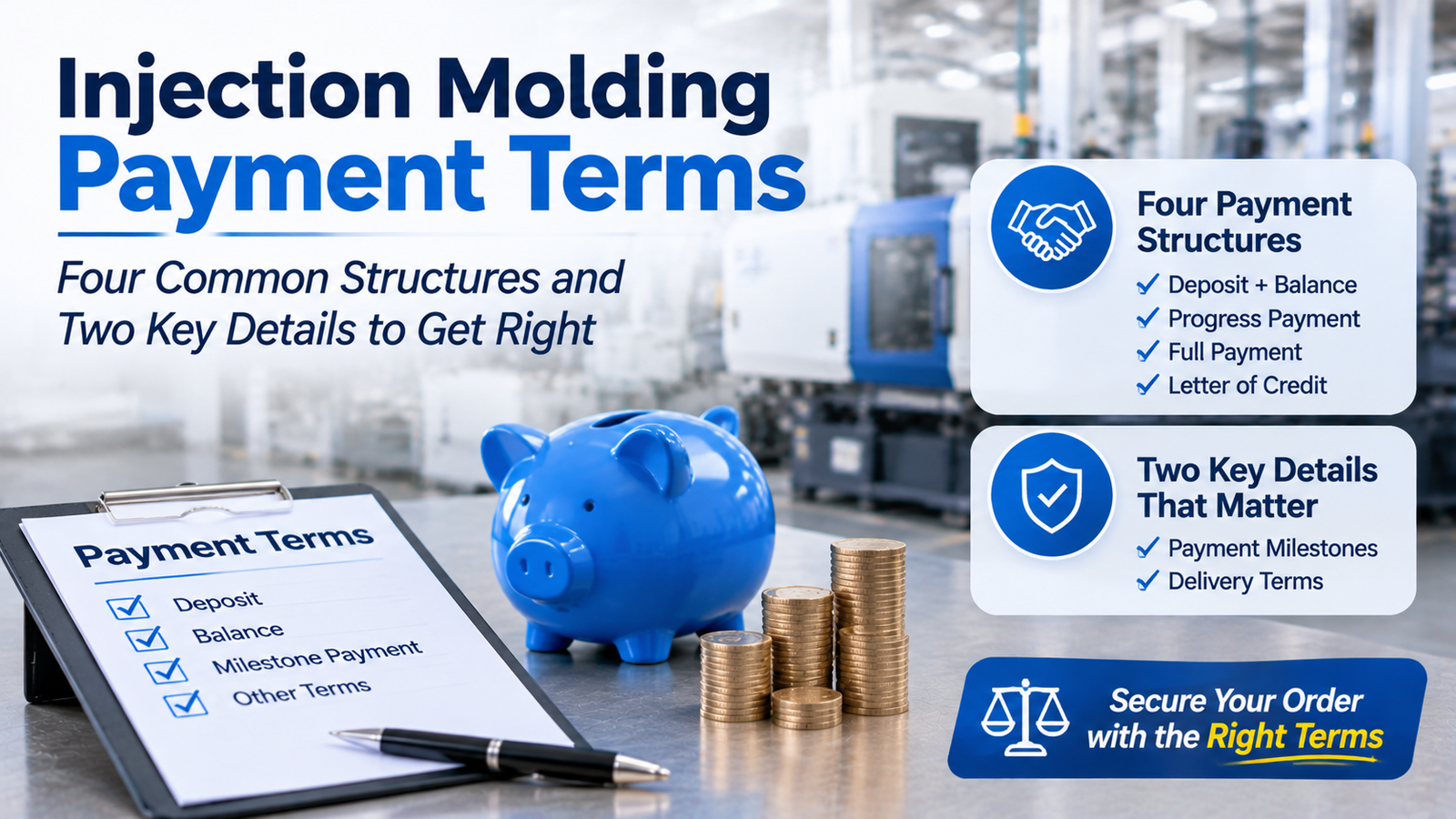
This guide covers the four payment structures used in Chinese injection molding, what each one actually protects, and the two structural details that matter more than the deposit percentage.
Injection molding payment terms: the four structures
| Structure | Cash flow | Risk to buyer | Risk to supplier | Typical use |
|---|---|---|---|---|
| 100% T/T before production | Full upfront | Very high | None | Small orders, or a red flag |
| T/T 30% deposit / 70% before shipment | Split | Moderate | Moderate | The standard structure |
| L/C at sight | Bank-mediated | Low | Low | Orders above $50,000 |
| Open account (net 30/60) | After delivery | Lowest | Highest | Established relationships only |
Only one of these is a reasonable default. The other three are either risky or expensive, and understanding why is what makes the negotiation short.
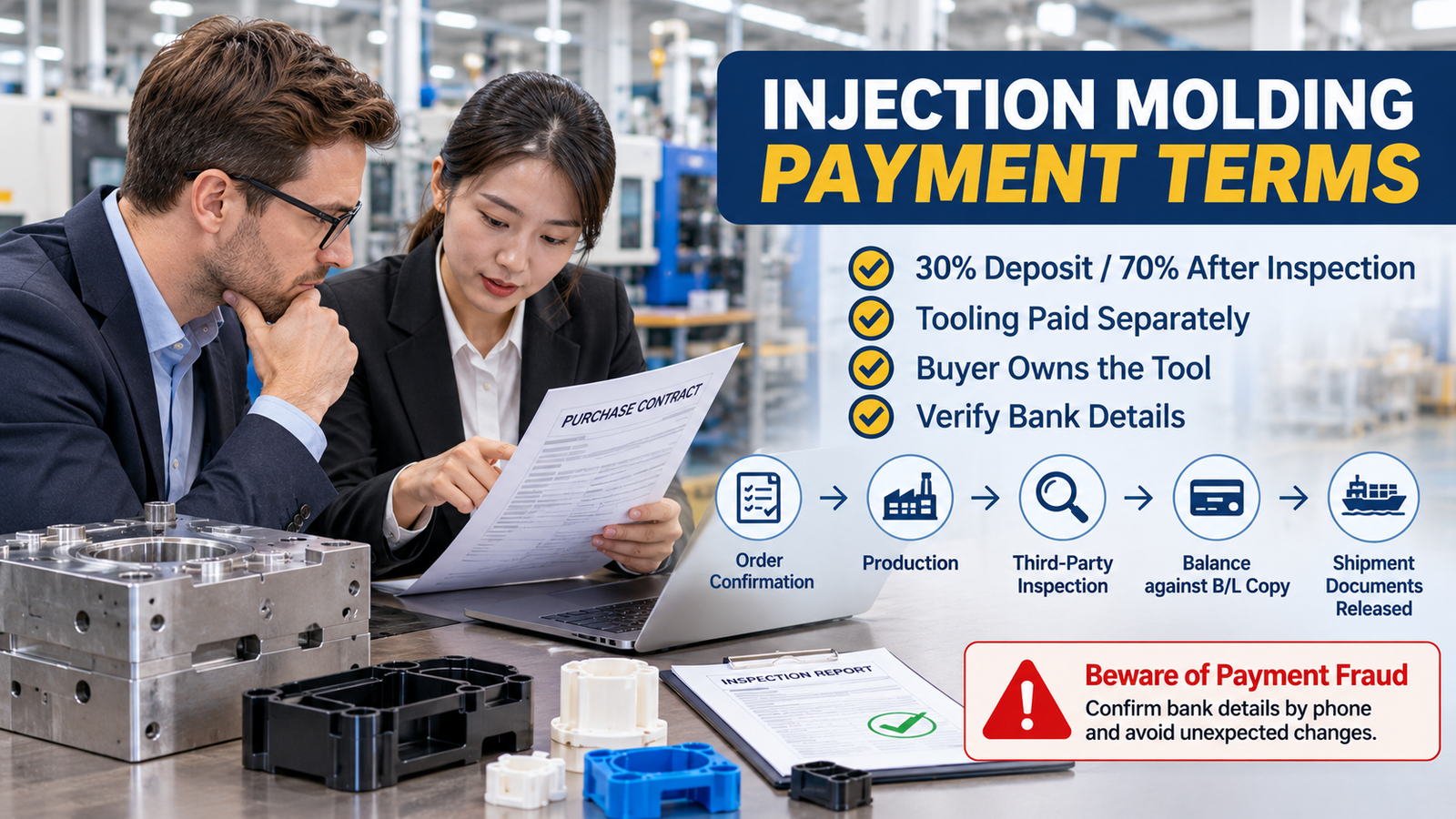
Injection molding payment terms: T/T 30/70
| Stage | Payment | Trigger |
|---|---|---|
| Deposit | 30% | Order confirmation, before material purchase |
| Balance | 70% | After inspection, before or against the bill of lading |
The 30 percent covers the supplier's material outlay and the machine time commitment. The 70 percent protects the supplier if the buyer walks away. Neither side is exposed to the full order value.
What matters more than the split is the trigger for the balance. Two variants:
| Variant | Buyer protection |
|---|---|
| 70% before shipment, no inspection | Weak — you pay before you see the goods |
| 70% after inspection, against B/L copy | Strong — you see the goods, then pay, then receive the documents |
The second is what you should be asking for, and most suppliers accept it. A supplier who insists on the full balance before any inspection is telling you something.
Injection molding payment terms: what "against B/L copy" means
| Step | Who | What happens |
|---|---|---|
| 1 | Supplier | Produces, packs, notifies for inspection |
| 2 | Buyer or third party | Inspects, approves |
| 3 | Supplier | Books the shipment, gets the bill of lading |
| 4 | Supplier | Sends a copy of the B/L |
| 5 | Buyer | Pays the 70% |
| 6 | Supplier | Releases the original B/L (or telex release) |
The bill of lading is the document of title — without the original, the goods cannot be collected at the destination port. That is why "pay against B/L copy" works: you have proof the goods exist and are loaded, and the supplier still holds the lever until payment clears.
L/C — when it is worth the cost
| Item | Detail |
|---|---|
| Cost | 0.5 – 2% of the order value, split between buyer and supplier |
| Time to open | 3 – 7 working days |
| Time to advise and confirm | 2 – 5 working days |
| Minimum sensible order | $50,000 — below that the fees exceed the risk |
| Main benefit | The bank pays only against compliant documents |
An L/C protects both sides because neither has to trust the other — the bank checks documents. But it also means:
- Documents must be exact. One wrong date, one missing certificate, and the bank rejects the presentation.
- Amendment fees apply for every change.
- Discrepancies are common on first attempts, and each one costs time and money.
For a $20,000 order, an L/C costs $200 to $400 and adds two weeks. For a $200,000 order, it is a rounding error and the right tool.
Our guide to injection molding cost covers where payment sits in the overall cost structure.
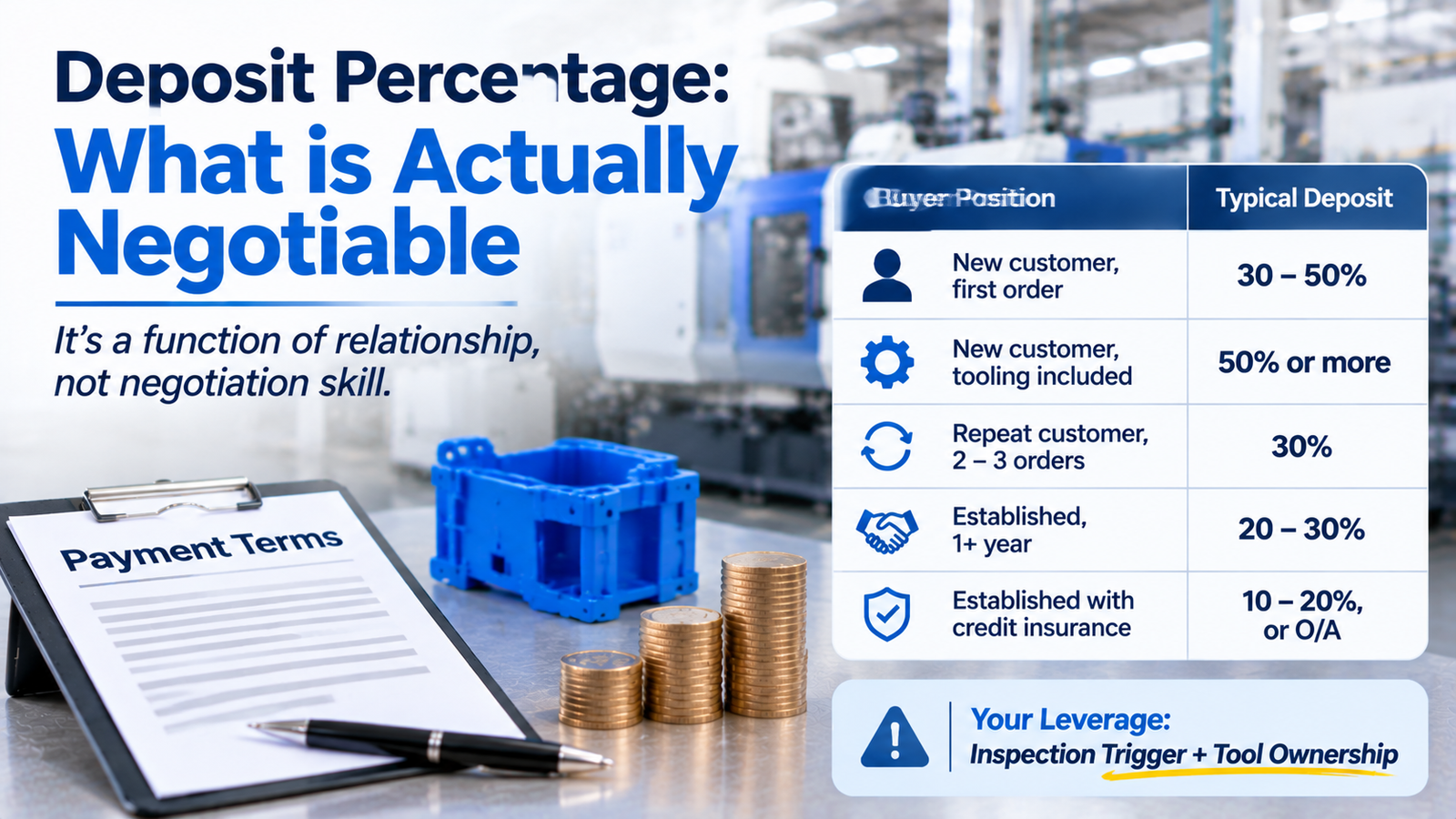
Deposit percentage: what is actually negotiable
| Buyer position | Typical deposit |
|---|---|
| New customer, first order | 30 – 50% |
| New customer, tooling included | 50% or more |
| Repeat customer, 2 – 3 orders | 30% |
| Established, 1+ year | 20 – 30% |
| Established with credit insurance | 10 – 20%, or O/A |
The deposit percentage is a function of relationship, not negotiation skill. A new supplier offering 10 percent is either desperate or not planning to fund your order properly — both are warnings.
Your leverage is not the percentage. It is the inspection trigger and the tool ownership clause — the two items that decide how injection molding payment terms actually protect you.
Tooling: pay it separately, and own it
| Structure | Common? | Buyer protection |
|---|---|---|
| Tooling 100% upfront | Common for new customers | Tool is yours, no amortisation risk |
| Tooling 50/50 (deposit / T1 approval) | Common | Balanced |
| Tooling amortised into piece price | Common | You pay more over time, and you don't own the tool |
| Tooling free, higher piece price | Common | Worst long-term option |
Two things to insist on:
- The tool is buyer property, stated in the contract. No exception. If the relationship ends, the tool leaves with you.
- Tool payment tied to T1 sample approval, not to order placement. You pay the balance when you have a sample you accept.
A supplier who will not state that the tool is buyer property is not a supplier you want to build a program with. This is a five-sentence contract clause, not a negotiation.
Inspection: the part that actually protects you
| Option | Cost | What it gives you |
|---|---|---|
| No inspection, rely on supplier QC report | Free | Nothing verifiable |
| Photos and video before shipment | Free | Basic visual confirmation |
| Third-party inspection (SGS, BV, TÜV) | $300 – 1,200 | Independent report, dimension check |
| Buyer's own QC on site | Travel cost | Full control |
For a first order, a third-party inspection at $300 to $1,200 is the cheapest insurance available. It costs less than 1 percent of a typical order and it converts "trust" into a document.
The inspection should check: quantity, dimensions against drawing, cosmetic criteria, packaging, labelling and any certification required. If the report fails, the balance is not paid and the supplier reworks.
Injection molding payment terms red flags
| Signal | Why it matters |
|---|---|
| 100% payment upfront | No working capital of their own — they cannot fund your order either |
| No inspection allowed before balance | They expect the goods to fail inspection |
| Refuses to state tool ownership | The tool is their leverage, not your asset |
| Payment to a personal account | No legal recourse, and often a fraud signal |
| Payment to a third company with no explanation | Possible invoice fraud or money laundering |
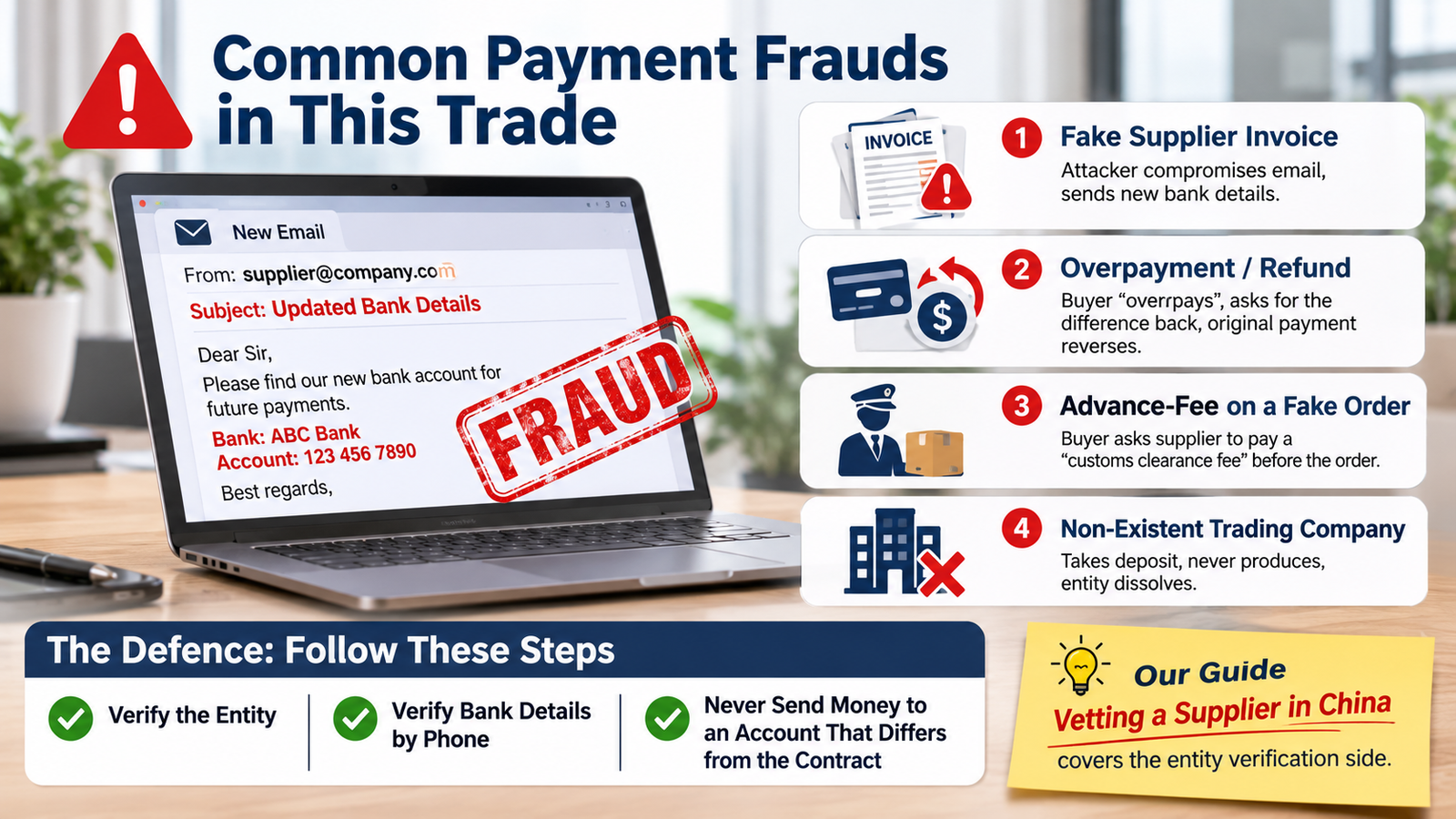
| Bank details change mid-order by email | Classic payment diversion fraud — always verify by phone |
| Asks for payment to a different country than the contract | Sanctions or fraud risk |
The bank-detail change is the most expensive one. Standard procedure: any change to bank details must be verified by phone against a known contact, never by email. Even if the email looks exactly right.
Common payment frauds in this trade
| Fraud | How it works |
|---|---|
| Fake supplier invoice | Attacker compromises email, sends new bank details |
| Overpayment / refund | Buyer "overpays", asks for the difference back, original payment reverses |
| Advance-fee on a fake order | Buyer asks supplier to pay a "customs clearance fee" before the order |
| Non-existent trading company | Takes deposit, never produces, entity dissolves |
The defence is the same for all four: verify the entity, verify the bank details by phone, and never send money to an account that differs from the contract.
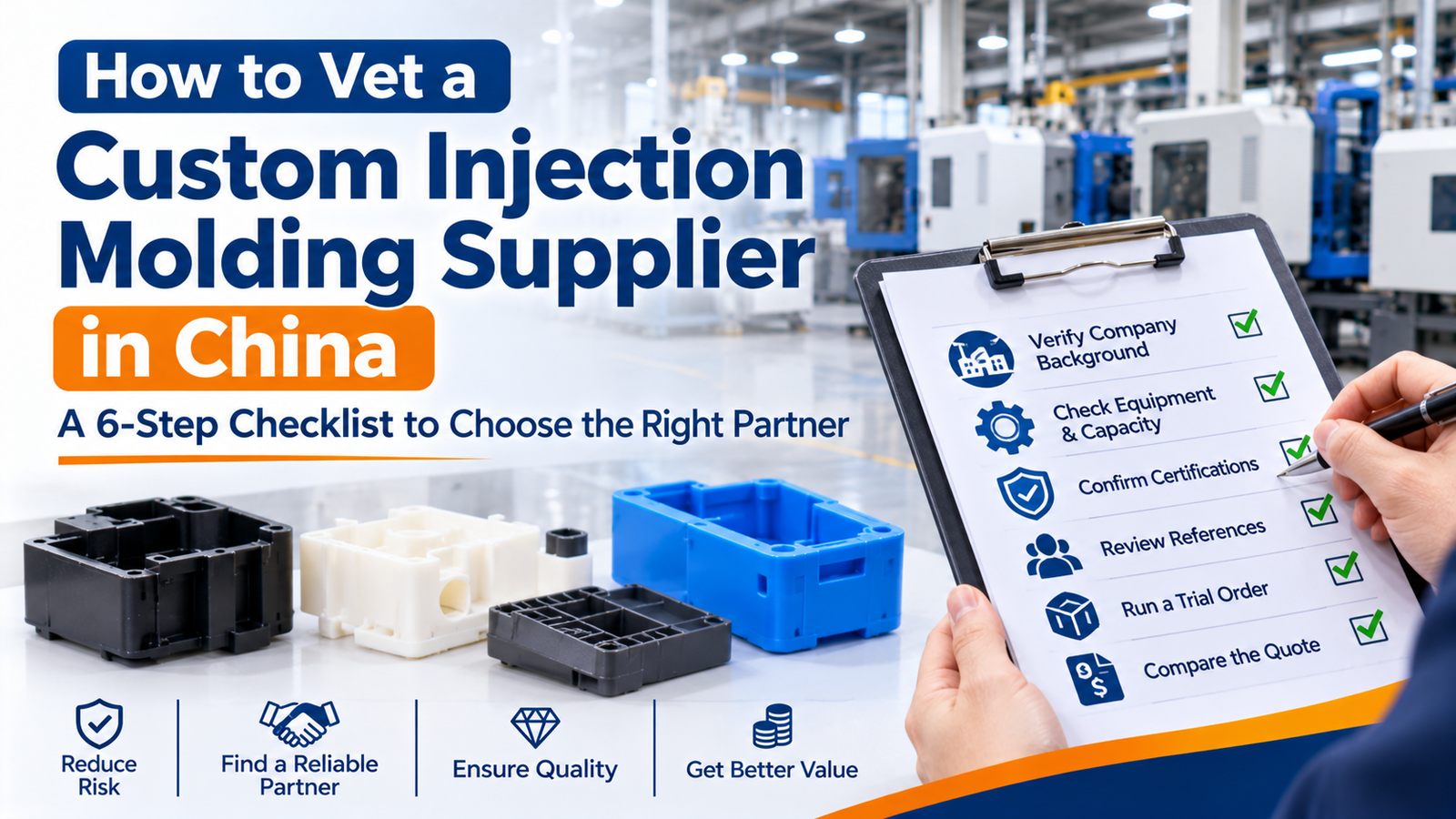
Our guide to vetting a supplier in China covers the entity verification side.
A payment structure that works
| Item | Terms |
|---|---|
| Tooling | 50% with order, 50% on T1 sample approval |
| Tool ownership | Buyer, stated in contract, transferable |
| Production deposit | 30% on order |
| Balance | 70% after third-party inspection, against B/L copy |
| Inspection | Third party, at buyer's cost, before balance |
| Currency | USD or EUR, stated in contract |
| Bank details | Verified by phone, changes only in writing plus phone confirmation |
| Late delivery | Penalty clause, 0.5% per week, capped at 5% |
That structure protects both sides and is accepted by most reputable Chinese suppliers without argument. If a supplier resists it, the resistance itself is the information — reasonable injection molding payment terms are not a concession, they are the market standard.
Related guidance
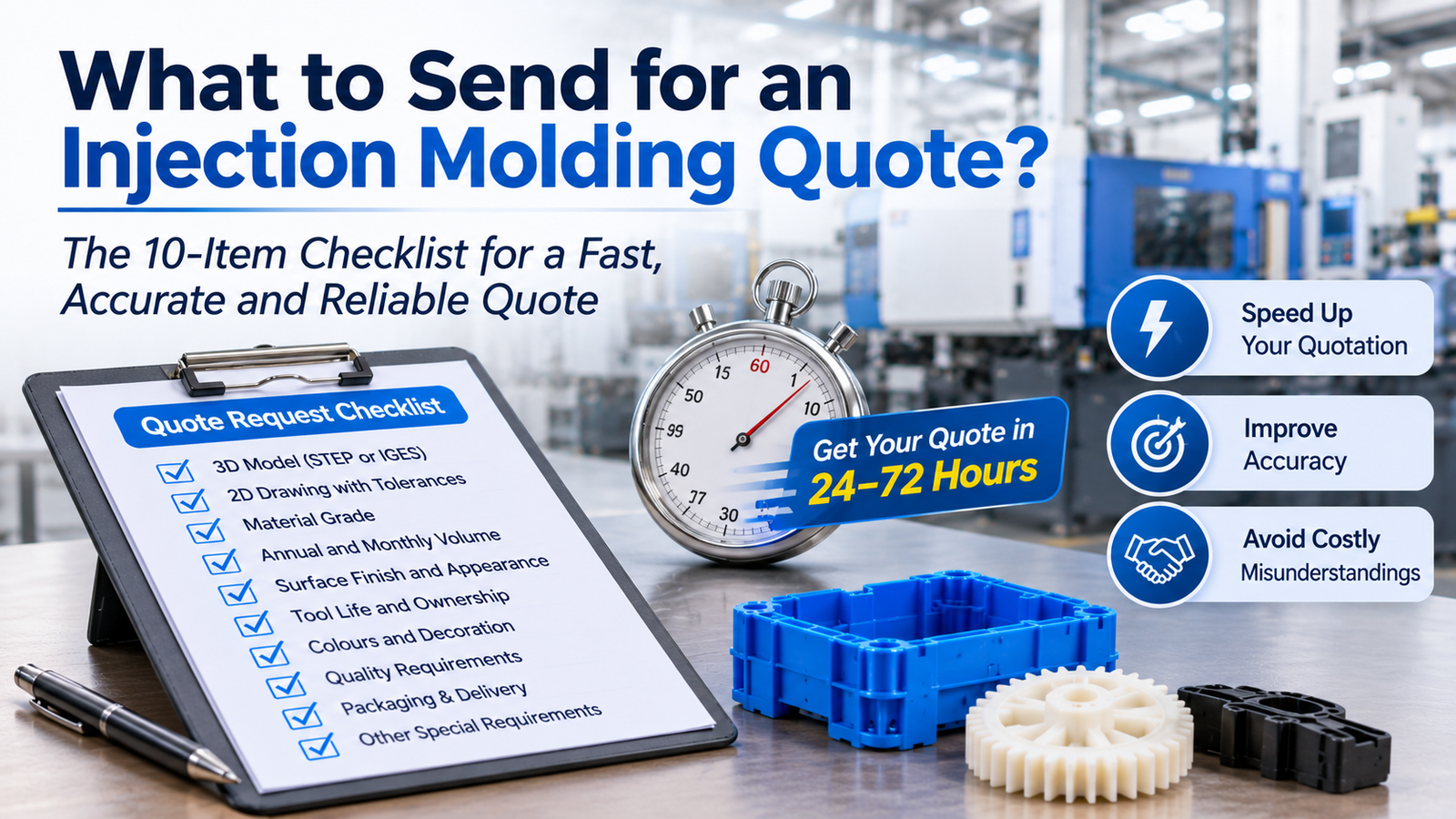
Our guides to getting an injection molding quote, injection molding MOQ, mold cost and auditing a mold supplier cover the rest of the buying process, and tolerance specification covers what the inspection should measure.
Payment practice in this guide reflects standard international trade terms, with documentary credit procedure following ISO and ICC UCP 600 practice, inspection standards from ASTM International, material data cross-checked against MatWeb and Engineering Toolbox, and processing guidance reflecting Plastics Technology and PLASTICS industry standards. For the trade-finance background, see telegraphic transfer and letter of credit.
What payment terms are standard for injection molding from China?
30% deposit with 70% after inspection, against a copy of the bill of lading. Tooling is usually paid separately — 50% with the order and 50% after the T1 sample is approved.
Is 100% payment upfront normal?
No. It is a red flag: a supplier that cannot fund material and machine time has no working capital, and cannot fund your order reliably either. Walk away or split the payment.
When is an L/C worth it?
Above roughly $50,000. Below that, the 0.5 to 2 percent fee and the two-week process cost more than the risk it removes. Above it, the bank checking documents is worth the cost.
How do I protect myself on a first order?
Pay 30/70 with the balance released only after a third-party inspection, and state in the contract that the tool is your property. The inspection costs $300 to $1,200 — less than 1 percent of a typical order.
Can the deposit be negotiated down?
It follows the relationship, not the negotiation. New customers are typically 30 to 50 percent, established customers 20 to 30. Your leverage is the inspection trigger and tool ownership clause, not the percentage.
What should I do if the supplier's bank details change by email?
Verify by phone against a contact you already had, never by replying to the email. Bank-detail change fraud is the most common and most expensive fraud in this trade.
Conclusion
Injection molding payment terms are less about the deposit percentage than about two structural details: the balance is released after inspection, and the tool is stated as buyer property. Get those two into the contract and the rest — 30/70, L/C, deposit size — becomes a normal commercial conversation rather than a risk decision.
At Rui Cheng we work on 30/70 with inspection before balance, state tool ownership in the contract as standard, and accept third-party inspection on every first order. Send the drawing and we will quote with the payment structure stated explicitly. Send us your drawing →