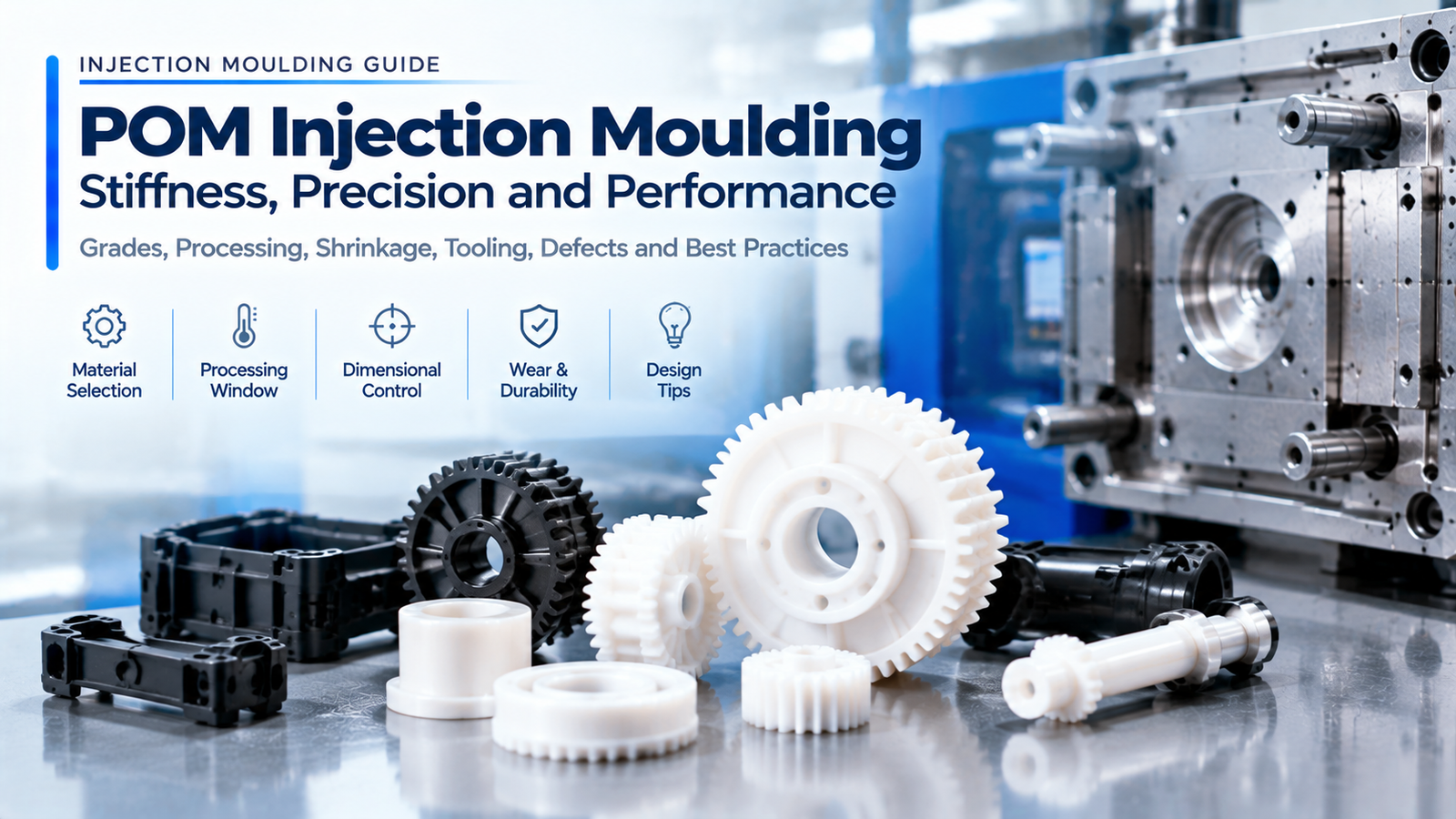
POM (acetal, also known by the trade name Delrin, has a reputation for being an easy material to run. It absorbs very little moisture, it machines beautifully, and it does not need the aggressive drying that nylon demands. That reputation is half true, and the half that is not true causes a lot of scrap.
POM does absorb moisture, and it is more sensitive to that moisture than its low absorption figure suggests. It is also a material chosen for low-friction applications, which is covered in our guide to self-lubricating Delrin. Running wet acetal does not just produce cosmetic defects — it breaks down the polymer itself. This guide covers how much moisture POM actually holds, what it does to the material, how to dry it correctly, and how to tell whether your resin is dry enough before you run it.
How Much Moisture Does POM Absorb?
POM sits in the low-absorption group, but "low" is not "none".
| Material | Water absorption, 24 h (%) | Saturation in water (%) | Drying needed? |
|---|---|---|---|
| POM (acetal) | 0.2 – 0.25 | 0.7 – 0.8 | Yes |
| ABS | 0.2 – 0.45 | 1.0 – 1.7 | Yes |
| PC | 0.15 – 0.35 | 0.3 – 0.4 | Yes, critical |
| PMMA | 0.3 – 0.4 | 1.7 – 2.0 | Yes |
| PA6 / PA66 | 1.0 – 2.8 | 8.0 – 9.0 | Yes, always |
Values are typical for unfilled grades and vary by supplier; always confirm against the grade data sheet.
The saturation figure matters more than the 24-hour figure. Pellets stored in a humid warehouse over a wet season can approach saturation at the surface even though the material absorbs slowly. POM at 0.7 percent is roughly ten times wetter than the 0.05 – 0.1 percent that good processing practice requires.
Why Moisture Matters More in POM Than Its Absorption Suggests
Two things make moisture in POM more damaging than the number implies.
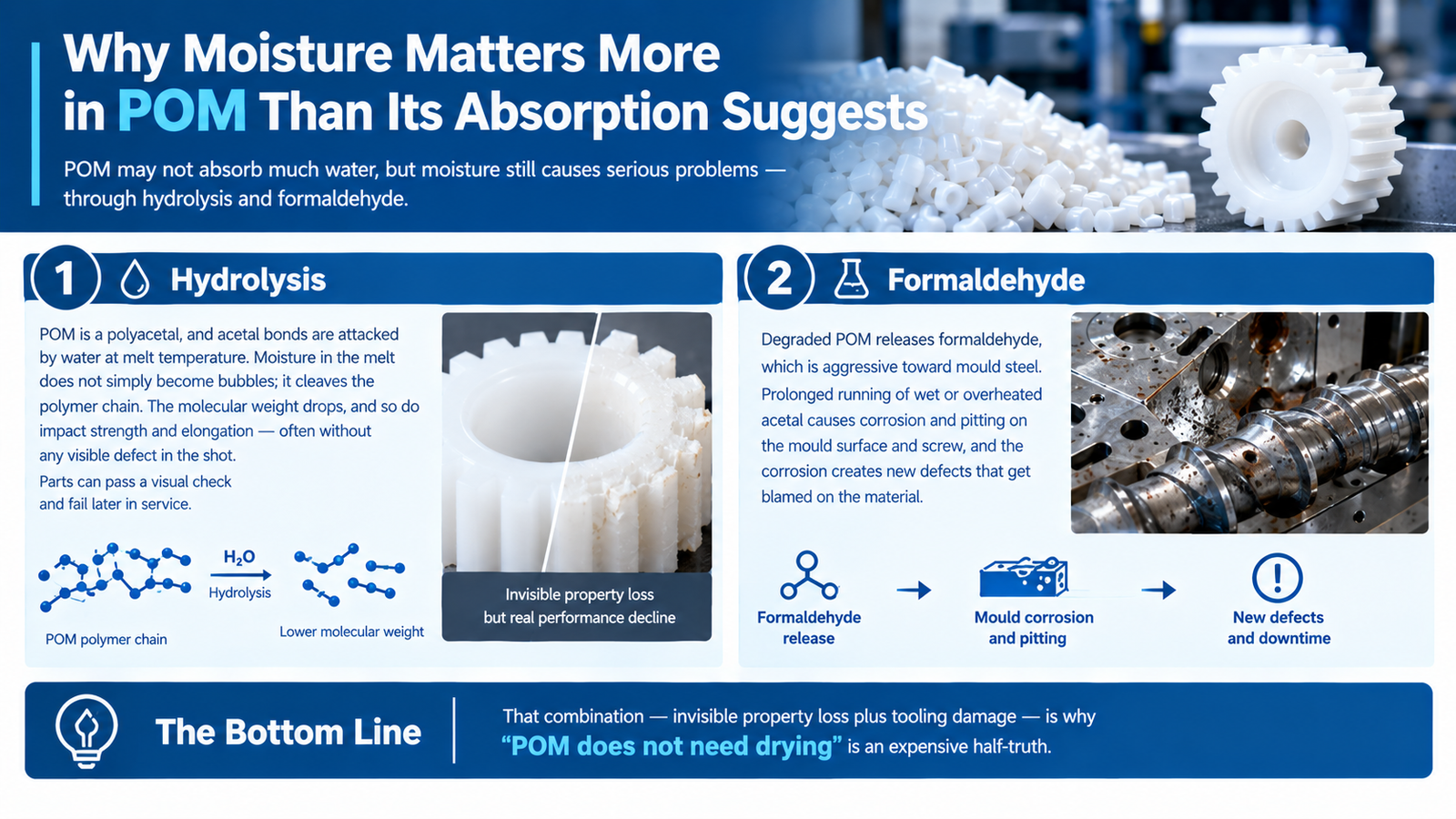
Hydrolysis. POM is a polyacetal, and acetal bonds are attacked by water at melt temperature. Moisture in the melt does not simply become bubbles; it cleaves the polymer chain. The molecular weight drops, and so do impact strength and elongation — often without any visible defect in the shot. Parts can pass a visual check and fail later in service.
Formaldehyde. Degraded POM releases formaldehyde, which is aggressive toward mould steel. Prolonged running of wet or overheated acetal causes corrosion and pitting on the mould surface and screw, and the corrosion creates new defects that get blamed on the material.
That combination — invisible property loss plus tooling damage — is why "POM does not need drying" is an expensive half-truth.
Signs Your POM Is Not Dry Enough
| Symptom | What you see |
|---|---|
| Silver streaks | Silvery lines or streaks radiating from the gate |
| Bubbles and voids | Internal voids on thick sections, bubbling at the sprue |
| Reduced impact strength | Parts crack or snap under loads the material should take |
| Rough, dull surface | Matt patches and a surface that looks under-filled |
| Mould corrosion | Rust, pitting or bloom on cavity surfaces |
| Smell | Sharp, pungent odour near the nozzle — a sign of degradation |
| Inconsistent weight | Shot weight varies between cycles |
The dangerous cases are the invisible ones: no streaks, no bubbles, but lower molecular weight and weaker parts. If acetal parts are brittle in use and the process looks clean, residual moisture is a prime suspect.
Correct Drying Parameters for POM
| Parameter | Recommendation |
|---|---|
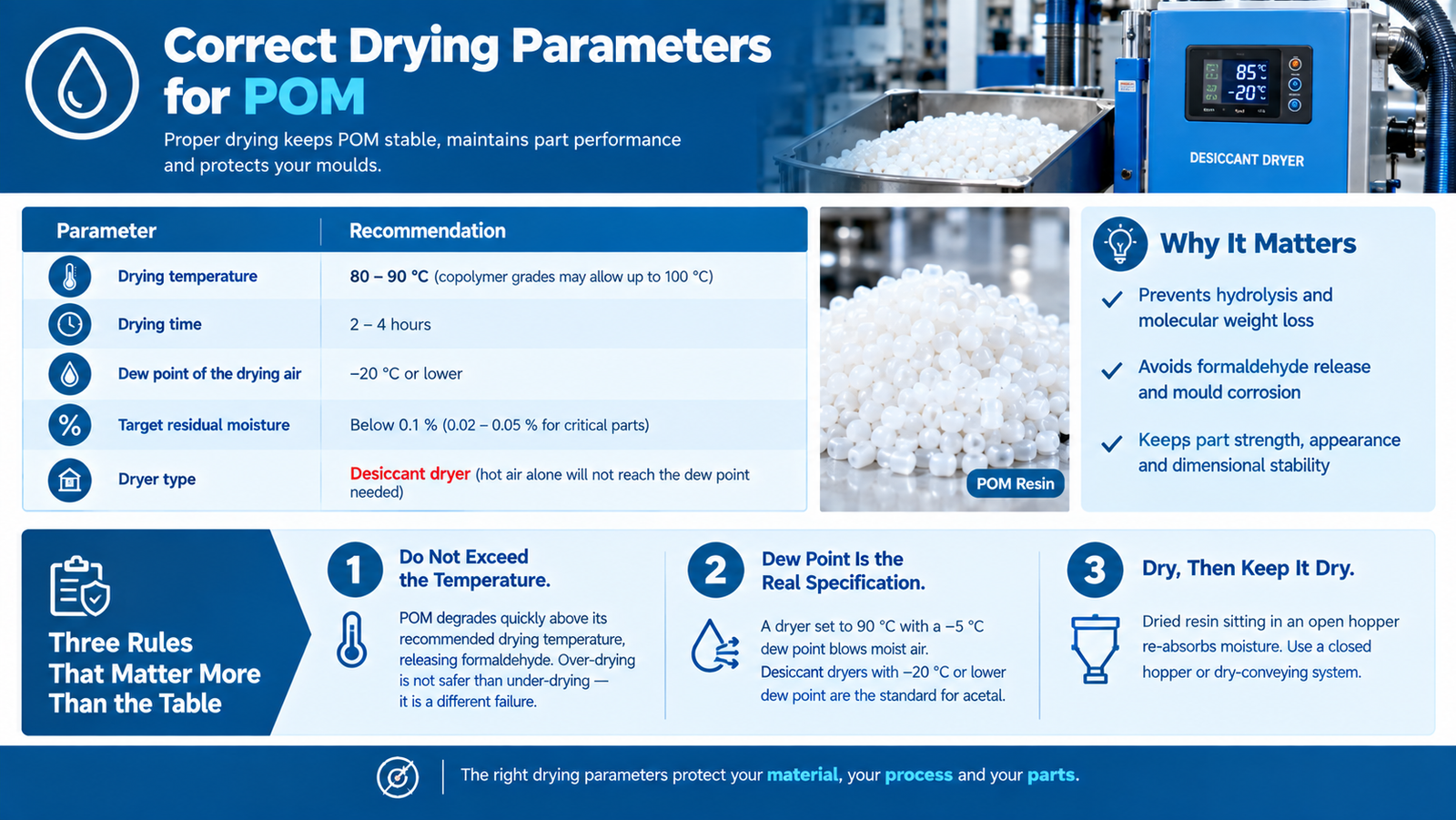
| Drying temperature | 80 – 90 °C (copolymer grades may allow up to 100 °C) |
| Drying time | 2 – 4 hours |
| Dew point of the drying air | −20 °C or lower |
| Target residual moisture | Below 0.1 % (0.02 – 0.05 % for critical parts) |
| Dryer type | Desiccant dryer (hot air alone will not reach the dew point needed) |
Three rules that matter more than the table:
- Do not exceed the temperature. POM degrades quickly above its recommended drying temperature, releasing formaldehyde. Over-drying is not safer than under-drying — it is a different failure.
- Dew point is the real specification. A dryer set to 90 °C with a −5 °C dew point blows moist air. Desiccant dryers with −20 °C or lower dew point are the standard for acetal.
- Dry, then keep it dry. Dried resin sitting in an open hopper re-absorbs moisture. Use a closed hopper or dry-conveying system.
Drying Parameters for Common Plastics
| Material | Drying temp (°C) | Drying time (h) | Dew point (°C) | Target residual moisture (%) |
|---|---|---|---|---|
| POM | 80 – 90 | 2 – 4 | ≤ −20 | < 0.1 |
| ABS | 80 – 90 | 2 – 4 | ≤ −20 | < 0.1 |
| PC | 120 | 3 – 4 | ≤ −20 | < 0.02 |
| PMMA | 70 – 80 | 2 – 4 | ≤ −20 | < 0.1 |
| PA6 / PA66 | 80 – 100 | 4 – 6 | ≤ −20 | < 0.1 – 0.2 |
| PBT | 120 | 2 – 4 | ≤ −20 | < 0.04 |
| TPU | 80 – 100 | 2 – 4 | ≤ −20 | < 0.05 |
PC and PBT need the highest temperatures and the tightest moisture targets; POM and ABS sit in the middle; nylon needs the longest time because it holds far more water.
How to Verify Dryness (Not Guess)
| Method | What it tells you | Practical use |
|---|---|---|
| Moisture analyser (loss on drying) | Residual moisture in the pellets | The reference method — check incoming lots |
| Dew point meter | Whether the dryer is actually delivering dry air | Daily check; most dryer faults show here |
| Weight-loss test | Moisture by mass before and after drying | Low-cost in-house check |
| Trial shot inspection | Silver streaks, voids, brittleness | Confirmation, not measurement |
| Shot weight stability | Consistency of the melt | Indirect but fast |
The single most useful daily habit is a dew point reading at the dryer outlet. Dryer desiccant saturates and heaters drift; the resin does not announce that the air turned wet.
Storage and Re-Moisture Pickup
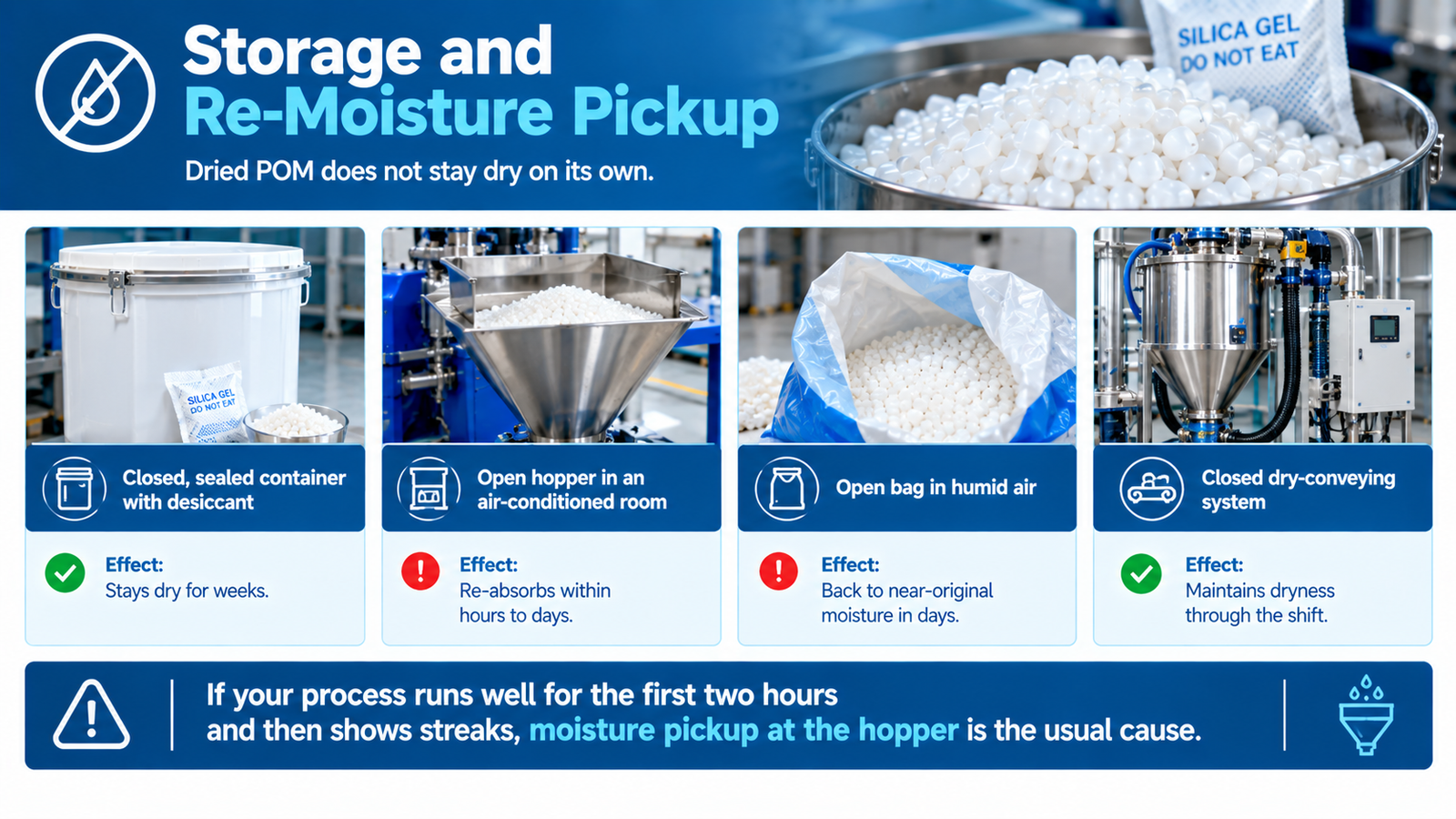
Dried POM does not stay dry on its own.
| Storage condition | Effect |
|---|---|
| Closed, sealed container with desiccant | Stays dry for weeks |
| Open hopper in an air-conditioned room | Re-absorbs within hours to days |
| Open bag in humid air | Back to near-original moisture in days |
| Closed dry-conveying system | Maintains dryness through the shift |
If your process runs well for the first two hours and then shows streaks, moisture pickup at the hopper is the usual cause.
Regrind and POM
Regrind complicates drying in three ways:
- More surface area — regrind picks up moisture faster than pellets
- Dust and fines — hold moisture and can char in the barrel
- Repeated heat history — already partly degraded polymer has less margin for further hydrolysis
Practical rules for regrind: keep it clean and dry, limit the regrind ratio (typically 20 – 30 % for unfilled POM), screen out fines, and dry regrind with the same parameters as virgin material. Never assume regrind is dry because it was in a sealed bag.
Common Mistakes
| Mistake | Consequence |
|---|---|
| Skipping drying because "POM is not hygroscopic" | Silent molecular weight loss, brittle parts |
| Drying above 100 °C | Formaldehyde release, material degradation, mould corrosion |
| Using hot air instead of desiccant drying | Air never reaches the dew point required |
| No dew point monitoring | A saturated dryer runs wet all shift without warning |
| Drying overnight at high temperature | Over-drying and degradation, not better dryness |
| Leaving dried resin in an open hopper | Re-absorption before the resin reaches the screw |
| Blaming the mould for streaks | Moisture is the cause far more often than tooling |
Conclusion
POM absorbs less moisture than nylon, but it is not moisture-tolerant — it is moisture-sensitive in a different way. Water in the acetal melt hydrolyses the polymer, lowering molecular weight and mechanical performance without necessarily leaving a visible trace, and the formaldehyde released attacks the mould itself.
For how POM behaves mechanically once it is dry, see the shock absorption performance of Delrin. Drying POM is straightforward once the specification is clear: 80 – 90 °C, 2 – 4 hours, desiccant air at −20 °C dew point or lower, and a residual moisture target below 0.1 percent, with closed storage afterwards. Verify with a dew point meter and a moisture analyser rather than by eye.
If parts are brittle, streaking, or inconsistent and the process looks correct, dry the resin properly and run the comparison — it is the cheapest test available, and in acetal it is usually the answer.
With in-house drying control, dew point monitoring and material qualification, we verify resin condition before every run. Send us your drawing and material grade to discuss drying and processing parameters for your part.
FAQ
Does POM need to be dried before moulding?
Yes. POM absorbs 0.2 – 0.25 % moisture in 24 hours and up to 0.8 % at saturation, well above the 0.1 % maximum recommended for processing. Drying for 2 – 4 hours at 80 – 90 °C with desiccant air is standard practice.
What happens if you mould wet POM?
Moisture hydrolyses the acetal polymer at melt temperature, reducing molecular weight and impact strength, and producing silver streaks, voids and brittleness. Degraded POM also releases formaldehyde, which corrodes mould steel and causes pitting.
What is the correct drying temperature for acetal?
80 – 90 °C for homopolymer and copolymer grades, with some copolymer grades allowing up to 100 °C. Do not exceed the resin supplier's limit: overheating releases formaldehyde and degrades the material faster than drying helps it.
Do I need a desiccant dryer for POM?
Yes, for consistent results. Hot air dryers typically cannot hold a −20 °C dew point, so they blow moist air and dry the surface only. Desiccant dryers with a −20 °C dew point or lower are the practical standard for acetal.
How do I know if POM is dry enough?
Use a dew point meter on the dryer outlet daily, and a moisture analyser to check residual moisture against the 0.1 % limit. In production, stable shot weight and the absence of silver streaks or voids are confirmation, but not measurement.
Can wet POM damage the mould?
Yes. Degraded acetal releases formaldehyde, which is corrosive to mould steel. Over time this causes pitting and rust on cavity surfaces and the screw, creating surface defects that are then wrongly blamed on the tooling rather than the material.
Drying is only one part of running acetal well — our guide to POM injection moulding covers grades, the processing window, shrinkage and defect control.