Mold cost is the single biggest question in any injection molding project, and it is also the least transparent. Quotes vary by a factor of five for what looks like the same part, and buyers rarely know why. This guide breaks down what an injection mold actually costs in 2026, what drives the price up or down, and how to evaluate a mold quotation properly.
The Short Answer: Typical Mold Costs in 2026
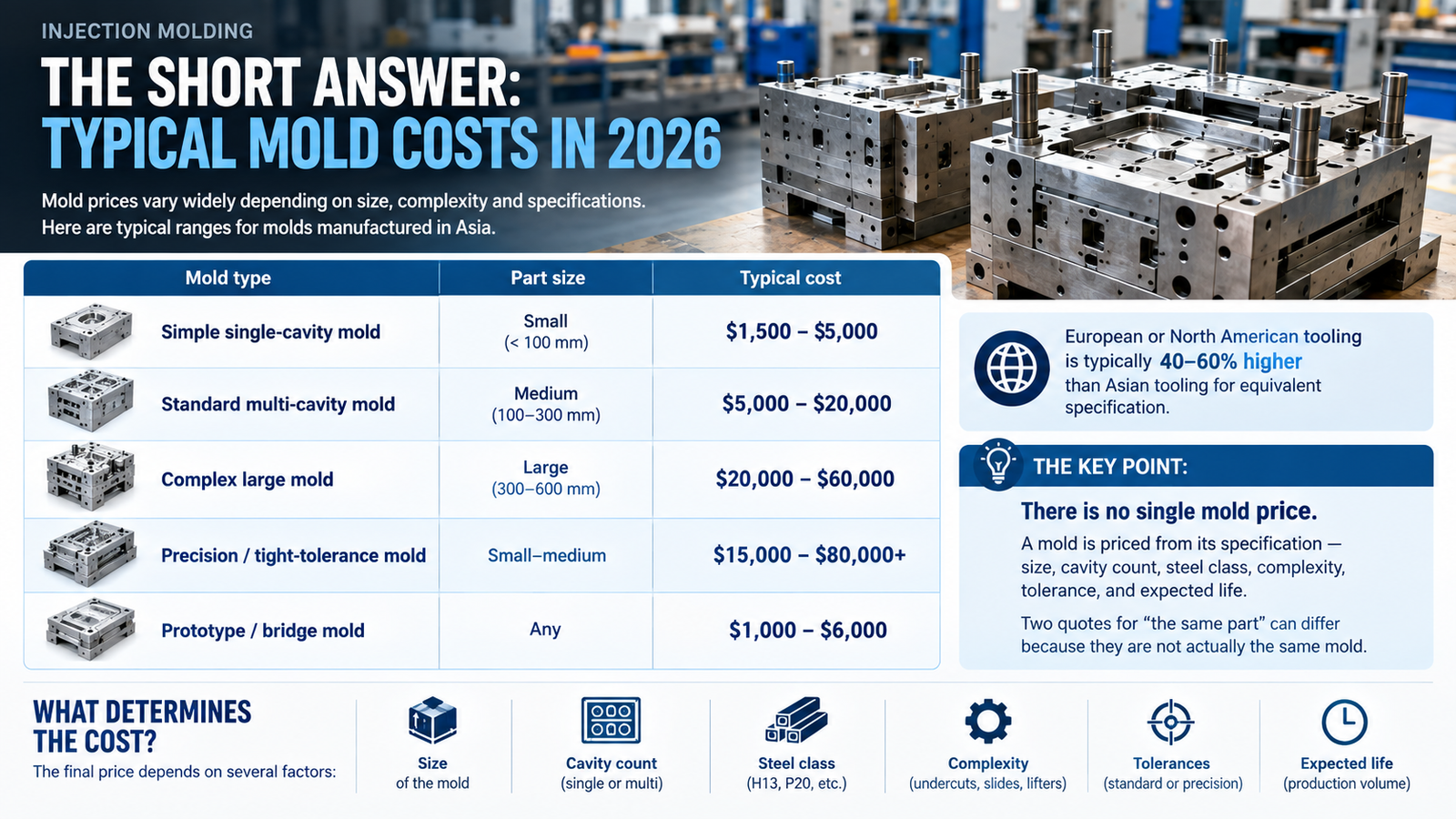
| Mold type | Part size | Typical cost |
|---|---|---|
| Simple single-cavity mold | Small (< 100 mm) | $1,500 – $5,000 |
| Standard multi-cavity mold | Medium (100–300 mm) | $5,000 – $20,000 |
| Complex large mold | Large (300–600 mm) | $20,000 – $60,000 |
| Precision / tight-tolerance mold | Small–medium | $15,000 – $80,000+ |
| Prototype / bridge mold | Any | $1,000 – $6,000 |
These are typical ranges for molds manufactured in Asia. European or North American tooling typically runs 40–60% higher for equivalent specification.
The key point: there is no single mold price. A mold is priced from its specification — size, cavity count, steel class, complexity, tolerance, and expected life. Two quotes for "the same part" can differ because they are not actually the same mold.
What Actually Drives Mold Cost
Six factors determine almost the entire price:
| Factor | Impact on cost |
|---|---|
| Part size | Larger = more steel, bigger machine, higher cost |
| Cavity count | More cavities = more machining, but lower cost per part |
| Complexity (slides, lifters, threads) | Each mechanism adds design and machining hours |
| Steel grade and mold life | Higher life class = better steel + heat treatment |
| Tolerance requirement | Precision work needs slower machining, more inspection |
| Surface finish / texture | Mirror polish and texturing add manual hours |
A part with an undercut that needs a slide can cost 30–50% more than the same part designed without one. This is why a DFM review before quoting saves real money: moving a snap-fit or repositioning a boss can remove an entire mechanism from the mold.
Cost Breakdown: Where the Money Goes
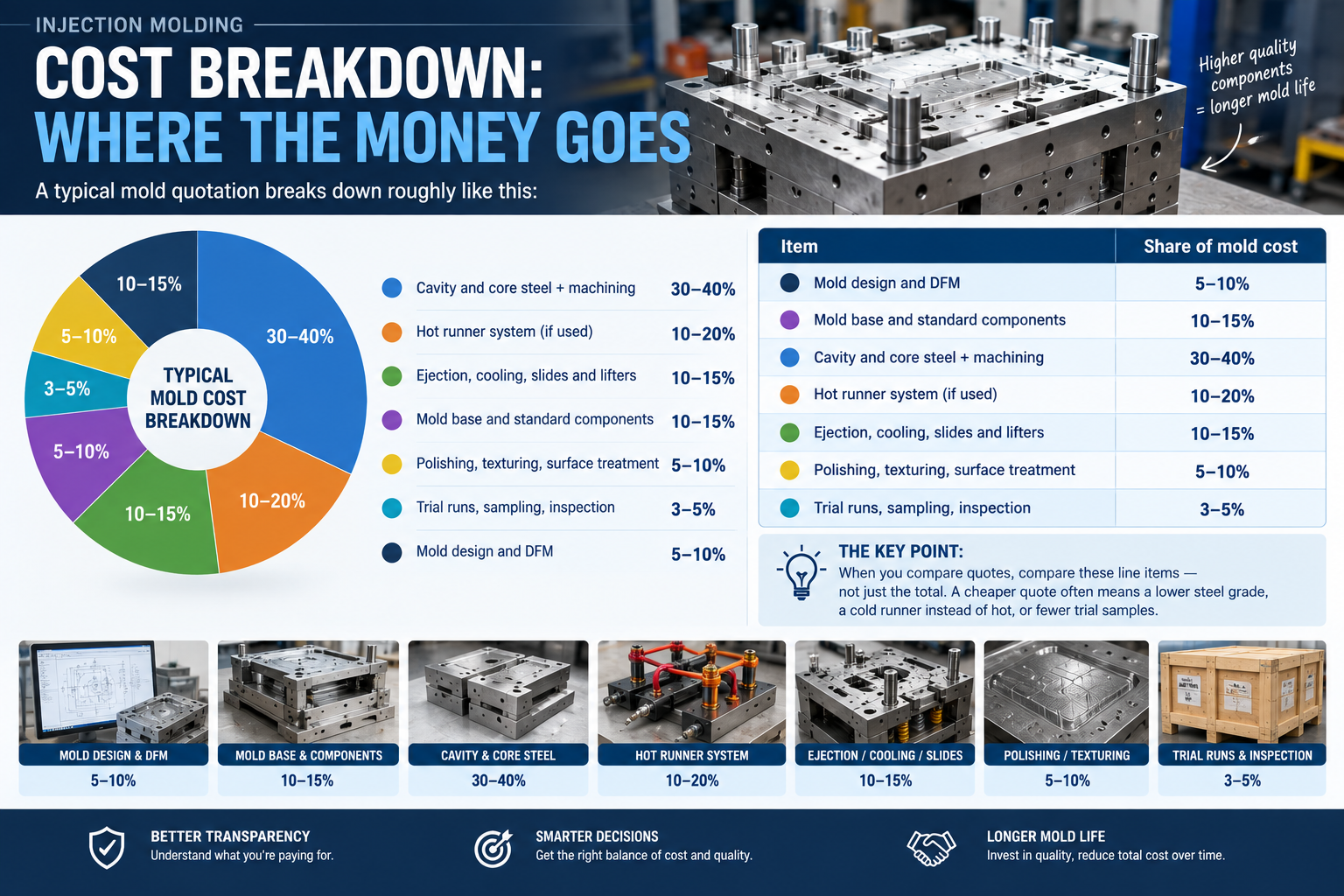
A typical mold quotation breaks down roughly like this:
| Item | Share of mold cost |
|---|---|
| Mold design and DFM | 5–10% |
| Mold base and standard components | 10–15% |
| Cavity and core steel + machining | 30–40% |
| Hot runner system (if used) | 10–20% |
| Ejection, cooling, slides and lifters | 10–15% |
| Polishing, texturing, surface treatment | 5–10% |
| Trial runs, sampling, inspection | 3–5% |
When you compare quotes, compare these line items — not just the total. A cheaper quote often means a lower steel grade, a cold runner instead of hot, or fewer trial samples.
Mold Steel Grades and Mold Life
Steel choice is where buyers most often overpay or underpay. The grade determines how many shots the mold can produce before it wears out.
| Steel grade | Typical life | Best for |
|---|---|---|
| P20 / 1.2311 (pre-hardened) | 100,000 – 300,000 shots | General parts, moderate volume |
| 718H / NAK80 | 300,000 – 500,000 shots | Good polish, cosmetic parts |
| S136 / 420 stainless | 500,000 – 1,000,000 shots | Corrosive materials, medical, optical |
| H13 (heat treated) | 1,000,000+ shots | Glass-filled, high-wear applications |
Mold life is also classified by SPI standards, from Class 101 (1,000,000+ cycles) down to Class 105 (prototype, 500+ cycles). Specify the life you actually need. Buying a million-shot mold for a 20,000-piece program wastes money; buying a 100,000-shot mold for a five-year production run costs more in the end through repairs and replacement.
How Cavity Count Affects Cost (and Cost per Part)
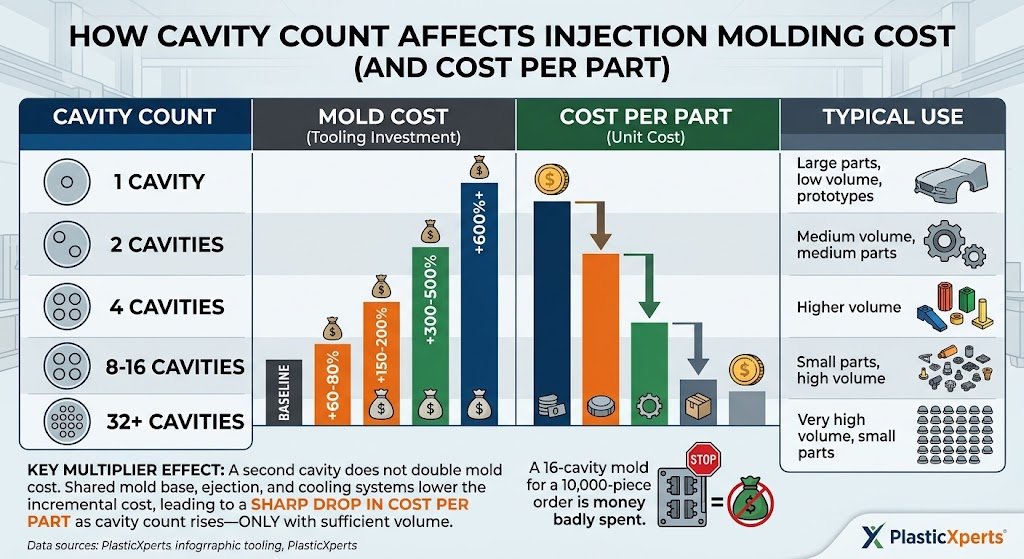
Cavity count is a trade-off between tooling investment and unit cost.
| Cavity count | Mold cost | Typical use |
|---|---|---|
| 1 cavity | Baseline | Large parts, low volume, prototypes |
| 2 cavities | +60–80% | Medium volume, medium parts |
| 4 cavities | +150–200% | Higher volume |
| 8–16 cavities | +300–500% | Small parts, high volume |
| 32+ cavities | +600%+ | Very high volume, small parts |
Note the multiplier: a second cavity does not double the mold cost, because the mold base, ejection, and cooling systems are shared. That is why cost per part drops sharply as cavity count rises — but only if you have the volume to keep the mold running. A 16-cavity mold for a 10,000-piece order is money badly spent.
Amortised Cost: The Number That Actually Matters
Mold cost is a one-time investment spread across the parts it will produce:
Cost per part (tooling) = Mold cost ÷ Total parts produced| Mold cost | 10,000 parts | 50,000 parts | 200,000 parts |
|---|---|---|---|
| $5,000 | $0.50 | $0.10 | $0.03 |
| $15,000 | $1.50 | $0.30 | $0.08 |
| $40,000 | $4.00 | $0.80 | $0.20 |
A $40,000 mold can be the cheaper choice if it runs 200,000 parts reliably. A $5,000 mold is the right choice for a 10,000-piece bridge order. Always evaluate mold cost against your total program volume, not in isolation.
Hot Runner vs Cold Runner: Is It Worth It?
| Cold runner | Hot runner | |
|---|---|---|
| Mold cost | Lower | +$3,000 – $15,000 |
| Material waste | Higher (runners scrapped) | Minimal |
| Cycle time | Slower | Faster |
| Part quality | Good | Better consistency |
| Best for | Low–medium volume | High volume, expensive resin, multi-cavity |
Hot runner systems pay back quickly when you are running expensive engineering resin or very high volumes, because eliminating runner scrap saves material on every shot. For low-volume programs, cold runner is usually the better investment.
China vs Europe vs North America
| Region | Relative mold cost | Typical lead time |
|---|---|---|
| China | Baseline (lowest) | 4–8 weeks |
| Europe | +40–60% | 6–12 weeks |
| North America | +50–100% | 6–12 weeks |
Chinese tooling is cheaper primarily because of labour cost in design, machining, and hand finishing — not because the steel is different. The steel grades and standard components available are the same international brands. What varies is the engineering discipline applied during design review, machining, and sampling. Evaluating a supplier's tooling process matters more than the country of origin.
What Should Be Included in a Mold Quote
A professional mold quotation should state (and the dimensional acceptance criteria should reference ASTM or ISO test methods):
- Part size, weight, material, and estimated cycle time
- Cavity count and mold layout
- Steel grades for cavity, core, and base
- Mold life class (SPI class or shot count)
- Runner type (hot or cold), gate type
- Slider/lifter mechanisms required
- Surface finish standard (SPI finish or texture specification)
- Runner system and ejection design
- Number and type of trial samples provided
- Lead time and payment terms
- What is excluded (part design changes, additional sampling, freight)
If a quote does not list these, it is not a quote — it is a number.
Payment Terms and Lead Time Reality
Typical terms for custom tooling: 40–50% deposit with the order, balance before shipment, with dimensional reports verified against traceable measurement standards. Lead time for a standard single-cavity mold is 4–6 weeks; complex multi-cavity or precision tooling runs 6–10 weeks. Add time for DFM review, sample approval, and any design revisions. The ISO 9001 process discipline in a tool shop shows up here: a shop that reports DFM findings before cutting steel finishes faster than one that discovers problems at first trial.
How to Reduce Mold Cost Without Regretting It
- Run a DFM review first — removing slides, simplifying geometry, and standardising wall thickness are free savings (SPE design guidance)
- Match the mold life class to your real volume — do not buy capability you will not use
- Use a cold runner unless volume justifies hot — save the system cost on lower-volume programs
- Standardise the mold base — custom bases cost more for identical function
- Allow sensible tolerances — every unnecessary precision band adds inspection and machining time
- Plan the family — if you have several similar parts, a family mold can share tooling cost
Conclusion
Mold cost in 2026 ranges from around $1,500 for a simple single-cavity tool to $80,000 or more for large precision tooling, and the price is set by specification: size, cavities, steel class, complexity, tolerance, and expected life. The right approach is to define the mold life and volume you need, get a DFM review before quoting, and compare quotations line by line rather than by total.
With in-house mold design and manufacturing, plus experience across tooling for automotive, medical, and industrial parts, we help customers specify molds that fit their volume and budget. Send us your 3D file and annual volume for a DFM review and a transparent mold quotation.
FAQ
How much does a typical injection mold cost?
A simple single-cavity mold for a small part typically costs $1,500–$5,000. Standard multi-cavity molds for medium parts run $5,000–$20,000, while large or precision molds can exceed $60,000. The price depends on size, cavity count, steel grade, complexity, and required mold life.
Why is one mold quote so much cheaper than another?
Cheaper quotes usually differ in specification: lower steel grade, lower mold life class, cold runner instead of hot, fewer cavities, less rigorous DFM work, or fewer trial samples. Compare the specification line by line, not just the total price.
How many cavities should my mold have?
It depends on annual volume and part size. Use one cavity for large parts or low volume, two to four cavities for medium volume, and eight or more for small, high-volume parts. Cavity count only pays off if you have the order volume to keep the mold running.
How long does it take to make an injection mold?
Standard single-cavity molds take 4–6 weeks. Complex multi-cavity or precision molds typically take 6–10 weeks. Add time for DFM review, sample approval, and design changes.
What is the difference between hot runner and cold runner molds?
A cold runner mold leaves a solidified runner that is ejected and scrapped with each cycle, and costs less to build. A hot runner keeps plastic molten in the manifold, eliminating runner waste and speeding the cycle, but adds $3,000–$15,000 to the mold cost.
Do I own the mold after it is made?
Yes, in most custom tooling arrangements the customer owns the mold. Confirm this in writing, along with the mold's maintenance history, when the mold will be transferred if you change suppliers, and who provides spare parts. Ownership without possession and documentation is not real security.