Shipping from China is the last step in the process and the one with the least tolerance for error — a tool that arrives damaged, a container held at customs, or a DDP quote that was never DDP costs more than the freight ever saved.
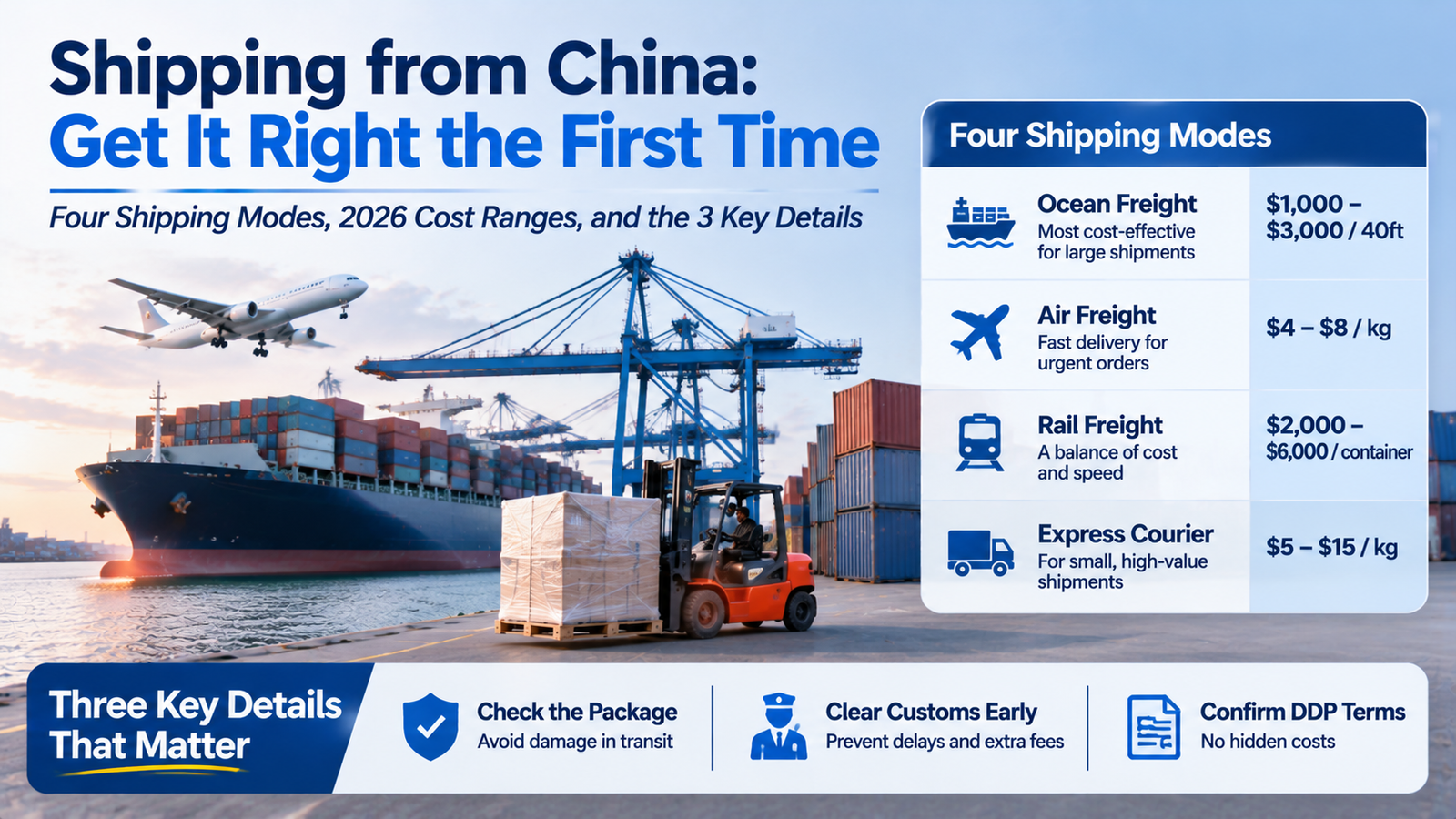
This guide covers the four shipping modes, real 2026 cost ranges, how molds and production parts differ, and the three details that decide whether the shipment arrives clean.
Shipping from China: the four modes
| Mode | Best for | Transit | Cost basis |
|---|---|---|---|
| Sea FCL (full container) | 15+ CBM, steady volumes | 25 – 35 days | Per container |
| Sea LCL (shared container) | 1 – 15 CBM | 30 – 45 days | Per CBM |
| Air freight | 100 kg – 2 CBM, urgent | 5 – 8 days | Per kg (chargeable weight) |
| Express (DHL / FedEx / UPS) | Under 100 kg, samples | 3 – 6 days | Per kg, door to door |
A single injection mold typically weighs 200 to 2,000 kg and occupies 1 to 4 CBM. That puts most molds in LCL territory, not a container.
Shipping from China: 2026 cost ranges
| Route | Mode | Typical cost |
|---|---|---|
| China → US West Coast | FCL 40HQ | $2,200 – 3,800 |
| China → US West Coast | FCL 20GP | $1,400 – 2,400 |
| China → US East Coast | FCL 40HQ | $3,500 – 5,500 |
| China → Europe (Rotterdam) | FCL 40HQ | $2,800 – 4,800 |
| China → anywhere | LCL | $85 – 160 per CBM |
| China → US / EU | Air freight | $4.50 – 8.00 per kg |
| China → US / EU | Express | $7 – 14 per kg |
Two things that are never in the headline rate: destination charges (LCL especially — $150 to $400 of THC, documentation and handling at the port) and demurrage if the consignee is slow to clear.
Shipping from China: molds versus production parts
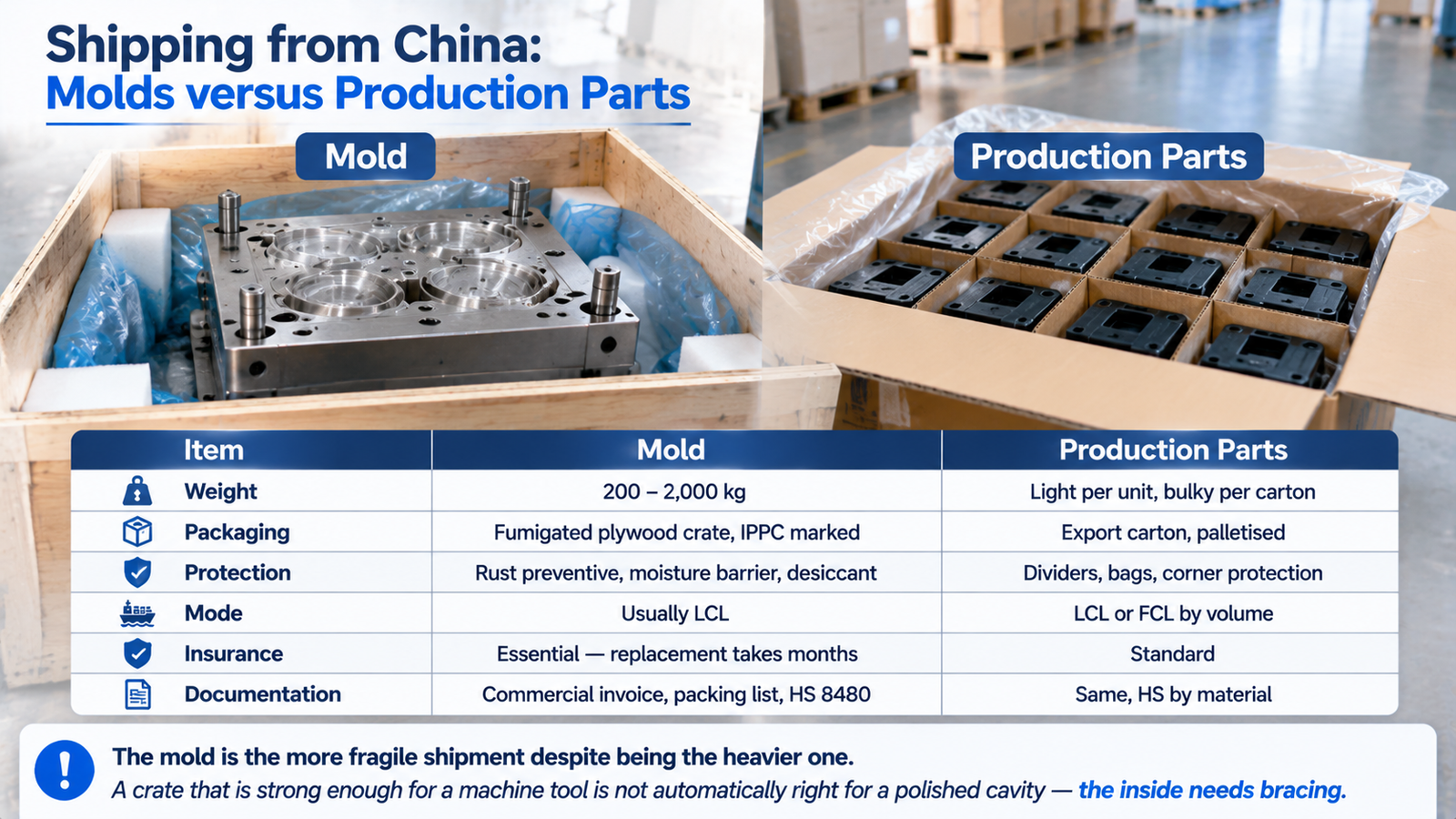
| Item | Mold | Production parts |
|---|---|---|
| Weight | 200 – 2,000 kg | Light per unit, bulky per carton |
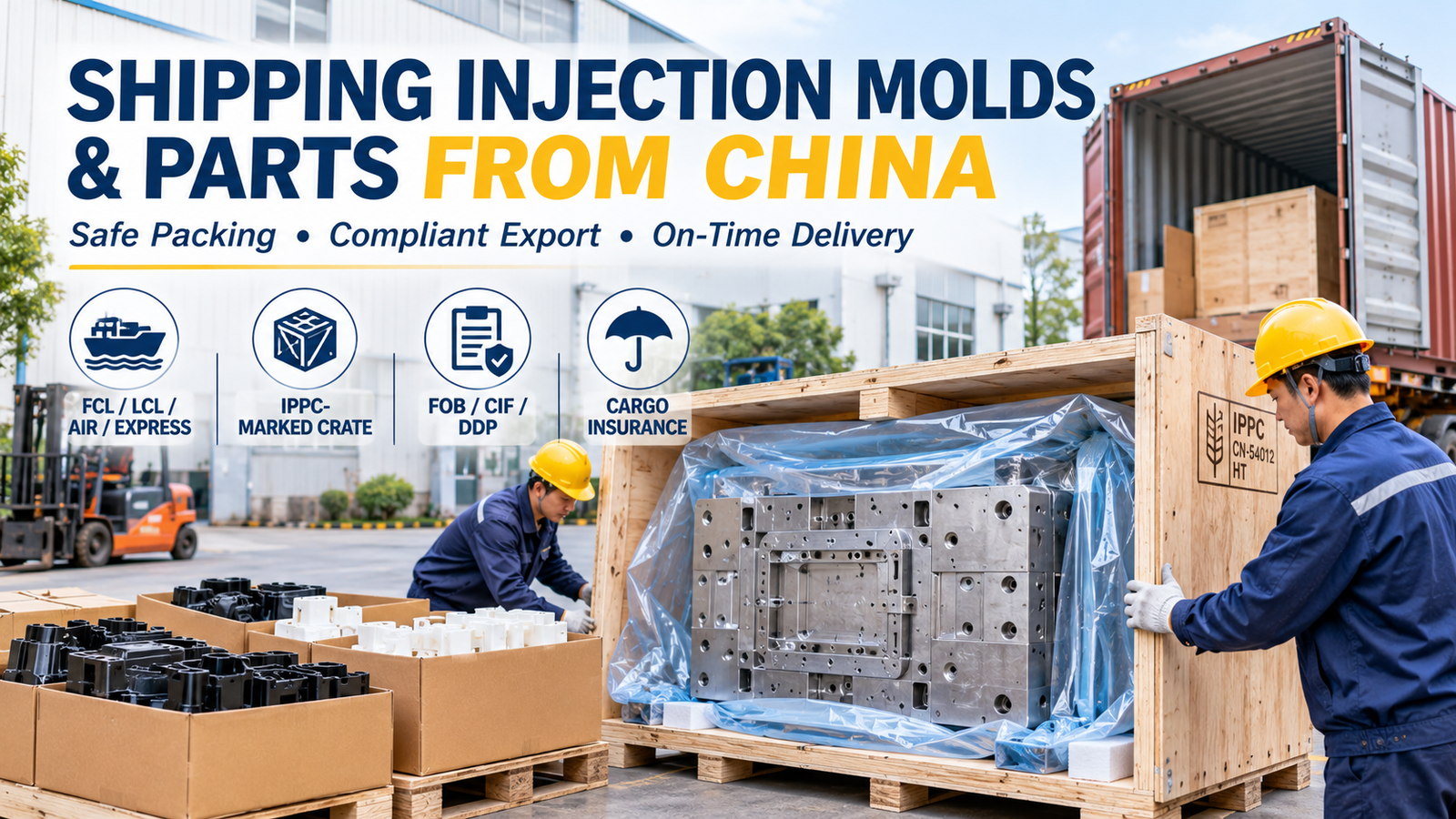
| Packaging | Fumigated plywood crate, IPPC marked | Export carton, palletised |
| Protection | Rust preventive, moisture barrier, desiccant | Dividers, bags, corner protection |
| Mode | Usually LCL | LCL or FCL by volume |
| Insurance | Essential — replacement takes months | Standard |
| Documentation | Commercial invoice, packing list, HS 8480 | Same, HS by material |
The mold is the more fragile shipment despite being the heavier one. A crate that is strong enough for a machine tool is not automatically right for a polished cavity — the inside needs bracing against the polished faces, not just against the outside.
Shipping from China: the three details that decide it
1. The crate must be IPPC marked
| Requirement | Detail |
|---|---|
| ISPM 15 | Heat treated or fumigated solid wood |
| Mark | IPPC stamp on the wood, visible |
| Plywood | Exempt — manufactured wood does not need treatment |
| Consequence of failure | Container held, crate rejected or returned at your cost |
Most Chinese exporters know this. Check anyway: a crate built from untreated pallet wood will be refused at the destination, and the mold sits in a bonded warehouse at your expense while it is resolved.
2. FOB, CIF and DDP are not the same risk
| Term | Supplier pays | Buyer pays | Buyer's risk |
|---|---|---|---|
| EXW | Nothing | Everything, from the factory door | Highest — you arrange export clearance |
| FOB | Export clearance, loading | Freight, insurance, import clearance | Freight risk is yours |
| CIF | Freight and minimum insurance to destination port | Import clearance and duties | Insurance may be minimum-cover only |
| DDP | Everything including duties | Nothing until delivery | Lowest — but verify the duty was actually paid |
The DDP trap: a DDP quote is only DDP if the seller actually pays the duty in the destination country. Some quotes are "DDP" in name and the consignee receives a duty bill on delivery. Ask for the import declaration number or a copy of the duty payment.
For a first shipment, FOB is usually the cleanest: you control the forwarder, you see the real freight cost, and no one is quietly absorbing or mis-stating the duty.
3. Insurance at 0.3 – 0.5 percent is not optional
| Item | Detail |
|---|---|
| Cost | 0.3 – 0.5% of CIF value |
| Covers | Physical loss and damage in transit |
| Does not cover | Delay, inherent vice, poor packing |
| Claim basis | Invoice value plus freight, per the policy |
A mold that is damaged on arrival does not get replaced quickly — it gets remade, which is four to eight weeks. Insurance at 0.4 percent of a $30,000 tool is $120. Take it.
Container loading: what buyers should ask for
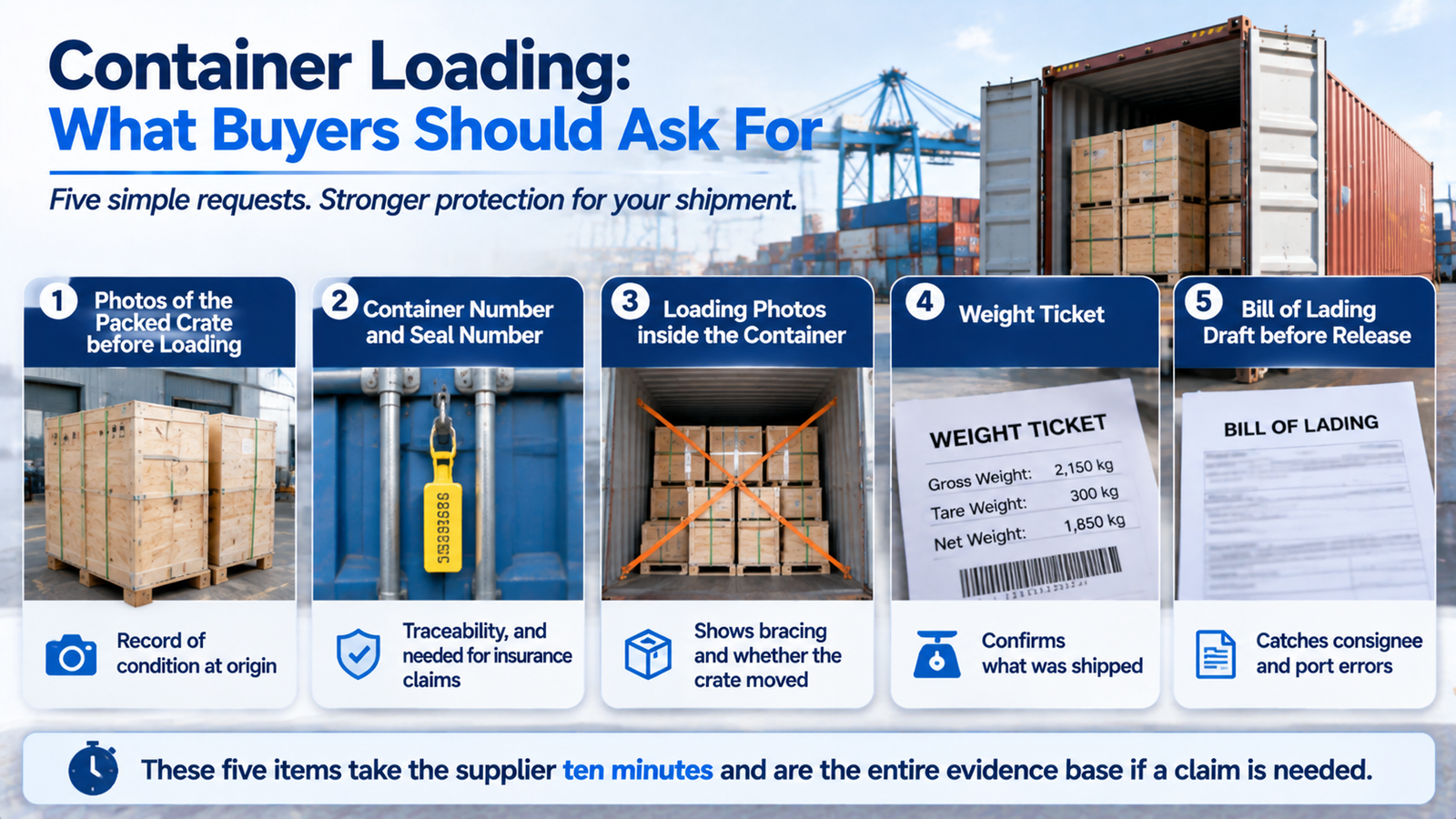
| Ask | Why |
|---|---|
| Photos of the packed crate before loading | Record of condition at origin |
| Container number and seal number | Traceability, and needed for insurance claims |
| Loading photos inside the container | Shows bracing and whether the crate moved |
| Weight ticket | Confirms what was shipped |
| Bill of lading draft before release | Catches consignee and port errors |
These five items take the supplier ten minutes and are the entire evidence base if a claim is needed.
Shipping from China: timeline to arrival
| Stage | Duration |
|---|---|
| Booking and container pickup | 3 – 7 days |
| Inland to port, export clearance | 2 – 4 days |
| Ocean transit (Asia → US West) | 14 – 20 days |
| Ocean transit (Asia → Europe) | 28 – 38 days |
| Port handling and release | 3 – 7 days |
| Import clearance | 2 – 7 days |
| Inland delivery | 2 – 7 days |
So a 25 to 35 day ocean transit becomes 45 to 60 days door to door. Air freight is 5 to 8 days transit and 10 to 14 days door to door.
Customs and duties: the numbers that surprise buyers
| Item | Typical rate |
|---|---|
| Injection molds (HS 8480.71) | 0 – 3.5% depending on destination |
| Plastic parts (HS 3926.90) | 3 – 6.5% base, plus trade measures |
| US Section 301 on Chinese plastics | Additional 25% on many lines |
| EU anti-dumping (specific products) | Varies by product and origin |
| VAT / GST | 19 – 25% in most EU states, recoverable if registered |
The Section 301 surcharge is the one that most often breaks a landed-cost calculation for US buyers. If the part is HS 3926.90, the base duty may be 3 percent and the surcharge 25 percent — verify with your customs broker before the order, not after.
Shipping from China: common failures
| Failure | Cause |
|---|---|
| Mold arrives with rust | No VCI film or desiccant, or a wet crate |
| Crate refused at destination | Untreated wood, no IPPC mark |
| Duty bill on delivery despite "DDP" | Seller quoted DDP but shipped FOB |
| Demurrage charges | Documents late, consignee not ready to clear |
| Undersized crate, damaged cavity | Crating built for weight, not for the polished faces |
| Higher cost than quoted | Destination charges excluded from the LCL rate |
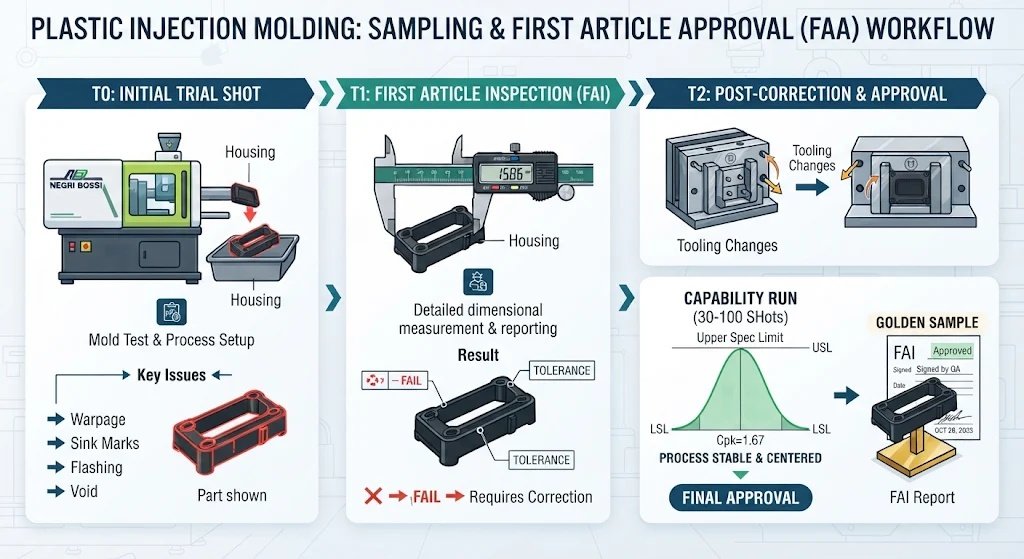
Our guides to payment terms, vetting a supplier, sampling and first article approval, mold cost and injection molding cost cover the rest of the buying process.
Freight and trade documentation practice in this guide follows standard international trade procedure, with packaging standards from ISO and ASTM International, material and part identification cross-checked against MatWeb and Engineering Toolbox, and processing guidance reflecting Plastics Technology and PLASTICS industry standards. For the regulatory framework, see Incoterms and ISPM 15.
How much does it cost to ship an injection mold from China?
Most molds are 200 to 2,000 kg and 1 to 4 CBM, so LCL at $85 to $160 per CBM is typical — roughly $300 to $700 to a US or EU port, plus destination charges. Insurance adds 0.3 to 0.5 percent of value.
Is it cheaper to ship by sea or air?
Sea is roughly 8 to 12 times cheaper per kg on large shipments. Air only makes sense when the freight difference is smaller than the cost of the delay — usually for urgent parts, not for tooling.
What is DDP and is it safe?
DDP means the seller pays duties and delivers to your door. It is safe only if the seller actually pays the duty — ask for the import declaration or a duty receipt. Many "DDP" quotes are FOB in practice and the consignee gets a duty bill.
What packaging does a mold need for export?
A fumigated plywood crate with IPPC marking, VCI rust-preventive film on the steel, a moisture barrier and desiccant, and internal bracing against the polished faces. Crating built only for weight will damage a cavity.
How long does shipping from China take?
Ocean transit is 14 to 20 days to the US West Coast and 28 to 38 days to Europe; door to door that becomes 45 to 60 days. Air freight is 5 to 8 days transit, 10 to 14 days door to door.
Do I need cargo insurance?
Yes, at 0.3 to 0.5 percent of value. It is the cheapest line item on the whole order and the only protection against a damaged tool that takes four to eight weeks to remake.
Conclusion
Shipping from China is decided by three details, not by the freight rate: the crate is IPPC marked and braced for the cavity, the Incoterm actually matches what was quoted, and insurance is in place. Get those right and the freight is a routine cost. Get them wrong and the cheapest quote becomes the most expensive shipment.
At Rui Cheng we crate every mold with VCI film, desiccant and IPPC-marked plywood, photograph the packing and container loading, and quote FOB as standard with DDP available on request with the duty documented. Send the drawing and we will quote the tool, the parts and the shipped cost to your port. Send us your drawing →