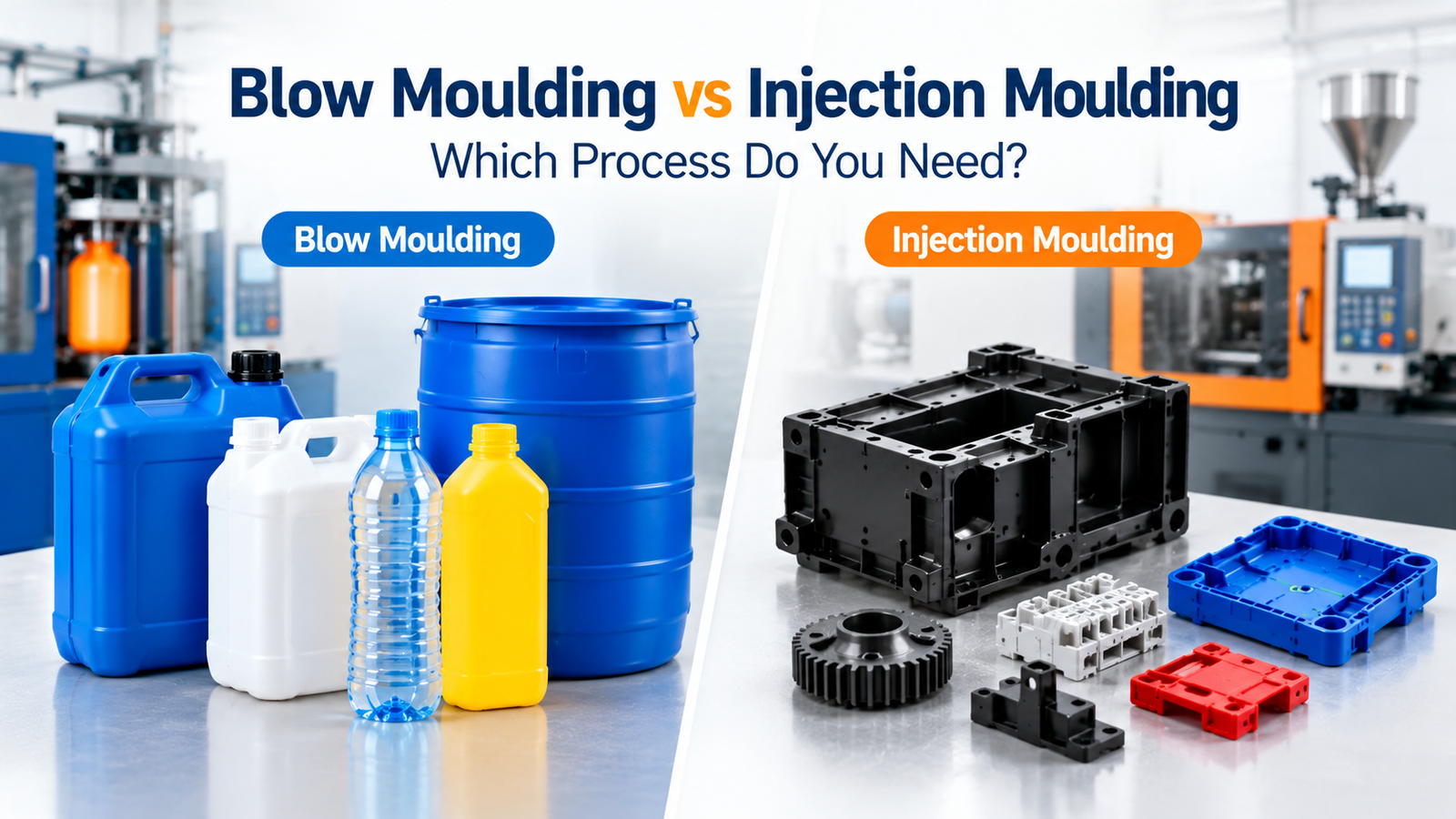
Blow moulding and injection moulding are the two most common processes for producing plastic parts at volume — and buyers frequently ask which one they need. The answer depends almost entirely on part geometry: hollow, bottle-shaped products go to blow moulding, while solid, detailed components go to injection moulding. Choosing the wrong process means paying for the wrong tooling, and that mistake is expensive.
This guide compares blow moulding vs injection moulding across tooling cost, unit cost, materials, tolerances, and production volume, so you can specify the right process for your project.
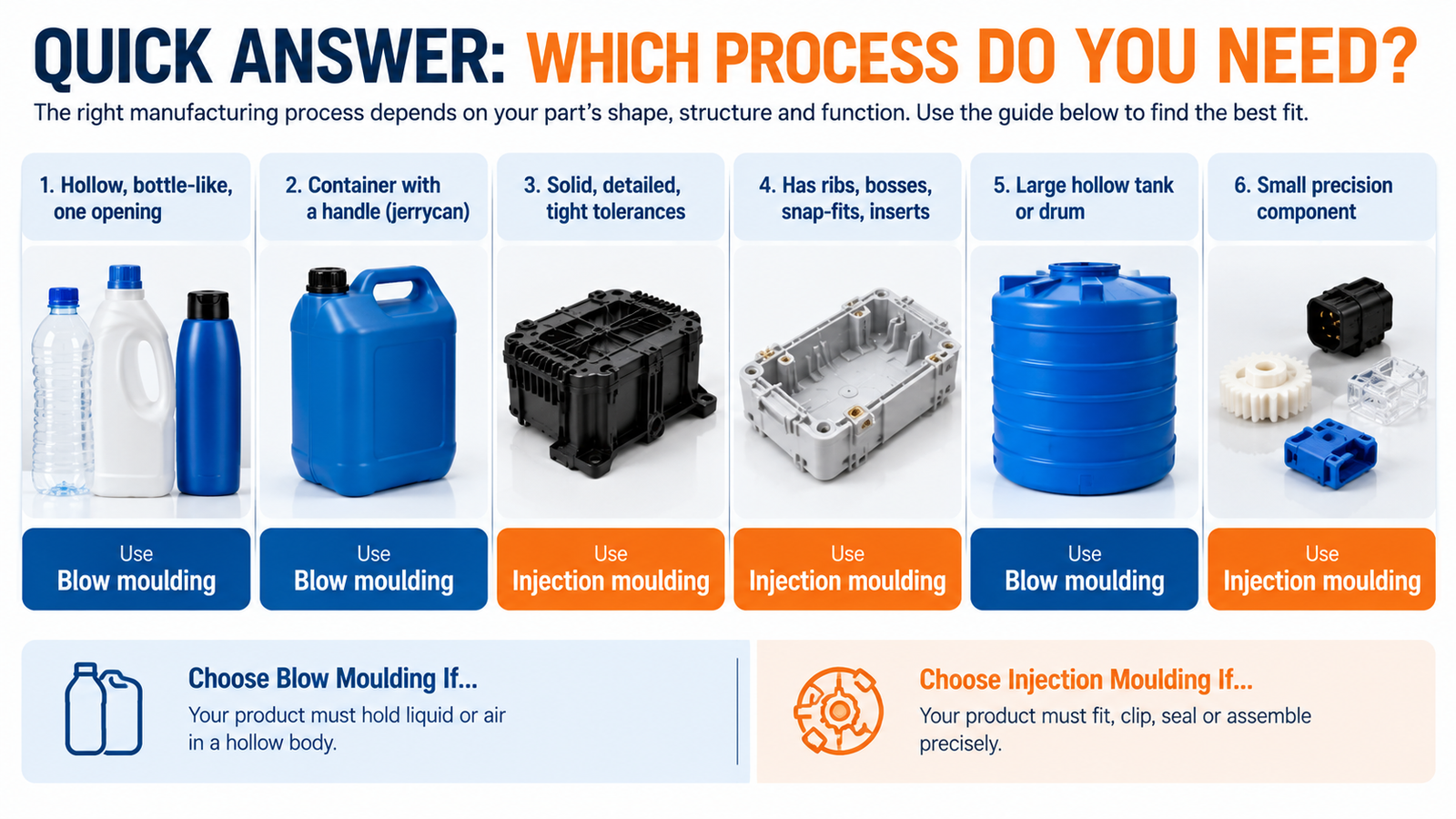
Quick Answer: Which Process Do You Need?
| Your part is... | Use |
|---|---|
| Hollow, bottle-like, one opening | Blow moulding |
| Container with a handle (jerrycan) | Blow moulding |
| Solid, detailed, tight tolerances | Injection moulding |
| Has ribs, bosses, snap-fits, inserts | Injection moulding |
| Large hollow tank or drum | Blow moulding |
| Small precision component | Injection moulding |
If your product must hold liquid or air in a hollow body, it is a blow moulding part. If it must fit, clip, seal, or assemble precisely, it is an injection moulding part.
What Is Injection Moulding?
Injection moulding injects molten plastic into a closed steel mould under high pressure — the dominant process of the plastics industry. The plastic fills the cavity, cools, and the solid part is ejected. It is the standard process for detailed, dimensionally accurate parts.
Key characteristics:
- Produces solid parts with complex features (ribs, bosses, threads, inserts)
- Excellent dimensional control — typically ±0.05 mm on general dimensions, tighter on critical features
- Wide material range (engineering plastics, glass-filled grades, elastomers)
- High tooling cost, low unit cost at volume
What Is Blow Moulding?
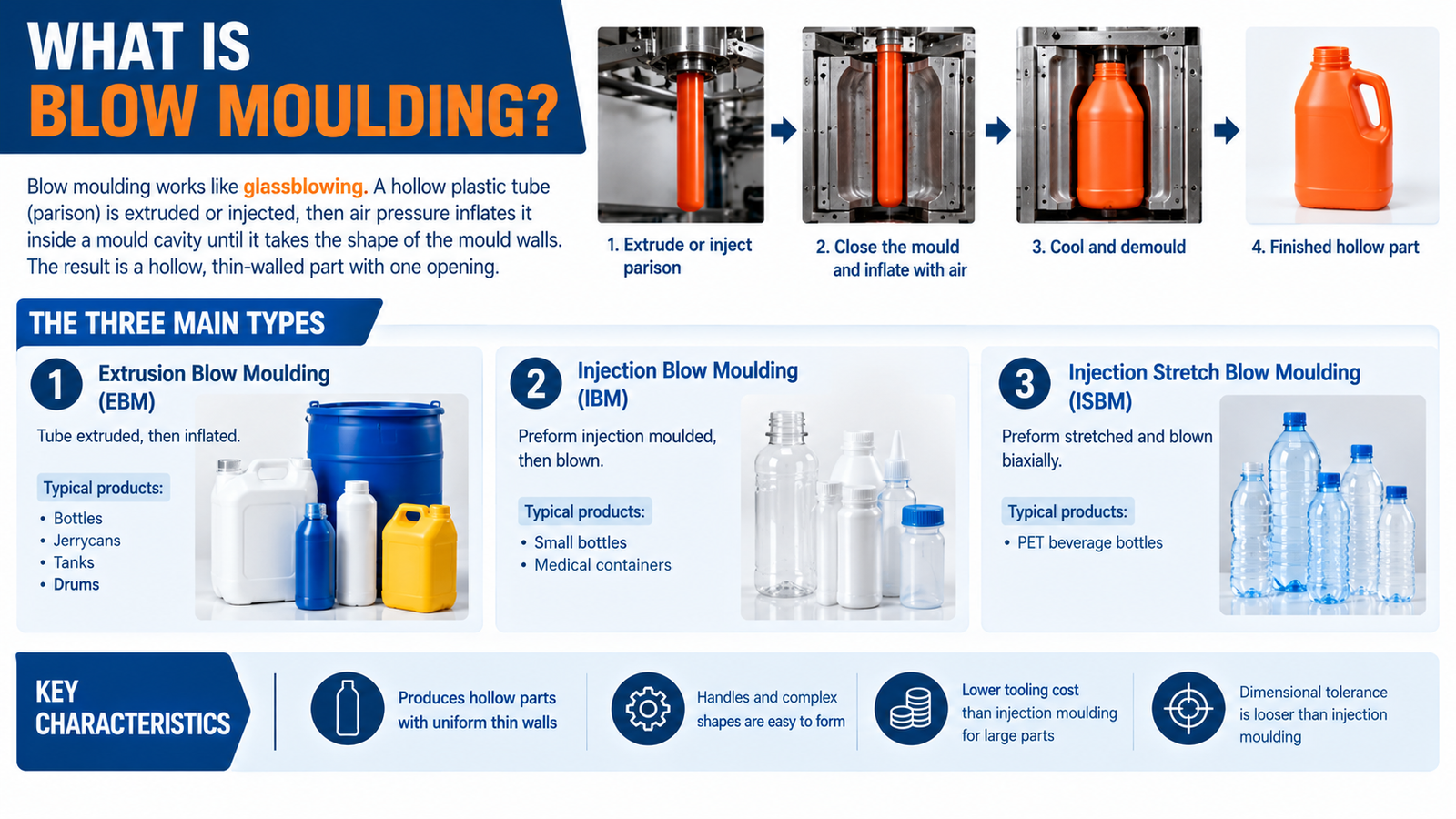
Blow moulding works like glassblowing. A hollow plastic tube (parison) is extruded or injected, then air pressure inflates it inside a mould cavity until it takes the shape of the mould walls. The result is a hollow, thin-walled part with one opening.
The three main types:
| Type | How it works | Typical products |
|---|---|---|
| Extrusion blow moulding (EBM) | Tube extruded, then inflated | Bottles, jerrycans, tanks, drums |
| Injection blow moulding (IBM) | Preform injection moulded, then blown | Small bottles, medical containers |
| Injection stretch blow moulding (ISBM) | Preform stretched and blown biaxially | PET beverage bottles |
Key characteristics:
- Produces hollow parts with uniform thin walls
- Handles and complex shapes are easy to form
- Lower tooling cost than injection moulding for large parts
- Dimensional tolerance is looser than injection moulding
Key Differences at a Glance
| Factor | Injection Moulding | Blow Moulding |
|---|---|---|
| Part type | Solid, detailed | Hollow, thin-walled |
| Tooling cost | Higher | Lower for large parts |
| Unit cost at volume | Lower | Low |
| Dimensional tolerance | Tight (±0.05 mm typical) | Looser (±0.5 mm or more) |
| Wall thickness control | Excellent | Moderate |
| Cycle time | Faster for small parts | Slower (cooling of thick sections) |
| Materials | Very wide range | Mainly PE, PP, PET, PVC, PC |
| Surface finish | Excellent (high gloss, textures) | Good (textures possible) |
| Insert/rib features | Easy | Difficult |
| Best volume | Medium to very high | Low to very high |
Tooling Cost Comparison
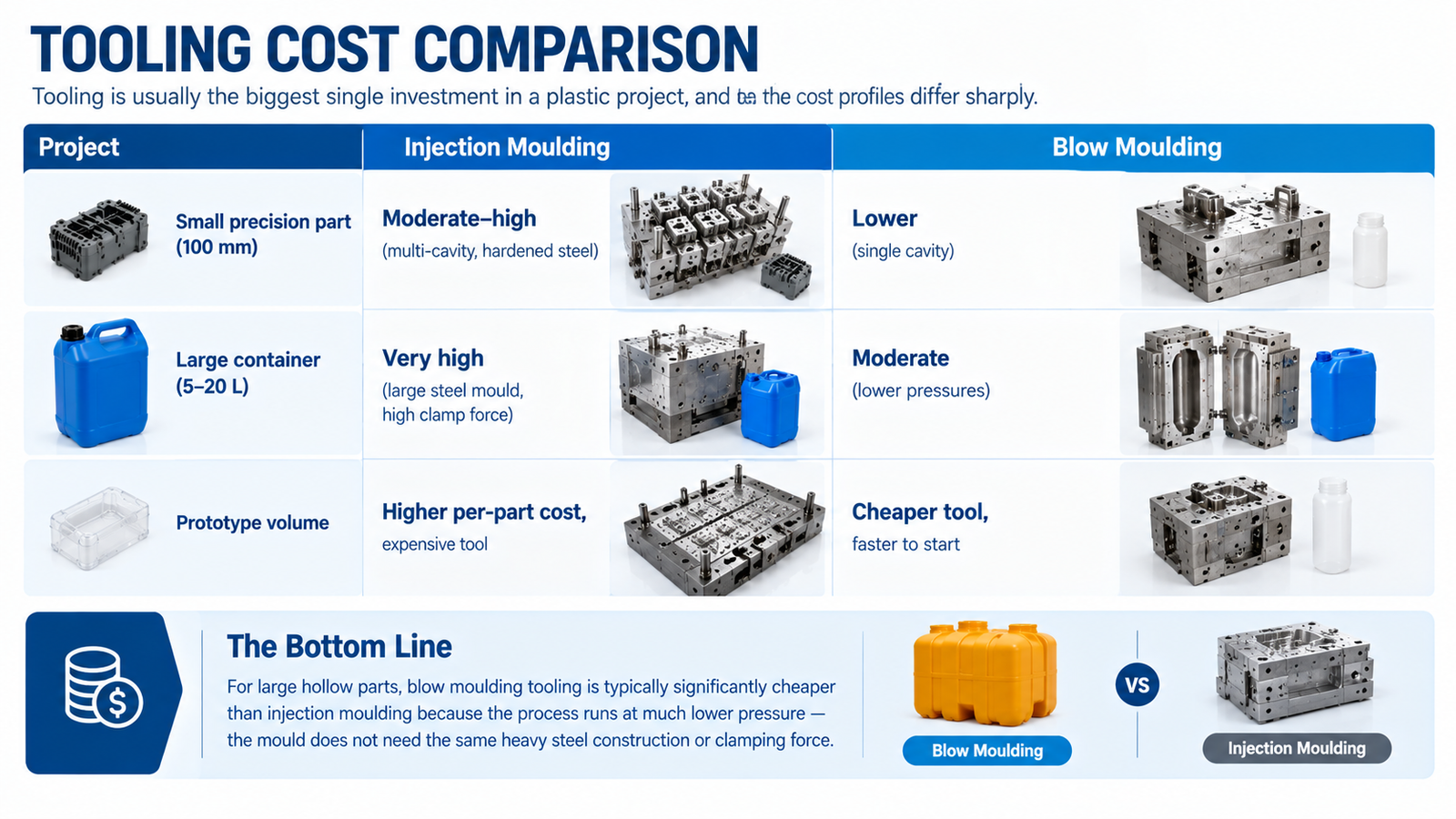
Tooling is usually the biggest single investment in a plastic project, and the cost profiles differ sharply:
| Project | Injection Moulding | Blow Moulding |
|---|---|---|
| Small precision part (100 mm) | Moderate–high (multi-cavity, hardened steel) | Lower (single cavity) |
| Large container (5–20 L) | Very high (large steel mould, high clamp force) | Moderate (lower pressures) |
| Prototype volume | Higher per-part cost, expensive tool | Cheaper tool, faster to start |
For large hollow parts, blow moulding tooling is typically significantly cheaper than injection moulding because the process runs at much lower pressure — the mould does not need the same heavy steel construction or clamping force.
Materials: What Each Process Can Run
| Material | Injection Moulding | Blow Moulding |
|---|---|---|
| PP (polypropylene) | Yes | Yes |
| HDPE / LDPE | Yes | Yes (most common) |
| PET | Yes | Yes (ISBM) |
| PVC | Yes | Yes |
| PC (polycarbonate) | Yes | Yes (special grades) |
| ABS | Yes | Limited |
| PA (nylon) | Yes | Limited |
| POM, PEEK, PPS | Yes | No |
| Glass-filled grades | Yes | Rarely |
Injection moulding supports the widest material range (verified against ASTM material standards), including engineering plastics and reinforced grades. Blow moulding is largely limited to materials with good melt strength — mainly polyolefins.
Dimensional Accuracy and Tolerances
If your part must assemble with other components, tolerance is the deciding factor.
Injection moulding holds tight tolerances because the part is formed against a rigid steel cavity under high pressure, following ISO tolerance practice. Typical commercial tolerances are around ±0.05 mm, with tighter control achievable on critical dimensions — and verified with coordinate measuring machines and gauges.
Blow moulding cannot match this. The parison is inflated, so wall thickness varies with the shape, and dimensions typically vary by several tenths of a millimetre. That is fine for a bottle cap thread, but not for a precision housing.
Design Considerations
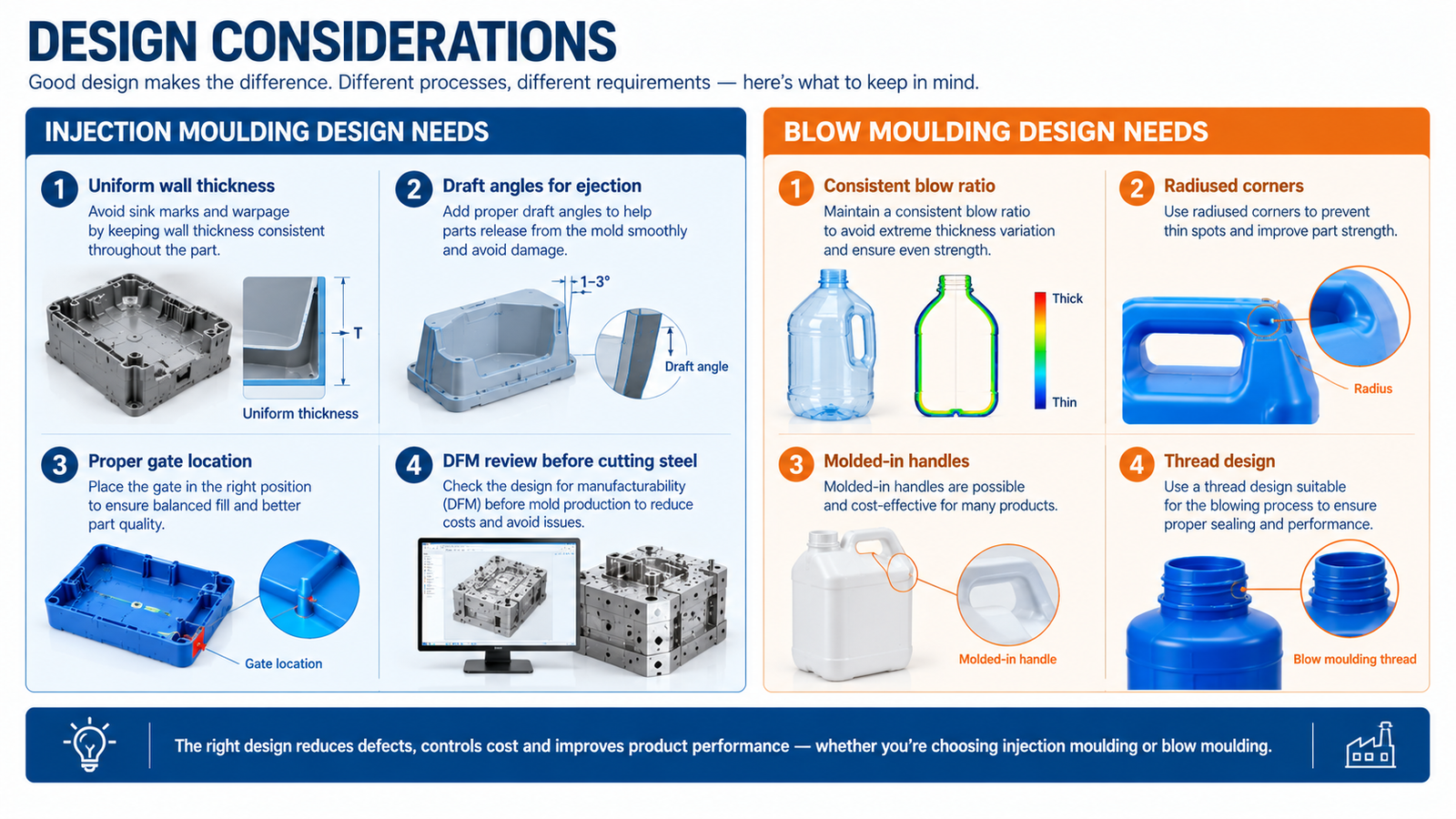
Injection moulding design needs
- Uniform wall thickness to avoid sink marks and warpage
- Draft angles for ejection
- Proper gate location for balanced fill
- DFM review before cutting steel
Blow moulding design needs
- Consistent blow ratio (avoid extreme thickness variation)
- Radiused corners — sharp corners thin out
- Molded-in handles are possible and cost-effective
- Thread design suited to the blowing process
Production Volume and Cost per Part
| Volume | Injection Moulding | Blow Moulding |
|---|---|---|
| 100–1,000 pcs | Higher unit cost (tool amortisation) | Competitive for large hollow parts |
| 10,000–100,000 pcs | Very competitive | Competitive |
| 100,000+ pcs | Lowest unit cost | Low unit cost |
At high volumes, both processes deliver low unit costs. The crossover depends on part size, cavity count, and material.
When to Choose Which — Summary
Choose injection moulding when:
- The part is solid with detailed features
- Tight tolerances and assembly accuracy matter
- You need engineering plastics or reinforced materials
- Surface finish and appearance are critical
- You need inserts, threads molded in, or multi-material construction
Choose blow moulding when:
- The part is hollow (bottle, tank, drum, canister)
- You need a large part with a low tooling investment
- The walls must be thin and uniform
- A handle or ergonomic shape is integrated into the body
- Fragrance or chemical barrier performance is the priority (with multi-layer dies)
Quality Control for Both Processes
Whatever the process, verification is what protects the buyer — and it belongs inside a documented ISO 9001 quality system. Dimensional inspection, wall-thickness measurement, drop testing, leak testing, and material verification are standard checks recommended by SPE and practised on moulded products. For blow moulded containers, wall thickness distribution and closure fit are the critical measurements; for injection moulded parts, critical dimensions and cosmetic appearance are the focus.
Conclusion
Blow moulding and injection moulding solve different problems: blow moulding makes hollow, thin-walled, large-format parts economically, while injection moulding makes detailed, dimensionally accurate components from the widest range of engineering materials. The right choice follows directly from your part geometry, tolerance requirements, and annual volume.
With experience in both injection moulding and blow moulding, plus in-house tooling, prototyping, and dimensional inspection, we support customers from process selection through mass production. Contact our engineering team for a process recommendation on your project.
FAQ
What is the main difference between blow moulding and injection moulding?
Blow moulding inflates a hollow plastic tube inside a mould to create hollow, thin-walled parts like bottles and tanks. Injection moulding injects molten plastic into a closed mould to create solid, detailed parts with tight tolerances.
Can blow moulding produce tight tolerances?
No, not to injection moulding standards. Blow moulding typically holds tolerances of several tenths of a millimetre because the parison is inflated and wall thickness varies. Injection moulding can hold around ±0.05 mm on general dimensions.
Which process is cheaper for large containers?
Blow moulding is usually cheaper for large containers because it runs at much lower pressure, so the mould needs less heavy steel construction and lower clamping force. Unit costs are also low at volume.
Which plastics can be blow moulded?
The most common blow moulding materials are HDPE, LDPE, PP, PET, and PVC, plus special grades of PC. Materials with good melt strength are required; highly filled or engineering grades like POM and PEEK are not suitable.
Can you produce both injection moulded and blow moulded parts for one product?
Yes, and it is common. Many products combine an injection moulded component (cap, closure, insert, housing) with a blow moulded body (bottle, tank, container). Working with one supplier for both keeps tolerances, colours, and delivery aligned.
How do I know which process my part needs?
If the part is hollow with one opening and holds liquid or air, it is a blow moulding part. If it is solid with ribs, bosses, snap-fits, or tight assembly tolerances, it is an injection moulding part. A DFM review of your 3D file gives a definitive answer before any tooling is cut.