Introduction
ABS offers balanced mechanical strength and moderate dielectric strength, making it suitable for consumer electronics housings and appliance components. In contrast, PVC demonstrates superior insulation, often used for cable sheaths and conduit systems. The dielectric differences directly define their suitability for different electrical environments.
In injection molding, ABS and PVC differ not only in processing temperature and flowability but also in electrical performance. PVC’s stable insulation ensures long-term protection, while ABS balances strength with moderate dielectric behavior.
How does ABS dielectric strength affect molded part performance?
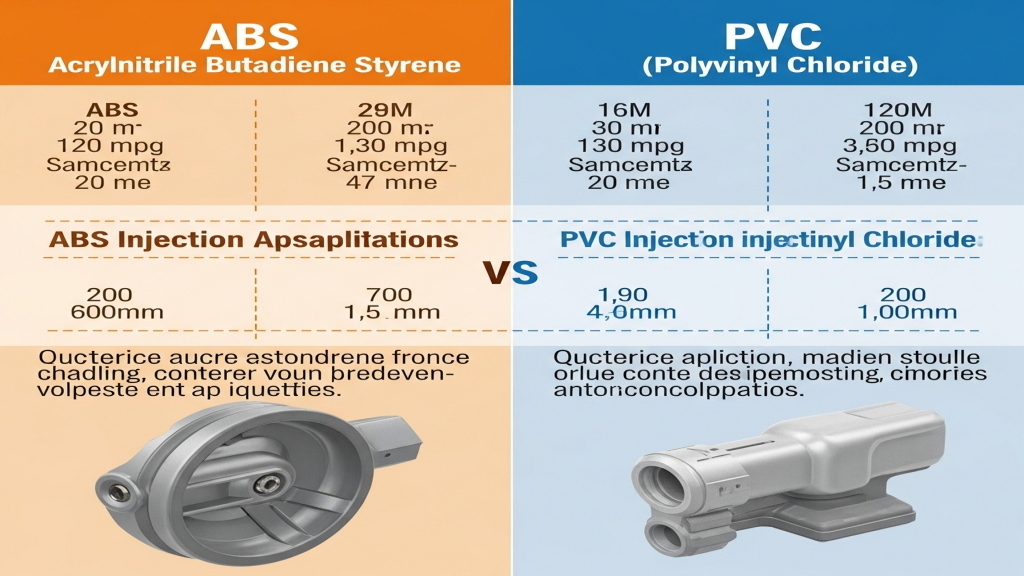
ABS dielectric strength ranges between 15-20 kV/mm, making it suitable for low-voltage housings and light-load electrical components. It offers dimensional stability in molding but may degrade under high humidity or sustained voltage. ABS’s dielectric adaptability is more dependent on environmental factors and part thickness.
- Material Selection: ABS fits applications requiring both structural and electrical performance.
- Process Optimization: Controlling moisture uptake extends service life.
- Application Expansion: ABS is common in appliances and low-voltage electronics housings.
- Performance Balance: ABS delivers both structural integrity and electrical functionality.
😊 ABS is ideal for molded parts that combine mechanical support with moderate electrical needs.
Why is PVC more advantageous in electrical insulation?
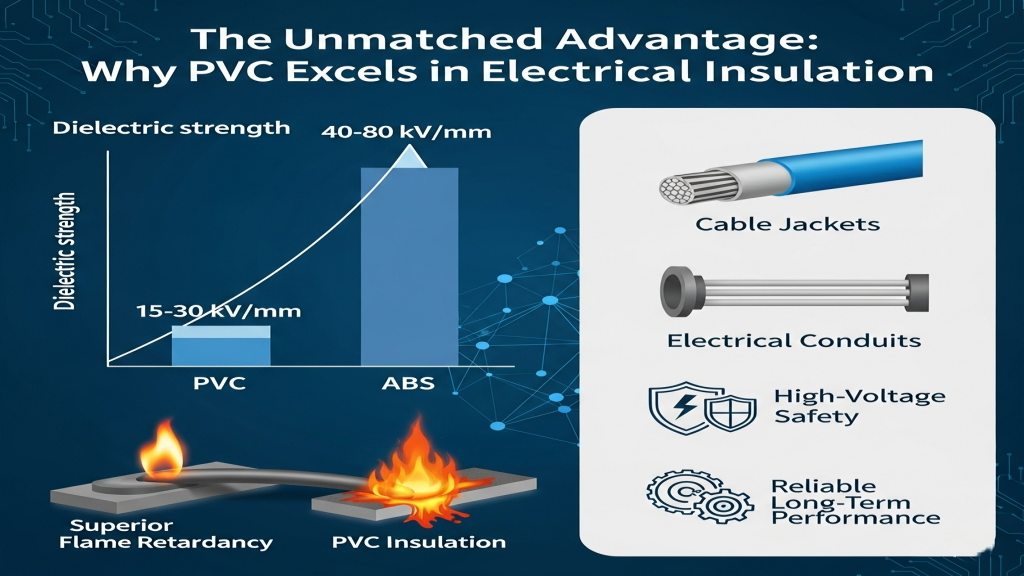
PVC dielectric strength typically falls between 40-80 kV/mm, far exceeding ABS, making it suitable for cables, conduits, and switchgear housings. It also offers superior flame retardancy, making it a trusted choice in electrical engineering. PVC’s high dielectric performance makes it the ideal choice for long-term electrical protection.
- Safety: PVC excels in sustained high-voltage environments.
- Flame Retardancy: PVC has inherent flame-resistant properties.
- Industry Applications: Widely used in cable jackets and electrical conduits.
- Reliable Insulation: PVC provides stable performance in professional electrical systems.
🔌 PVC dominates electrical applications with its insulation and flame resistance.
How to choose between ABS and PVC in combined applications?
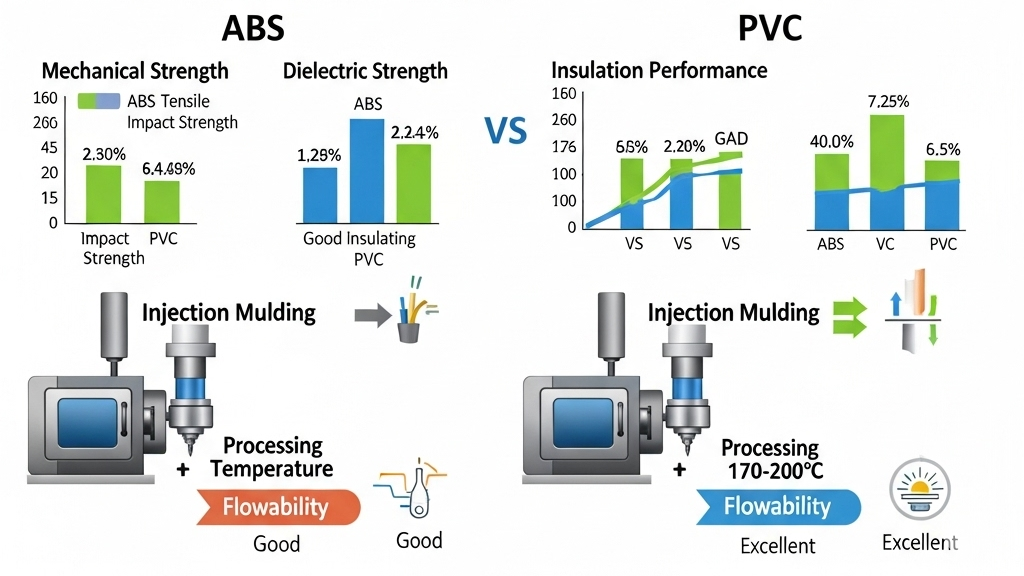
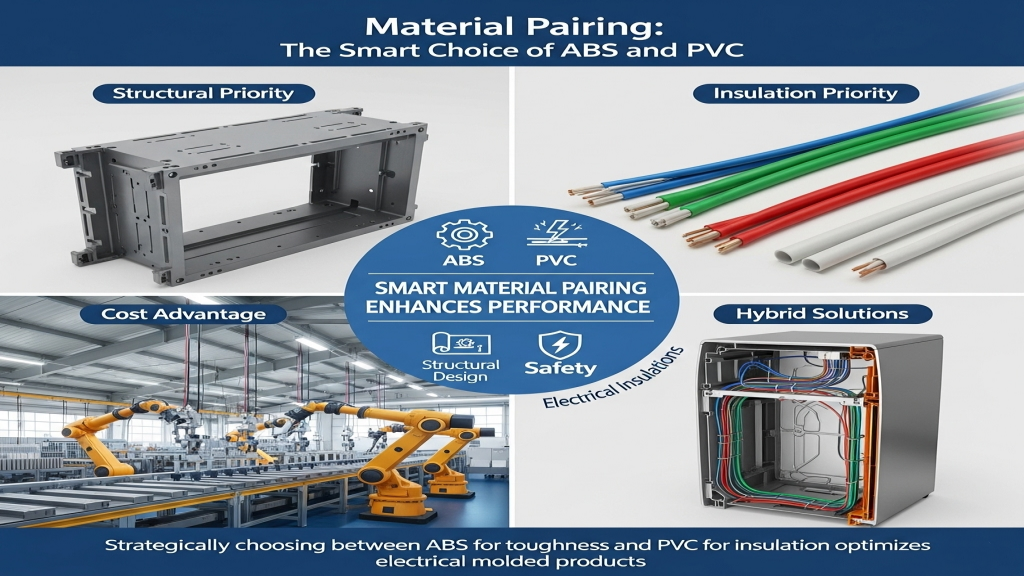
In applications requiring both mechanical support and electrical insulation, ABS and PVC often become alternative choices. ABS delivers toughness and moldability, while PVC excels in long-term insulation and environmental resistance. Smart material pairing enhances molded part performance and durability.
- Structural Priority: ABS is suited for load-bearing molded components.
- Insulation Priority: PVC is better for strong electrical protection.
- Cost Advantage: ABS is cost-effective for large-scale production.
- Hybrid Solutions: Material choice depends on the specific use case.
⚡ Choosing ABS or PVC strategically can optimize electrical molded products.
ABS vs PVC Dielectric Performance Comparison
| Property | ABS | PVC | Application Gap | Processing Impact |
|---|---|---|---|---|
| Dielectric Str. | 15-20 kV/mm | 40-80 kV/mm | ABS for low V | PVC for high V |
| Moisture Abs. | Low | Very low | ABS sensitive | PVC stable |
| Flame Retardant | Moderate | Excellent | ABS needs mod. | PVC inherent FR |
| Application | Low-voltage | Cable sheaths | ABS structural | PVC electrical |
How do material differences shape industry applications?
The selection of ABS or PVC in electrical and structural components depends largely on their dielectric behavior and processing suitability. ABS is preferred for functional housings and load-bearing roles, while PVC stands out in insulation and fire-safety applications. Their dielectric properties ultimately define their industry roles.
1.Electronics: ABS is used in lightweight housings and low-voltage devices.
2.Electrical Conduits: PVC provides cable protection and wiring channels.
3.Home Appliances: ABS balances mechanical strength with moderate insulation.
4.Industrial Cabling: PVC ensures long-term durability and insulation.
Conclusion
The dielectric gap between ABS and PVC highlights their distinct roles in the injection molding industry. ABS emphasizes strength and functionality, while PVC dominates in insulation and flame resistance. Businesses must weigh electrical conditions, durability, and cost before making material choices. A well-balanced selection ensures both safety and structural reliability.
For expert assistance in implementing for your production needs, visit our resource center or contact us. Let’s help you scale up your manufacturing with precision and efficiency!